Category Archives: Commentary on Religion

Samhain: 2010

Samhain                                                    Waning Harvest Moon

In the ancient Celtic faith Samhain (October 31) and Beltane (May 1) were the only holidays.  W. Y. Evans-Wentz gave a folklorist’s account of that faith in his first book, . Evans-Wentz wrote this amazing work, little known in spite of his later and famous first translation of the Tibetan  Book of the Dead, after wandering several months through the Celtic countryside, staying in the villages and modest homes and listening to these stories as they were told around fires of peat, voices passing on a tradition and whiling away the dreary winter months in a time before electricity.

Think of such a time as the cold begins to bear down on us and the leaves have fallen, the vegetables brought in from the garden now lying in their dark storage.  Imagine if those vegetables and what grain might be stored as well, imagine if they were your food, your only food, for the next five to seven months.  Though the Celtic winters were not as severe as the ones here in Minnesota, they were just as fallow, the earth no longer yielding fruits, all hope of new produce gone until late spring.

It’s easy for me to imagine this because I harvested the last of our vegetables yesterday.  I would be in a panic r if we had to survive on the few carrots, beets, potatoes, onions and garlic we have stored dry.  Yes, we have honey, canned tomatoes and some pickles, but even for the two of us, we would have to be almost magicians to live off this amount of food.  At best we would enter spring mere shadows of our October well-fed selves.  As supplements to our diet, our stored food is wonderful, a blessing; as sustenance alone, it would be meager.  At best.

Among the Celts this was, too, a time when the veil between the worlds thinned and passage eased from the Other World to this one and from this one to the Other World.  Like the Mexican Day of the Dead, celebrated on the same date, it was a time when ancestors might visit.  To keep them happy their favorite foods and music and dress would be available.  The Celts also believed that, in addition to the dead, the inhabitants of faery could come and walk among human kind.  They might steal children or lure unwary persons back across the veil, back to the world of faery where time passes so differently than it does here.

We have the faint memory of this holiday today.  The costumed remind us of the strange and often scary entities of the Other World that flit, often unseen, among the living on this night.   The jack o’lanterns have descended from the Samhain carved turnip (a rutabaga to us in the U.S.) which, when lit with a candle, glows yellow, much like a skull.  The carved turnip and the parshall were put on or near the lintel (sound familiar?) to keep those roamers from the Other World at bay.

On a personal and spiritual level this can be a time to consider the past growing season, Beltane as the Celts called it.  What came to maturation in the last six months?  Have you taken time to harvest and store up the fruits of those efforts?  It can also be  a time to consider the fallow and bleak time ahead, Samhain.  While Beltane might be the Baroque or Rococo time of year, heavily decorated with lots of shadows and light, winter is the minimalist season, a time when the canvas might even be bare.  Then we might confront our world as a Mark Rothko painting, an inward time, of seeing the other as it resides in our Self, or going down to the well of the collective soul and replenishing ourselves for the year ahead.

A paradox rears itself here.  A paradox most neatly stated in the observation by certain Western thinkers that September 29th, Michaelmas, the celebration of the archangel Michael, is the springtime of the soul.  Thus, as the growing season wanes and finally extinguishes, we follow Persephone under ground, down into the cathedrals of our own souls.  There we can recharge oursSelves in the deep waters.
Under the: Who Will Miss Them Anyhow banner

Fall                                        Waning Harvest Moon

Retired chaplains warn against ‘don’t ask’ repeal

“Dozens of retired military chaplains say that serving both God and the U.S. armed forces will become impossible for chaplains whose faiths consider homosexuality a sin if the “don’t ask, don’t tell” policy is thrown out.

If a chaplain preaches against homosexuality, he could conceivably be disciplined as a bigot under the military’s nondiscrimination policy, the retired chaplains say. The Pentagon, however, says chaplains’ religious beliefs and their need to express them will be respected…

“My heart doesn’t bleed for these chaplains,” said Mikey Weinstein, president of the Military Religious Freedom Foundation. “If you don’t like it, there’s a very simple solution: Fold your uniform, file the paperwork and find something else to do.””

The Constructive Task

Fall                                                   Waning Harvest Moon

Another morning of cool, wet weather.  The beginning of October.  No.  Scratch that.  The end of October.  I recognize this fall weather actually; it comes to us courtesy of the climate that used to be Indiana’s.  This is the weather pattern of my boyhood.  Sunny, sometimes warm, sometimes not fall days, then rain drifting over into ice or snow with some cold, a January thaw that makes everything muddy and nasty, then a bit more cold and snow until March when the muddy, nasty part returns until spring.  This weather pattern had a good deal to do with my move north, since I wanted stable seasons and in particular real winters.  Now it seems the weather patterns I left have begun to follow me.

The Liberal Spirit is on Ancientrails now, just look on the left side, all the way at the bottom under Ge-ology.  This presentation completed a six part exploration of, first, the movement West of Unitarian-Universalism, and then the nature and future of liberalism, especially as it applies to matters often called religious.  I like working in three parts because it encourages me to think longer than the usually 5-7 page presentation, to take an idea further, develop it.  Not sure what I might do next, but I do feel a need to begin what my old seminary theology professor would call the constructive task.

Constructive theology as an abstract idea involves the coherent development of ideas, ideas about the ultimate nature of reality, human existence and the forces that work on both of them.  My notion of a Ge-ology, which continues to rattle around, make sense, but defy careful development is a significant part of where I want to go, but there’s a lot more to piece together.  The whole notion has become a more and more pressing idea for me as I work in the Sierra Club legislative arena.  It confirms what I have known now for some time.  The representative democracy which serves our nation well at a conflict reduction level, does not work well when it comes to deep, systemic change.  Its checks and balances, its partisan politics and its ephemeral nature make radical change not only unlikely, but almost impossible.  This is by design and it does well at frustrating regional ambitions or the rise of a revolutionary faction, yet those same mechanisms also frustrate radical analysis, even in those instances in which it is so obviously needed.

Upstairs now to our business meeting, still massaging our way toward Kate’s retirement, getting comfortable with the financial side and with our new life.  Not long now.

The Tao of Liberal Thought

Fall                                        Waxing Harvest Moon

Art to me is an anecdote of the spirit, and the only means of making concrete the purpose of its varied quickness and stillness.
Mark Rothko

Another brush stroke about contemporary art and the future of liberal thought.  Given Mark Rothko as the exemplar of the link between liberal thought’s future and the radical rethinking of Western art he represents for me I will extend the metaphor one large leap further.  The future of liberal thought has a cathedral.  It is in Houston, Texas and the photo at right is of its exterior.  I’ve not visited it, but it is on my list and it stays in my imagination as a sacred place of the always contemporary spirit.

The interior is a quiet space, reserved as the website says, “as an intimate sanctuary available to people of every belief.”    Funded by Houston philanthropists its interior contains multiple canvases painted by Mark Rothko, hence its designation, the Rothko Chapel.  It is not its dedication to people of every belief that makes it a cathedral to the future of liberal, rather it is Rothko’s commitment to seeking truth through a leveling of old forms and the bravery to rethink and rexperience something so fundamental as art.  This chapel gives form to a new way of finding the future, a way, a tao, that does not flinch at change, takes nothing for granted, perceives no one, no institution, no book as a final authority save the open and always unfolding book of our universe.

Imagine your inner cathedral lined with the somber, blue paintings.  Imagine a small black tiled floor and a simple leather cushion set on a metal plate.  Now go and sit upon the cushion, clear your mind and your heart and allow your Self to speak to you through the painting.  Whatever it says to you is the path you need to follow.

Here’s another way of thinking about this.  Each progenitor of a new faith tradition, from the Buddha to Lao Tse, Jesus to Mohammed, each had a liberal approach to the questions of human spiritual longing.  Each one.  They were in their historical moment, raised in a particular faith tradition, taught its comprehensiveness, its completeness, its sufficiency.  They each went deep into their faith tradition and found it wanting.  They did not step back and say, no, these are thoughts that must not be; they did not say, no, our tradition will reveal itself to me if I only wait longer.  No.  They did not leave on their shoulders a cloak that no longer fit, a cloak that had, in fact, come to chafe.  Each of them, from Abraham to Zoroaster, stepped out from beneath the overhang of the past and dared commit themselves to an alternative, an uncertain future.

This is our responsibility, the great possibility that lies before as liberals approaching the holy wells of human understanding.  We, too, can throw off the cloak of former beliefs that has come to chafe and replace it with a walking staff for the way is long.  In the old Celtic Christian faith, the Christianity that preceded Rome in the British Isles, the monks had a form of spirituality called peregrenatio, literally wandering around.  The walking staff of personal responsibility will keep you company as you wander on the way, traveling from hut to hut, open to the hospitality available where ever you come to rest.  This is the future of liberal thought and it may be your future.

Questioning the Questioners

Fall                                          Waxing Harvest Moon

An idea keeps nudging its way forward and I want to get just a bit of it on paper, or in print, or bytes.

The Future of Liberal Thought.  Is equivalent to the struggle over the last century and especially since WWII to define what art is.  That is, a shaking of the foundation, eliminating beauty and traditional forms like painting and sculpture, at least as they had been perceived, to run out in the desert of unknowing.  Saving art by killing it.  If you meet the artist on the road, kill him.

The paintings that capture this notion for me are those of Mark Rothko.  Compare this piece to the Mannerist, Baroque and Neo-Classical works.  Is it of the same tradition?  Does it have the same aim, the same desire?  What of the artist?  What was he thinking?  Or, was he thinking at all?

Just so.  Consider.  The Holocaust.  The Armenian genocide.  WWI.  WWII.  Korea.  Vietnam.  The Great Depression.  Mass starvation, drought, despair.  The cold war.  The rise and fall of the United Soviet Socialist Republic.  Quantum mechanics.  Relativity.  Godel.  Wittgenstein.  The decoding of the human genome.  The discovery of planets in other solar systems.  Manned flight to the moon.  Men and women shuttling regularly between earth and the heavens.

The death of God.

Well.  How do we approach the questions of meaning, the questions often called religious questions?  How do we approach them in light of scientific, cultural, political and economic changes?  Are these changes so momentous that they demand a break with our religious past, a break similar (the same?) in kind to the radical artistic movements of the 20th century?  I think so.

Anyhow, this is where I’m headed.  More.  Later.

Digging In

Fall                                        Waxing Harvest Moon

Here’s a book recommendation:  36 Arguments for the Existence of God by Rebecca Goldstein.  It has the shetl resonance of Singer, the contemporary Jewish life feel of Chaim Potok and philosophical skill worthy of a Talmudic scholar gone over to the dark side.  This book recounts a few events in the life of Cass Seltzer, a psychologist of religion whose book, The Varieties of Religious Illusion, contains an appendix-36 arguments for the existence of God.  Since he dismantles each argument, he becomes a famous atheist, but “an atheist with a soul.”  This book is funny, sad, romantic, disillusioning, deep and wide.  An excellent read.

Pink daffodils and the baroque.  After I get done here, I plant two bags worth of pink daffodils, then work on Baroque tours for the Friends of the Institute.

On a dog note.  Vega and Rigel continue to dig and dig and dig in what I have decided to name the D.R.A., the dog recreation area.  This amounts to giving up.  After having spent a lot of time keeping Rigel in, expanded electric fencing, new barriers at the upper deck gate and hardening the chain link fences bottom against digging, and after having spent more money than I’m willing to acknowledge on keeping both Rigel and Vega out of the garden and the orchard, I’m gonna give’m this play area.  They know have more than hole they can stand in and only their backs show above the ground.  I think they’re after gophers, but whatever it is, my dog restraint activities have a limit and I’ve reached mind.  Let’em dig.

Let There Be Darkness

Fall                                                Waxing Harvest Moon

Let’s try darkness again.  In Taoism the familiar Taiji makes my point about the essential and complementary nature of light and dark.  Taoism gives equal weight to the yin and yang* represented in the taiji, the small circle of yin within the yang and of yang within the yin, emphasizing the Taoist belief that all things contain their opposite to some degree.  So, one part of my argument simply notes that light and dark are both necessary, necessary to each other, nothing apart from each other.  In the Taoist taiji they represent the dynamic movement of heaven to which all things must conform.

In our Western cultural tradition, though, light has taken precedence over darkness, both in a physical and in an ethical sense.  Jesus is the light of the world.  Persephone goes into Hades and the earth mourns her absence until her return when it blossoms into spring.  Eurydice dies and Orpheus goes to the underworld to retrieve her.  Dante’s Divine Comedy finds Dante wandering, lost in the dark wood of error, before he begins his descent, guided by Virgil, into the multiple layers of hell.  The traditional three-story universe also reinforces these ideas:  Heaven above, earth, and the infernal regions below. Milton’s Paradise Lost follows the rebellion in heaven and the casting out of Lucifer, the Morning Star, into hell where he builds his enormous palace, Pandemonium.  Our common sense understanding of death involves hiding the body beneath the earth.  Why?

Coming out of the spiritualist tradition represented by Camp Chesterfield (see below) death involves a transition into the light, the spirit world.  Ghost Whisperer, a TV program, uses the trope from this tradition, as dead souls are led into the light.  It is, perhaps, no wonder that darkness, night and the soil come off badly in our folk metaphysic:  up and light is good; down and dark is bad.

I wish to speak a word for the yin, symbolized by the moon, the female, the cold, the receiving, the dark.  The moon illustrates the taiji perfectly.  In the dark of night, the moon, yin, reflects the sun’s light, yang, and offers a lambent light, neither yin nor yang, but the dynamic interplay between the two.  So we could look for art that features the moon as one route into the positive power of darkness.

Also, any seasonal display in a work of art, whether of spring, summer, fall or winter can open the question of each season’s value, its role in the dynamic of growth and decay, emergence and return.  This can lead to a discussion of the importance of the fallow season, the season of rest, the earth’s analog to sleep.  This can lead to a discussion of sleep and its restorative powers.

Art work of mother and child, or especially, mother and infant, can stimulate a discussion, in this context, of the womb, of the fecund nature of the dark where fetuses and seeds develop before their emergence into the world of light.

Similarly, death focused works of art can open up a discussion of birth and death as dynamic moments of change, yin and yang of human (or animal) development.  This could lead to conversation about the Mexica (Aztec) belief that life is the aberrant condition and that death is the vital, regenerative moment; we are here, goes one Mexica poem, between a sleep and a sleep.

Winterlight festivals represent a western imbalance focused on the light, the yang, and a tendency to cast the yin in a negative light, something to be avoided or eliminated or held in check.  As I said previously, this is understandable given the pre-historical science which made the return of the sun doubtful and therefore terrifying.  Many of these festivals are, too, our favorites:  Christmas, Deepavali and for a different traditional reason, Hanukkah.

In my own faith tradition, roughly pagan, I look forward to the dying of the light and celebrate as my most meaningful holiday, the Winter Solstice.  Of course, I also celebrate the return of the light that begins on that very day, but first I immerse myself in the long night, the many hours of darkness.  This affords me an opportunity to acknowledge the dark, to express gratitude for its manifold gifts.   In this way my idiosyncratic faith has a ritual moment that honors the taiji, utilizing the cues given by the natural world.

To find art that emphasizes this aspect of darkness I plan to walk the museum from top to bottom, searching for images and objects that can help our visitors understand that when they celebrate the festivals of light that darkness is the reason for the season.  I would appreciate any thoughts or ideas.

*In Chinese culture, Yin and Yang represent the two opposite principles in nature. Yin characterizes the feminine or negative nature of things and yang stands for the masculine or positive side. Yin and yang are in pairs, such as the moon and the sun, female and male, dark and bright, cold and hot, passive and active, etc. But yin and yang are not static or just two separated things. The nature of yinyang lies in interchange and interplay of the two components. The alternation of day and night is such an example.

Photocentrism

Fall                                              New (Harvest) Moon

OK,I made this up.  Photocentrism is a focus on the virtue of light that, by implication, puts darkness in a negative or bad relative position.  Just because I made it up, however, does not mean I’m joking.  The context:  the docent annual meeting today and the presentation of a new December of the month called Winterlights.  I agree that Winterlights is a complex noun that has a rich associative feel.  I even agree that the celebrations in what I have long called holiseason–Thanksgiving to January 6th, the traditional 12th day of Christmas, Epiphany (visit of the Magi to Bethlehem), and the date for the celebration of Christmas in the Eastern Church–offer an unparalleled opportunity to learn from other cultures about matters deep in the human psyche:  Thanksgiving, Advent, Deepavali, Hanukkah, Posada, Winter Solstice/Yule, Christmas, Western New Year on January 1, the 12 days of Christmas and maybe Kwaansa, though its constructed nature makes me a bit shy of it.  Eid al Adha, the Muslim holiday that marks the end of Hajj by celebrating the Irbrahim and Ishmael story, falls in November this year, but not within holiseason itself, so I’m going to leave it out of this discussion.

The festivals or holidays of light, in particular Deepavali, Hanukkah, Winter Solstice (although is a special case as we shall see) and Christmas (more for what it replaces, Saturnalia, than what it celebrates itself) do have a common thread.  Deepavali, Winter Solstice and Christmas all relate to the despair felt in subsistence agriculture communities when the light of the sun seemed as if it would wink out and perhaps disappear altogether.  This fear, of the Sun’s final rising, put its mark on well-known pre-historical landmarks like Stonehenge, Chichen-Itza and the great Newgrange dolmen in Ireland.  Without a knowledge of the physics and celestial mechanics of the earth’s orbit and the sun’s central place in our solar system, it was frightening to consider the possibility that this time, this winter, the gradual diminishment of daylight might proceed all the way to an apocalyptic darkness.  No light for the crops.  No crops for the animals.  Cold all the time.

What to do?  According to theories of sympathetic magic, like produces like, so the logical response to oncoming darkness was a bonfire, a torch, a brave manifestation of light and heat in hopes that the sun, since it is like light and heat, will either be rekindled or seduced into rising again.  And these practices work.  Each time the bonfires were lit, the torches paraded, the sun did not disappear, but returned to once again start the growing season and stave off starvation and freezing for another year.

All of this makes sense, granting the scientific understandings of these early peoples.  As cultures grew more sophisticated and astronomical knowledge became a bit more advanced, however, it did put out the lingering fear that the darkness would one day come and never leave.  So holidays that focused on light, especially, but fire, too, became integral parts of the cultural and religious traditions of many peoples.

They all leave out one important thing, though.  The virtues of darkness.  I first became aware of the following arguments when I began to research the goddess, the great mother goddess.  I won’t get into here the debate surrounding the contention by some that a great mother goddess preceded the monotheistic, patriarchal deities of the Abrahamic religions, though I’ll tip my hand enough to say that I don’t find the evidence compelling.

What I found out about darkness surprised me and changed my mind about how I view it.  Darkness is as necessary as light.  Seeds start growing in the dark soil, away from light and even after they penetrate the surface, their roots continue to press their way into the surrounding nutrient-filled earth.  Mammal babies live their first few months of life in the moist, nourishment rich environment of their mother’s womb. (OK, not in the marsupials and the platypus and the echidna’s instance, but you get the drift.)  Darkness creates the time of rest and restoration for us and for many animals.  It is when we sleep and when we dream.  Darkness is the natural condition of space, attenuated by billions of stars only in what amounts to a small total area of the vastness of the universe.  Light itself requires a degree of darkness to create vision.  Anyone who’s ever been in a whiteout where snow and sky mix to create a vertiginous world with no up and down, no distinguishing characteristics understands the problem well.  Or consider a bright, very bright light and its affect on your sight.

This argument can be cast as a feminist one in which the light represents patriarchy and the darkness the creative agency of women.  It can also relate to anti-racism work in that we tend to equate darkness, blackness with evil, with corruption and decay.  This denies the regenerative, restorative and generative nature of darkness and narrows our conceptual world in literally dangerous ways.

How could this relate to Winterlights?  Without this kind of background the celebration of light has a sinister side as well its assumed positive one.  The celebrations of light only make sense in terms of the deep cultural background and when we go there we need to understand the fear that created these holidays has also unbalanced our appreciation of the other state, darkness.  I’ve not given it any thought, but I imagine there works of art that make darkness a central theme, that could be used to help put the other holidays in a balanced perspective.

Hanukkah is a special case here in which the focus does not seem to be on the Winter Solstice but on a cultural achievement by the Maccabees, the expelling of the Greeks.  It does however beautiful-darknessshare a darkness dispelling theme with the others.
There is more to say here, much more, but I’m hungry.  Catch you later.

Chicken Pot Pies and Memories

Fall                                                 Waning Back to School Moon

Before the Vikings game on Sunday I made two chicken pot pies, whole pies filled with chicken, vegetables and a thickened vegetable broth made in the process.  These are my second and third meat pies and I find I enjoy making them as much as I do soup.  Something about baking a pie that has meat and vegetables intrigues me.  This one had our leeks, potatoes, onions, carrots, garlic, parsley and thyme.  My favorite vegetable from this garden is the leek.  The subtle flavor and the delicate flesh of the leek both appeal to my palate.

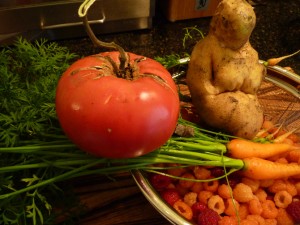
Here are a few of the ingredients plus a tomato and raspberries from our garden.  This potato looks similar to the woman of la mouthe in the MIA’s collection.  At least to my eye.670_0300 Fresh ingredients are key to Italian, Chinese and vegetarian cooking so a garden facilitates those cuisines, at least during the harvest system.  Our best meals of the summer happen in September.

Visiting Westminster today brought up all kinds of memories.  Don Meisel, former head pastor, came into the men’s room once during a Presbytery meeting.  I had a report on top of the urinal, reading it.  Don said, “My, you must get a lot of work done.”  Presbyterian humor. Another surprising Don Meisel moment.  There on the wall of a hallway was the exact same Granlund sculpture, the Tree of Life, that I bought Kate for her 50th birthday.  Don had given it to the church in memory of his wife.

Jim Campbell’s name came up, too.  Jim was a top exec of Northwest Bank and a leader on the Community Involvement Program’s board.  I worked at CIP for 4+ years, starting as a janitor and week-end staff person during seminary and moving up to Director of Residential programs.  Jim came to me at one point and asked if I would take on directing both the Residential programs and the Day Activity Centers.  I thought about it and said no.  That surprised him, I could tell.  It surprised me a bit, too.  I had no interest then or later in advancement, even though I did end up as an Associate Executive Presbyter.

Then, the chapel.  What a peaceful space,  a definite English feel to it wood, limestone, slate floor, a beautiful organ.  Wilson Yates, then professor of society and religion at United Seminary, married Raeone and me in that chapel in 1979.  Ed Berryman, the organist, refused to play the music we wanted.  I don’t remember what it was.  We had Handel’s Water Music.  Ed liked it.

There were, too, many mornings of bible study with urban clergy in the now much renovated basement area.  Bible study was always one of the fun parts because Presbyterian clergy pride themselves on their scholarly ability.

Well, off to bed.  Gotta catch the Empire Builder at 7:30 am.

Following the Old Religion

Lughnasa                                            Full Back To School Moon

Summer has three endings:  Labor Day which marks the end of summer vacation for many school children; and, for many adults like myself, kicks us into serious mode as all those years of conditioning continue to affect our attitude;  Mabon, or the Fall Equinox, which comes tomorrow, that point when day and night balance each other, neither claiming dominance, though the trend matters and at this equinox, the balance tips toward night as the darkness increases, pulling us toward the longest night, the Winter Solstice on December 22nd and Samhain, or Summer’s End according to the old Celtic calendar which divided the year in half, Beltane-Samhain or the growing season, and Samhain-Beltane or the fallow season.  Samhain comes on October 31st and, like all Celtic holidays lasts a week.

The growing season has this triple farewell reflected too in the holidays of Lughnasa, the festival of first fruits, Mabon, the peak of the harvest and harvest home, and Samhain, the end of the harvest season and the end of the growing season.  No matter how you notice or celebrate it these real changes in the agricultural year still happen, they still have critical importance for our human community, and they still deserve our attention.  Why?  Because our ages old relationship with agriculture is what separates us from the hunter-gatherers.  Agriculture allows us to live in villages, towns and cities by producing surplus food on farms in much the same way that the honeybee produces surplus honey while still making enough for the colony to survive on throughout the winter.

Without those who farm, there would be no surplus food.  With no surplus food we would have to revert to subsistence agriculture, growing what we needed every year or hunting and gathering.  This would prove daunting since most of us have forgotten or never been taught how to grow food, how to hunt, how to identify edible plants.

This is the great hidden reality for many, if not most, urban dwellers, who make up, since 2008, over half of the world’s population, a projected 5 billion people by 2030.  Without  a healthy eco-system, one that can support intense tillage, that is, sustainable tillage, the world’s urban dwellers will be bereft of something they cannot do without:  food.  Add to that the pressure on the world’s fresh water supply and two fundamental sustainers:  food and water are at peril.

Granted following the holidays of the Great Wheel will not work magic–sorry to all my Wiccan friends–but it would remind us all, 8 times a year, of the source of our sustenance.  That would help.  Naming our days after these holidays (I do it in the upper left of each post) keeps that reminder fresh.  Our sustainers, mother earth and father sun, do not require us, do not need anything from us, yet they will support us if we live within their limits.  These holidays began when our ancestors realized the need to remind themselves of the delicate, fragile harmony required for human life to flourish.

Over the course of the years and centuries and millennia since, hubris has lead us further and further away from the old religion; we have replaced it with  idols, fetishes, really.  We will, at some point, pay the price for our blasphemy as we upset that harmony, creating an environment that will no longer sustain human life.  Only if we step back from our profligacy can we ensure our survival.

Knowing the rhythms of the natural world, of the agriculture that feeds us, of the systems that keep water fresh and available, is our only chance to avoid apocalypse.  Will we do it?  I don’t know.