Category Archives: Holidays

Lughnasa: A First Fruits Festival and Beginning of the Harvest Cycle

Lughnasa                                                       Waning Grandchildren Moon

Turning round the star wheel we have come again to the first day of the month named after Augustus Caesar, First Citizen of Rome.  In Celtic lands this month was:  Welsh–Awst, Scots Gaelic–an Lunasdal and in Irish:  Lughnasadh.

Though the coming of Autumn is not visible, the wind tells us it has come.   Fujiwara no Toshiyuki

The Japanese word risshu means the first day of Autumn.  By solar equinox reckoning we are a good 8 weeks away from that day, yet Toshiyuki’s poem suggests another way to look for the fall of the year.  Are there signals in the air, in the plant world, among the animals?  Yes, there are. Lughnasa, a cross-quarter holiday in the Celtic calendar, marks the half-way point of the changes from the summer solstice to the fall equinox.

The bees have put away honey all July and August is the month when their honey production wanes.  Many flowers and vegetables have already grown, flowered and fruited:  iris, daffodil, tulip, lily, dicentra, coral bells, hosta and phlox.  The long grasses have seeded as have many of the tall weeds, including the hemp that grows here in abundance.  There are stalks, brown stalks, in the garden, the signs of a more general senescence that will over take all the flowers and vegetables as August continues and becomes September.  Animal babies have begun to mature, witness the opossum pictured here a few weeks ago.

The main signal of seasonal change though, for me, is the change in the angle of the sun light.  By August 20th, the sun’s angle of declination at its highest point in the sky, noon, will be 12 degrees less than the 69 degrees it achieved on June 20th, the summer solstice and the sun’s highest angle at our 45th degree of latitude.  This changed angle, subtle at first, becomes obvious as August moves on and creates the tone of seasonal change in advance of temperature and other meteorological signals. We now journey toward the sun’s lowest angle of declination here, 22 degrees, reached at the Winter Solstice on December 21st.

In many webpages you will find confident reference to Lugh as the Celtic sun-god and to Lughnasa as his festival.  Maybe.  Celtic lore has a number of obstacles to clear understanding.  The most difficult obstacles lie in the sources of information that we have for ancient Celtic life.  Whatever written information, if any, the Celts left behind have been lost in the wake of the Roman invasions that began in 55 BC with the arrival of Julius Caesar.  As a result we always look at the Celts through the eyes of their conquerors.  Tacitus, for example, records the story of the Druids and their last stand across the Menai Straits in northwestern Wales.  It is Caesar’s accounts of the Gallic Wars (Celtic Wars) that gives us much of the scanty information we have about Celtic religious life.

The next main source of information about the Celts comes from the Roman Catholic Church that overtook and weeded out both the ancient faery faith and the peculiar and attractive version of Christianity that evolved on its own before the Roman Church came.  This Celtic Christianity emphasized a close relationship with the natural world and retained practices resonant with the Celtic faery faith.

Nowadays a different, but no less problematic type of interpretation occurs when the neo-pagan community takes up these holidays and puts into them the mythological narratives that appeal most to their sensibility.   They can do this, of course, and, in fact, they do, but it does not mean that the interpretation they place on the sacred days have much, if any, congruence with the practices and beliefs of the ancient Celts.

Thus, the Celts and their ancient life exist behind by shrouds of interpretation motivated by ancient political exigency, motivated by medieval religious arrogance and now motivated by contemporary irrational adoration.

Lugh, in other words, is a name put on a Celtic deity by the Romans, who tended to associate the gods of conquered tribes with gods of their own.  Lugh came to be equated with Hermes, Mercury to the Romans.  We have very little direct information about the Celtic pantheon, though there is some.

What we do know for certain is that on and around August 1, for centuries, Celtic and English peoples celebrated the first fruits of the harvest on a day called Lughnasa.  Brian Friel’s wonderful play, Dancing at Lughnasa, gives an excellent account of the holiday as it was still practiced in the early part of the 20th century.  As the Burns poem below* attests, part of its celebration included going out into the fields of barley or wheat or rye or whatever, to practice human fertility rites.

Like the rest of the Celtic holidays, Lughnasa involved a week of fairs and markets, a time of celebrations, gatherings of people from various rural areas.

These holidays were and are significant in the daily lives of rural folks in the Celtic Countries and England.  The Lammas Meadows are an example.  Lugg Meadows in Herefordshire, England are the largest and best preserved of 20 Lammas Meadows in England today, some of which still follow the medieval land tenure system that created them in the first place.

In this system the lord of the manor, who owned the fields, would rent the prime bottom land to those who could afford the rent.  Bottom land was the most valuable land in the middle ages because it often had a sandy or rocky bottom with layers of fertile silt on top, creating a well-drained and rich field for growing hay.  Hay was critical for it fed the many animals used in farming and in the other work of the manor through the winter.

The fee-holders would mark their holdings with ‘dole stones’, the holding being irregular strips of the bottom land on which they purchased the right to harvest hay.  From Candlemas (the Catholic holiday laid over the Celtic celebration of Brigid, the triple Goddess, Imbolc) to Lammas (the Catholic holiday laid over the Celtic Lughnasa) the fee-holders and the Lord kept the Lammas Meadows ‘shut for hay.’  Over this time only the Lord and the fee-holders could enter the land.  On Lammas Day, however, the fields would open to the commoner–the person who used the common land–who could browse his animals in them until Candlemas, February 1st of the next year.

The farmer making hay from the Lammas Meadows (see pic) has an interesting graphic about his concept of sustainability.  It involves a triple bottom line:  social, environmental and economic.   Here it is:

from a fascinating website:  Wilson’s Almanac

*It was on a Lammas night,
When corn rigs are bonnie,
Beneath the moon’s unclouded light,
I held away to Annie:
The time flew by, wi tentless heed,
Till ‘tween the late and early;
Wi’ sma’ persuasion she agreed
To see me thro’ the barley.

The sky was blue, the wind was still,
The moon was shining clearly;
I set her down, wi’ right good will,
Amang the rigs o’barley
I ken’t her heart was a’ my ain;
I lov’d her most sincerely;
I kissed her owre and owre again,
Among the rig o’ barley.

I locked her in my fond embrace;
Her heart was beating rarely:
My blessings on that happy place,
Amang the rigs o’barley.
But by the moon and stars so bright,
That shone that hour so clearly!
She ay shall bless that happy night,
Amang the rigs o’barley.

I hae been blythe wi’ comrades dear;
I hae been merry drinking;
I hae been joyfu’ gath’rin gear;
I hae been happy thinking:
But a’ the pleasures e’er I saw,
Tho three times doubl’d fairley
That happy night was worth then a’.
Among the rig’s o’ barley.

CHORUS

Corn rigs, an’ barley rigs,
An’ corn rigs are bonnie:
I’ll ne’er forget that happy night,
Among the rigs wi’ Annie.

Robert Burns

Summer. It’s About Time.

Summer Solstice                                      Waxing Strawberry Moon


The longest day of the year.  Light triumphant, streaming, steaming.  The darkness held at bay.

Summer Solstice

This is an astronomical phenomenon transformed and translated into a spiritual one.  We humans have over millennia taken solstice and equinox alike as moments out of time, a sacred caesura when we could review our life, our path as the Great Wheel turns and turns and turns once again.

The Celts first divided their year into two:  Beltane, the beginning of summer, and Samhain, literally summer’s end.  As their faith tradition developed, they added in both solstices and equinoxes.  Since Beltane and Samhain occurred between the spring equinox and the summer solstice and the autumnal equinox and the winter solstice respectively, they became known as cross-quarter holidays.  Imbolc and Lughnasa filled in the other two cross-quarter spots.

It is the eight holidays, the four astronomical ones and the four cross-quarter, that make up the Great Wheel.  In the most straight forward sense the Great Wheel emphasizes cyclical time as opposed to linear or chronological time.  This seems odd to those of us raised in the chronological tradition influenced by Jewish and Christian thought in which there is an end time.  With an end to time the obvious influence on our perception of time is that we progress through the days until they become years, which become millennia until the Day of the Lord or that great risin’ up mornin’ when the dead live and time comes to a stop.

That this is an interpretation rather than a fact rarely crosses the mind of people raised on birthdays, anniversaries, celebrations of one year as it comes followed by the next.  Our historical disciplines from history itself to the history of ideas, art history, even geology and the theory of evolution all reinforce the essentially religious notion of time as a river flowing in one direction, emptying eventually into an unknown sea which will contain and end the river.

Immanuel Kant, in attempting to reconcile the dueling metaphysics of two apparently contradictory philosophical schools (rationalists and empiricists), hit on the notion of time and space as a priori’s, in a sense mental hardwiring that allows us to perceive, but is not inherent in the nature of reality.  That is, we bring space and time to the table when we begin ordering our chaotic sense impressions.  My interest in the Great Wheel and in the traditional faith of my genetic ancestors came in part from a long standing fascination with the question of time.  We are never in yesterday or tomorrow, we are always in now.  What is time?  What is its nature and its correct interpretation relative to the question of chronological versus cyclical time?

I have not settled these questions, not even in my own mind, and they continue to be live topics in philosophy.  Learning to pay attention to the Great Wheel, to the now, and to the specific place where I live has pushed me toward the cyclical view, as has gardening and now the keeping of bees.  It is, today, the Summer Solstice.  Again.  As it was the last time the earth visited this location in space (ah, yes, space.  another conversation which we’ll bracket for now) and as it will be the next time.  This is a literally cyclical view of time based on the earth’s orbit around the sun, one which returns us, over and over to much the same spot.

Next summer when the solstice arrives the asiatic lilies will be ready to bloom, Americans will be getting ready to celebrate the fourth of July and kids will be out of school.  The mosquitoes will have hatched, the loons returned and basketball will finally be over.  These kind of phenological observations depend on the repetitive, cyclical character of natural events.  There is a real sense in which this time does not move forward at all, rather it exists in a state of eternal return, one solstice will find itself happening again a year later.  Is there any progress, from the perspective of the solstice, from one to the next?  Not in my opinion.

I don’t deny the intellectual value of arranging knowledge in what appears to be a rational sequence. It aids learning and explanation, but it may well be a mistake to think that sequence exists outside our mental need for it.  It may just be that time is, in some sense, an illusion, a useful one to be sure, but an illusion none the less.

Even if it is, we still will have the Summer Solstice and its celebration of light.  We will still have the Winter Solstice and its celebration of the dark.  We can see each year not as one damned thing after another, but as a movement from the light into the dark and back out again.  We can see the year as a period of fallowness and cold (here in the temperate latitudes) followed by a period of fertility and abundance.  This is the Great Wheel and it currently makes the most sense to me.  That’s the light I have today anyhow.  Let’s talk next year at this time.

A Holiday Sunday

Beltane                                       Waning Planting Moon

What the hell, I thought, I’ll just cook a chicken.  And I did.  With onion, walnut, Paul Prudhomme poultry seasoning and sesame  oil.  It’s cooling off on the rack right now.  I also cooked up a pot of wheat berries.  Both are moves from the Brenda Langton course I took on healthy eating.  She had a few tips for the week.  One, pick a meat and use it for several meals.  So, you bake a chicken and have it as a meal.  That’s today.  Later on for sandwiches or in a salad.  At the end the week you through the carcass and left over meat in a soup pot and make some sort of potage or the other.

The wheat berries go into cereals, smoothies, ontop of waffles or salads.  Can be eaten alone, too.  She also recommends having nuts around the house for use as condiments and snacks.  None of this is rocket science but it is nice to have a framework.  Add in fruits and veggies and there’s a healthy week of meals.

Had to go upstairs to let a dog out and had some of the chicken.  Moist with a crunchy skin.  Delicious.

Got part way through ch. 17 in Wheelock, too.

Finally, I watched the last of the Indiana 500 mile race.  This race and high school basketball have as much to do with being a hoosier as the lakes do with being a Minnesotan.  Danica finished at #5.  Ashley Judd looked cute running down pit row, clutching her straw hat and trying to keep her sun dress decent.  Her husband, Dino Franchitti, just won his second 500 and she seemed very happy for him.

The Residue of Sacred Time

Beltane                                           Full Planting Moon

I’ve done some weeding, well, a good bit of weeding, but the heat, now 89 and direct, drove me back inside.  At least the dew point is reasonable, but over 80 and I begin to wilt.  Three cheers for central air conditioning.  Over the years I’ve adapted to the Norwegian lifestyle, that is, living like we were in Norway with no windows or doors.  Now it’s important to me.

That holiday penumbra has fallen over time, a sense that fireworks and hot dogs, or gods on pedestals carried by shouting crowds, or parades with car after car of  young women doing the wave or a hushed night filled with candles and quiet might break out at any moment.   Sacred time comes to us in many guises and its residue, as we grow older, collects on our soul, offering us a taste of eternity each holiday, birthday, anniversary.  This residue is one of the unexpected and great joys of aging.  I can hear the marching bands passing, the quiet congregation praying, family members talking while decorating the offrenda, the winter winds howling on a solstice night.

A weekend to remember.

Starting back up with Strib blogs

Beltane                               Full Planting Moon

“To be wronged is nothing unless you continue to remember it.” – Confucius

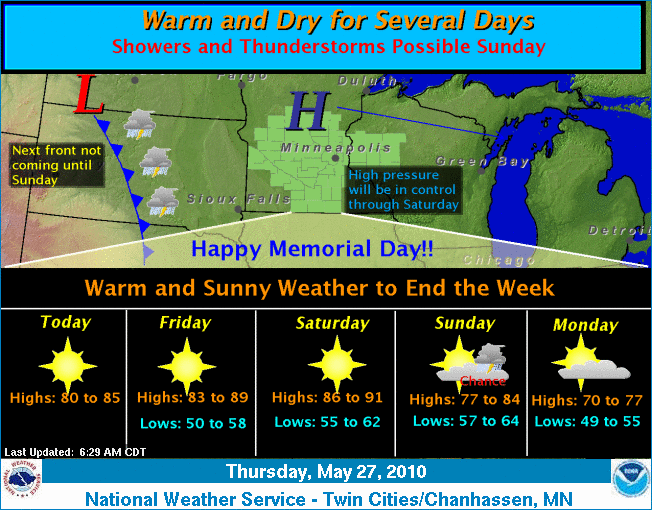
The dew point has dropped into  northern numbers.  The sun shines, but the heat has not cranked up into Louisiana bayou territory like it did on Monday.  We have good daytime dew points through Sunday, though nighttime dew points will be high Friday and Saturday.

No severe weather in the forecasts for the next few days with the exception of possible thunderstorms later Sunday and Sunday night.   This looks a genuine outdoor grillin’, bike ridin’, gardenin’, relative visitn’ holiday weekend on this the school kids’ usual date marking the beginning of summer.

The Celts, who divided their year into four parts, saw May 1 as the beginning of the summer season while   more astronomically inclined cultures made it toward the end of June with the solstice that has become known as the summer solstice, on or about June 20th.  As a kid in central Indiana, where Memorial Day and Labor Day were the twin gate posts to Summerland, this was the true start.  Funny how it’s remained that way for me over all these years.

cnsw527

Mom

Beltane                              Waning Flower Moon

Already down to 33.  Bound to head lower.  Glad I covered all the tender plants.

Mother’s day has little resonance for me.  Mom has been dead now for almost 46 years, meaning she’s been dead as long as she was alive.  I passed her 17 years ago.  It feels strange to have lived into areas of life which my mother never experienced:  near retirement age, grandkids, dealing with the inevitable losses of friends and loved ones other than your parents.

It’s not that I didn’t love my mom.  I did.  It’s just that home faded away for me the year after she died.  I went off to college, then got involved in the political radicalism of the 1960’s and became estranged from Dad.  In essence that meant I became estranged from Alexandria, Indiana, too.  I grew up there from age 1 and a half on, experiencing those magical years of pre-teen life when the world has not much larger compass than your street, your friends, your parents, but after age 18 I returned only very occasionally, for ten years, not at all.

Of course, Mom was important in my life.  She loved me and believed in me.  She and my aunt Virginia nursed me back to health after a serious bout with polio.

What we remember and what actually influenced us, of course, are not always (ever?) true to the lived experience, but they are true for our psychic life and I have a particular memory of Mom that was formative.  One year a garden spider built a web over the window in our kitchen, the window next to the kitchen table where we ate breakfast.  All spring and summer Mom and I watched that spider, watched her repair the web, spin up her prey, eat them.  What I recall most from that was the sense of wonder, of awe that came off Mom in gentle waves.  She also took insects outside in a kleenex and let them go.  I do, too.

I also remember times when she took to me an ice-cream parlor when I got straight A’s on my report card, which was all the time so I got a lot of ice cream, but more than that, I had the attention and time with Mom.  I was close to her side of the family, the Keatons, growing up and have continued my close connection with them over the years.  In part it was my way of staying connected to Mom, to her values and to the people and places that shaped her.

But Mother’s Day?  Nope.  Doesn’t work for me.  Too much Hallmark, too little real sentiment.

Beltane: 2010

Beltane                               Waning Flower Moon

The old Celtic calendar divided the year into two seasons, Summer and Winter.    Summer began on Beltane, May 1st, and ended at Samhain, Summer’s End, at October 31st.  Summer is the growing season, the time when a subsistence farming economy like that of the Celts in Britain and Ireland raised food stuffs that had to last throughout the long, fallow season of  Winter.

As my inner journey has  changed over the years since Alexandria, Indiana and my received Methodist Christianity the wisdom of these early earth based faith traditions means more and more to me.   The technology of food raising and preservation has changed dramatically, it is true, but the human need for food has not.  We still need enough calories to sustain us throughout our day and most of those calories still start out in the form of plant material.

Taoism emphasizes conforming our lives to the movement of heaven.  At its most obvious level this means making the rhythms of our lives congruent with what the Celts called the Great Wheel of the Seasons.  If you care for flowers, have a vegetable garden or raise bees, then the biological imperative of their seasonal needs tends to pull you into the season.  If you enjoy the gradual and beautiful transition in Minnesota from the growing season to the depths of Winter, the cool days and leaves may call you outside, perhaps to hunting and fishing, perhaps to hiking and birdwatching, perhaps just for the changing colors.  As fall changes to winter, you may, like the bears, begin to  hibernate, turn away from the cold and begin to do inside work.

Taoism also encourages us to conform our lives to the possibilities of the moment.  That is, when standing in a river, pushing it back upstream is foolish, but it is possible to dig channels for it and divert it’s energy.

The Great Wheel is often seen as a metaphor for the human journey:  baby (spring), youth (summer), adulthood (fall), elderhood (winter).  The tao of human life is to act as the moment in life you are in suggests.  A twist on this might be to consider what the adult stage finds calling to it when the season of summer is upon us.  There are many levels.

Beltane offers us a chance to reflect on those things in our lives that have begun to take on real form, that seem poised for a season of growth.  In my case bee-keeping and the translation project come to mind.  I’ve done preliminary work with both of them and it may just be this summer that they grow into regular parts of my ongoing journey.    I hope so.

Whatever it is for you, whatever things in your life  need a long hot summer for maturation, give it to them.  This is the movement of heaven.

Kate’s colleague Dick, whom I have mentioned occasionally here, has come close to the end of his painful last days.  The cancer has proved more than his body and the medical wisdom we have now could defeat.  What comes to maturation for him in these first days of summer is the whole of his life and the transition of death.  None of us know what lies on the other side of the grave, or even if there is another side, but all lives end.  Vale, Dick.

Dinner with the Kids

Imbolc                                   New Moon (Wild)

Kate and I went into the city to Azia for my birthday dinner.  An Asian fusion place, it has an interesting menu filled with crossover items like kannon steak and potatoes and an omakase (trust) sushi/sashimi meal.

The food was good, but the main thing we both noticed was that this kind of night time dining in the city is not our scene anymore.  I mean this quite literally.  We had a good 15 to 20 years on everybody–diners and staff–in the place.  It was fun to see that whole aspect of life that was so crucial when we were younger.  Reminds me that there are always couples out on the town, others in elementary school, some suffering through middle school.

As we pass out of life’s phases, we often leave them behind, no longer staying in touch with pre-school or college, say, once we enter the work-a-day world.  American society tends toward age segregation, a phenomena self-induced for the most part.

A good birthday, 63 trips around the sun done.  Or, as I heard on a TV show, “One year closer to the sweet release of death.”  Cheery thought that.

Not Wild. Not Yet.

Imbolc                                    New Moon (Wild)

With the weather calm, blue skies and no wind, welcoming the Wild Moon seems a bit off point.  As February ends, though, and we head into March the character of the Wild Moon will show up.  Soon, the push and pull between winter’s resistance and spring’s temperate insistence will create storms as we oscillate back and forth until the sun’s rising angle makes spring inevitable.  The next  six weeks are a real meteorological festival when our latitudes entertain a host of weather’s finest celebrities:  sudden snow fall, driving rain, howling winds, sleet, ice and bursts of warmth.  Get ready to be entertained.  It will be, well, wild.

This morning the grocery store was full of shoppers with some aspect of Valentine’s day on their mind.  They bought candy, two for one ribeyes and items for their honey’s favorite meal.  As I checked out the clerk, a young woman with orange/red hair asked me if I had special plans for Valentines.  Yes, I told her, it’s my birthday and my wife and I will go out to eat.  What about you? I asked.  Oh, she said, I work until 2:00, then hanging out with friends I guess.  It’s a day for people that love each other to show that.  She  sounded a bit sad.

When I got back there were boxes inside from the mail, one from Singapore and two from Bonaire, Georgia.  One came yesterday from Denver.  Fun.

I’m dickering with Groveland UU to become a field instructor for an intern they want to hire.  It’s an old problem for me.  They don’t have much money, but the time commitment involves travel as well as an hour plus with the intern, once a week for nine months.  A lot of time for me.  Yet, mentoring is, I believe, an important part of our role as we get older, so I want to do it.

Monkish

Imbolc                                 Waning Cold Moon

Boy.  3 this morning.  The cold moon has almost winked out and it’s still cold here.

We have at least 2 feet of snow in our orchard.  The goose berry and currant plants have only a foot of cane showing.  In the way snow has stayed on the ground, this has reminded me of an old fashioned Minnesota winter.

It’s great learning weather.  Nothing like sitting next to the green metal gas stove in the study, Wheelock on the book stand,  the snow covered boulder wall outside.  Just like a monk in a scriptorium.