Category Archives: Latin

Golden

Samhain                                                 Thanksgiving Moon

Watched movies and TV, ate lamb, lounged around with the dogs.  That was Thanksgiving.Titan   Titan is the only other body in the solar system with liquid on its surface. It has hydrocarbon lakes and seas, shores and rivers, and seasonal rainfall like on Earth Today found me back at the Latin and ready to go.  The first hour was golden.  I was on and it flowed.

I broke for about an hour to work in the garage, clearing the way for the biggest part of the project, dismantling the dog feeding and sleeping stations lovingly and well built by Jon now many years ago.  We have stuff stacked on them and some in them, so spots have to be found for all of that.  There is plenty of room.  After all, we have a three car garage and only one vehicle.

When I came back, the Latin aqueduct that had opened earlier, closed.  Weird.  I couldn’t make the words dance.  So, I put up my papers and my commentaries and my grammar. This kind of work, much like writing, will not be pressed.

Soon it will be time for lunch and our inter-species nap.  My eyelids are already drooping.

Upset the Apple Tree

Samhain                                                  Thanksgiving Moon

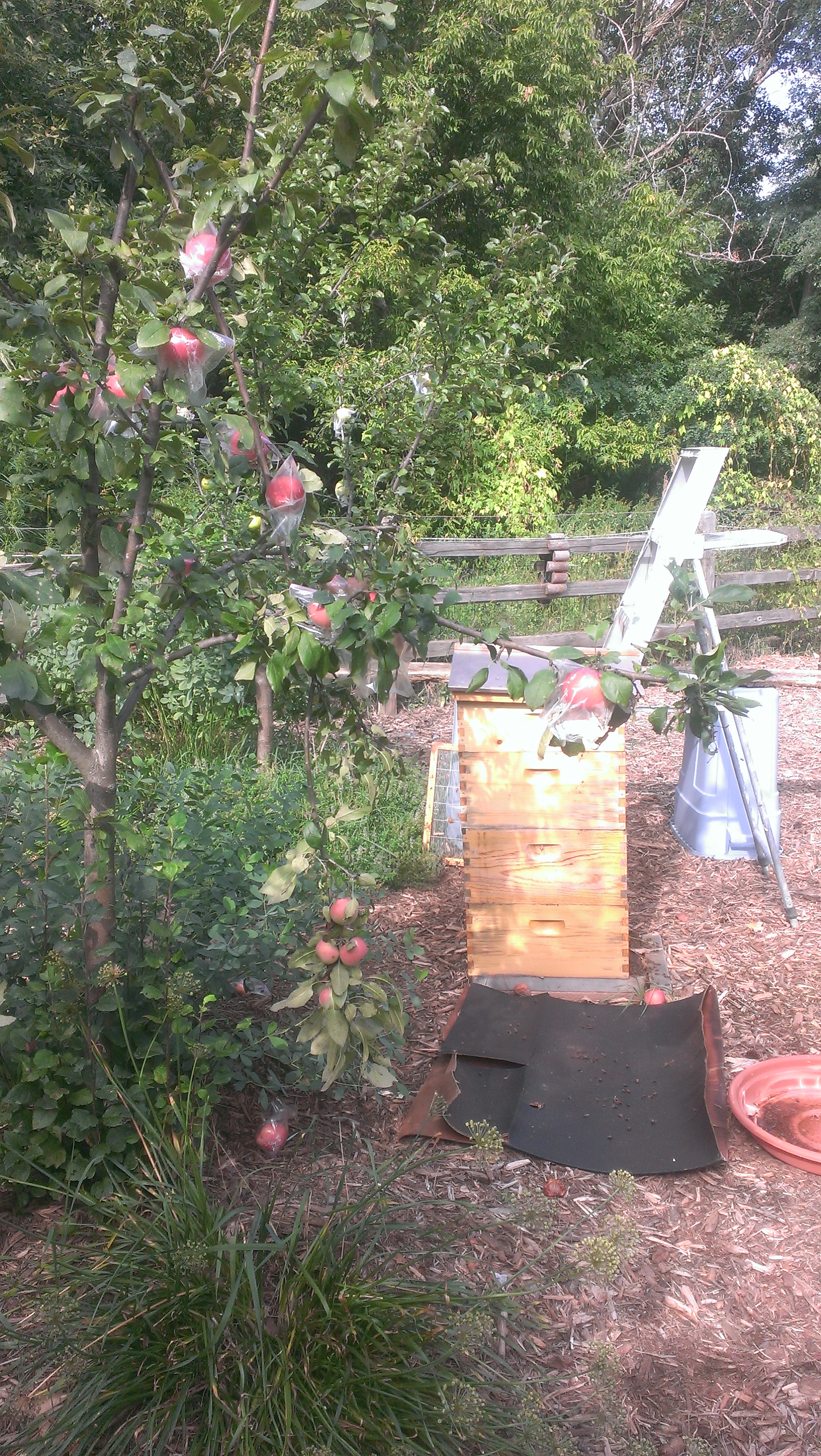
After the heavy snow a week or so ago, I looked out and saw that the bee hive had snow IMAG0929and some leaves on its top.  Odd, I thought, but didn’t go out to investigate.  Our orchard, where the bee hive is, is visible from our kitchen.

Today I went out to hitch up the cardboard sleeve which had slid down to the ground and attach it firmly for the winter.  That snow and some leaves on the bee hive was one of of our apple trees.  It had tipped over from the weight of the snow and landed on the bees.

(It was the tree beyond the bee hive in this picture.)

I cranked it back to vertical, tied it off to the fence with some plastic coated dog leads and realized it would require some more soil and some compacting before the snow flies, probably this week.

The bees now have their winter protection.  The garage is on the way toward reorganization, too.  I spent an hour and a half or so doing this and that, glad to get out of the chair, even though it is a Miller Aeron.

More Latin later.  Translating Lycaon from the Latin while I push the story through different paces in Dramatica.  That’s fun.

I also started reading Robert Silliman’s Alphabet.  He’s a language poet and this is a series of riffs beginning with each of the letters of the alphabet.  It’s a very big book.

(Zeus and Lycaon in Wedgewood)


Everything You Need

Samhain                                                                                                         Thanksgiving Moon

“If you have a garden and a library, you have everything you need.”
Cicero

I’m set.  The library surrounds me as I write this and the garden is two weeks into its winter slumber.  Cicero and I agree about life’s necessities, books and a place to grow food and flowers.  Between them they service the body and the mind.

It’s a dull, grey November day. Rain dribbles out of the sky, unwilling to commit.  The temperature remains in a warmer trend, 45 today, a trend our weather forecaster says will remain until early December.  I hope so since we’re headed out across the plains a week from tomorrow, exposing ourselves to the wind driven weather coming down, with no topographical resistance, from the Arctic.

Finishing up ModPo and getting off the Latin plateau I had inhabited for many weeks has left me in a satisfied Holiseason state of mind.  Before them Modern and Post Modern ended and the garden got put to bed, the Samhain bonfire held.  So this is a time of endings, as Samhain celebrates, and festival season beginnings.  The unusual confluence of Hanukkah and Thanksgiving means the whole last week of November will be celebratory. In December then we can focus on Yule, the Winter Solstice and the pagan side of Christmas.

In the coming weeks I look forward to finishing Missing’s 5th revision and getting it off to the copy editor, learning Dramatic Pro and using it as I develop Loki’s Children while I continue to work in the new “in” the Latin style that Greg pushed me towards.  This will also be a time when I consolidate my understanding of the Modern and the Post Modern and do some more writing around that, especially as it changes and informs my Reimagining My Faith project.

Reading poetry more regularly will also be part of the next few weeks, too.  I want to continue my immersion in poetry.  One of the ModPo teaching assistants, Amaris Cuchanski, said poetry is the leading edge of consciousness and I believe she’s right.


Thank God It’s Frida

Samhain                                                        Thanksgiving Moon

Latin with Greg this morning.  I felt like I’d made good progress with my work, but in doing the translating with him, I hit a snag.  There was a long sentence, six verses in length, with a complicated structure, hinging on a definition of a verb that was, Greg said, esoteric.  Getting that one out of whack made the entire six verses difficult, entangled. Just when I began to feel incompetent (not a feeling I enjoy), Greg pushed us further into the translation.

Once we got out of that briar patch my work improved.  “Perfect.  You’ve got it!”  “It was just that complex sentence and ferunt (the verb in question) that messed you up.  You kept at it.  That’s the key.”

“Oh, tenacity I have.  I’ve got too much time in this to give up now.”

Kate’s away at a continuing medical education event on pain.  After Greg and I finished I fed the dogs, made lunch and took a nap.  Gertie, who rehurt her leg, came in and snuggled up next to me.  This afternoon she’s moving much better.  Good to see since she’s been down for a few days.

Finished up ModPo with assessments of four other student’s essays and watched a beginning video on Dramatica Pro, the new writing software I purchased.  I plan to use it to build Loki’s Children, but before that I have to learn how to use it.

With Latin on a steady course and ModPo finished, I’ve just got Missing and Ovid to occupy my days.  And they’re plenty.  With, of course, learning how to use Dramatica.


Education for Everyone

Samhain                                                              Thanksgiving Moon

Back from sheepshead.  The goddess let up and gave me some good cards tonight, one very good hand in particular.  A roll of the dice for Fortuna.

Finished the last ModPo poet today, the last video of Al Filreis and the gang doing close readings.  I still have my assignments to write, but I’ll finish those tomorrow.  I chose not to get a certificate in the Modern/Post Modern class, but I’ve earned one in ModPo.  There are 35,000 people in the class.  35,000.  That would be a crowded lecture hall.

The revolutionary impulse of the MOOCs is just beginning to be felt.  The university will have to have a rethink in not too many years with this technology working on the disaggregation of education in the same way the net has disaggregated so many things before it.  This will work to the benefit of many constituencies:  the poor, the geographically isolated, the third phasers, adult learners of all ages, even the traditional college student for whom the cost of four years has become a leaden albatross hung around their neck at graduation, a weight rather than a celebration.

Missing’s fifth revision has begun to open up very exciting possibilities, ones I didn’t see before.  I’ve reentered the story with the same enthusiasm I had when I first wrote it.

Four more verses of Ovid done.  Greg and I talk tomorrow, the first session where I’ll be using the new technique of staying “in” the Latin.  I’m looking forward to gaining more facility with it.

Still Plugging Along

Samhain                                                      Thanksgiving Moon

Working through the revisions in Missing, having fun, surprising myself.  About a third of the way into the manuscript, though the later chapters have more work than what I’ve done so far.  Ways of knitting themes and character development with the narrative come more easily at this stage.

Got a new piece of software today, Dramatica Pro.  I’m hoping it will help me deepen my work while making it more exciting.  I’ll let you know how it goes.  It’s supposed to take a long time to learn.

Five more verses of Ovid.  These verses had a textual problem that had me digging around in the Oxford Classical Text’s version.  It’s supposed to be the best manuscript available now.  The Metamorphoses presents certain problems since it’s oldest manuscript dates from the 9th century, seven to eight hundred years after it was written.  The Aeneid, for example, has some fourth century manuscripts, still within the time of the Roman Empire.

And finished up the next to last poet of ModPo. I’ll finish tomorrow and start on my assessments on Friday.  Yeah.

Just Glad For Them To Be Over

Samhain                                                            Thanksgiving Moon

Finished the quick page through of Missing and have decided on key steps to take next. There will be some formatting, substantial rewriting at the end, amplification of descriptions in certain parts and a bit of rearranging.  My goal is to finish before we leave for Denver.

My capacity to translate while “in” the Latin seems to be growing.  In the passage from today Jupiter is very mad and has decided to destroy the mortal race.  Which he will do, later on in the book.  How?  By means of a flood.

I’m down to the last two poets in ModPo, plus the four assessments of other’s writing assignments.  After two and a half months of considerable work in ModPo and Modern/Post Modern, I’m experiencing that end of the quarter blah.  I don’t really want to finish the work, but I’m going to because I’ve invested so much now.  I get this filled up feeling, brought on by choices I’ve made, yes, but it’s still there.

These were two really good courses and worth the time and effort, more than repaying the work.  Just glad for them to be over.

Missing, In the Dark Wood, Lycaon

Samhain                                                               Thanksgiving Moon

Involved with what is, I believe, technically the fifth revision of Missing.  20,000 words went out today, a whole story line about a goddess and her giantess assistance.  It included, too, a favorite part of the book for me, the Wyrm and the Weregild, a group of expert giant dragon hunters.  But this storyline does not intersect directly with the primary story in Missing and it’s now in the pile for Loki’s Children, which now has over 50,000 plus words available from the drafts and revisions up to now of Missing.

Some key names got changed, transitions made more clear.  I got about half way through a quick review.  Probably will finish with that tomorrow.  Then I’ll go back in and start adding some more description, some character development and I may, probably will, change the ending to give it more punch.  Thanks to Stefan for the idea.

Translated another four verses in the story of Lycaon today, too.  These were hard, either the Latin was thick or I was.  Maybe both.  Still.  Done.  That’s my goal per day.

Also worked on ModPo’s final week.  Two very interesting poets today.  Erica Baum is a conceptual poet who combines photography and found language to create intriguing works.  Here are two images we reviewed in class:


The first is from a work called Card Catalogues where Baum photographed certain portions of the New York University Library’s old card catalog.  Each photograph is a poem of juxtaposition created by the strange constraint of alphabetically organizing knowledge.  The second is one of several pieces from a work, Dog Ear.  These are all large photographs, Card Catalog is too, and she hangs them in galleries together, though each photograph stands alone.  This is part of the conceptualist idea that ambient language contains all we need as far as poetry.  We only have to work to find it.  But that work can be difficult.

The next poet is Caroline Bergvall, a French-Norwegian who works in English.  Her work is a ten-minute recitation of 47 different translations of the famous opening lines of Dante’s Inferno:

When I had journeyed half of our life’s way,
I found myself within a shadowed forest,
for I had lost the path that does not stray.  from the Mandelbaum translation

This is a strangely evocative, haunting experience.  You can hear her read it here.

(Frame from a 1911 Italian film version of the Divine Comedy. The director’s name was Giuseppe De Liguoro. from this website.)

Off the Plateau

Samhain                                                         Thanksgiving Moon

It’s been a week since Greg recommended I get to the place where I can read the Latin and translate as I read.  This means doing what I’ve already done, looking up words, writing out a translation, but there is now another step.  I look only at the Latin and translate it without reference to Perseus (on the web) or even to my notes.  If I stumble, I go back to Perseus and the notes.  Then back to the Latin alone.  Only when I can look at the bare Latin and translate the sentence with no outside aides, can I feel finished.

I thought this would slow me down and at first it did.  As I grew used to doing it though, staying “in” the Latin, as Greg called this method, began to make things easier.  I began to to see the shape of sentences quicker, the subjects and objects popped out faster.  Verb tenses and noun/adjective/pronoun declensions are becoming more automatic.

Staying “in” the Latin is winching me up, slowly, from the long plateau I’ve inhabited.

Here’s an example: “Hac iter est superis ad magni tecta Tonantis
regalemque domum.”  This is a line from the story of Lycaon in the second large section of Metamorphoses, Book I.  Just looking at this line, with no aids, I will read it to Greg this way:  Hac, on this, est, is, superis iter, the exalted way, ad magni tecta, to the great temple, Tonantis, of Thundering Jupiter, regalemque domum, and his royal home.  So the translation reads:  On this is the exalted way to the great temple of Thundering Jupiter and his royal home.

(Lycaon wants to test the omniscience of Iupiter and serves him human meat.  Hermann Postumus, 1542)

It has taken literally years to get to this place and I’m not all the way there yet.  But I’m moving faster and better now.


The Weight of the Inert

Samhain                                                                      Thanksgiving Moon

I finished the fourth and last writing assignment for ModPo.  I’m attaching it because it was fun, a riff on the Chance poetics of John Cage, Jackson Mac Low, and Bernadette Mayer (pic).

Next week we finish up and my 3 months excursion into the modern and the post modern through Coursera will be at an end.  The gardening season has come to an end.  And Holiseason is just beginning.

Over the next weeks and months I plan to consolidate my learning both in poetry and the post modern.  As I’ve said before, I want to include these concepts in reimagining my faith.

BTW:  Some of you have expressed interest in the MOOCs.  Here are the two I’ve worked with and can recommend:  Coursera and EdX.


The Weight of the Inert

Version I

“5 Before the sea and the sky that hangs over all the lands and

was one of the faces of the whole of nature in the world,

I have spoken of the chaos, the amount of raw indigestaque

and nothing but an inert and heaped up in the weight of the same

not well joined the seeds of discord of things.

10, supplying light to the world, no one has as yet the Titan,

not renew the waxing moon horns,

or hanging in surrounding air

balanced by its own weight, or long arms

edge of the lands stretching out her arms;

15 and that the air, land, sea, and there, and sky.”
 

Version 2

5 and and which covers

One look in the whole world,

the said, the amount of raw

and only if the weight of the inert

things do not go well.

10 Nothing in the world,

neither growing Phoebe

or in the surrounding region

their own weights, and not long

15 and that the air, land, sea, and there, and sky.


Since I’m currently engaged in translating Ovid’s Metamorphoses, I performed the following operation. First, I copied a Latin section of Book I: 5-15 from Perseus, a classics aides website. I took that section and put it into google translate. I then went through the Latin and eliminated all words with the letter a and ran it again through google translator. The result is version 2.

I retained the first version here so you could see that the translation was far from smooth and contained some chance operations on its own. In that sense version 2 is more than 1 step away from the Latin version of number 1 since it introduces the still clunky results of the google translation algorithm into the altered text.

Version 2 surprised me. It makes almost as much sense, if not a bit more, than Version 1, not in the Latin, of course, but in the English machine translation.

I hear a surprised boy saying, “And, and which covers one look in the whole world.” Another voice, perhaps a chorus replies, “The said, the amount of raw and only if the weight of the inert.” Another, deeper voice, an adult male weary with experience says, “Things do not go well.”

The boy again, chastened now, “Nothing in the world, neither growing Phoebe or in the surrounding region…”

And finally a resonant female voice, mature and wise, “Their own weights, and not long and that the air, land, sea, and there, and sky.”

All this on a stage bare except for the actors, a broken Greek column and a small tripod holding a basin in which a bright fire burns.

A fluxus moment, perhaps performed on an off-Broadway sidewalk, the stage improvised with concrete blocks and plywood.   The air is cold, midnight of the Winter Solstice, and a flier announcing the performance reads, “Saturnalian Words. The voice of Sol Invictus.”

This has a Harry Haller, magic theater resonance for me. The whole thing could be a performance in one of the side stages, feeding the Steppenwolf in all of us.

OK, I know I’ve gone pretty far afield with this, taking it from chance to dialogue and from dialogue to theater and then positioning the theater in Hesse’s imagined dramatic space. But that very journey speaks of seed text and deterministic method, that somehow flensing an ancient text, then using a very contemporary technology to alter it, can create haunting, yes, I’ll say it, meaning. Meaning created in that most artistic of ways, with the caesura as important as the content.

What did that one look over the whole world see? And why does a rejoinder to it reference the raw and the inert? The next line seems very apt in a Kafkaesque, Hesseian way: “Things do not go well.” How could they?

Finally the last two spoken lines speak of loss and seem to refer back to that one look over the whole world which saw what? “The air, land, sea, and there, and sky.”