Category Archives: GeekWorld

Glad They Didn’t Name It After The Titanic

Beltane                                                             Early Growth Moon

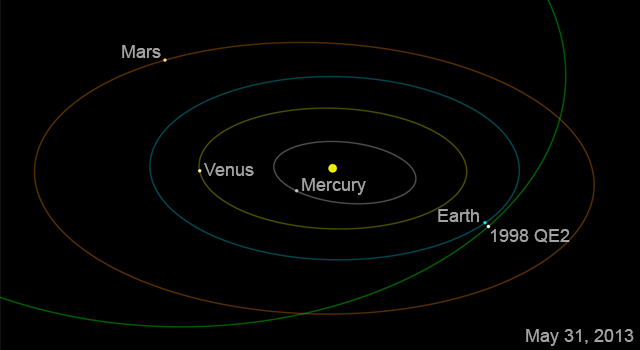
Asteroid 1998 QE2 to Sail Past Earth Nine Times Larger Than Cruise Ship

“On May 31, 2013, asteroid 1998 QE2 will sail serenely past Earth, getting no closer than about 3.6 million miles (5.8 million kilometers), or about 15 times the distance between Earth and the moon.” nasa


Third Phase: Robots

Beltane                                                                                   Early Growth Moon

Frank and Me is an engaging movie with a quick plot twist at the end that caught me napping, but the intriguing question raised is Frank’s relationship with the robot his son gives him to care for him.

Like most technophiles robots have been on my mind for a long time. Forbidden Planet came out, for example, in 1959 when I was 12.  I read I Robot before that. At the time they seemed much more science fiction, probably only science fiction.  In fact, it is very difficult to convey today the gap between many of those things we saw as science fiction and any reality we ever expected to experience.  Space ships?  With humans aboard?  Moon landing?  Video phone calls?  Robots?  Come on.

As a child of that era and a science fiction oriented one at that, imagine my delight when we land roving robots on Mars.  Mars!  Or, a human made machine leaves the solar system.  The Oort Cloud!  Calling my brother in Saudi Arabia and my sister in Singapore, with moving pictures and both of them on the screen with me at the same time.  Get outta here.

When it comes to the question of how much care we can offer the elderly through robots, I’m jumping up and down.  Let me at’em.  I don’t want to plan robberies with one like Frank did, but I can easily imagine a relationship with a robot.

Some people, Frank Langella, lead actor in Frank and Me among them, think those kind of relationships should be with humans.  A recent Wired article suggested that a fuzzy robot sold now as a companion for Alzheimer’s patients may work too well.  People talk to it.  They bemoan the relationship people might have with the robot.

Why?  I mean, it’s not like we’re going to send people robots and then say, “Now, you have your robot.  Let’s not ever hear from you again.”  No, the robots will be part of a care-giving strategy.  Perhaps they’ll do household tasks and some particular care-giving like medication administration.  Perhaps they’ll be dialogical, with a capacity for learning and different accents.

We pay home health care aides around $20,000 a year.  And there are fewer and fewer signing up for the jobs.  It’s not hard to see why.  This trend has accelerated just as the number of elders in our culture will increase enormously.  I’m glad the Minnesota legislature voted to let child care workers and home health care workers organize.  If they can get better pay, benefits and training, we’ll have more people wanting the work.

But my sense is that even if that sort of improvement changes their lot somewhat, it will still not be enough to meet the needs of people who. like myself, want to age in place.  We can do it, but most of us will need help of some kind.

(Hector, a mobile assistive robot and smart home interface for the elderly.  forbes magazine)

It seems to me that a joint work force of robots and better paid home health care aides is a big step toward solving the problem of affordable care for the rapidly increasing elderly population. And I will welcome it.

I think back to Alvin Toffler’s Future Shock.  He suggested we were moving toward a High Tech, High Touch society.  That is, the more technologically sophisticated we become, in the same proportion we become eager for human contact, need human contact.

Those who write about the elderly and robots always seem to paint things as either/or.  Either we increase the number of in home health care workers or we use robots.  No, we’ll do both.  And we’ll love it.

I want mine for my 70th birthday.


About Time

Beltane                                                                              Early Growth Moon

I have stood on the shore of time itself, looking out on the broad sea that laps upon its sand, the vast space ocean, touching all, then circling back, once more to the beach where time rests, gay umbrellas stuck here and there, the men and women in bathing suits, swim suits, bikinis, nothing at all.  No children, just the adults of this one tribe, homo sapiens, from this one lonely outpost, away there in a long arm of the Milky Way Galaxy, nothing special as things universal and cosmic go, just conglobulated star dust.

They watch, as I do, the darkness and the many lights, those stars, those other suns, in other galaxies and those we can see only a tiny, tiny fraction of the whole though we strain these eyes of ours, a gift from the home planet and its billions of years of effort to create one who could see it back.

We watch, the ape that walks and talks, thinks, sees, laughs and cries.  The arms and the legs and the mind and the heart of this universe, allowed here on the beach so we can act out our purpose, seeing the rest, looking for all this, back at all this, born of star dust and doomed or fated or blessed to return.

I have stood on the shore of time itself.  And so have you.

Overview Effect

Beltane                                                                                              Early Growth Moon

“There have been household gods and household saints and household fairies. I am not sure that there have yet been any factory gods or factory saints or factory fairies. I may be wrong, as I am no commercial expert, but I have not heard of them as yet.”
G.K. Chesterton

The video below, 20 minutes long, came to me via friend and cybermage Bill Schmidt through his daughter, Moira.  I include the two quotes along with it to emphasize a subtle point.  Chesterton was looking anthropomorphically at the locus of fairies, gods and saints, ok as far it goes, but he neglects the much longer tradition of nymphs, dryads, fairies of the woodlands and fields, holy wells, sacred mountains, places of pilgrimage and, most tellingly underlined in this wonderful video, the dynamic, vital oasis in the midst of the vacuum of space:  Earth.

(John Byam Liston Shaw  angel offering the fruits of eden)

We live already, as Bill likes to point out, in paradise.  We are, unfortunately, working hard, very hard, through the godless, saintless and fairyless world of commerce–Chesterton surely had this right–to expel ourselves from paradise.  There is no east of Eden in space.  If we lose this paradise, there is not another for us to inhabit.

Heat-Trapping Gas Passes Milestone, Raising Fears  The level of the most important heat-trapping gas in the atmosphere, carbon dioxide, has passed a long-feared milestone, scientists reported Friday, reaching a concentration not seen on the earth for millions of years.”   NYT yesterday

I enclose the second, seemingly far out of context, quote which comes from our money manager because it highlights a fall in the prices of copper, platinum and paladium.  This fact, falling commodity prices, rather than science or political will, are the main things that will work in favor of stopping the Polymet mine near the Boundary Waters Wilderness Area and its follow-on mines that await only its successful completion of its environmental impact statements.

(expulsion, Masaccio)

PolyMet expects to mine copper by late 2015   One day after announcing plans to raise $80 million in cash, officials of PolyMet Mining Corp. on Thursday said they are moving headlong toward permitting and, eventually, construction of Minnesota’s first copper-nickel mine.”  Duluth Tribune

We should not, must not, leave these decisions to the whims of the market.  We must develop the political and personal will to say no.  Hard?  Yes.  Necessary?  Listen to the astronauts and look at the thin layer of atmosphere that is all that protects us from the harsh reality of the space we inhabit.

“Commodities markets. It wasn’t all bad in April: natural gas futures rose 9.0%, cocoa futures gained 9.1%, and wheat futures rose 6.3%. Now for the bad news: gold fell 7.8% last month to an April 30 COMEX close of just $1,474.00. Silver cratered 14.6% in April; copper fell 6.4%, platinum 4.3% and palladium 9.2%


OVERVIEW from Planetary Collective on Vimeo.

Why They Lectured In the First Place

Beltane                                                                             Planting Moon

I have begun reading various books I have collected about Ovid.  In Ovid Recalled, a book I started today, I found an odd piece of random knowledge that really made me stop.

In giving an example of outdated practices that persist in cultures the author, a Cambridge don, used the university lecture.  The lecture began as a work around because texts were not readily available in sufficient quantities, nor were they affordable.  After publishing became commonplace, the rationale for the lecture no longer existed.  My guess is you sat through as many as I did.

Now this made me think about the recent hooplah about massive open online courses or moocs.  One criticism of moocs from various university faculties is that they ruin the interactive nature of–you guessed it–the lecture.  All this reminds us that there is nothing fixed about professors and lectures and classrooms on physical campuses.  It just represents the most convenient to deliver education based on one set of assumptions; that is, gather students physically then disperse them among classrooms.

We can and should rethink all these assumptions.


Minneapolis standoff ends when robot subdues holed-up suspect

Spring                                                                     Planting Moon

A headline you don’t expect to see, tucked back in the second section:

Minneapolis standoff ends when robot subdues holed-up suspect.

Very Robocop.  Omni Consumer Products (OCP) in Minnesota?  Could find no picture of the device, but here are a two of actual robotics in use by police departments in the U.S.


The scene where a suspicious vehicle was discovered on W45th Street near Seventh Avenue in the Times Square section of Manhattan.


Note that credit.  Formerly local company.  Will it transform into OCP?


A Sheet of Light

Spring                                                         Bloodroot Moon

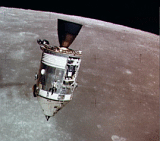
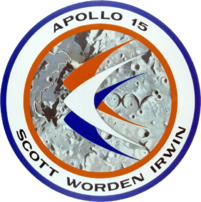
Here’s a clip from a fascinating interview with Al Worden, command module pilot for Apollo 15*.  The interviewer identifies 7 men, all command module pilots for Apollo missions, as holding (having held) the loneliest job in the world.  Of course, it wasn’t in or on the world, but quite far away from it.  When these men were orbiting the backside of the moon, not only were they over 2,000 miles from their crew members; they were also further away from earth than any other human has ever been.

His description of the stars from there.  That’s what got me.


“You were a quarter of a million miles away from home though.

Yes, you’re a long way away but the thing that most impressed me about being in lunar orbit – particularly the times when I was by myself – was that every time I came round the backside of the Moon, I got to a window where I could watch the Earthrise and that was phenomenal. And in addition to that, I got to look at the universe out there with a very different perspective and a very different way than anyone had before.

What I found was that the number of stars was just so immense. In fact I couldn’t pick up individual stars, it was like a sheet of light. I found that fascinating because it changed my ideas about how we think about the Universe.

There are billions of stars out there – the Milky Way galaxy that we’re in contains billions of stars, not just a few. And there are billions of galaxies out there. So what does that tell you about the Universe? That tells you we just don’t think big enough. To my mind that’s the whole purpose of the space programme, to figure out what that’s all about.”

* from NASA Apollo 15 site

Mission Overview

The primary objectives assigned to the Apollo mission were as follows:

  1. to perform selenological inspections, survey and sampling of materials and surface features in a preselected area of the Hadley-Appennius region;
  2. to emplace and activate surface experiments;
  3. to evaluate the capability of the Apollo equipment to provide extended lunar surface stay time; and
  4. to conduct inflight experiments and photographic tasks from lunar orbit.

I Knew Her Right Away

Spring                                                                              Bloodroot Moon

Home again, home again.  The dogs greeted me with unusual joy and vigor.  Vega spun round and Gertie jumped up, biting at me to come play.  Tumultuous.  And wonderful.

Kate came into the Loon Cafe and picked me up from the Hiawatha light rail.  She had on blinking ear-rings.  The server at the cafe, before I arrived, had asked her, “Is that how your friend will recognize you?”  It was.  I knew her right away.

She led us through the maze of parking spaces to the truck, not easy in the mammoth commuter ramps that collect cars from the western burbs.

The trip home had no remarkable moments, a good thing for travel.  I did use, for the first time, a bar code boarding pass on my cell phone.  Felt very with it.  You all have probably done it for years, but it was amazing to me.

It’s nice to use the full size key-board and not the 92%, slick metal keys of the netbook.  Having said that, the netbook has been the best single computer purchase I’ve ever made.  It goes everywhere with me when I travel.  It’s compact, picks up wi-fi with ease and has a 92% keyboard, which is why I bought it.  It’s allowed me to post on this blog from as far away as Cape Horn, south of Tierra del Fuego.


III

Imbolc                                                              Valentine Moon

Considering a strategy for revision.  How do I utilize the comments, opinions, various thoughts from my beta readers?  Where do I begin?  Do I proceed from front to back or do I manage certain structural issues first?  How much time should I give myself to complete it?  May 1st seems good.  That would give me six weeks accounting for the D.C. trip and beginning work in the garden and with the bees.

OK.  May 1st.  Beltane.  Finish revision III in time for the growing season.  A good time to start full bore on writing Loki’s Children.  And getting that revision in the hands of an agent.  I have a March 30 class on publishing at the Loft, so that should work well with that timing.

Given the time frame, which if you notice I set as I wrote, I can reason backwards to plan.  Review all the comments.  Have done.  Note down all that needs to be done.  Their ideas, my impression of what they mean for Missing, and my ideas sparked by the reader’s impressions, then set to work.

(note, I revised my ideas on revision after I found this handy pyramid.  I’m gonna follow it.)

Make sense to me to deal with structural issues first.  Transitions, movement of the story as regards John and the unmaking–their relative weights and interleaving.  The POV issue is structural, too, in this case.  Finding those areas where the action flags and cutting them out.

After those I can attend to the character development/recognition matters and the map/diverse number of places, plus revamping the action in light of the cuts above.

Finished up my computer upgrade this morning by installing the speakers.  Now I have a Pandora station playing, Early Music.  Nice with the snow falling.

Collecting

Imbolc                                                                       Valentine Moon

Tumblr.  Addictive in a sense I don’t fully understand yet.  I’ve selected bloggers on Tumblr, largely where folks post images of one sort or another, who present art.  Over 100 of them at last count.  At any one time only a handful might be posting, so keeping up, or at least staying roughly abreast is doable.  The range of images that folks select is wide, one of  the charms of Tumblr for me, a chance to both get inside people’s heads as they choose images to post and an opportunity to see art that I wouldn’t have found on my own.  In that sense it’s a very eclectic museum.

(folder: architecture)

The addictive part for me is that I’m saving images, image after image, in those files I talked about reorganizing a while back.  Many, many art folders:  art contemporary, art Russia, art Symbolist, artist Blake, artist Matisse.  Cinema and television.  Natural world.  Cities.  War.  Travel.  So on.

Like a squirrel delighted with finding an abundance of acorns, I pluck these images up in my digital cheeks and carry them over to the small holes I’ve dug in my hard drives memory to cache them.  The folders have begun to grow fat with image after image.  Perhaps a hundred images or more in some instances.

(folder, art photography.  the pope’s apartment the night before his announcement about his retirement.)

My question is, why am I doing this?  Part of it is a desire to see again striking images or historically significant images or funny images or moving images.  That’s true, but mostly, like the squirrel, I dig the hole, then go on to dig another hole, often forgetting the one I dug before.  This is what oak trees count on.  How oak forests grow.  Of course, I know where all my folders are and I can open them whenever I want, but my point is that I’m more engaged in stuffing them full than utilizing them.

Utilizing them for what?  My first approach to answering this question will come on Thursday when I start reading the catalog for the Pre-Raphaelite show at the National Gallery.  I have a folder filled with Pre-Raphaelite art and will find images, I imagine, of most of the pieces in the show.  Perhaps I’ll curate them myself, re-organize them in different ways, trying to emphasize different aspects of this 19c phenomenon.  Perhaps I’ll use the images for comparison, for tracing the history of certain themes and techniques.  Or, I might just open the folder and look at them, one after the other, taking in their color, their subject matter.

(folder History England.  a 1920 poster for the tube.)

This is an activity only possible with the internet and large hard drives.  And a lot of time.  It feels important; that’s why I’m writing about it.  But why?  No idea.