Category Archives: permaculture

Home As A Political Statement

15  bar steep rise 30.05  5mph NNW windchill 11  Samhain

Waxing Crescent Moon of Long Nights   Day  8hr  56m

Below are photographs of recent work underway along the wood’s edge here.  Almost done for this year.

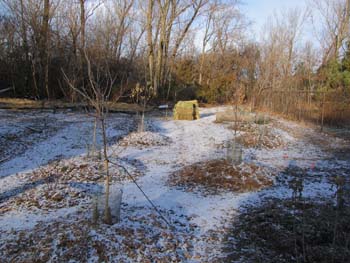
orchardinwinter350.jpg

The fruit trees as winter takes hold.

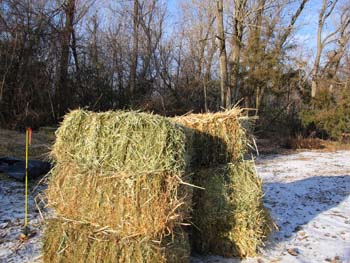
marshhay350.jpg

Marsh hay before use.  AKA hay without seeds or straw without seeds.

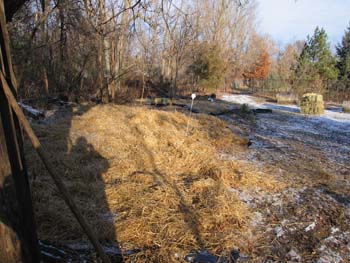
plasticandmulch1350.jpg

View along the wood’s edge facing due north.  The straw in the foreground and mid-ground covers the black plastic.  The area covered is approximately 15 feet wide, that is, 15 feet between the truck path and the beginning of the forest proper and extends perhaps 150-200 feet from end to end.  This whole area will have shrubs and small trees planted in the spring.

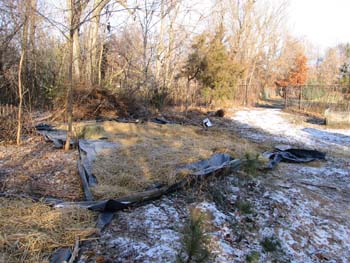
progress350.jpg

This gives you a better picture of what’s going on here.  I ran out of hay on Sunday and had to get the new load visible in the first shot.

Do you remember how you felt when you first realized you loved someone?  I have that feeling over and over with the land here.

A Holimonth Filled With Holy Days

Kate and I will head over to Beisswingers in a few minutes.  The lawn tractor has had a checkup, gotten set up for winter storage and had its blades sharpened.  It will go in the machine shed, the one back on the wood’s edge.

After that, we will start laying the black plastic.  I cleared the area of standing weeds, trees and brush over the last three weeks.  I want to get the plastic down before it snows.

Though by my reckoning we’ve been in Holiseason since Samhain, the pace does pick-up between Thanksgiving and New Years.  A real holimonth filled with Holy Days.  The sacred puts itself before us in so many ways over the next few weeks.

The article I posted yesterday from the magazine Orion points to a key locus of the sacred:  home.  At some point over the weekend I’m going to post some thoughts about home and ge-ology.

The Most Radical Thing You Can Do

From the Faraway Nearby
The Most Radical Thing You Can Do
Staying home as a necessity and a right
by Rebecca Solnit
Published in the November/December 2008 issue of Orion magazine

LONG AGO the poet and bioregionalist Gary Snyder said, “The most radical thing you can do is stay home,” a phrase that has itself stayed with me for the many years since I first heard it. Some or all of its meaning was present then, in the bioregional 1970s, when going back to the land and consuming less was how the task was framed. The task has only become more urgent as climate change in particular underscores that we need to consume a lot less. It’s curious, in the chaos of conversations about what we ought to do to save the world, how seldom sheer modesty comes up—living smaller, staying closer, having less—especially for us in the ranks of the privileged. Not just having a fuel-efficient car, but maybe leaving it parked and taking the bus, or living a lot closer to work in the first place, or not having a car at all. A third of carbon-dioxide emissions nationwide are from the restless movements of goods and people.

We are going to have to stay home a lot more in the future. Continue reading The Most Radical Thing You Can Do

Dis and Dat

Quick note:   Finally, after over 4 years I’ve cleared obstacles between garage bays, set up during and just before the renovation.  Much better.

Today I also changed the nutrient solution in the hydroponics and tried again to the encourage the eggplants to fruit.  I now have several peppers at various stages of growth.  Very cool.  At least to me.

Last I got out the chain saw and cut up the trees I cut down last week.  They went on the extra large Varmint Hotel.  You might know it by its other name, brush pile.

That seemed enough for the morning, so it’s nap time now.

WTS Writer’s Saving Time

29  bar rises 29.97  2mph SSE  windchill 28   Samhain

New Moon (Moon of Long Nights)

Day after.  No turkey hangover.  But.  I have begun to reset my clock for a 10:30 bedtime.  Soon I’ll be able to get up early again and write for my usual four hours in the AM.

A bit more work outside, but the heavy lifting is done.  Now it’s putting down the black plastic, straw on top of that.  Final stroke is mulch over the vegetable beds (to add organic matter) and over the bulbs I planted.  That should all get done in the next week or so, then it’s inside time for at least four, maybe five months.

Over the course of that period I want to restart my writing routine and, sigh, work on edits and revisions.  I say sigh because my last 12 years has the litter of so many good intentions in this regard and so little to show for it.   Maybe this will be the decade.  Not that many left.

Kate has a Hanukah piece underway and some Christmas knitted and crocheted items, too.  She’s a whir of activity, a real equivalent to a woodworker in a shop.  A creative gal.

Two Little Peppers and How They Grew

34  bar steep rise 30.05  2mph W  Windchill 31  Samhain

Last Quarter of the Dark Moon

The big news!  I have two peppers emerging in my  hydroponic garden.  That means the fertilizing I’ve done has succeeded.  This is the first fruits I’ve been able to coax out of the hydroponics.  But, not the last.

More time on the forest’s edge.  Whacking down tall weeds, cutting down acacia new growth, a little pruning and general clearing.  One more major project before laying down the plastic and mulch:  cut up, move and burn a tangle of vines, small trees and branches cast off during a clearing operation in this area last fall.

Working outside when it’s cool appeals to me.  The work heats me up and I can strip down to whatever level of clothing fits.

Working on the Forest Edge

32  bar steep rise  30.08  0mph NW  Windchill 31   Samhain

Waning Gibbous Dark Moon

Got groceries at Festival.  Grocery prices have gone up, maybe 15-20%.  Many people bought their Thanksgiving turkeys from a young woman with a table set up beside the butcher’s counter.  Christmas music played in the background, in sympathy, I guess, with the lonely retailers who expect no Christmas present purchases this year.

Once again I purchased produce unrecognizable to the check-out person, a friendly girl of about 18.  Is this a rutabaga?  No, jicama.  Is this a sweet potato?  No, a yam.  Oh, do they taste different?  Yes and have different colors, too.  What about these, are they good?  Rambuta.  Yes, just slice around the middle and take the top off.  Are they sweet?  Yes, if you like sweet, you’ll like these.  They’re not too sweet, are they?  No.  Medium.

Then I was on my way with my plastic bags, once again shopping without the cloth bags I’ve purchased for the purpose.   I wish they’d hop in the car without my having to remember.
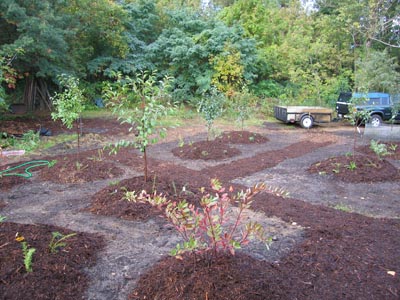
orchard-week-1frtrees400006.jpgThe rest of the morning I cleared ground along the forest edge so I can put down black plastic, then mulch, to kill all the flora we do not want in the way when we plant the crops that will distract the birds from our orchard.  They will provide a height sensitive edge, stair stepping back toward the poplars, ash, cedar, oak, acacia and pin cherry behind them.

Built up a good appetite.  Still eating the 11-bean soup I made a week and a half or so ago.  Nap.

Now, after the nap, I’m doing inside things I’ve held off until I had a bit of time in the afternoon.  I put ink cartridges in my Canon Pixma printer.  This is a real rip-off.  Even when printing only black, like copies, it uses up colored ink.  This means that you have to replace the color cartridges as often as the black ones.  Guess what?  The colored cartridges are expensive.  Anyone with this printer as their primary printer pays a lot for the privilege.  My laserjet printer handles black and white in an economical manner.

Also cleaned the carpet in the study.  Dogs leave the occasional trail.  Also cleaned the stairs.  Dogs, again.

Kate’s upstairs threshing beans from our garden.  I look forward to using them in recipes over the course of the winter.

The cones are finally on the zone 5 grasses in the perennial garden.  I hope they survive.  They were a nice, delicate touch behind the lilies, iris and, later, the iris and sedum.

Oh. BTW.  No fruits on the pepper or eggplant yet.  It was a false pregnancy.  This may take a while to get down.

Before and After: The Orchard in Autumn, year 1

65  bar steep drop  29.80  2mph W  dew-point 45  sunrise 7:12  set 6:51  Autumn

Waxing Crescent of the Blood Moon    rise  11:04 AM CDT    set  8:00 PM CDT

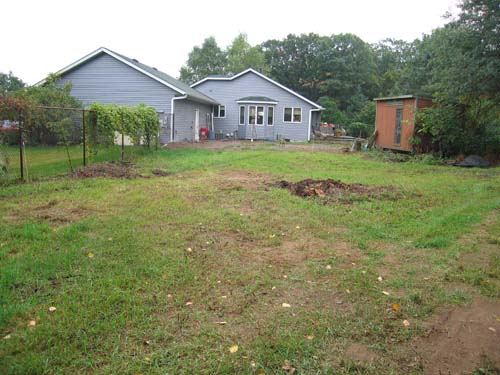
orchard-before-2008fromwoods500.jpg

Before

Ecological Gardens
“What is permaculture?
Permaculture (Permanent Culture) is the conscious design and maintenance of agriculturally productive ecosystems that have the diversity, stability and resilience of natural ecosystems. It is the harmonious integration of landscape and people providing their food, energy, shelter, and other needs in a sustainable way (Mollison, Bill. Permaculture: A Designer’s Manual. Tyalgum: Tagari Publications, 1988.). Ecological gardening is an attempt to apply these design principles to backyard ecosystems.”

We had the post-installation walk through in which Paula began to explain the plants, their particular needs and uses.  Lindsay came, too.  The plant guilds (see a post a bit ago) around the fruit trees fix nitrogen, fight off predators, attract beneficial insects and help build soil nutrients.  The clover sown among the fruit tree mounds and their guilds will further fix nitrogen and add a flash of white to the orchard. orchard-week-1frtrees400006.jpg

Right now the primary thing is to provide the whole with adequate water.  The blueberries need some straw to hold in moisture.  In preparation for next spring I will clear and smother a belt 15 feet back from the truck access way, creating a place to plant a forest edge.  The edge plants will be shrubs which birds and other animals prefer to the fruits in the orchard.  That’s a permaculture strategy for reducing animal feeding on human edibles.  It also attracts wildlife, which we do to some extent now anyway.

Over the winter Paula and Lindsay will complete a site design that will begin to integrate the features of permaculture even more tightly into our overall landscape.  As years go by, a great virture of permaculture is that it requires less and less maintenance because it mimics or recreates natural ecological balance through plant diversity.

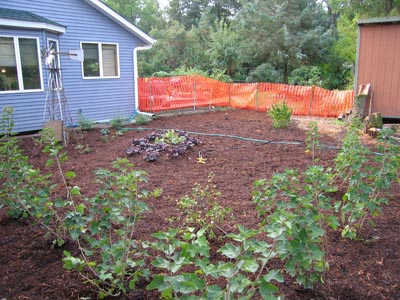
orchard-week-1nearhouse400002.jpg

Ta-Dah!

52  bar rises 30.15 omph N  dew-point 43  sunrise 7:11  set 6:52 Autumn

New Moon (Blood)

The orchard installation completed.  Here are some photographs of the finished result in its earliest moments.  Next spring we should have some very expensive apples.  Later the cost will amortize over more and more years and more and more fruit.

Feels good to have this as our view out the kitchen window.

orchard-week-1frtrees400006.jpg

Cherry, Plum, Pear and Apple trees in their mounds.  The colorful bush is a sandcherry.  Mulch is down and the clover seeded.

orchard-week-1nearhouse400002.jpg

Hazelnuts, coral bells, currants, gooseberries and lead plants.

orchard-week-1bberry400004.jpg

One of two blueberry patches.