Samain Thanksgiving Moon
At Bean Fosters Coffee House off Golden Ridge Road I wandered into a new phase of thought. Suitable for birthdays and holiday giving in Korea a red envelope contained money to pay my astrologer. Elisa sat in the back at a large table for four, today’s ubiquitous laptop in front of her; my natal chart, a copy of the one I already have, with handwritten notes on it beside her.
(all astrological symbols used are the work of Lucis)


 retrograde, 9th House.
These symbols (glyphs) were on the upper left in Elisa’s hand. She had run the current position of the planets, stars and moon and overlaid that information with my natal chart. In my still very limited understanding the first three mean that Neptune squares (is at a right angle with) the moon. The second symbol, Mercury, appears to be going backwards in relationship to the earth (retrograde) for the next three weeks and it is moving from my 9th house into my 8th.
 Like the study of kabbalah with Rabbi Jamie it’s easy to get overwhelmed with all the new information since astrology and kabbalah are centuries, millennia old. Both have multiple competing schools and a good deal of learning necessary to fairly evaluate them. That is, they both require a certain suspension of disbelief in order to get traction. Kabbalah has enriched my understanding of Judaism in many ways, none more important than its insistence that all the Torah is metaphor, but it took me a good ways in to the study to learn this. By undermining a literal interpretation of the Torah, kabbalah gave me a way to appreciate and use the biblical material without having to contort my own thinking. In my world that reopened those old stories that we know so well, made them available for my own growth.
I suspect astrology contains the same sort of insights. I’m so new at it that I can’t say for sure, but I think the equivalent insight (to the one above about the Torah) is about archetypes. Astrology, as Elisa said, is a “gateway.” It can open the mind and heart to the interaction of archetypes on our lives. This close connection between Jungian (and Platonic) thought synchs up with so much of my personal history. Years of analysis with Jungian analyst John Desteian. Studying with aspiring analysts. The Ira Progoff Intensive Journal retreats. Degrees in philosophy, anthropology and theology. The whole reimagining faith project. Even fiction writing and this blog.
 To give you a taste of the possibilities here are a few lines from an analysis of mercury retrograding into my 9th house: “Re-examine what you believe as Mercury backs up into the 9th house. Your beliefs create what you experience. It’s time to consider the future. What you do now effects the outcome. What’s your overall philosophy of life? Are your really living it?…During this transit you may be called upon to re-assess what the truth really means.”
I’m going to go back into Jungian thought, too. Focused for the moment on archetypes. Astrology, as Tarnas sees it, opens a window, a gateway (as Elisa said), into the movement of archetypal energies through our lives. It is not predictive; it is illuminating. As Neptune squares the moon, for example, it is a difficult time for certainty, for confidence, for contentment. Knowing that this is part of the archetypal ocean in which I’m swimming helps me not overreact, make rash or impulsive decisions. At least I think that’s what it means. More to come.
 Wonder what the stars (and the planets) have to say about reading my full chart for the first time today? We could look it up. I’m going to Golden, under Table Mesa, to the Bean Fosters coffee house. Elisa, a petroleum geologist, dean of academics at a consortium of community colleges and a member of Congregation Beth Evergreen has done whatever astrologists do with my birth information. She says the consult lasts as long as I have questions. She really doesn’t have that long, so I’ll restrain myself.
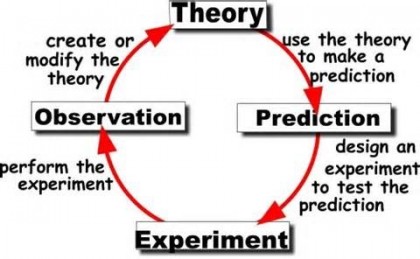
 Bacon also points out that the path of facts and induction may be slow, but it heads in the right direction. No matter how fast you go down a path without facts, you will never reach the truth.
 His emphasis on depth psychology, in particular synchronicity and the collective unconscious, as partial evidence that the modern Self need not be wholly isolate makes sense to me. I had many years of Jungian analysis and find the non-pathological approach of Jungian thought very congenial. I’m not sure how many outside the world of depth psychology would agree with him on this point however. But, I do.
 Neither an obvious nor an easy matter. “I’m going to have my chart read this afternoon.” “I know.” “Yes, you know, but you don’t approve.” “Oh, I think it’s fine to read your chart. But, believing it?” She shrugged. Kate and I share a strong or high version of the modern Self, reason uber alles. I have flirted, however, for a very long time with a Romantic view carrying an aesthetic and spiritual seeker’s heart inside a rationalist’s body and mind. This is not a synthesis. It’s a carrying of opposites, learning from both, knowing the parallel, never touching rails down which they run.
 One more turn to Tarnas before my consultation with Elisa tomorrow. He made his move toward a synthesis of the modern mind and the Romantic–equivalent to the distinction between the self shaped by the Copernican disenchanted cosmos and the primal, ensouled (enchanted) universe that went before. His initial step came through depth psychology, tapping the collective unconscious and the idea of synchronicity to suggest a permeable self influenced by the cosmos and influencing it. Having opened the door between Self and cosmos with depth psychology, he turned toward astrology.
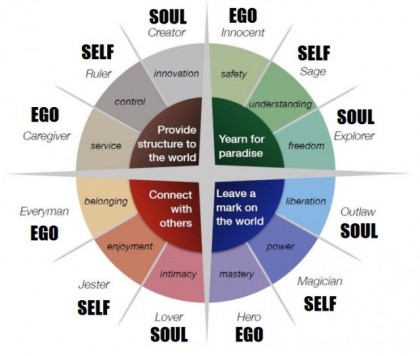 His argument about skepticism as a tool, not an end, was a wakin’ up moment for me. Oh, duh! Of course. Only I hadn’t seen it that way. Skepticism was a way of life for me and I treated the world of ideas as you might expect. I embraced almost nothing, held every philosophical and religious claim at a skeptical arms length. Yes. And no. I had let the tool use me, rather me using the tool.
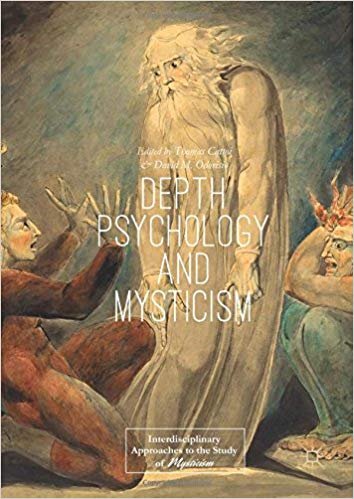 My only point here is that astrology, especially one linked as Tarnas does to the concept of archetypes, may provide us with aids to self-knowledge, aids that light up an enchanted universe, help it become visible. And if it does, I want to use it, include it in my tool kit. Right there alongside skepticism. But I don’t see it as the only, or even the most important, clue to an ensouled universe.
 When Orion rises, as he does each year, and I see him for the first time, it is the same feeling as seeing an old friend again. The same feeling. Orion has been with me and I with him since the guard shack in Muncie, Indiana where he graced my night shift attention. Orion is not merely starry objects far away, arranged in a distinctive pattern, though he is that. He is a part of the universe with which I have a personal relation. Is that relationship reciprocated? I don’t know. But, it feels like it.
 The current signature line on my e-mails is from John Muir, “You are not in the mountains, the mountains are in you.” Yes. In this discussion that includes depth psychology it’s appropriate to notice the synchronicity of living on Shadow Mountain, that massif within the psyche that contains all that we fear, that we reject, that we push away. How bout that? And beyond my study window is Black Mountain.
 As we try, some of us intuitively like me, some of us more systematically like Tarnas, to heal the rupture between the human and the living universe, we find a drag chute attached to our thought: 500 or so years of human autonomy, freedom, even liberation, 500 years of human probing, learning, knowing about the world seemingly disconnected from our Selves. The more classically educated you are, the more broad your learning, the more likely you are to feel something wrong with this line of thinking. It doesn’t add up. How can the universe have intention, consciousness? It’s the objective reality we probe with minds like Einstein, Bohr, Sagan, Darwin, Pasteur, Curie. We’ve found its regularities, its laws, its patterns, and we can use them to predict natural behavior and therefore exploit it.
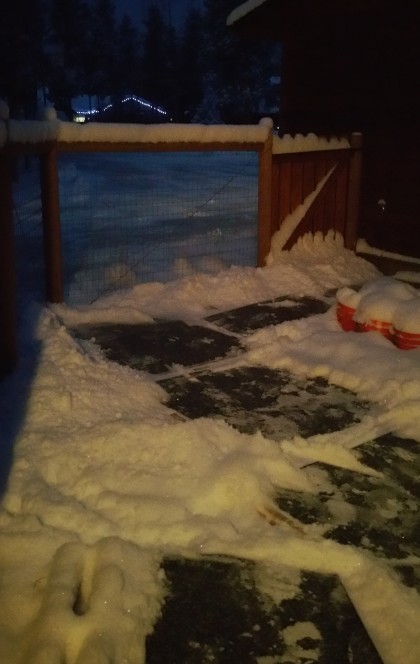 7 degrees this morning on Shadow Mountain. About 10 inches of fluffy powder since Saturday night. Fell yesterday clearing snow off our temporary decking, the palettes and stall mats I’ve shown before. Not hurt. Reminded, again, pay attention.
 But, as the human mind, using its sharpest tools, reason and skepticism, saw through this primitive perspective, and, as monotheistic religions posited a creator who made a special creature, humankind, in their God’s own image, a gap grew between the human and the universe. Now, in the modern era, we look out from within to a morally neutral cosmos, devoid of soul or spirit, moving with randomness according to physical laws that, since we have discerned them, reveal the trapped, the determined nature of, well, nature.
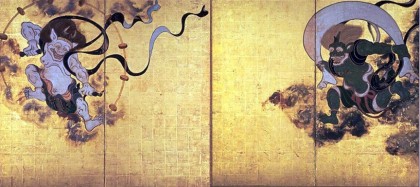 The weather gods have chosen an apt offering for the last day of fall, 8 inches of snow. In true Colorado fashion it will probably be here tonight and tomorrow, gone by Thursday if not late Wednesday. Looking forward to it. A difference between Colorado and Minnesota exists in forecasting snow. Here in Colorado people pant for the snow, welcome it, do celebratory dances. In Minnesota, not so much. It means work and slick roads in the Gopher State; here snow means beauty, tourist dollars, and will be gone conveniently.
 Astrology. Judaism has its weird side. Kabbalah, in particular. Turns out the kabbalist’s support astrology and if you follow the story of creation from a kabbalistic perspective, you can see why they might. At the shattering, the sharding of the divine light, ohr, pieces of divinity divided into minute pieces, atoms you might call them, and since then have created and recreated everything in the universe. That means that all things are connected, as part of the original attempt to create an undivided holy creation. In a sense it means that all things yearn for each other, to be rejoined, made whole again.
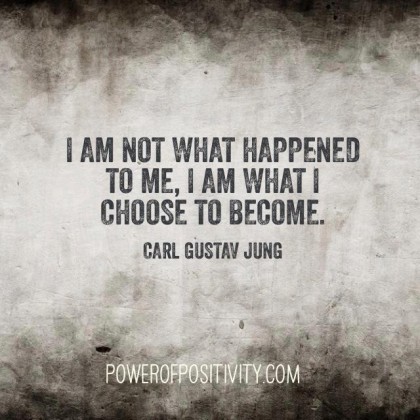 The concept of the north/south nodes has some connection to the past lives notion, which seems far fetched to me, but I got opened up a bit here, so I was listening. The idea is this: the south node is your default approach to life, the one, if you’re a past lives enthusiast, informed by the accretion of knowledge from other lives you’ve lived. It’s comfortable, effective, easy. But. Not growthful.
 Went to mussar yesterday for the first time in three weeks. Lots of hugs. Lots of obvious caring for Kate. One of the ironies of this whole situation is that three weeks ago yesterday Kate and I co-taught a mussar session on compassion, rachamim. The next morning at 6 a.m. she was in the E.R. at Swedish. She’s been gone from home ever since.
 It was not the content of the discussion, but its nature that finally lifted my stress. Considering the meaning of truth, identifying the Jewish take on it, relating the search for truth to loving-kindness all stimulated my thinking, made me go deep. And that was the solace. Leaving the squirrel-in-a-cage stressors behind for a while, I went into that realm of memory and creativity where old ideas and new conditions meet, changing each other.
 There is, I’m coming to understand, a unique Jewish epistemology, one which places a possible truth on the table and passes it around to the many gathered in its presence. Each one comments, shares the part of the elephant that they can see. The process iterates since commentators will comment on others reactions. It does not mean that there is no truth, this is the key move, but that truth itself is multi-perspectival. It takes a village to know a truth.
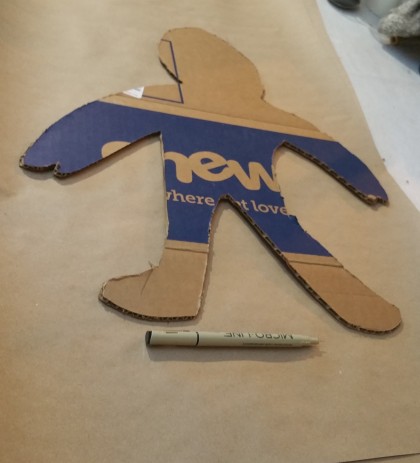 Odd experience yesterday. I led an exercise that involved body outlines I made from this template. (they actually looked better than this picture might suggest.) The kids responded to several prompts, among them: first school memory, early friends, where were you born, childhood hobby, childhood dream, then illustrated them on their body outline. The results are beautiful in many cases, revealing in all of them.