Summer Woolly Mammoth Moon
 Yesterday was a big day. Up early to write, workout. Lunch with Alan Rubin to start planning for the 6th and 7th grade religious school at Beth Evergreen. Home for a fitful nap. Left at 5:30 pm with Ruth for Boulder. We had a reservation at Japango on the Pearl Street Mall before seeing the Fiske Planetarium show on black holes. Driving home under the waxing gibbous moon with Jupiter below it, Mercury and Venus visible, too, as well as Mars and Saturn. A planetary moment. No twinkling please.
A highlight from the Alan Rubin meeting was deepening my relationship with him, learning more of his history, sharing some of my own. I agreed to take on the task of researching Jewish Liturgical history.
 We want to reframe the high holidays, Rosh Hashanah through Yom Kippur, in a reconstructionist way, then help the kids come to their own way of reframing. In the traditional understanding, taken here from the Chabad website, each year on Rosh Hashanah “all inhabitants of the world pass before G‑d like a flock of sheep,” and it is decreed in the heavenly court “who shall live, and who shall die … who shall be impoverished and who shall be enriched; who shall fall and who shall rise.” After ten days to seek repentance from those we have harmed in the previous year, God closes the Book of Life, sealing the fate of each worshiper.
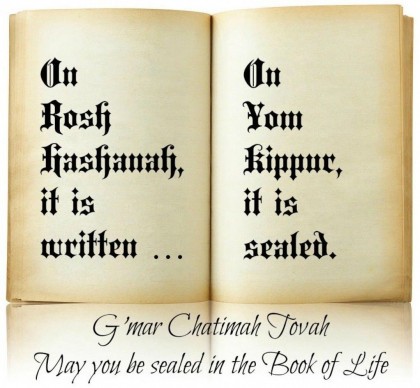 The tradition implies a white bearded, Santa Claus like God who checks on the naughty and the nice. He takes out his celestial quill pen and starts scratching. He pauses, waiting to see what you have to say for yourself, then after a reasonable interval (the ten days), he writes fini.
How did these holidays come to be celebrated in the first place? Why? Who observed them and how? Have the observances and meanings of those observances changed over time? How? This is the exegetical move, gathering as much data as possible about the historical holidays. The hermeneutical move comes after it, asking what in our current circumstance, our present moment, if anything, corresponds to the original intentions. There is, too, a theological move here, asking if the metaphysics of the holiday can still be plausible. If not, that informs the reframing, too.
 In my peculiar little world this is great fun. Looking forward to engaging similar research throughout the upcoming liturgical year.
Contrast this with my evening with Ruth. (Ironically, she is exactly the target audience for the above work, being a Jewish girl about to enter 7th grade.) We went to a sushi restaurant in Boulder where she had a sushi Tokyo plate. I had a sashimi plate, chef’s new choices. Green tea, too, for both of us. Ruth said, “You know me so well.”
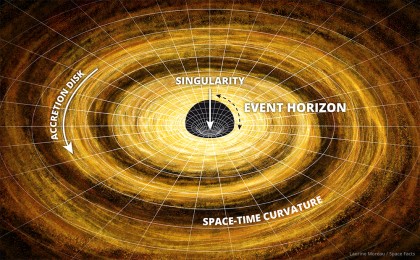 After the dinner we drove back up Broadway to the Boulder campus of the University of Colorado, about 5 minutes. At the planetarium, where we’ve gone many times, we saw a presentation on black holes. It covered the usual topics of star death, neutron stars, supernovas and the formation of black holes with their extraordinarily deep gravity wells. It also covered recent observation of the long pursued gravity waves at the Laser Interferometer Gravitational-Wave Observatory (LIGO).
From the book of life to the heat death of the universe in one Friday. Quite the journey.
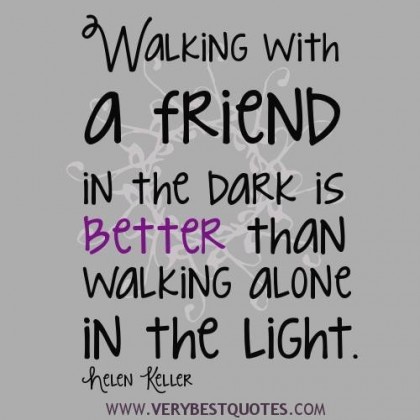 Mario is already in town, taking wildfire pictures with his usual acumen, traveling over mountain passes. Tom and Paul fly in today and we’ll have a slow cooker Irish stew up here on Shadow Mountain, all of us. These are friends of well over thirty years, men with whom I shared twice monthly meetings over that time, plus annual retreats. That bond was the toughest thing to leave behind when Kate and I moved out here.

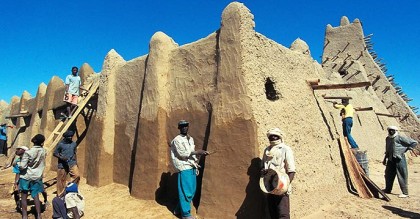
 Here’s the key idea, from Mordecai Kaplan: the past gets a vote, but not a veto. That is, when considering tradition, in Kaplan’s case of course Jewish tradition, the tradition itself informs the present, but we are not required to obey it. Instead we can change it, or negate it, or choose to accept, for now, its lesson.
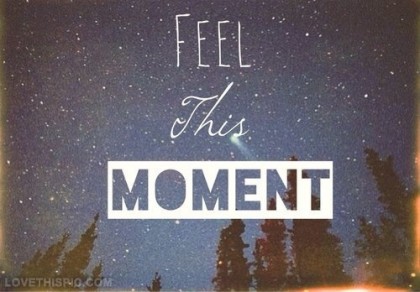 Which brings me to another realization I had this week. Just like environmental action is not about saving the planet, the planet will be fine, it’s about saving humanity’s spot on the planet; the idea of living in the moment is not about living in the moment, it’s about remembering we can do no other thing than live in the moment.
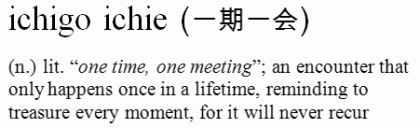 The past is gone, the future is not yet. Always. We can be sure, confident, only of this instance, for the next may not come. To be aware of the moment is to be aware of both the tenuousness of life, and its vitality, which also occurs only in the moment. To know this, really know it in our bones, means we must have faith that the next moment will arrive, because it is not given. Not only is it not given, it will, someday, not arrive for us. That’s where faith comes in, living in spite of that knowledge, living as if the next moment is on its way.
 Probably not many folks count down to the Summer Solstice, but I do. It marks my favorite turning point in the year, the point when the dark begins to overtake the light. Yes, it’s the day of maximum daylight, but that’s just the point, maximum. After the summer solstice, nighttime begins a slow, gradual increase until my favorite holiday of the year, the Winter Solstice.
 Summer and the light has its charms and its importance, too, of course. A warm summer evening. The growing season. The ability to see with clarity. The sun is a true god without whose beneficence we would all die. Worthy of our devotion. And, btw, our faith. So I get it, you sun worshipers. My inner compass swings in a different, an obverse direction.
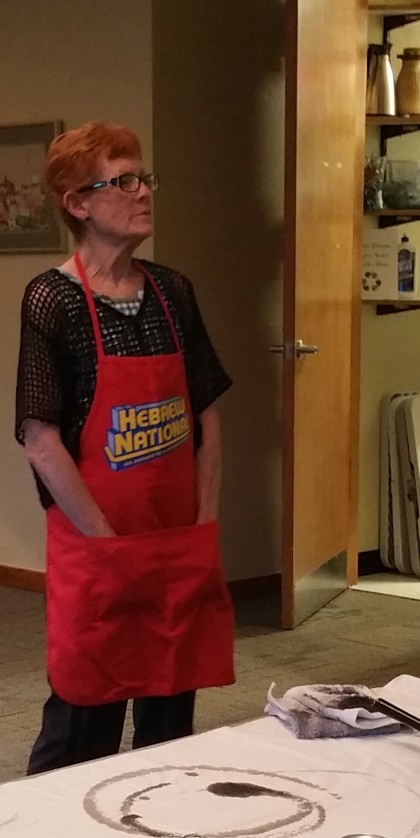
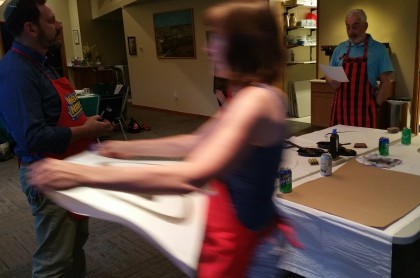
 Odd things. First, a small group of folks at Beth Evergreen, mostly qabbalah students like myself, report seeing me as an artist. A visual artist. This is based on my last two presentations, the first being Hebrew letters with quotes relating to their deeper meanings and the second, last Wednesday, that used the sumi-e zen practice of enso creation. Now I’m far from a visual artist, I have two very good ones in my immediate family, Jeremiah Miller and Jon Olson, but to be seen even modestly in their company is a real treat.
 Second. Damned mower wouldn’t start. As I said earlier. Put in fresh gas. No joy. Hmmm. You Tube. You Tube, that Chinese patron saint of the do it yourselfer. Looked up mower won’t start. Found a video of a guy. One with a small wrench who showed how to take apart the carburetor, poke wire into various holes and then, voila, vrrooom. Didn’t look too hard.
 Best of all, when I yanked the starter cord after closing the carburetor back up, the mower started. To those of you with a mechanical gene this no doubt sounds trivial, probably very trivial, but to me. Wow. I fixed it myself.
 I’m not an athlete, not a Latin scholar, not a very good visual artist and definitely not much of a mechanic, but I have an amateur’s capacity. Trying these things makes my heart sing, keeps life vital. I suppose, going back to yesterday’s post, you could say I have faith in myself. Not faith that I can do anything I try, that’s just silly, but faith that if I try I can learn something new, maybe introduce something important to my life.

 How does this make for an excellent practice? Doesn’t it really just increase anxiety? You might think so, but no, at least not for me. What it does for me is highlight the value, the necessity, of faith. How so? Faith is a choice to live in the face of doubt, faith is an act of courage that says, in spite of doubt, or because of doubt, I choose to get up in the morning. I choose life. Trivial? Hardly. Just ask Kate Spade, Anthony Bourdain, Robin Williams. Faith, not faith in a supernatural guarantor, but faith that for this moment the contingencies of life will not extinguish me, not overcome me, is a necessary virtue, in many ways, the sine qua non of virtues.
 I want to know that my choice to come up here this morning to write is an act of small courage, an act of faith that my breathing will not stop, not right now, that I will not fall down the stairs and break my neck, that what I write has some importance in spite of little evidence. Think, for example, of Stephen Hawking. The contingencies of life, the abyss, opened its maw for him early. Instead of cowering before it, he did not allow those contingencies to define him, instead he chose to live as if what he could do in spite of those contingencies, in spite of the moment to moment dangers to his existence, was important. True faith. The courage to become who you are in the face of dangers, toils and troubles. That’s faith.
 But life will not be fooled. That job will end. A marriage can falter. The children can move away, disappear. Our home can burn down or be lost to the mortgage brokers. What happens to your life when it has its own personal Ragnarok? Can you survive the death of the gods? The answer is yes only if you have known all along that they are what is secondary, that they are not gods at all, demi-gods at best, maybe dryads or nymphs, maybe not divine at all.


 Over the course of the evening I discussed quantum physics in relation to time, the placing of a second hive box at the Herman’s, travel to Peru, working as a marketing consultant, “In business, as a consultant, you’re always justifying your existence,” and watched Rabbi Jamie’s yarmulke float to the bottom of the dunk tank.
 The weather was perfect. 75 degrees, dry and blue sky sunny. It was a good event for both of us. Folks came up to Kate and said they were glad she was going to be on the board. Two other recent shoulder surgery folks attended, their effected arms still attached to their body with slings. Kate has been consistent with her rehab. The pain relief alone has been enough to make it a successful procedure, but now she’s regaining range of motion, too.
 Faith. The middah of the month for Beth Evergreen. Emunah. Last night at MVP, the mussar vaad practice group, we talked about emunah. Rabbi Jamie and Marilyn said that in the early days of mussar classes at Beth Evergreen, some time ago, the middah that caused the most consternation was this one.
 One of us in the group last night said, “The universe is for me.” I have other friends who believe the universe is a place of abundance, or, as author
 Turns out quite a lot. Another of us last night told a story of night diving. A favorite activity of hers. She said she turns off her diving light and floats in the night dark ocean. While she’s in the dark, she imagines a shark behind her. The shark may kill her in the next moment, but until that moment she is keenly alive. This is, for me, a perfect metaphor for faith. Each day the shark is behind us. A car accident. A heart attack. A lightening bolt. A terminal diagnosis. Yet each day we float in the dark, suspended between this moment in which we live and the next one in which we are dead. And we rejoice in that moment. There is faith.
 This is the existentialist abyss of which Nietzsche famously said, “If you stare into the abyss, the abyss stares back at you.” Living on in spite of its direct glare, that’s faith. This sort of faith requires no confidence in the good or ill will of the universe, it requires what Paul Tillich called the courage to be. I would challenge that formulation a bit by altering it to the courage to become, but the point is the same.
 So. My practice for this month involves, in Rabbi Jamie’s phrase, sharpening my doubt. I will remember the shark as often as I can. I will recognize the contingent nature of every action I take, of every aspect of my life. And live into those contingencies, act as if the shark will let me be right now. As if the uncertainty of driving, of interacting with others, of our dog’s lives will not manifest right now. That’s faith. Action in the face of contingency. Action in the face of uncertainty. Action in the face of doubt.


