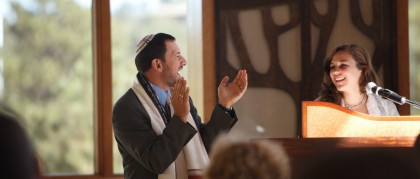
“Look at the candles. Choose one. Focus on receiving the light from the candle. Let your thoughts go. When they intrude, come back to the light of the candle.” Sounds like a meditation seminar. It wasn’t though. The speaker was Rabbi Jamie Arnold at Beth Evergreen last night. This was during last night’s shabbat service.
Had I not attended the kabbalah session on Tuesday I would have missed a key point. Kabbalah originally meant receive. It now has the connotation of tradition, teachings received by students over the centuries from kabbalistic sages.
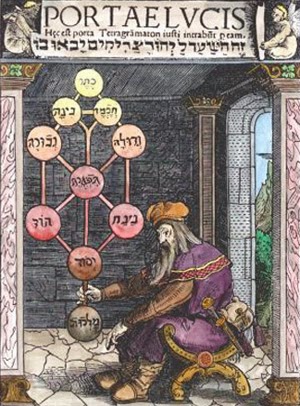
Too, another key idea of kabbalah is that of a broken world. Shards of light, of divinity, of the sacred scattered from the vessel chosen by God to be the other in a newly created universe. That vessel could not contain the light and shattered into the matter that forms our world. This means that each part of our cosmos contains that light, a spark we can access in our Self, our soul, which is pure awareness. As pure awareness, we can attend to the light of the world.
As masked souls-our always state, we have to learn how to see the light. The service at Beth Evergreen offered mediation styles for that purpose. The second focused on following our breath and punctuating it while visualizing the Hebrew letters forming the tetragrammaton, one of the names of God. This was difficult for me since the shape of the Hebrew letters are distant memories. My Hebrew class was in 1974. Still, the breathing and its pauses on the inhale and exhale was meditative in itself.
I’m staying open to learning from this ancient faith, a tribal religion sustained by its traditions and the difficult history of its people.
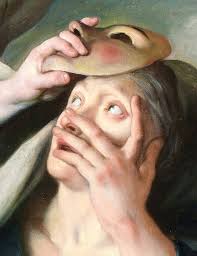
Franz Messerschmidt, sculpltor, (photo) Sailko, CC BY-SA 3.0,
Masks. The sample session about kabbalah has had me focused on masks I wear. Here are a few: grieving son, angry son, abandoned son, skeptic, philosophical analyst, anxious son, anxious man, friend (I think each friendship might prompt a different mask), loving husband, anxious husband, devoted and loyal husband, protective husband, father, proud father, step-father, grandfather, cousin, brother (again, a different mask for Mary and Mark), dog lover, grieving dog lover, gardener, beekeeper, greenman, mountain man, 60’s radical, weary 60’s radical, writer, anxious writer, fearful writer, reader, blogger, Celt, German, Minnesotan, Hoosier, Coloradan, member of Beth Evergreen, anxious member of Beth Evergreen, hiker, traveler, traveler for fun, traveler for self-knowledge, meditator, translator, Latin student, mussar student, fellow traveler of Judaism, driver, angry driver, meditative driver, commuter man, docent, art lover, art critic, poet, exerciser, reluctant exerciser, healthy man, dying man, sick man, indulgent man, poor eater man, healthy eater man, home maintenance scanning man, home maintenance securer, worker supervisor (home maintenance), father-in-law, theater and movie goer, chamber music lover, jazz lover, politically dutiful man. Well, it’s a start.
The idea here is to know your own masks without judgment, then order them from core masks to peripheral. What masks can you not take off without removing some skin? Those are core (actually near core) and the most resistant to change. The core itself, the I am, is pure awareness and has no mask. I have an issue here with the kabbalah, not sure how a soul, a self, the core of me, can put on a mask. The donning of a mask seems contradictory to pure awareness, how would the motivation to mask up occur? How could it be actuated? This is important to my philosophical analyst mask though, as Jamie pointed out, the practical application of these ideas doesn’t require an answer.
The ultimate goal is to be able to take off and don masks appropriate to each moment. To do this, of course, we have to be self-aware, we have to know what mask we have on. This will take practice.
Kabbalah. Last night at Beth Evergreen we dipped our toes in an ancient lake, one so esoteric that information about it was not written down until the time of the Spanish Inquisition. The kabbalah, it was felt, needed nuanced interpretation and written down it could be read by those who might misunderstand its teachings.
But during the Inquisition so many scholars were killed that many were concerned the teachings might be lost, so books began to be written. The Zohar is the famous Kabbalah text, a central work on Jewish mysticism.
Isaac Luria, a rabbi of 16th century Safed, a town in Galilee, at that time in Syria, is a key figure in contemporary Kabbalah.
Years ago Kate wanted me to go to Hawai’i with her for a continuing medical education event. I said, no thanks. She insisted. I went. My expectations were completely wrong. I had a cheesy hula dancer dashboard ornament, loud shirt, noisy American tourist understanding of Hawai’i. We went to Maui and the Big Island that year. I wanted to stay.
My sense of kabbalah comes from a teeny understanding of it as mysticism and the fact that Madonna got into it some time back. Its popularity among celebrities at that point made me avoid it then and colored my anticipation of what Jamie would have to offer. Last night I wanted to stay.
In kabbalah parlance in both instances I donned a mask of cultured (actually ignorant in these cases) sophistication. This mask has its advantages as it helps me avoid wasting time on matters I don’t consider important. But the instance of Hawai’i and kabbalah teaches me that this mask also excludes rich experiences if I know too little about them.
A key point of kabbalah is awareness of the masks (personas) we use and being able, eventually, to take them off and put them on when appropriate. Sounds like a long ride.
Teeth cleaning a.m. Kate and I now schedule teeth cleaning and annual physicals together. I call it medical entertainment. Just like going to the Tallgrass Spa together. Almost.
Mussar afternoon. Soul cleaning together, too. I’m learning a lot about Judaism with her. And, I’m impressed with what I’m learning. Here’s the key new insight: Judaism has, from a long time ago, insisted that abstract ideas like mercy, compassion, judgment, faith have embodied reality. That’s what all those laws are about, how to make the faith work in daily life.
This is very different from the Christianity in which I was trained. Christianity unhitched this very earthy, practical religion from the notion of embodied abstractions, letting the abstractions become dominant. This led to a growing gap between dogma and actual practice. Of course, many Christians work at making their faith inform their lives, but the tools are not as good the ones in Judaism. It’s not the laws themselves, but the spirit of actively grappling, every day, every moment with what it means to show mercy, to judge, to practice loving kindness, to exhibit patience that gives Judaism its lived flavor.
Rabbie Jamie and congregant
Still don’t want to be a Jew, no interest in converting, but I have a lot of interest in learning how to live from the community of Beth Evergreen. Probably the best religious experience of my life.
It was with sadness that I read of the fight at the MIA last week. No matter the apportionment of blame between the two groups, this kind of violence within the museum shocked me. It also underscores the danger of cynics and demagogues setting the tone for our national conversation. Fists and physical confrontations are a means of dialogue, a blunt means, but one nonetheless. When the Whitehouse itself makes racism, anti-semitism, misogyny, xenophobia, terraism (violence against mother earth) not only acceptable, but for some normative, then this country will descend into further acts of violence, often one on one or many on one.
When I first started volunteering at the Minneapolis Institute of Arts in 2000, continuing education events for docents and guides (I was a guide at the time.) were held on Mondays in the morning. An excellent speaker on some aspect of art, art history or museology would give us an hour to an hour and a half presentation. I have a three inch thick notebook filled with notes from those events.
After the lecture the museum was open, but closed to the public. That meant we could take as long as we wanted to wander the galleries, taking time with this work, then that one. No interference, no one walking in front of you or talking loudly. It was my favorite meditation, of all the ones I’ve tried.
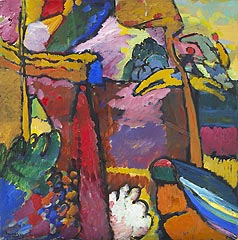
Study for Improvisation V-Kandinsky
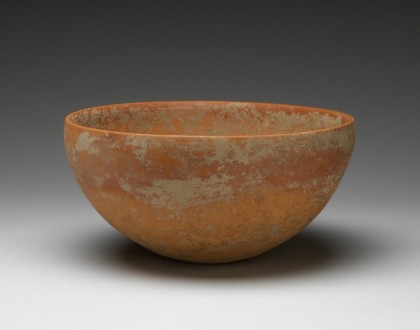
I had certain favorites: the Bonnard with its wonderful colors, Dr. Arrieta by Francisco Goya, the Rug Merchant by Gerome, the tryptych Blind Man’s Buff by Beckman, Kandinsky’s wonderful painting in the same room, the Doryphoros. I also loved the ball game yoke, the Olmec jade mask once owned by John Huston, but the Asian art always occupied most of my time. The tea house, the tea bowls and implements, the tatami room with its beautiful screen of the Taoist Immortals, the seated Buddha, the Scholar’s room, the ferragana stallion in metal, the Song dynasty ceramics, pieces carved from jade, the Wu family reception hall, the sand mandala, I couldn’t spend enough time with them.
On those quiet Mondays these works all became my great friends, friends that stay with me now, even 17 years later and 900 miles away. Also, on those quiet Mondays I found an alternative spirituality, one not rooted in the earth nor in the world’s great religions, but in the inside out nature of creativity. All of these works, some in overt ways, some in the covert way of working within a certain tradition, reveal the inner worlds of the artist. Reverting to the language of the post below the art allowed me-and you-to dive into another’s holy well, to see their inner life. This is a rare and privileged thing which explains to my satisfaction the enduring power of all art.
It is also the diametric opposite of Trumpism/Bannonism. The museum is a place to see what a world without these men can be.
While writing the pendulum piece yesterday, I began to consider my inner life in a way I hadn’t before. It occurred to me, probably obvious to you, but not to me, that the inner world is timeless. It’s not part of the body (I’m not sure what I mean by this.) and does not participate in the changes of aging. That world, one we each carry within us (or about us, or as us), is quiet relative to the constantly moving, pulsing, buzzing blooming nature of reality beyond it. (Thanks to William James.)
chalice well, Glastonbury
Perhaps this is what the New Testament means when Jesus says, “The kingdom of God is within you.” Not only is the within timeless, it’s also boundaryless, extending into an infinite realm, not all known, at most partially. That’s not to say it’s static, not at all, just ask your dream life.
This is exciting to me, considering the world within. The weird part, the somewhat new part for me, lies in the metaphysics of the within. As I consider it, feel its reality, my inner world seems separate from the physical realm altogether. I know, in terms of contemporary neuroscience, that this could be challenged; but, in spite of that, this private place seems untethered from both the outer realm and my body and, oddly, my mind.
The mind, in my use of it here, is a tool, a way of managing the interface between my body and my current concerns in the world. It does have a Janus faced quality in that it can look out to the world as the dasein of Heidegger suggests; but, it can also look inward, into my inner world. Using the mind as a point of reference, it becomes a mediator between inside and outside, but, in a manner similar to the inner world, a part of neither.
So, when I say the inner world is not part of my mind, I say that because the mind is the tool I use to know that world, as it is the tool I use to know and interact with the outer world.
Therefore, we can ask, what is the ontological character of the inner world? Does it have being in the way of, say, a rock, a tree, a dog, another person? I don’t know the answer to this question. It is, in the sense of isness, real since it can be perceived as Bishop Berkeley put it, but its isness seems different qualitatively from my body or the world in which it moves and lives and has its being.
This inner world is the homeworld of the imagination, of the interplay between ideas and intuition. It is the realm of memory and the alteration of memory, of the creation of memory. It is the place of fairy tales, of myth, of legend, of gods and goddesses. It can be explored with some difficulty. It often manifests after it has done its own work, throwing up a new way of seeing. In fact, my understanding of it as timeless and spatially infinite is just such a new of way of seeing for me.
Canto 3
I’m not saying this well. What is amazing to me, what is pushing me to explore this idea is the vastness of the inner world and its unique nature for each human being. Maybe for each dog and cat, wombat and shark for all we know. In other words in a room full of people we see them in this familiar world as distinct entities, yes, but still in this world. Yet, each person is a holy well that, like the holy wells of Ireland and Wales, provides entrance to another world, a world sui generis.
So, in fact, that room full of people is not only what it appears to be, but is also a collection of unique worlds, worlds unseen by any eye but each person’s inner eye.
In, but not of. Yesterday at mussar, a spiritual/ethical system within the Jewish tradition, I had a complex moment. We were discussing truth and mercy, the relationship between them. To compare mercy and truth I defined mercy as suspension of judgment. Truth though is a sword and a judgment. If that’s correct, then not all truth is merciful. Rabbi Jamie started to dispute that, but had to leave for his daughter’s wisdom teeth extraction.
In the conversation that followed afterward my use of the sword metaphor was identified as a Christian trope, “I come to not bring peace, but a sword.” I’ve been working very hard over the last year to bracket my mode of theological thinking while absorbing a Jewish style of thinking. This requires effort because though I abandoned Christianity over 30 years ago, my seminary education and professional life as a clergyman reinforced my already strong Judaeo/Christian enculturation. Christianity does still define much of how I think and feel about matters religious and secular.
While that’s obvious, I still felt a flush of embarrassment at being identified with a New Testament informed concept. That flush, as mussar teaches, is an important signal about where growth is necessary.
On the way back up to Shadow Mountain I described my situation to Kate as similar to traveling. “I love to go where the culture is very different from mine, where I’m a stranger. It helps me know my self.” Kate’s journey is one of a Jew deepening her own understanding, her own identity as part of a religious world. My journey is closer to travel, “It feels like I’m traveling on the inside.” In this case no geographic change is necessary for me to be a stranger.
This inner travel exhilarates me, but it also confuses and, in a mild sense, scares me. I’m trying to gain wisdom and personal growth from Beth Evergreen while maintaining my own identity as a pagan. But, not only that. My life as a pagan is not divorced from my enculturation as a Christian. I’m a cultural Christian in many ways. That means I encounter many shocks to my inner world, shocks that wake me up, like a Zen koan, but that also and in the same instance disorient me.
Yaowarat
It’s like being on Yaowarat Road in Bangkok on a weekend night. On Friday and Saturday night the sidewalks of Bangkok’s Chinatown, of which Yaowarat is the main street, fill up with small restaurants, often two tables, some chairs and a street vendor style kitchen with a wok, propane tank, utensils and a stack of plates and soup bowls. What food are they serving? I don’t know. I speak neither Thai nor Mandarin. Many people are there who do understand the food offerings, how to eat them, but I’m not one of them. I’m in, but not of the street life. Observing, yes, eager to learn, yes, but even after sampling some food and gaining some insight, I will go back to my hotel, a stranger traveling through.
I’m grateful to the folks at Beth Evergreen and Kate for putting up with my being present as a stranger and an inner traveler. A long journey, barely begun.
Charlie – The conversation turned towards reality, the nature of human experience, and the essential nature of life as Mystery. I finished this short Stephen King novel this weekend (The Colorado Kid) and really loved the unanswered questions left for the reader at the end of the story. The following is part of King’s afterword which comments on the nature of life and mystery:
“I don’t want to belabor the point, but before I leave you, I ask you to consider the fact that we live in a web of mystery, and have simply gotten so used to the fact that we have crossed out the word and replaced it with one we like better, that one being reality. Where do we come from? Where were we before we were here? Don’t know. Where are we going? Don’t know. A lot of churches have what they assure us are the answers, but most of us have a sneaking suspicion all that might be a con-job laid down to fill the collection plates. In the meantime, we’re in a kind of compulsory dodgeball game as we free-fall from Wherever to Ain’t Got A Clue. Sometimes bombs go off and sometimes the planes land okay and sometimes the blood tests come back clean and sometimes the biopsies come back positive. Most times the bad telephone call doesn’t come in the middle of the night but sometimes it does, and either way we know we’re going to drive pedal-to-the-metal into the mystery eventually.
“It’s crazy to be able to live with that and stay sane, but it’s also beautiful. I write to find out what I think, and what I found out writing The Colorado Kid was that maybe—I just say maybe—it’s the beauty of the mystery that allows us to live sane as we pilot our fragile bodies through this demolition-derby world. We always want to reach for the lights in the sky, and we always want to know where the Colorado Kid (the world is full of Colorado Kids) came from. Wanting might be better than knowing. I don’t say that for sure; I only suggest it. But if you tell me I fell down on the job and didn’t tell all of this story there was to tell, I say you’re all wrong.
Don’t know why it took me so long, but I know how to make America great again. It will not require red baseball hats or xenophobic bluster. No, it only requires listening to the ideas of a Passionate priest, Thomas Berry. Berry wrote a small book, The Great Work. It influenced a turn in my political activity from economic justice to environmental concerns.
This 258 page book is a quick read and it introduces The Great Work. Civilizations, according to Berry, have a quintessential role that only they can perform. The one he identifies for our civilization is this: Creating a sustainable existence for humans on this earth. That is our Great Work. It is the way to make America Great again.
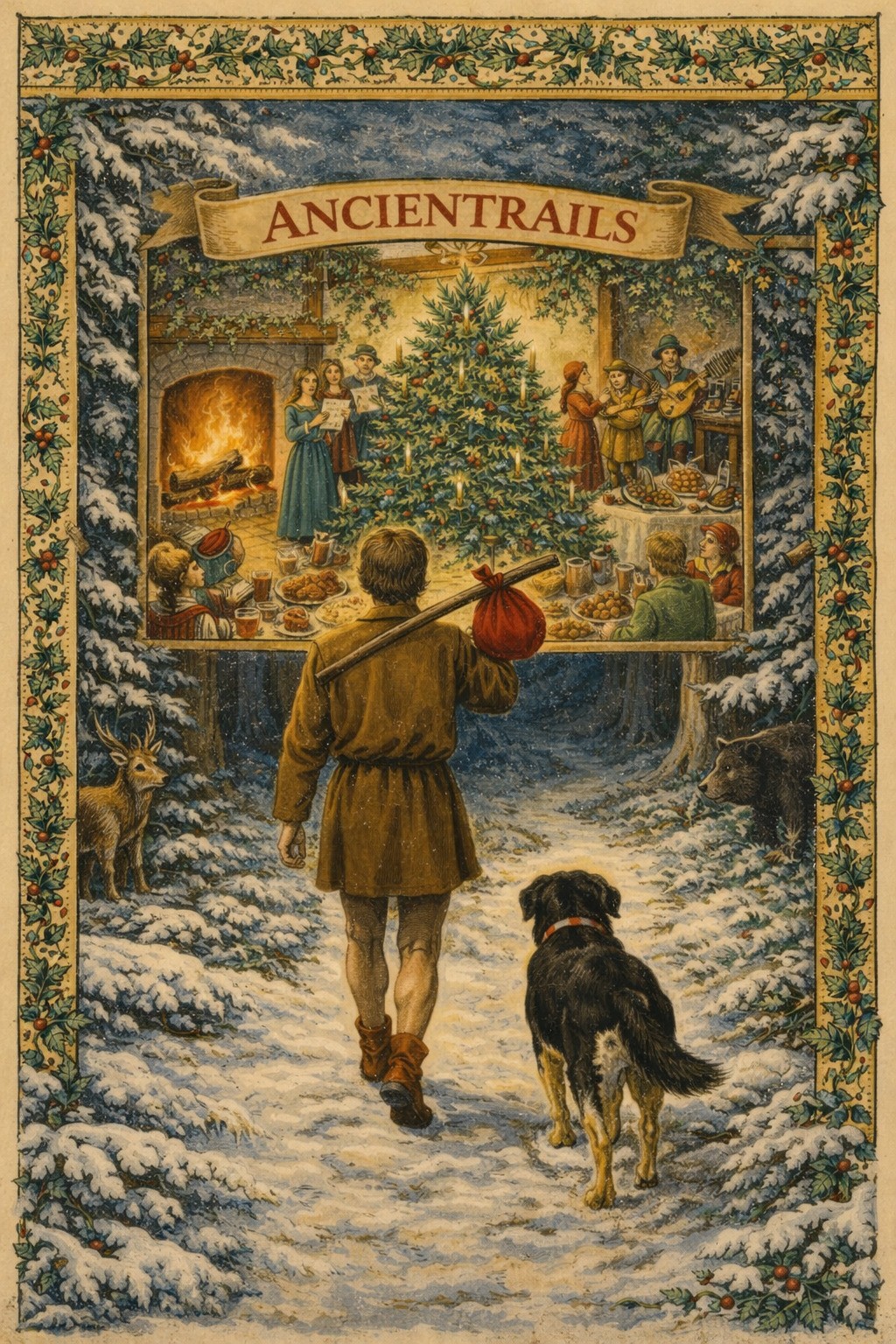
The phrase, the Great Work, comes from medieval alchemy. The primary, original material of the universe, the prima materia, in the alchemist’s lab can create the philosopher’s stone. The philosopher’s stone could turn base metals into gold or silver and extend the alchemist’s life.
We can take the prima materia of the U.S., its citizens and its land, put them in the alembic created by our need for survival and our need for economic justice, and turn up the heat until we have our philosopher’s stone. When we have it, we can use it to heal the earth and create good-paying jobs for all.
Then, then America will be great. Not only again, but still and not only still but into the future as well. May it be so.

 The idea here is to know your own masks without judgment, then order them from core masks to peripheral. What masks can you not take off without removing some skin? Those are core (actually near core) and the most resistant to change. The core itself, the I am, is pure awareness and has no mask. I have an issue here with the kabbalah, not sure how a soul, a self, the core of me, can put on a mask. The donning of a mask seems contradictory to pure awareness, how would the motivation to mask up occur? How could it be actuated? This is important to my philosophical analyst mask though, as Jamie pointed out, the practical application of these ideas doesn’t require an answer.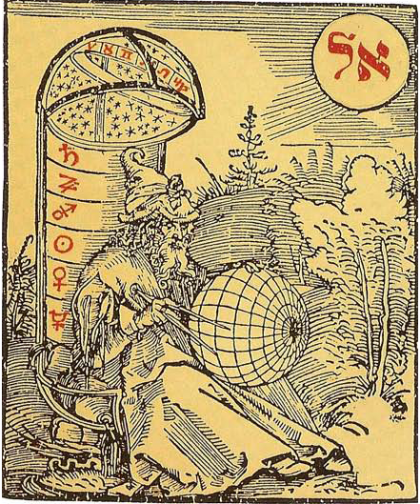




 Don’t know why it took me so long, but I know how to make America great again. It will not require red baseball hats or xenophobic bluster. No, it only requires listening to the ideas of a Passionate priest, Thomas Berry. Berry wrote a small book,
  The phrase, the Great Work, comes from medieval alchemy. The primary, original material of the universe, the prima materia, in the alchemist’s lab can create the philosopher’s stone. The philosopher’s stone could turn base metals into gold or silver and extend the alchemist’s life.