Category Archives: Reimagine. Reconstruct. Reenchant.

Feel the Rain On Our Face

Lughnasa                                                                    Recovery Moon

There are many ways of becoming native to this place. The one that worked for me involved a combination of following an ancient liturgical calendar based on seasonal changes in temperate latitudes: the Great Wheel and gardening. There are many other paths. Chado: the Way of Tea integrates the tea ceremony with a finely divided sensibility to Japanese seasons, some only two weeks long. Hunter/gatherers have to be native to the place where they are or they will not survive. Followers of the Tao, the way, lean into the rhythms of the natural world rather than away from them, flowing through the world as water does in a stream. Hiking and camping and canoeing. Forestry with an emphasis on forest health. Conservation biology.

Oddly though practitioners of modern agriculture are often as estranged from their place as residents of vast urban enclaves. And I recently read, in Foreign Policy magazine’s July/August edition, an intriguing explanation as to what lead current, often corporate, agriculture astray. When the population explosion gained prominence in the mid-1960’s, think Paul Ehrlich’s “The Population Bomb,” a concentrated focus on methods of improving agricultural productivity resulted. And it worked. More acres went under the plow, more chemicals went into the soil and onto crops, antibiotics filled food animals, food production became more sophisticated though not more nutritious, fast cheap restaurants bought and sold fast cheap food. There are real dangers in letting ourselves become strangers to our home world.

Becoming native to this place is analogous to being born again, revivified for the act of belonging to, being part of this planet. Second naiveté, Paul Ricoeur’s wonderful notion, can follow a state of critical distance:

“According to Ricoeur, the rational forces brought to our civilization through modernity have made it difficult to accept religion or scripture in the “first naïveté” sense. Once subjected to rational inspection, the literal meanings of religion really do not hold up…”  exploring spiritual development

Modernity has put the fruits of enlightenment reason and modern technology forward as more significant, more important than the growth of a tomato, than the beauty of a wilderness lake. It has substituted the grace of a soaring condor with the stiff, hard brilliance of an airplane. That tomato, grown soft and juicy on the plant, got replaced by a hard-skinned, pre-ripe picked fruit designed for machine harvesting and long distance transport. Distances that used to require human feet and legs, or the same of horses, now demand only that we sit and wait.

Before you resist this. This is not a screed against airplanes, cars, computers, telephones or grocery stores. It is a recognition of the rupture, the critical distance, modernity has created between our lives and the world that sustains them. Food comes from soil and plants and the animals that eat the plants. Oxygen from the plants at work. Water used to be purified by the very wetlands we fill in or drain to build subdivisions or to plant more acreage of chemically injected crops.

Life, in other words, exists in a delicate balance with the inanimate; that balance is literally billions of years old and one we cannot afford to ignore. Yet we do. And so we must make an effort to again become native to this place, this place which in its wonder gave life a chance.

Following the seasons as they change and following within those changes emergence, growth, life and death became easier for me when I overlaid on spring/summer/fall/winter the four big solar events of equinoxes and solstices, then put between those the cross-quarter holidays of my Celtic ancestors:  Samhain (summer’s end), Imbolc (in the belly), Beltane (the beginning of the growing season) and Lughnasa (the first harvest holiday). When I write the season at the top of this blog, I remember, for example, that we are now in the season of first harvests. And sure enough Kate brought home some wonderful heirloom tomatoes today.

The extensive gardens, both flower and vegetable, plus the orchard that Kate and I installed and nurtured in Andover reinforced the lessons of the Great Wheel. At Halloween, Samhain’s paler descendant, our garden would be finished, the beds covered, foods in jars in the basement, garlic hanging from rafters, onions and apples spread out. We were part of the turning wheel and the turning wheel shaped what we could and could not do. We lived then with the rhythms of the temperate latitudes, in some harmony with them.

Now we are in a new place, a more arid, less fertile place and the way of becoming native to it is still in process. But it will come.

We cannot all go back to the land. Cities dominate the living patterns for most of the world. But we must find ways, whether through community supported agriculture or urban hydroponics or organized trips to the countryside, to help us all feel the rain on our face. We all need to wonder at the slender green shoots that brave their way through the late snows of winter. Or, at the tropical lushness of equatorial jungles. Or the marvel of lives lived fully in the world ocean. Our lives and the lives of our grandchildren depend on our becoming, again, native to this place. To know our spot with a second naiveté so that we will care for, love this rocky, watery wonderful earth.


Becoming Native to This Place

Lughnasa                                                                Recovery Moon

The most ancientrail of all is becoming native to this place.

But, why must we become native to mother Earth? Aren’t we native simply because we are thrown onto the planet’s surface at birth? Yes and no. Yes, in that we are an organism designed to live in this gravity, breathe this concentration of oxygen, use plant matter and other animals as food. No, in that those of us thrown into a complex industrial/technology culture are native not to the planet itself, but to adaptations made over centuries by economies and governments. This includes the U.S., Europe, most of Asia, the Middle East and Latin America, as well as residents of urban areas on every continent.

In the U.S.A. we are native to electricity as Kate and I learned just this Monday.  Our typical life ground to a halt along with 4600 others when the power went out. We are native to a night lit not by fire, but by bulbs. We are native to warm houses in winter, cool ones in summer. Our hunting and gathering takes place at King Sooper, Safeway, Lunds, Byerlys. We are native to antibiotics, surgery, dental care.

When we climb the additional 3,600 feet in altitude from Denver to our home on Black Mountain Drive, we sit comfortably in a moving chair powered by the ancient remains of dinosaurs and forests. We are native to telephones, computers, text messages. We are native to machines and carpenters and plumbers. We are, in short, native to almost anything but this planet where we live.

You could reasonably ask whether this matters. Our future lies in the stars anyhow, doesn’t it? Maybe so. Especially if we render the earth uninhabitable for humans. Which, with climate changing drivers still dominant in our world economies, we’re working hard to accomplish.

I believe it matters. Why? The short answer is that becoming native to this planet, again, is our best hope for throttling back those climate change drivers. We can escape to the stars while having a beautiful homeworld as our base of exploration.

The longer answer has to do with the nature of our humanity. Technological and industrial estrangement from the rhythms of the natural world is almost a canard, a cliche. We expect tomatoes in winter. We expect access to any part of the planet within hours. Even the colors of our sunrises and sunsets often have chemical pollutants to thank for their vibrancy.

We need to awaken ourselves to the essential, everyday miracles: photosynthetic conversion of sunlight into food, the transpiration of that same process, oxygen, being a gas we need to survive. And this consciousness that we have. How about that. Or the intricate and interdependent web of living things. The changing of seasons in the temperate zones. Water’s strange characteristics.

In the next post I’ll suggest one way of becoming native to this place.

The Lure of Yesterday

Summer                                                                   Recovery Moon

NYT had a video and an article, 36 hours in Siem Reap. This type of article is a regular feature and one that gives a wonderful, quick entré to a particular locale. My visit in 2004 is now 11 years ago and the Siem Reap of this video has many upscale tourist options that didn’t exist when I was there. The Siem Reap of 2004 was a sleepy village though studded with many smaller hotels and one big one, the Hotel D’Angkor. Hostels were as evident as tourist hotels. But the building boom had already begun and the Siem Reap of 2015 had its roots in 2004.

As such articles do, it featured a wide array of things to do from shadow puppetry performed in front of a fire and screen to dining in upscale restaurants, tours on tuk-tuks and shops featuring Cambodian village crafts. I suppose the article does its job as a teaser, a what if I were there, even briefly fantasy, but it glossed over, very lightly, the primary reason Siem Reap has become an international destination. Quite a feat, really, in a country ravaged by years of the Khmer Rouge and corrupt politicians.

Angkor. Angkor is a site containing over 70 temples, each built by a different ruler of the Khmer, and extending over many square miles. It is much more than Angkor wat, the supposedly eponymous temple. In reality Angkor wat just means Angkor temple. That direct translation does not differentiate the best preserved and fascinating temple closest to Siem Reap from all the others. Ta Prohm. Bayon. Banteay Serai. And many, many others.

Angkor is a built space that has carried the Hindu culture of the  Khmer deva-rajas, god-kings, who ruled between 802 a.d. and 1351 a.d., into our time and will carry it far into the future. The intricate bas reliefs, the monumental four-faced sculptures with the classical Bayon smile, the elephants carved in stone, the florid decor of Banteay Serai require time and reading to appreciate. Ta Prohm, an often photographed temple, has been left as the forest has reclaimed it, with kapok trees growing through doorways and over roof tops.

Outside many of the temples small bands of Cambodian musicians play traditional music. My first reaction was oh how wonderful, authentic music played among the temples of this ancient culture. Then I began to look closely at the band. Most were missing a foot or an arm or a leg or carried other scars from the many landmines that continue to plague the Cambodian people.


One of my most memorable travel evenings was spent on the outer stone wall of Bayon, watching the living temple across the way as monks clad in saffron and maroon hit gongs, lit incense Bayon and prayed along with passers by who came to worship. The sun set and the shadows changed the expressions of the four-faced sculptures said to be the likeness of Jayavarman VII, the last deva-raja, who converted to Buddhism. The monkeys howled, insects chirped and the deep bass of the temple gong reverberated. Incense scented the air.

Week II Post-Surgery

Summer                                                                   Recovery Moon

Week II post surgery. My energy improves daily though I’m not back to full stamina. The surgical stigmata, six wounds where the robot’s arms pierced my skin, are healing nicely. It no longer hurts to lie down on them. An unpleasant, but anticipated side effect of the surgery, temporary incontinence, seems to be clearing up much more rapidly than I’d imagined it would. And, most importantly, I’m presumptively cancer free, the only question being possible microscopic metastases. I test for that in early September.

The tomorrow wall has crumbled. I can now see into the future again. Yesterday I made Amtrak reservations for my 50th high school reunion in September. The overnight California Zephyr runs from Denver to Chicago and then a short ride on the Cardinal to Lafayette, Indiana where I’ll pick up a rental car and drive the rest of the way. I do it this way because the Cardinal gets into Indianapolis after midnight and this allows me a good night’s sleep, plus I can gradually re-enter Hoosier space driving familiar highways back to Alexandria.

camp chesterfield2
The Trail of Religion

Again this time, as I did for the 45th, I plan to stay at Camp Chesterfield, a Christian Spiritualist center. It’s a quirky, old, interesting place. And, it’s cheap.

The loft is ready for its second round of construction, more shelves, then more shelving. I’ve abandoned my attempt to get the books properly organized as I shelve them because I need to clear space for more shelves. I can sort and organize as much as I want come fall.

My psyche has not caught up to my body’s healing pace. Though the tomorrow wall has fallen, I still find my days somewhat chaotic, not sure what to do, then what to do next. We’ve had a continuing drip, drip, drip of other matters: cracked tooth, dying boiler, Kate’s very painful back that contribute. All those seem to be moving toward resolution. I’ve even found a plumber for the generator install, a niggling thing still hanging on.

I’ll find my psyche back to its usual eagerness over the next week or two. I look forward to it.

Again, gratitude to all of you who sent notes over the cancer season. It matters.


Oh, You Were Lucky

Summer                                                                        Recovery Moon

Been thinking about luck and fortune. The meanings are slippery and often adjust themselves to rationalization. For instance. I was lucky to find my cancer early enough for successful treatment. Well, yes. But. I was unlucky to find cancer at all. It was my good fortune to find, with Kate’s help, competent and caring medical professionals in Colorado. Again, sure. But. It was my bad fortune to need as much of their competence and caring as I did.

Over the last few days since the catheter came out I’ve had this thought, “Boy, was I lucky. I had cancer, but it was treatable. And, I found it and treated it quickly.” The facts are true. I had cancer. It was treatable. It was found and treated quickly. But lucky seems askew. Lucky would have been to have never had cancer at all. Lucky described my state prior to diagnosis, not after. After, it was data, decisions, actions.

I write this because I’ve been tempted to another line of thought, too. I was lucky; I had prostate cancer, not lung cancer, pancreatic cancer, any cancer that most often defies treatment. There is a tendency to diminish the severity of our own situation and compare it to the dire circumstances of others. This helps psychologically, but it changes neither the fact of my situation nor theirs.

Each situation is as it is. Cancer is bad, no matter what type, no matter its response or lack of response to treatments. This disease is not one, but many; it is polymorphous and diverse. I’ve had friends with terrible cancers that eventually caused death. I’ve heard the stories of many men who’ve had the same arc with prostate cancer that I have. And others who have died.

Lucky and fortune play no part, save as soothing conceptual anodynes. Facts. They are what matter. Love and friendship can give aid in real time and I’ve experienced it. But that was not luck. That was kindness, compassion.

Third Phase Summary

Summer                                                            Recovery Moon

The third phase. First phase: childhood/education through at least high school, maybe undergraduate college. Second Phase: career/family formation. Third phase: Post career with adult children. This last phase has become an extended and to some extent new part of normal life. In the recent past the third phase was often short, interrupted by illness and often marred by poverty and ended not long after it began, especially for men.

Advances in medical science, improved social security and medicare and the maturation of the baby boom generation have combined to push the third phase into greater and greater prominence. We live longer, with better health and improved economic conditions. Too, the large population bulge of the baby boom is forcing society to see the third phase. In the past it may have been possible to consign the aging third phaser to the margins of society, but with the huge numbers of those born between 1946 and 1964 third phase citizens will be a larger and larger percentage of the population.

This is exciting. It allows our culture as a whole to reconsider the third phase and its implications for both individuals and society. Since the third phase is post career/work and usually represented by a couple with no children at home, it places an inflection point on the question of individual worth. The normal external markers affecting self-worth are employment and children. Both of these are in the past for most third phasers. Or, at least the time when they dominated an individual’s life is in the past.

Though it may be frightening to some this means that we each get the opportunity to reshape our lives, often around activities more closely aligned to our own interests. Kate, for example, always a hand-worker and seamstress, now focuses on quilting. I was able, earlier than most third-phasers, to focus on writing, political work and the arts, interests which sustain me now in my late 60’s. Family is still important, of course, with grand children and the lives of adult children, but those interactions happen occasionally rather than daily. This allows a pleasant mix of intimate, family contact while ensuring enough time for independent activities.

The third phase continues to fascinate me as I see friends headed into it and experience it myself with Kate. Friendships matter even more, with the hard work of friendship done while family and career dominated, and become increasingly precious as those factors reduce in importance. In my case the Woolly Mammoths and the docent corps continue to enrich the third phase.


Don’t Leave Town

Summer                                                   Healing Moon

With the waning healing moon 13% full I have been healed.

Here’s an analogy. One April day when the air is a bit cool and daffodils have broken through, yellow against the gray, a stranger comes up to you, perhaps at home or at a bus stop, in the grocery store.

“I have something to tell you. You have been chosen at random to be put on trial for a terrible crime. The maximum penalty for this crime is death.”

“Wait,” you say, “What do you mean? How is that possible?”

“You’ll know more after an initial hearing before the judge. Until then keep yourself available. Don’t leave town.”

A month later, in a Gothic courthouse, you visit a judge who opens your file.

“Hmm. Well. This is all in order. Yes. Sorry you had to be chosen, but these things happen all the time, you know. I’ll call with the results of the trial in about a week. Don’t leave town.”

Shaken even more than when you met the stranger, you go home. You don’t leave town.

“This is the clerk of court calling. Is this X?”

“Yes.”

“You have been found guilty and the sentence is death. You’ll be under house arrest since the execution date is not certain. Sometime in the future. Don’t leave town.”

Stunned, you fall back in your recliner. In every way you feel the same as you did before the stranger came except for your various reactions to his news. Anger, fear, courage, hopelessness, resistance, frayed anxiety. Now this.

“Hello, X?”

“Yes.”

“The judge has decided to hold another hearing on your case. Please come back to the courthouse on this date. Thank you.”

On a day almost 3 months from the stranger’s visit, you climb in your car in the dark. They’ve set the hearing for a very early hour. On the way you realize this might be your last chance. You consider the suddenness, the arbitrary nature of your guilt. And you feel afraid. Again.

The hearing is long and you are present, but can neither hear nor see. Hours later you awake in a prison cell, disoriented. You don’t remember why you are there. Slowly, it comes back. The trial, the sentencing, the final hearing.

A jailer in blue prison garb says, “You’re free to go. The report of your hearing will be available in three to five days. Don’t leave town.”

Unbalanced and unsteady from the hearing process your wife drives you home, this time through dense rush hour traffic. At home you gradually put the hearing behind you.

On a quiet afternoon three days later the phone rings. You pick it up. It’s the judge.

“X. How are you feeling? I see. Well, let’s get right to it. The panel looked over your case and decided to set you free. No capital punishment. You may leave town whenever you wish.”


Yet Another Appointment

Summer                                                                   Healing Moon

Today is my pre-op/post-op consultation with Dr. Eigner’s physician’s assistant, Ann. She’ll go over what I need to do for surgery prep, what we can expect during the surgery and immediately after, then give us post-op instructions. My level of comfort with all this is substantially higher with Kate involved, both because she’ll be there to hear what I miss and because her own skills make her over-qualified to help me before and after surgery.

I continue to sleep well, have no symptoms (none expected, but still good). Since we are now 10 days out, I’ve stopped my aspirin. My feelings have become more labile as the surgery approaches, which makes sense to me.

The surgery itself has a paradoxical quality, as I imagine many such surgeries do. The paradox is this. It offers me real hope, an opportunity to continue my third phase cancer free. And, that, of course, is the reason for the surgery. On the other hand it has attendant pain and discomfort, improbable but possible complications.

It also might reveal that the cancer is worse than we imagine.  My staging included the seemingly innocent, NxMx. The N refers to the status of the lymph nodes near the prostate and the M refers to possible metastasis, or the spread of the cancer to the rest of the body. The x means unknown.

This is where the paradox becomes strong, intense. The surgery might (probably will) move me past this whole episode. In that case, hallelujah. Or, it might dash that hope and begin another series of tests and treatments. In that case, uh-oh.

The good news is that if Eigner had suspected lymph node or metastatic involvement he would have ordered imaging studies prior to surgery. He didn’t. That’s a positive sign, but only that. We won’t know until the surgery is over, perhaps not even then. We may have to wait on the pathology report, or even the first few p.s.a readings in the year + after surgery.

My emotions ride along the trajectory of which outcome dominates my mood. Most of the time I imagine negative margins on the removed prostate. That means no cancer cells in the tissue surrounding the removed organ. Not definite relative to NxMx, but very positive. Occasionally my rational side will bring me up short while I’m feeling good about this most likely outcome. Wait, it says. You might be right, but what if you’re wrong. Then, you’re feelings will fall from the height of hope to the canyon of uncertainty. Oh. Right.

When rationality moves me to consider all the possible outcomes, then I can slip into fear. One problem with an active imagination (7 novels and one underway) is that I have no difficulty following the path of more tests, more treatment all the way to death. The first feeling that comes in the wake of that thought is fear.

I’ve worked out over the last 50 or so years, a philosophical position that calms me before the fear dominates and shakes my foundations. Usually. Nothing’s 100 percent. I’ve expressed it elsewhere. The short version is: something, some time. It’s buttressed too by my belief that life is the mystery, death is ordinary. And those rocks around Turkey Creek and Deer Creek Canyon roads. The ones that have been here so much longer than I’ve been alive and will be here so much longer after I die.


Gold Dust

Summer                                                             Healing Moon

pollen2300Gold dust has rained down on us since early June. It’s not residue from the Pike’s Peak Gold Rush, but pollen from the many pines. So fine that it passes through screens, it coats furniture, floors, computer screens, door sills and window sills. Yesterday evening we had a sudden, violent downpour of rain. The rain collected the gold dust, then spread it on our driveway in Fibonacci inspired whorls. Daughter-in-law Jen has nostalgia for the time of the pine pollen from growing up in North Carolina.

upstairs downstairs
upstairs, downstairs

About the same time we moved into what the weather folks identify as a more typical pattern, warming and drier. Our house, which has no air conditioning, stays cool in the mornings, evenings and nights, but afternoon can be a challenge. That fact has moved purchasing ceiling fans up on our priority list. Even before, Kate says, the new cooktop, oven refrigerator, and dishwasher. So, pretty important.

Finding the self difficult to nourish right now. Instead of the usual avenues I wrote about yesterday I read, watched a movie, did small chores. Still in distraction mode rather than introspection. It will pass.

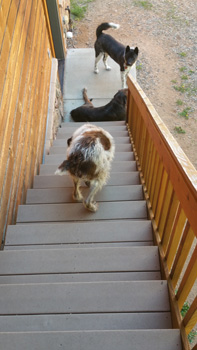
Vega, Gertie and Kep all come up to the loft to keep me company. They come upstairs; they go downstairs. Busy.


Nourishing the Self

Summer                                                      Healing Moon

Finding myself driven into my Self, wanting to nourish my soul/Self, my inner life, needing to do that. Mood a bit down, usually precedes inner work, and I plan to follow that thread today.

I may use the intensive journal, read some poetry, look into some books on the inner life. Meditate. Maybe hike a bit.

The tomorrow wall has gone back up, closing off my dreams for the future. This is not bad. It focuses me on the here, the now, but I will not allow this wall to stand after July 8th. No matter what the final pathology report says I plan to regain my usual rhythm. Write. Translate. Explore Colorado. Learn new things. Go out with Kate, the grandkids.

An example of what’s going through my mind right now. In traffic on I-70 yesterday, headed east, away from the mountains, I looked at all the cars and trucks and buses filling lanes, six lanes altogether, going east and west. Unbidden came the thought that all these drivers, all the passengers will get taken off the board.

This traffic, filled with strangers on unknown journeys to unknown destinations, purposeful and not, was a moment in history. And history’s tide would wash over it, sweeping in its wake all the souls present.

This was not a dark thought, rather a descriptive realization, offered to me, I think, by my unconscious. Why? To place my current predicament in context. Am I going to die? Yes. And so are all these others. As have all the others who lived, say, 120 years ago.