Category Archives: Third Phase

Vulnerable & OK

Spring                           Mountain Spring Moon

Quick note to say I’ve moved past the mood of the last post. Business meeting this morning with Kate at the Wildflower. We shared some of our mutual vulnerabilities: mortality, worthiness, relationships with kids and grandkids. In that unusual alchemy of love vulnerabilities shared become a source of strength and self-forgiveness. 25 years now of letting each other in, hearing and the seeing each other, loving each other. A gift beyond measure.

Spring, 2015

Spring                                   Mountain Spring Moon

The sun hits the celestial equator today at 4:45 pm. It also rises due East and sets due West. This is the day the serpent crawls up Chichen Itza. Though meteorological spring, the three months between the coldest and warmest months, began on March 1st, today is the old holiday, one celebrated in cultures across many lands.

Here, for example, is an interesting paragraph about spring from the perspective of wu xing: “In Chinese thought, spring is associated with the color green, the sound of shouting, the wood element, the climate of wind, things sprouting, your eyes, your liver, your anger, patience and altruism– and a green dragon. Not surprisingly, spring is also associated with the direction east, the sunrise direction as Earth spins us toward the beginning of each new day.”  earth and sky

Spring sees the early evidence of winter’s end, celebrated at Imbolc, when the lambs are in the belly, brought forward. The lambs are born. The grass is plentiful so the ewes can give milk and nourish their babies. The gradual loosening of winter’s cold and snow and ice continues, accelerates until the days have warmth as their usual state.

The warmth and the sun climbing toward the north signal plants and animals both. Hibernation ends so the visible population of critters increases rapidly, coming out for the food the new season promises. Spring ephemerals burst out of the snow: snowdrops, crocus, aconites. Later, the daffodils will come, too. The strategy of the spring ephemerals is an interesting one. They emerge, bloom and die back before whatever is in the surrounding vicinity can leaf out, thus capturing all the available sunlight before shade covers their spot.

If Michaelmas is the springtime of the soul, then the vernal equinox is the springtime of the body, of the material and animate world. No surprise then that it serves as the proximate marker for the Christian easter, focused as it is on the resurrection, the new life of the body. Both Christmas and the Easter, the two key Christian holidays, one marking the incarnation and the other the death and regained life of Jesus, focus on the body and its possibilities. In the first instance the body is seen as a vessel for the divine and in the second the body is seen as no longer bound by the strict laws of the animal world. Death is no longer the end.

The Great Wheel suggests a similar, but profoundly different way of viewing these two most profound mysteries: birth and death. The Great Wheel focuses on the rhythms of the natural world and on their sequence, their repetitiveness. Taken most literally it adds nothing to these rhythms, nor does it subtract from them. Birth and death occur as the great wheel turns, as the earth revolves around the sun, source of the vital energy that maintains life between these antipodes.

This intricate interdependence between animals and plants in their life cycles, the sun and the earth’s orbit around it, is common, literally mundane. Profane, too, I suppose. Yet the miraculous is here, too and we need no sacred text to see it. Out of the stuff born in the birth of the stars themselves, stuff borne later on the solar wind and in the cataclysmic explosions at the deaths of these same stars, came the material that created our sun and our home, this planet, this earth.

Then, consider what happens next. That same stuff, now reordered and shaped into this planet, somehow reconfigured itself so that it could move, so that develop intention and instinct, so that it could replicate itself rather than having to wait for the violent processes more usual for the distribution of matter. And that that stuff, the same from the heart of the stars, so reconfigured, grew in complexity and capability until human babies began to born. Babies that could, probably for the first time here on earth, perhaps for the first time in the whole of the universe, see that which gave them the potential for life, the universe in its particularity here on earth and its dizzying universality in the cosmos.

The birth of the universe’s own eyes and ears and poets and composers and painters and dancers came and as miracles. And still do. In the same way the death of these same poets and artists does not end the births. No, the births keep coming and the deaths do not end them. In my mind this is the true resurrection, the actual reincarnation, the exact moment of rebirth. Death does not end us. We continue. And Spring is just the season to bless and hold this true miracle close to our hearts.

Make Choices. Live Them.

Imbolc                                            Black Mountain Moon

P1020952750Selling the house in Andover. We’ve put our best effort into this sale and so far? No offers. Lots of lookers, but no buyers. It’s been four months since we closed on Black Mountain Drive which means for those four months and now a fifth, March, we’ve been paying two mortgage payments. Warren and Sheryl did it for several years and we can sustain it, but we don’t want to.

The longer it lingers, since it has a certain amount of our assets tied up, the leaner and tighter our budget becomes. Not unexpected, but not pleasant either.

There was risk in buying here before we sold the Minnesota house, but it was one we took with our eyes open. I’m glad we made the choice. This house fits us so well. Kate did a great job in finding it. Moving first simplified, by a lot, the whole process of exiting 153rd Ave. NW. And, we got to start our new life here in Colorado.ruthandgabe 86

An interstate move is expensive under any circumstances, especially when you have 20 years of belongings to move. Though we reduced by about a third, we still had a lot to move. The final tally, of course, is not in yet, but even when we add it all up, it will have been worth it.

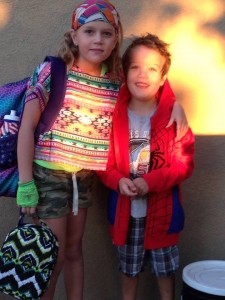
Why? This was the time to move in terms of our health. We’re still healthy enough to establish a new life. And, moving to Colorado allowed us to accomplish two goals with one move. The first, being closer to the grandkids, was both about seeing them more often and their ages, Ruth, 8, and Gabe, 6.  As with our health, this was the time to move to be part of their lives while they still tune into grandparents.

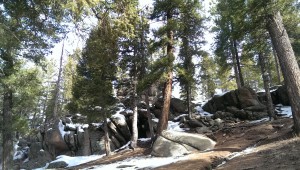
IMAG0977The second goal we accomplished was to move into a place of great natural beauty with space for our four dogs and our mutual creative work. Living in the Front Range of the Rocky Mountains means we have a home where the eco-systems vary by altitude and the altitude varies a lot. It also means spectacular vistas, interesting weather and wildlife.

So, we chose and now we live with the choice. Happily.


Learning Colorado

Imbolc                                         Black Mountain Moon

Signed up for 4 Colorado Native Plant Master programs: one in the foothills, one in the montane eco-system (ours) and one in the high plains. 3 of these are 3 session 8:30-12:30 classes. The fourth is a two session, 9-3, course on plant sketching. Don’t really want to qualify for the Native Plant Master program since it has requirements for volunteering that I don’t want to fulfill, but I want the content and the chance to meet some people involved in botany here.

All part of becoming native to this place. Starting this week I plan to keep a nature journal, hand-written, a record of our yard, hikes, these courses, geology lectures and field trips, meteorology notes. I’m not much of an artist, but I think with some practice I can draw plants and animals, maybe sketch geological features, at least well enough to call them to mind when I review the entries.

We drove into Evergreen for our business meeting at the Wildflower Cafe. It was good to see those folks again. Afterward we drove around Evergreen a bit, going out to the I-70 entrances and seeing in the distance snow covered peaks. Our mountains around here have snow, but are not snow covered.


It’s All Real Stuff

Imbolc                              Black Mountain Moon

Prep days. Yesterday reorienting my workouts, today moving back into Ovid with the Latin. Prep is important but I find I want to hurry through it, press on, get to the real stuff. But, it’s all real stuff, isn’t it?

When doing the Latin, for example, I want to work fast, translate easily, get it. But, most often I have to work slowly, translate with difficulty, struggle to understand.

In the MOOC I’m taking from McGill University the current section is on physical literacy. An amazing insight for me. Literacy in the alphabetic, language based world, yes. Numeracy in the numbers based, mathematical world, yes. But physical literacy? That is, learning basic moves and physical actions that can later be strung together to play a sport, keep one fit, teach us how to fall, no. The idea never occurred to me.

It apparently surfaced in the 1930’s in America whereas numeracy only emerged as an idea in the 1960’s. It’s not surprising, I guess, since the move from the farm to the town and city was weighted against the old, physical ways that had existed since hunting and gathering gave way to the neolithic revolution.

Perhaps, come to think of it, becoming native to this place is a component of physical literacy, a tactile spirituality. As we move less and less, we interact with the natural less affectively, less often, less well. Perhaps play is a big component of becoming native to this place, wandering aimlessly in the woods or by a pond, in the mountains, on lakes.

Anyhow, I’m excited about this idea, a human trilogy necessary for a satisfying life: literacy, numeracy and physicality.

Plateaus

Imbolc                                  Black Mountain Moon

Struggling with Caesar. Two things keep me at it. This quote: confusion is the sweat of the intellect. And, struggle is the first and painful step toward flow. There is, too, that stubborn insistence that I can learn this.

I’ve not discussed learning plateaus in the Latin for some time, but I passed one last week, when I began to be able to read the Latin without referencing vocabulary or grammars. This lasted only for a couple of sentences, but I did it. This capacity has resurfaced since then, but the ease I experienced last week is gone. For now. What I mean here is that I’m struggling on a much different plateau than in the past.

This process has been excruciatingly slow. It’s very similar to working out though. You keep at it, do a certain amount regularly and the benefits slowly accumulate. Right now I’m doing an hour to an hour and a half of Latin a day. That’s about all my mind can tolerate without becoming resistant to further work.

I’m midway through today’s work in the Gallic War, book 4, section 26. Caesar’s troops have landed near the White Cliffs of Dover and are fighting their way ashore. It’s tough going for them right now.

And Then Is Heard No More

Imbolc                               Black Mountain Moon

Let’s paint the same message as below, but with a different brush and color. Gray fading to black dominated the last post. Let’s use blue fading to dark, dark blue here.

Life is the time between the first rays of dawn and the last, bruised hours of twilight. At its brightening life comes with expansiveness, light revealing first this and then that, all new. These are the hours of Heidegger’s being thrown into the world. We see first a soon-to-be familiar face, then faces. Realize at some point a home, then the home in a particular place. That place is in a larger frame which sometimes takes a while to come into focus. At some point we know that the 1950’s, this time of childhood is neither, say, the the 1930’s of our parent’s time nor is it the middle ages with knights and castles and it is not, either, the future. Not 2000. Not 1984.

Over the next few years we learn that our unique self will have its hour upon the stage over a certain span of time, not any we wish, but this one and this one alone. Who we are to become, what we are to do must fit into these years, years that have their own shape, their own special challenges, their own significant opportunities. We choose this path, that person, those places. They fit or they don’t. If they don’t, we choose again.

As the years accumulate and our hour ticks down, the choices become fewer, narrower. Our own history now shapes our future. This is a time of reaping, of being the person you have chosen to be, the unique mixture of your Self and the times into which you have been thrown. When the reaping is finished, our hour is up.

fides quaerens intellectum

Imbolc                         Black Mountain Moon

Reimagining faith surfaces, then falls back, behind other projects. Latin, books, art. This surprises me somewhat. I spent 20 years, 5 in seminary and 15 in the full-time ministry, focused on matters of faith. After I retired at 44, there was always some engagement, at times strong, then smaller and smaller though in the liberal religious tradition, not Christianity. All that investment of time suggests a deep commitment to the mystery of faith, one that you would think would keep me engaged.

And it has, if I read the trajectory of my life correctly, (A difficult task to do from inside the life, I grant you.)  but in unusual or atypical ways.

Faith seeking understanding (fides quaerens intellectum) was the motto of St. Anselm of Canterbury the 12th century Catholic who attempted to move beyond scripture and the holy fathers in “proving” Christianity. Anselm, like many in the scholastic tradition, took as certainty that the search proceeded from faith to understanding. That is, faith came first, then human reason sought to understand it.

Reason seeking understanding prior to faith defines the period of the Enlightenment and its deconstruction of the Christian scaffolding built up in the 1600 years that had followed the death of Jesus. As Anselm and others inside the church feared, a search for understanding that does not proceed first from faith can-and did-lead to knowing without need of religion.

There is a third route, one which proceeds from intuition or from inner light. It does not proceed from faith, nor does it rely on reason first, rather the heart leads from inside the human experience.

This is, perhaps, Emerson’s “revelation to us” in his well-known introduction to his essay nature. It means starting with the deeply felt, the unreasoned, perhaps the irrational, pushing aside books and dogmas, theorems and the laws.

Here’s one such thread in my own life. In Madison County, Indiana we had two main economic sectors: farming and manufacturing. We had the remnants of the great pioneer push west, now growing beans (soybeans) and corn, raising cattle and pigs, and producing milk. We also had the American equivalent of England’s “satanic mills”, huge automotive factories that employed thousands working three shifts a day.

So from young childhood the dialectic between agriculture and technology grew within me, not as an intellectual argument, certainly not as a matter involved with religious faith, but as a felt and experienced reality.

Pipe Creek ran through Alexandria. It was the creek (pronounced “crick”) that took a dogleg turn through town. In the rains that came in late summer it often flooded, putting the high school’s football field underwater. Some locals could be counted on to take their fishing boats out and putter along the 50-yard line.

It was, in that sense, wild, literally untamed. Yet its name called up not wilderness, but the factories and their waste. That it may have been named for an Algonquian speaking chief of the Delaware nation, Hopocan, who was also known as Captain Pipe, is a late learning and does not negate the long association I have between factories and the running water near my home.

Pipe Creek runs through my life, carrying in its compromised waters the tension between natural and artifice, a fruitful tension that has spilled out now in my third phase as a deep lake. In that deep lake artifice lies submerged, Atlantis like, civilization that triumphed for a time, then disappeared beneath.

Faith positions us in the world, however widely this term might be applied. Many faiths, including Christianity, posit a world beyond this one, one to which we more properly belong and to which we can retire after the last mystery has visited us. My reimagining of faith is in this regard simple. It positions us as in and of this world, the one in which we participate daily.

Pipe Creek in this reimagined faith fills the lake. Its waters rise over all human endeavor, taking them in as it takes in trees and rocks and sand and skeletons. This is neither an apocalyptic view nor a judgmental one, rather it is descriptive.


Here. And Not.

Imbolc                                   Black Mountain Moon

IMAG0948

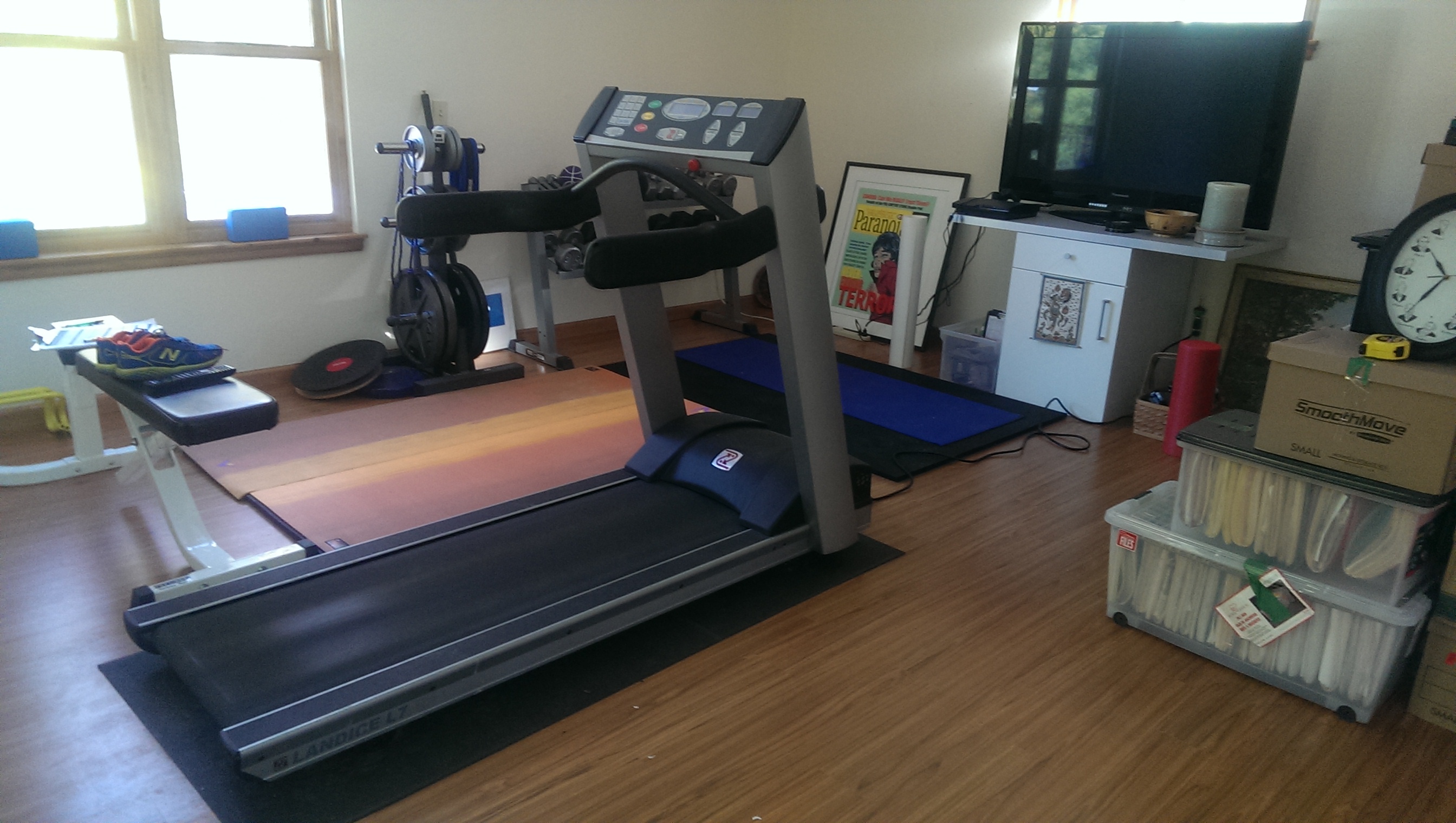
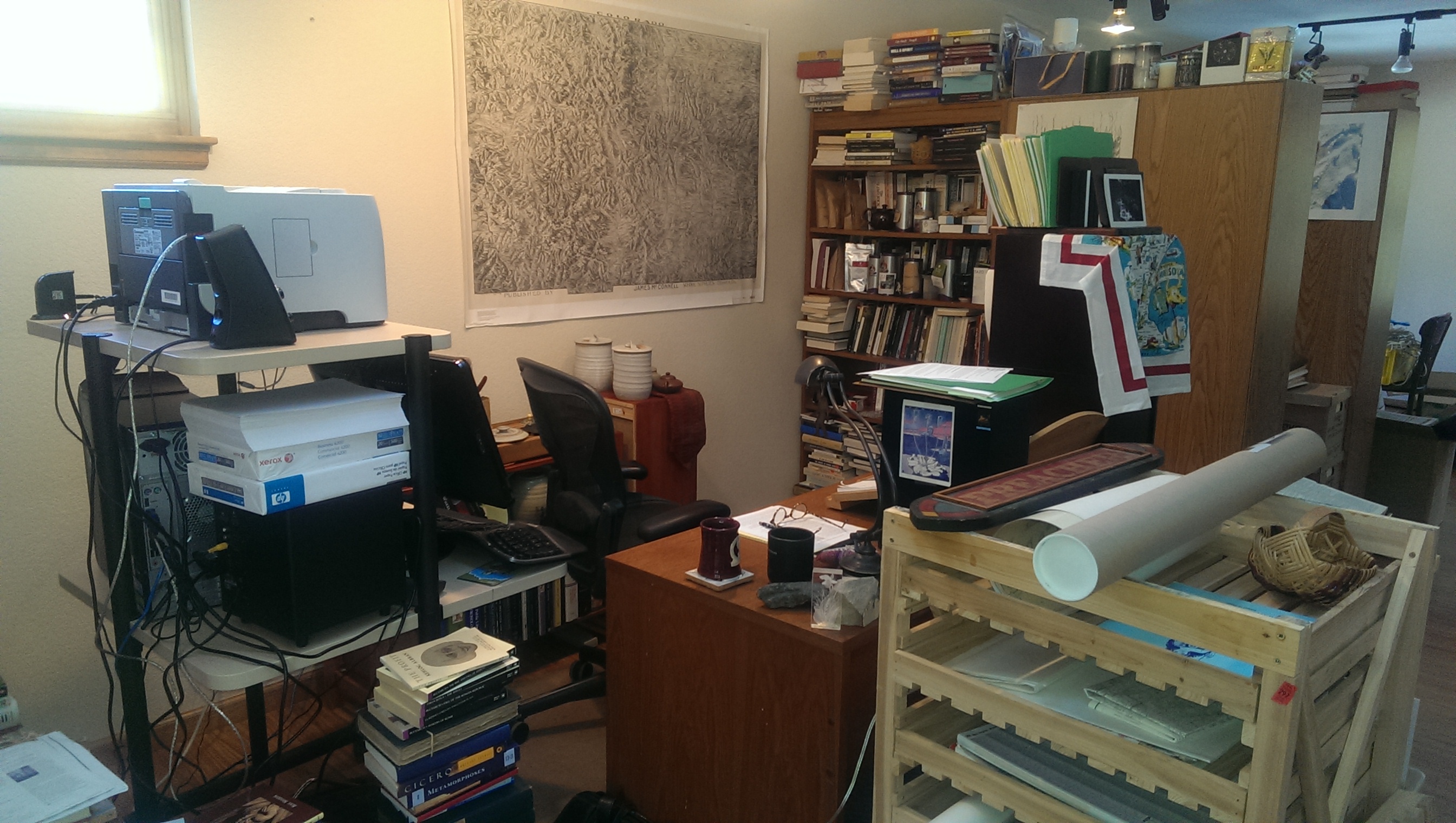
With the books in organized clumps, art still in boxes, files in the horizontal file, journals, dvds and novel notes stacked together in banker’s boxes, and the exercise area functional I’ve reached a stasis in terms of organizing the loft. Kate got back to sewing yesterday, making a table runner from a pattern both she and Annie bought this last week. Her sewing area has also begun to take shape with her table, cutting surfaces, stash, sewing machine and Matilda (the dress mannequin) in usable, if not permanent places.

We await now the new Stickley table we purchased for downstairs, which will make that space more flexible when entertaining or during family game nights. The reading room, the bedroom, the living room and the kitchen all have usable, if not permanent configurations. The garage and the homeoffice remain hangouts for the cardboard set, art in the latter and mostly gardening/beekeeping/tools in the former.

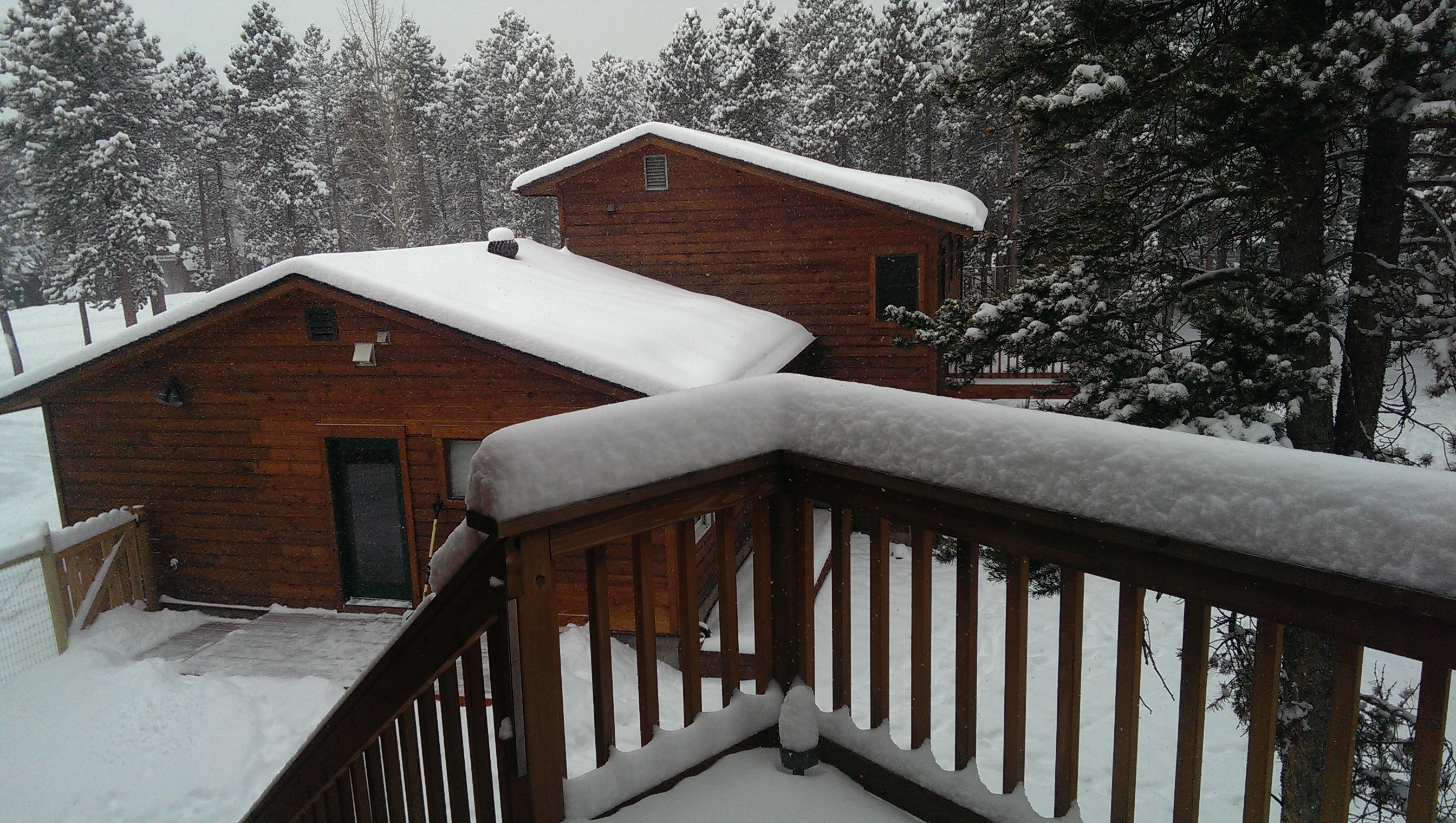
Over the next few weeks Jon will install built-in bookshelves up here, attach my pull-up bar and help us IMAG0950hang art in the house. He’ll also develop plans for linking the house and the garage, a current problem spot for us. Why? There’s no straight line into the house from the garage and no path that can be cleared. We have to move through the snow to get to the truck or upstairs to the loft. Not a big deal, but one that could be better.

Kate went in yesterday and had a day as grandma, doubled with Barb’s presence. They were at Barb’s apartment with Gabe and Ruth who were out of school for teacher’s conferences. In one of those mysterious moments we humans have from time to time, Kate went from Minnesota grandma to Conifer grandma, a change that began at the birthday cum house warming celebration on Saturday. She’s now fully here (as I sense it) and in the life she dreamed about as we prepared for and executed the move.

There’s a bit further for me to go. I got a very sweet book from Ruth as a birthday present, a compilation of IMAG0942poems and images about Grandpop plus comments from her. I feel completely here as Grandpop and did perhaps sooner than Kate, but the Self that has begun to grow here, a Colorado, Western Self has barely emerged. In part I need to get my old rhythms back, the ones I mentioned yesterday: Latin, writing, art history, exercise, sheepshead, perhaps some political work. But, too, I need new rhythms: exploring Colorado and the near West with Kate, hiking and snow-shoeing in the mountains, learning the history and the geology and the biology of the land we now call home. It will be the dialectic between the old, stable patterns and ones possible only because we live here that will finally get me all the way here. For now, I’m neither fully here nor fully gone from Minnesota. Liminal. Again, still.