Beltane Mountain Moon

Beltane Mountain Moon
Beltane Mountain Moon

Time last night. Qabbalah. Does the past exist? Oh? How do you know? Key learning, something I have to learn and relearn, the past exists, yes, but only in the present. Just like, oddly, the future. Why? We never have any time other than the present. Never. We can pull ourselves away from awareness of the present by being focused on the past regrets, anger, guilt, yet we can only experience the past in the present. So, whether it has any ontological reality or not, we cannot know it except as a ghost that we carry forward with us.
Likewise, the future never arrives. Free beer tomorrow. Our dreams or fears or hopes or anguish about a future event can affect us, but, again, only in the present. Now is all there is, and, again oddly, the moment we think of the now, it is past.

Moment to moment the Reconstructionist prayer book says, the process of creation is renewed. Creation continues. Revelation continues. Tradition changes. This seems right to me and offers us substantial hope. We are not bound by past. This moment is new and we can choose in it to experience the past differently, to change the narrative, to reframe. In the same way we can choose-this is very existential-to reframe our future hopes and fears.
 In the present, which has never existed before and will recede as if it were never there, all things can be made new. This is a subtle idea, at once obvious and at the same time almost impossible to grasp. Yet it is true that the 71 years of my life have passed in moments, always in the now. Even in 1947 my life passed moment to moment in increments, the very same as the increments I experience today in 2018.
Reb Zalman, founder of the Jewish Renewal movement, and a resident of Boulder until his death, talks about sin as a remnant of the past that is no longer useful, a story whose narrative obscures our ability to be in the present and, therefore, to make choices in the present. I really like this idea since it removes sin from morality and certainly removes it from any stain on the essence of a person. When we discussed this last night, I offered a metaphor from gardening, “A weed is a plant out of place.”
Beltane Mountain Moon
The home of goddess Pele
Beltane Mountain Moon
Beltane Mountain Moon
Kim Stanley Robinson: Red, Blue, Green Mars meet the proposal.
Beltane Mountain Moon
Beltane Mountain Moon
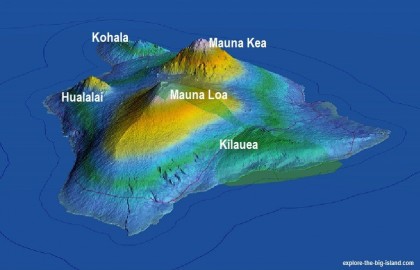
Volcanoes of the Big Island
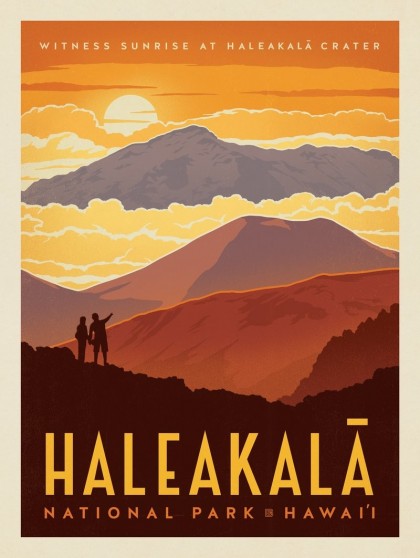 In the month of the Mountain Moon Kilauea has reminded me that my interest in mountains precedes the Rockies. My first mountain driving experience was Haleakala on Maui. I learned there that you don’t have to brake going up, take your foot off the accelerator and the mountain takes care of you.
Haleakala means house of the sun and on one of our trips to Maui I did the tourist thing of seeing the sunrise on Haleakala. As we rode in the small van around 4 a.m., the skies were cloudy, rushing across the island, allowing the full moon to become visible, then blocking it out. Even though we were on Maui, a tropical paradise, the early morning temperatures on Haleakala’s summit, 10,023 feet, were cold and windy. Black Mountain, visible from my window here in the loft, is 10,731 feet.
 Hawai’i put vulcanology on my oh this fascinates me list. On a visit to the big island, Hawai’i, we drove the Highway east out of Kona, traversing first Hualalai, which sits just above Kona, then Mauna Loa, the long volcano, and finally, climbing up the eastern flank of Mauna Loa we went past Kilauea. We did not go in that day, driving on to Hilo town. On our way back, later that evening, we drove along the southern flank of Mauna Loa again, the air scented by gardenias and jasmine.
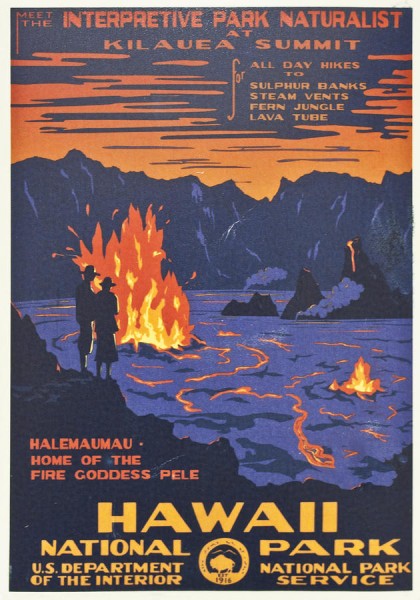
In 1999 we visited the Big Island again, this time staying in Volcanoes National Park at Volcano House. We were there for two weeks. Learning the language of volcanoes was easy there: fumaroles, vents, calderas, pahoehoe, ropy undulating lava, and aa, fragmented sharp blocky lava, lava tubes, magma, magma chambers, and the home of Pele, Halemaʻumaʻu Crater. (see poster above)
Hiking a long path around the summit, walking on lava flows where the Pu’u O’o vent added to the land mass of the Big Island, exploring inside now drained lava tubs with ferns growing from the ceilings and reading about volcanoes gave me both an experiential and intellectual immersion. I’ve followed Kilauea off and on since then and the news coming out of the Big Island has me riveted.
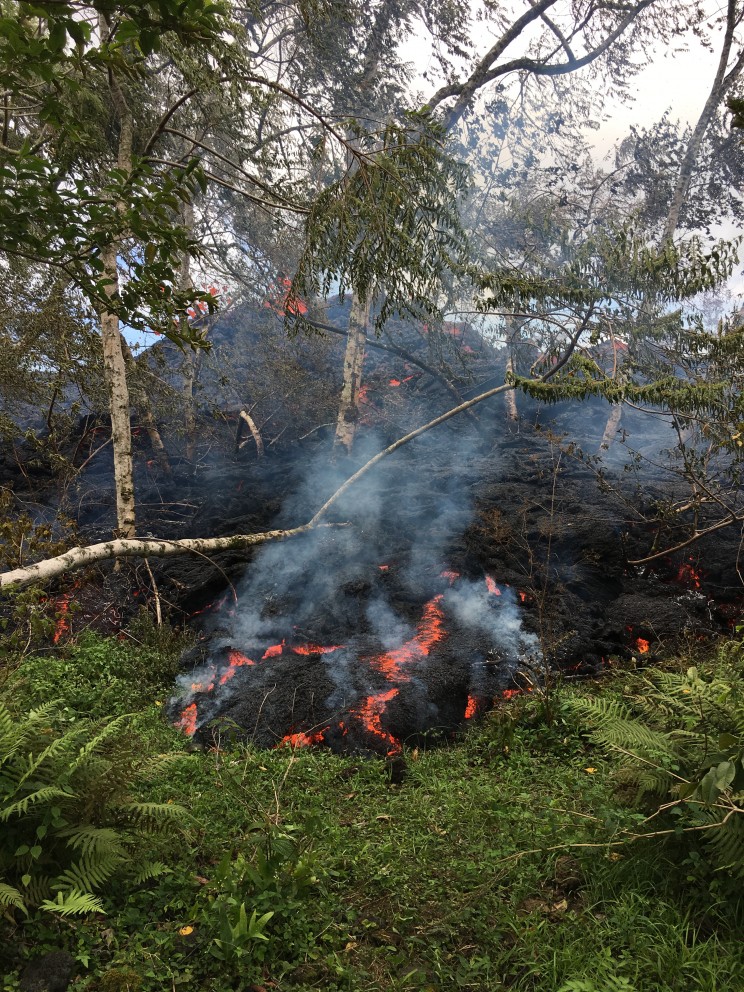
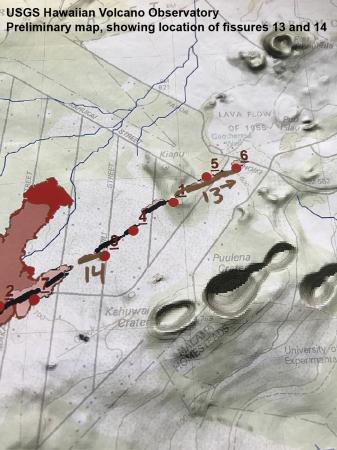
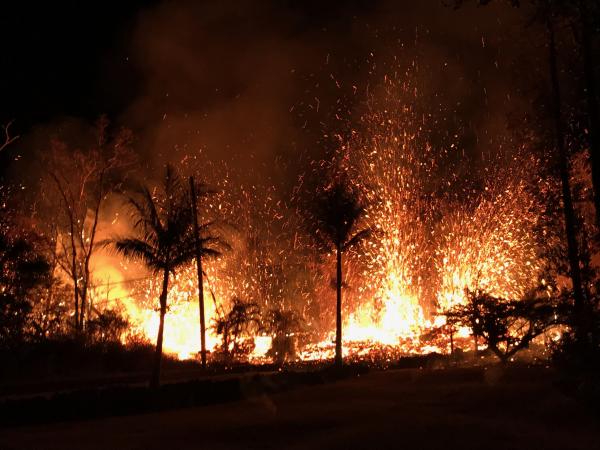
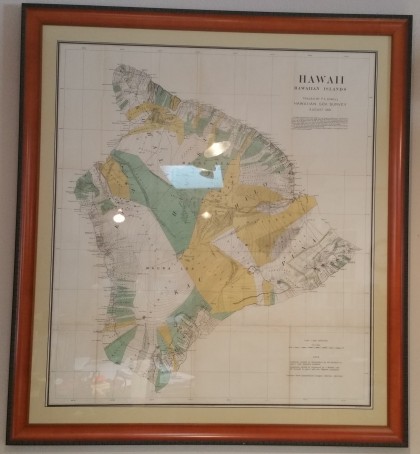 Maps. Kate bought me this wonderful vintage map of the Big Island. It now hangs in a prominent position here in the loft, reminding me of many adventures including our stay at Volcano House. Kilauea is in the yellow portion of the map that extends south to the Pacific and butts up against the large swath of green in the middle. The new eruptions are in the eastern, white segment that extends to the north from the point where Kilauea meets the Pacific. This is Kilauea’s eastern rift zone*. People building there knew about the rift zone, but hoped it wouldn’t affect them, much like we hope our location in the Wildlife Urban Interface, WUI, won’t result in our home burning down. Mother Nature gives no passes for human hopes however. She decides when and where things happen, according to her own laws.
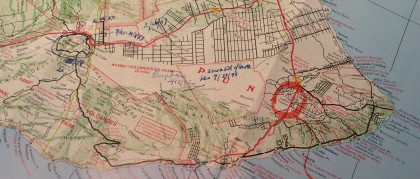 Over years of travel I have purchased maps and annotated them. I did this especially in Hawai’i where we visited often while Kate practiced. It is a popular location for continuing medical education. Each time we visited I would mark where we had gone, the date, sometimes a brief note though the longer explanations were in my notebooks. We spent time on Maui, Hawai’i, and Kaua’i, enjoying all of them in turn. Each has their particular charms.
The section of my Big Island map above shows the eastern rift zone area with our 1999 visit marked by the black circle in the upper left and the current eruptions in the Leilani estates circled in orange. The Lo’ihi seamount, the latest island of the Hawai’ian archipelago forming beneath the sea, is just south of the shoreline shown here. It’s the volcano that is most directly over the hotspot** which has formed the whole archipelago.
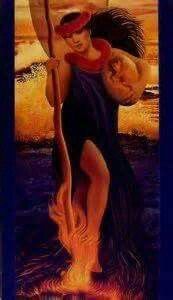 In 1999 I stood on the rim of Halemaʻumaʻu Crater. Next to me were empty bottles of gin and rum, sprays of flowers, especially red ginger and bird of paradise, a lei of gardenias. These were left by native Hawai’ians who came here to worship Pele, the goddess of fire, of volcanoes, of creativity. This is, according to Hawai’ian theology, Pele’s current home though I imagine she will be moving in the next few thousand years to Lo’ihi.
Rudolf Otto, the German religious philosopher who wrote about the nature of the holy, said it combines two elements: awe and the mysterium tremendum et fascinans***. Gazing down over the rim, looking 150 to 200 feet to the crater’s floor, awe came bubbling up at me. In 1999 Pele’s home had no active, visible lava, but just knowing that the magma existed below a thin crust of cooled lava was enough. There is a large lava lake in the crater now.
Otto could have written these words to describe my feeling: “overpoweringness, majesty, might, sense of one’s own nothingness in contrast to its power.”
Wordsworth, too, in the World Is Too Much With Us:
“I’d rather be
A Pagan suckled in a creed outworn;
So might I, standing on this pleasant lea,
Have glimpses that would make me less forlorn;
Have sight of Proteus rising from the sea;
Or hear old Triton blow his wreathèd horn.”
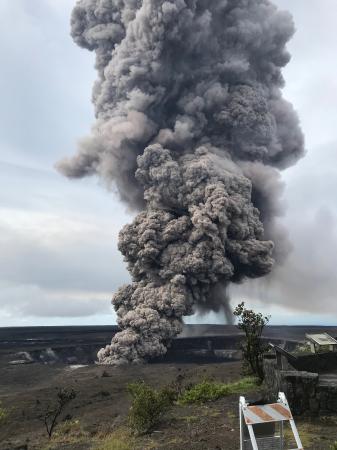
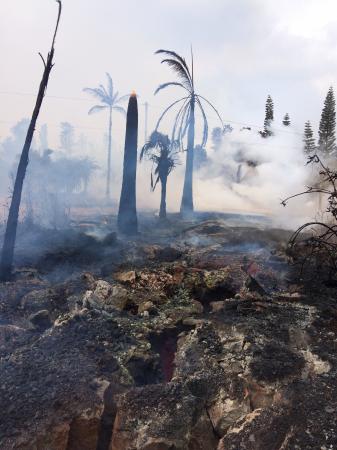
The lava on Kilauea is about 2,200 degrees Fahrenheit. Various magma chambers up to six miles below the surface feed the lava flows into Halemaʻumaʻu Crater, formerly fed (up until this last week) Pu’u O’o and now feed the fissures breaking through the eastern rift zone 21 miles from the Kilauea caldera. Here is the raw power of our wild universe visible in its most primal form, kin to the winds of a hurricane, the awful speed of a tornado, the waters of a tsunami, flooding rivers, avalanches, wildfire, orogeny. Nothing subtle at all in these forces; we ignore them at risk to ourselves and those we love.
I need no book, no prayer, no revelation of another. Here is the great wild, the generative power of the tao laid out for all to see. Stand in a sanctuary and feel no more divinity than in their presence. Visit St. Peter’s or the Temple Mount or the Wailing Wall or Angkor or the Great Medicine Wheel and know no more of the sacred, the holy than when the heat of the lava brushes your delicate skin. Pele’s touch.
*Rift zones are areas where the volcano is rifting or splitting apart. The rock in a rift zone has many cracks and is relatively weak, and thus it is easiest for magma to make its way to the surface through these rift zones.
**Hot spots are places within the mantle where rocks melt to generate magma. The presence of a hot spot is inferred by anomalous volcanism (i.e. not at a plate boundary), such as the Hawaiian volcanoes within the Pacific Plate. The Hawaiian hot spot has been active at least 70 million years, producing a volcanic chain that extends 3,750 miles (6,000 km) across the northwest Pacific Ocean. Hot spots also develop beneath continents. The Yellowstone hot spot has been active at least 15 million years, producing a chain of calderas and volcanic features along the Snake River Plain that extends 400 miles (650 km) westward from northwest Wyoming to the Idaho-Oregon border.
*** Rudolf Otto and the numinous
“Mysterium tremendum et fascinans” (fearful and fascinating mystery):
Spring Mountain Moon

Yes, it arrived. The bad Samsung got hauled away ignominiously with nary a tear of loss or grief. The new Kitchenaid now glares from its Cylon lens, hunting for dirty dishes, pots and pans that need a wash. This morning I walked past it and a single word glowed on the small screen visible from the front: CLEAN. Oh, joy. Oh, bring on the robotic revolution.
 Buddy Bill Schmidt shared a paper sent to him by a friend from JPL, Jet Propulsion Laboratories. It’s title is: Science and Enabling Technologies for Exploration of the Interstellar Medium. Exploring among the stars. I mean, wow. Still an avid reader of science fiction, I thanked Bill and noted in my reply that we live in a time when science fiction and science fact often intersect. One of the delightful realities of living through this particular era.
Since we have a deep freezer drawer filled with ground beef from our quarter we bought last fall, I picked up an important cookbook, The Essentials of Cooking Ground Beef. In it, to both Kate and mine’s delight, is a recipe for the famous Matt’s jucy lucy’s. This recipe is for sliders and last night I divided a pound of hamburger into eight parts, balled them up, dented the ball with my thumb and stuck white cheddar inside. Hmmm. Tasty. Served with frozen Arby’s curly fries, dill pickle slices and haricourt vert. OK, that last dish didn’t really fit, but I always like to have a vegetable and it was available.

As the photo at the top shows, we did get another round of snow yesterday. Maybe four inches. All of it welcome. Precipitation, especially now, aids to some extent in fire protection and recharges the ground water. When your daily water comes from the ground water, having moisture to replace what’s been used is important. Water is safety as well as life here. Without it we become vulnerable to lightning strikes, visiting campers and the odd animal trying to navigate high voltage power lines.

Kabbalah tonight. More about time. Qabbalah is another way to explore the interstellar medium, a matrix of space/time with its deep roots in what I’ve learned the mountain and rivers poets of ancient China called absence. Absence is at the heart of Ch’an Buddhism, that peculiar blend of Taoism and Buddhism that emigrated to Japan to become Zen. Absence is the place of the Tao, the generative force that gives rise to the ten thousand things in all their uniqueness and detail. Learning to penetrate the gauze of sensation and feel your way into the absence behind it leads to enlightenment. In fact, both Ch’an and its child, Zen, believe in instant enlightenment; once you learn this truth in your core, you know what needs knowing. Absence makes the heart grow wiser.
Oh. I did get my cleaning, reorganizing finished. Spiffed up and ready for a return to both writing and sumi-e.
Spring New Shoulder Moon
 “I’m a doer.” Kate said this yesterday. Yes, she is. So much so that we often referred to her as the energizer bunny. Jon’s divorce, Sjogren’s and arthritis has made doing difficult, often downright painful. The combination put her in a tough place psychologically; but, it feels now, for the first time in a year plus, that she’s going to push through it. As Winston Churchill said, “If you’re going through Hell, keep on going.”
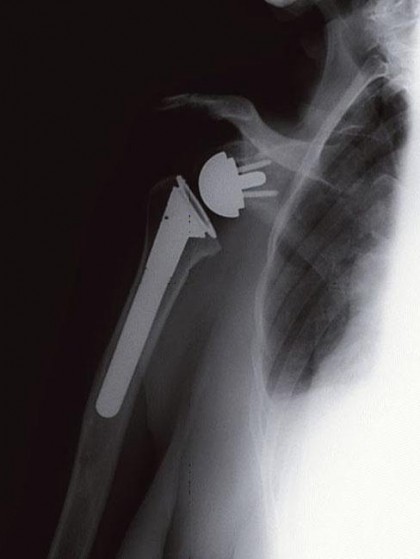 We had her first post-op appointment yesterday and got to see an x-ray of the new appliance. This isn’t hers, but it’s an accurate representation of what we saw. As this image shows, the ball of the shoulder is now where the socket used to be and the socket where the ball used to be. This reverse total shoulder uses different muscles to power the arm, the deltoid in the main. It also reduces pain more for certain patients though I’m not sure why.
Seeing the screws, poking out from the ball, seemed strange to me, but it underscores orthopedics as the carpentry of medicine. Sawbones. The multiple uses of the inclined plane. Thanks, Archimedes.
These surgeries, joint replacement, aren’t perfect, but they’re way better than doing nothing. My knee, for example, is not the knee I had when I was 40, but it is pain free and I can work out without contorting myself. I can’t stand for long periods of time, but I can stand without pain. Kate has two artificial hips and now an artificial shoulder. Pain reduction is a primary benefit of all these procedures and it’s usually pain that leads to them in the first place.
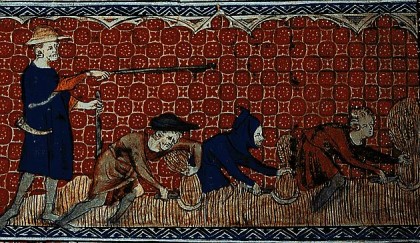 We often talk about folks for whom physical labor is key to their job: trades people, movers, utility workers, lumberjacks, mechanics, farmers, even physicians. Prior to joint replacement as an option, they had to suffer through the pain or stop working. Imagine what it was like on the frontier to have debilitating hip pain, a shoulder that would no longer move above a right angle, a knee that buckled under pressure. Or, in the middle ages, for peasants. Soldiers. Domestic servants.
 It’s likely, for example, that Kate’s years of lifting babies and young children led directly to the arthritis that ruined her right shoulder. That’s the Schneider hypothesis since the sort of dysfunction her shoulder displayed is most common in women.
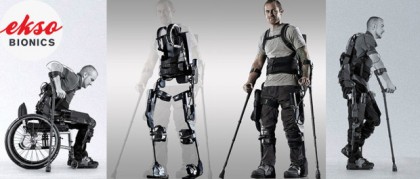
These are life extending surgeries, making it possible to live, rather than exist. I imagine that soon bionics will be more generally available and will complement this sort of procedure, perhaps making up for atrophied muscles which are a common sequelae of joint problems. All this is part of the glass half full view of the future.
Imbolc New Life Moon
 Wow. Weather station says the humidity outside is 66%. Inside 2%. Aridity is the norm, humidity a rare phenomenon here. Like most rarities it’s welcome. Most welcome.
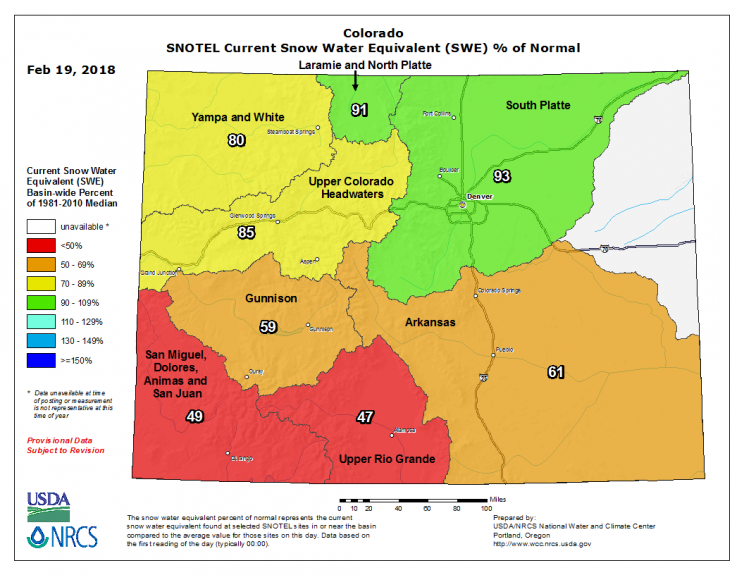
4 or 5 inches of snow yesterday. Every flake helps in this dry year. Old timers here are not worried yet because March and April are the big snow months. If the patterns change, we’ve had a big ridge over us for most of the winter pushing cold and snow to the east, north of us, we may recover. In this case recovery means two things, a wetter forest heading into fire season and a snowpack closer to average.
In the land of 10,000 lakes water was abundant and loved, not so much for its quality as water, but for its pleasing manifestation in the landscape. Cabins on the lake. Walleye fishing. Lakes in the cities. The Mississippi rising in Itasca and flowing down toward New Orleans, passing through Minneapolis and St. Paul on its way there. The majesty and wonder of the great lake, Superior.
Here though water is water, aqua vita. Its necessity for human life, for livestock, for healthy more fire-resistant forests is never far from the minds of folks in the West. As I read recently in 365 Tao, the earth breathes out, clouds form and water moves from place to place. This fundamental physiology of our planetary eco-system is, oddly, more apparent in its absence than in its over abundance. The humid east and the arid west.
Since we got just less than 6 inches, it means I blow the driveway. Ted plows six inches and above. Gonna wait another hour or so though since it’s only 6 degrees and I’m more cold sensitive now, both as a Coloradan and a septuagenarian.