Want to know how far we are into the Buck Roger’s world? Read below.
Our Mission, Vision, and Expertise
MISSION
The Center for Space Resources (CSR) is a research and technology development center dedicated to the human and robotic exploration of space and the utilization of its resources for the benefit of our society through the joint efforts of academia, government, and the private sector.
VISION
The Center for Space Resources (CSR) pursues the study and utilization of space and planetary resources by developing technologies for prospecting, drilling, excavation and extraction, materials processing and manufacturing, and spacecraft and habitat life-support systems. In addition to the many practical uses of space exploration on Earth, the greatest achievement bringing benefits to humankind would be to develop in-space commercial applications of space technology and planetary resources. These applications will one day form the basis for new space industries that will include:
Harvesting of solar energy outside the Earth atmosphere
Development of an in-space reusable transportation infrastructure carrying payloads from Earth to geostationary orbits, the Moon, Mars and back
Servicing of satellites and orbiting spacecraft to extend their useful lifetimes and reduce the costs of space operations
Processing of value-added materials in Earth orbit based on planetary resources
Utilization of resources for in-situ planetary applications, such as energy, propellants, manufacturing, and habitat development
EXPERTISE
Following the distinguished tradition on Earth resources curriculum and research programs at the Colorado School of Mines, the Center for Space Resources is extending the expertise of the School outside our planet, by supporting the human and robotic exploration and utilization of resources in space, the Moon, and other planetary bodies in our Solar System. The Center pursues these objectives by establishing joint education, research, and technology development projects with other academic institutions, government agencies, international partners, and companies in the private sector in the following areas:
Lunar and martian regolith properties
Planetary soil drilling and excavation
Extraction and processing of volatile and solid planetary material
In-situ resource utilization (ISRU) technologies
Advanced manufacturing with planetary materials for equipment and habitat construction
Lunar and planetary dust characterization, management, and mitigation techniques
Sensors for trace-species and biogenic gas detection on the Moon and Mars
Life support systems on spacecraft and planetary habitats, including fire suppression, environmental monitoring and control, water processing, and energy generation from waste and fuel cells
Advanced materials for in-space repairs and thermal protection
Technical and economic analyses for identifying potential commercial developments in space
A saga of small proportions, but a saga nonetheless. After a late pickup of the RV due to the previous renter breaking a large outside storage container door, we were cramped in getting stuff into it. Ruth and Gabe slept in it in our driveway on Friday night and we finished packing Saturday morning.
We left around 7:30 am. Due to dire traffic predictions I picked a route that would minimize traffic though it would take a while longer to get there. I don’t mind using time on my own volition, but backed up bumper to bumper on an Interstate? Not so much.
Being a little bleary from the previous day I ended up missing the route I had chosen and finding the exit for an alternate instead. Instead of taking the turn for Empire and Granby, right next to Rocky Mountain National Park, we drove to my first idea, a routed going north out of Dillon on Co. 9. Some of the driving was on roads with narrow to no shoulders and I was still getting used to the hippotamus like wallowing of this big beast. One slight run off the road scared the bejesus out of me.
In an attempt to get back to the Granby route I took off east on Co 14. This was fun because it took us through the vast high plain known as North Park. There are three parks, South Park, Middle Park and North Park. South Park is in Park County, close to our home. We turned north again at Walden, a quaint little town that calls itself the moose viewing capital of the state.
Ruth, above the cab
Somehow though, after we passed into Wyoming, I missed Wy 130 and in the process took us off through the Medicine Bow National Forest. This was also beautiful, but much further south than I intended. This meandering took us about 100 miles out of the way. All good from a not all who wander are lost perspective, but it had a negative effect later on.
By the time we made it to Jackson, after a trip through another National Forest with mountains blued out as the sun sat behind them, a river flowing north beside the road, it was dark. Both Kate and BJ recommended against taking the Teton Pass at night, so I listened. We found a temporary home for the RV in the Jackson KMart parking lot.
For about three hours. At 12:30 pm a knock on the door and very bright lights outside announced the Jackson police department. Contrary to what we had heard KMart does not welcome overnight stays and “Jackson has an ordinance against illegal camping.” Oh. Well. If you put it that way.
So, again bleary eyed, this time after 12 hours or so of driving I put on pants and shoes, started the hippo and we moved away from KMart. Kate suggested we try the Motel 6, a place Jon stays when he comes to ski. $63 a night. They said rooms were $248 a night, a special rate just for the eclipse. Ha. However, the desk clerk kindly said we could stay in their parking lot for free. We did.
About 7 o’clock Sunday morning we fired up the hippo and drove to, wait for it, McDonalds for coffee, potato type food and an egg mcmuffin. We wanted to get out of Jackson and onto the Teton Pass. Which we did.
It’s not a difficult drive in the light, but it would have been treacherous in the hippo at night. Again, beautiful. Natural beauty surrounds us here in the West, especially following the Rocky cordillera north as we did. Sort of.
Once down the Teton Pass we passed into Idaho at Victor, then turned north toward Driggs. BJ, Kate’s sister, lives a half hour out of Driggs, up the side of the bowl that the mountains create here, a small version of a Park. Her home is rustic with wood flooring, weathered porches and an outbuilding that includes a sauna and a greenhouse. It’s quiet here, the opposite of Broadway and 78th in NYC, where she lives in the Beacon Hotel.
Tomorrow is the eclipse. We’ll see it from a meadow near here. More after that.
Losing the Sun
8/22/2017 Eclipse Moon
Kate, BJ, and Jon. On BJs deck.
A black sun. Coronal flares shooting out, white against a blue-black sky. No birds flying, a sudden cool silence. Two minutes and twelve seconds passing fast. At 11:35 am, against a clear, just moments before hot blue. Gasps and exclamations came over these lower hills of the Big Horn Range, the ragged Tetons across the Tetonia valley, mute.
A moment of the occult revealed by darkness. The sun always moves across our spinning planet with those vast, hot flames reaching for the edges of the solar system. Unseen. Even the sun itself, except at a quick glance, or in the periphery of vision, stands hidden in its own brilliance. Not yesterday. Not for two minutes and twelve seconds.
A sight reminiscent of a secret society. Only initiates can see the truth. And it is so. It may be a secret society of millions or billions, but it is exclusive, often, as for me, happening, if at all, only once in a lifetime.
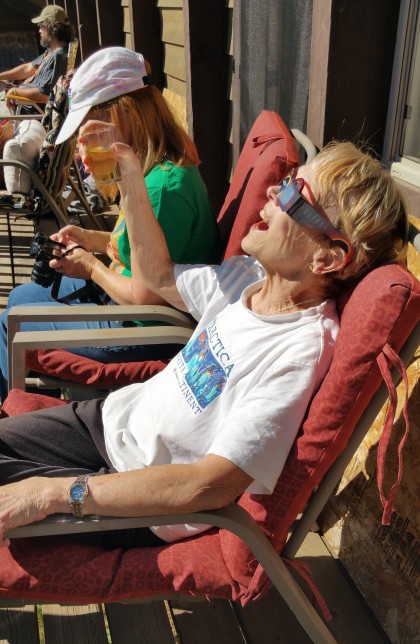
Six Olson/Johnsons: Jon, Ruth, Gabe, Anne, BJ, Kate and one Welsh Teuton sat on BJ’s east facing deck, eyes covered in glasses dark enough to make walking with them on impossible. At first we baked, heat from a late Idaho summer crackling down from the sun, naked and fierce as it can be at midday.
Totality
A small pinch of black intruded on the faded yellow globe we could see through the eclipse glasses. Baily’s beads, sunlight bouncing through valleys created by lunar mountains, shimmered for just a second then disappeared. The small pinch became a bigger one as our usually nocturnal moon, and a new moon, usually invisible, at that, showed up, its shadow cone moving at hundreds of miles an hour, racing across the U.S. from Portland to Charleston, passing us here just across the Big Horns from the vast potato fields of southern Idaho.
That image, black sun, coronal flares across the deeply bruised heaven is now a permanent resident in my memory. Brief though it was, its violation of the natural order so consistent over my life time, much like an earthquake disturbs our sense of the stability of the earth on which we walk, was so intense that it will stay available to me.
How often in a life do we get to shock ourselves in such a way? The sun shines in through the window of the RV as I write this, back to its old dangerously luminous self, too shiny for my eyes. “There are more things in heaven and on earth than are dreamt of in your philosophy, Horatio.”
Our common sense philosophy allows us to move through our days without recourse to constant surveillance. The earth is solid. The air breathable. Night follows day. Our heart beats. During the day the sun shines unless obscured by clouds. When our experience deviates from these home truths, our inner world shakes. Can’t get enough oxygen? Heart pauses? Earth moves. Night comes near noon on a cloudless day. Even if we know the why, the empirical fact of such an insult to the received wisdom of our lives alters our confidence in what we believe. Alters it in a deep and profound way.
Alpine glow during totality, looking toward the Tetons
Perhaps such events are the key to humility. What we assume is true may be mistaken, mistaken in some fundamental way. Once one pillar of our inner temple is shaken, we may need to examine them all.
August 23, 2017 Lughnasa Eclipse Moon
The day of the eclipse has come and gone. Jon, Ruth, and Gabe left that day for Colorado. The eclipse was on the first day of Gabe’s fourth grade year and Ruth, though already in school for a week or so, missed classes on Monday, too. They had to get back. It took Jon 11 and a half hours to get home.
BJ, Kate, Anne at Kates birthday party apres eclipse
Later that day Kate’s two sisters, Annie and BJ, Kate and I, drove into Driggs for a post-eclipse return to this earth. Traffic in that small Idaho farm town was heavy, a traffic jam slowed us down getting to the art fair which was our destination. There were mumblings about how the expected 100,000 people had ended up being only 10,000 and artists seemed disappointed in their sales.
Since we never left BJ’s deck to see the eclipse we escaped any traffic getting into place for a viewing and the traffic coming up from Conifer was never heavy, even on I-80, so that small Drigg’s experience was it for us. Fine with me.
Annie and BJ put together a birthday party for Kate with a happy birthday banner, glow in the dark bracelets, flowers and color changing small candles. We had salmon, potato salad, baked beans and fruit for dessert.
Tetonia
The next morning we had breakfast up at the big house. (what Kate and I from the RV perspective called BJ’s place) Kate ended up feeling crummy and left early to spend the morning resting. I wrote a bit, read, talked with Annie and BJ.
In the afternoon Annie, BJ and I drove 15 minutes over to Tetonia, a smaller town than Driggs, with the same name as the county. As you drive east away from the Big Horn foothills where BJ lives, the Tetons dominate the horizon, especially four jagged peaks that have a distinct alpine feel. The tallest and most severe of the peaks is Grand. Between the Big Horn foothills on the west and the Tetons in the east is a flat plain dotted with fields of wheat, alfalfa and pastures with Angus and horses. There are barns with hay lofts, Harvestor silos, grain elevators and farm equipment dealers on the main road. If you bracketed out the mountains, it could be a location in Iowa or southern Minnesota.
We visited a small shop in Tetonia, a show case for Steve Horn, who makes furniture, carves wood into whimsical fire place mantels with dancing bears or curious elk. The quality of his work is high and the prices reasonable. There were also other local crafts such as white turquoise jewelry and woven pine needle baskets, various rugs of a rustic cabin sort and a few scattered antiques.
Ankole-Watusi Horn, an African breed of cow
There were also four horns, two smaller and two larger, that made me wonder what animal could possibly have worn them. So I asked. The owner came down from her office area above the store. “You know, I’ve been meaning to look them up. Give me a minute.” I did. “Come on up here, I’ll show you.” These were the horns of a central African cattle breed called the Ankole-Watusi. The largest horns of any cattle breed. The pictures she pulled up showed large cattle, perhaps oxen size, with enormous horns.
BJ wanted to eat lunch at the Badger Creek Cafe, a Tetonia restaurant a couple of blocks beyond Steven Horn’s place. “Put together by two chefs from NYC. Really good food.” Also closed on Tuesday and Wednesday. We all liked the name of a small woodworkers shop nearby, Mortise and Tenon.
Because BJ’s realtor and friend, Bobbie, had invited us over for dinner, we went back into Driggs to pick up some dessert. The Austrian pastry shop was closed as was Cicerolls, so we went to Broulin’s, a local supermarket. While there, I told BJ I liked it. For those of you familiar with Minnesota supermarkets, it would have been between a Lund’s and a Bylery’s, nicer than Colorado’s King Sooper.
from Bobbie and Barney’s deck
Turns out the locals, Bobbie for instance, view it as an intrusion by Jackson Hole prices and tastes into the area over the Teton Pass in Idaho. Probably so.
Later we met Bobbie and Barney at their home which overlooks the large agricultural plain with the craggy Tetons on display on its eastern edge. A very peaceful place.
A week from today we’ll be on the road in a rented R.V., Ruth and Gabe on board, headed to Driggs, Idaho. It will be Kate’s 73rd birthday. I wrote a post on Ancientrailsgreatwheel.com about dark ecology and the ecocide. It occurred to me just now that the total eclipse might be the perfect metaphor for it.
As the extinction event occasioned by our rapidly changing climate, both already well underway, slides over the face of our inner sun and blots it out, we will not enter total darkness, but the corona of that black sun will flare in our consciousness, the heavens filled with the stars and galaxies of our inner universe will pop into view. We will have a chance then to consider the majesty of all of which we are a part, often hidden. We will see the world without us and know that it can and will be beautiful, more than we can imagine.
Perhaps this eclipse on August 21st is an opportunity for us all to merge the outer with the inner, to experience the same fear our long ago ancestors did when they imagined the world might die, the sun might never reappear. It may be a chance to integrate this slow motion catastrophe through which we are living, in which we are implicated, and consider it in a new way.
I’m going to try for that experience. Maybe you will, too.
Dark ecology. I’ll post more about this both here and on AncientrailsGreatwheel.com, but it interests me a lot right now. It’s a contrarian view of the climate crisis, but not in a denier vein. These are folks who accept climate science, but take a pessimists look at the likelihood of change, at least change sufficient to stave off disaster. They don’t see it happening. This could be equated to the final stage of the grief process, acceptance.
I’m not familiar enough now with the movement to comment in depth, but the tone of it strikes a chord in me. Admittedly, it’s a melancholy chord though the more you know about both climate science and the current political will to tackle change, the more that chord may come to dominate the melody of your life. It’s either brave, facing reality in spite of its horror, or defeatist. Maybe it’s both.
Whichever it is, it feels like an important approach to climate change at an emotional level and one I want to better understand. If you want a sense of dark ecology’s direction, take a look at this manifesto on the Dark Mountain website.
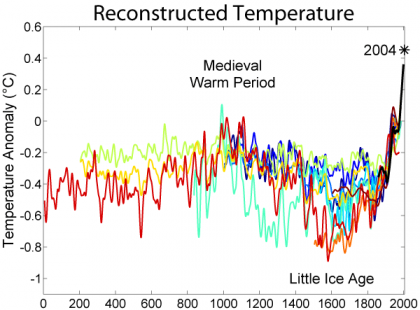
“Earth rapidly is approaching the point where the amount of warming locked in by human pollution exceeds the limits nations set last year at the international climate meeting in Paris, according to government-backed research unveiled Monday.
The planet faces “committed warming” by 2.7 degrees before 2100 if fossil fuels are burned at current rates for another 15 years, the scientists based in Colorado and Germany determined.” Denver Post 7/31/2017
When I took a serious Climate Change MOOC three years ago, the scientists who taught in the course referred to this committed warming as baked in. It was clear three years ago that the attempt to limit warming to 2 degrees would fail for two reasons. One, that amount is baked in by the amount of CO2 already in the atmosphere. Second, the rate of emissions continues to grow overall, not stabilize or decline.*
So there is not only the Donald to wreak havoc with the future, but the already emitted carbon dioxide and other gases like methane.
Yes, we need to make clear to any who will listen that these are the facts, not the fake news of our current government or self-interested fossil fuel barons. And, yes, we need to work toward as much mitigation of emissions and their effects as we can. But. We also need to face the coming changes as they will be and, even, as they probably will be, worse than we imagine.
This means taking a doubled view into the world with us. The first view sees what we can do now as necessary, as critical, yet realizes the messiness of global politics is not going to push over the line to sensible policy. The second view absorbs the first and sees the future clearly rather than through solar powered/wind energized eyes. It’s going to be bad, probably not too bad for those of us with less than thirty years to go in our remaining lifespan, but for our children and their children? Bad, trending to worse.
How can we work now to help them be resilient, proactive in their adaptive strategies? How can we work now to help them develop psychological/spiritual tools for coping with the cultural stresses that are inevitable? We cannot brush away the bad effects by magical thinking. Oh, the world will catch on and act in time. No, it won’t and it hasn’t. We need sober work on how to live with changed weather, increased heat, moving targets for animals and crops in terms of altered seasons, the disruptions of sea level rise, spread of insect borne diseases and the like.
This doubled view, pragmatic when looking at the long run, yet hopeful enough to maintain action in the short term, is critical so that we do what we can now, yet plan realistically for our next generation’s life.
*“The annual growth rate has increased since record keeping began in 1960 from just under 1 ppm in the 1960s to more than 2.4 ppm through the first half of the 2010s. The past two years have set a record for the fastest annual growth rate on record.”Climate Central.org
We’re grieving. Kate visited her rheumatologist yesterday. She has both Sjogren’s Syndrome and rheumatoid arthritis. Eric told her that patients with Sjogren’s struggle in the arid west since it’s a disease that creates dryness in the mouth and the eyes. The low humidity here exaggerates and reinforces those symptoms. In addition both Sjogren’s and r.a. (rheumatoid arthritis) can sap energy, cause joint stiffness and generally make life difficult. “This is the new normal,” Kate said.
Jon also has multiple significant diseases: type 1 diabetes, hypothyroidism, Addison’s disease (low production of cortisol), r.a. and has managed them very well. He’s 48 now and shows none of the sequelae normally associated with a long history of type 1 diabetes. These chronic conditions take up money, time and a lot of attention, requiring daily, and often more frequent than that, self-care.
Life is different now and will remain that way, that’s what we’re grieving. We had hoped there would be some medicine, some procedure, some magic that would put these insults behind us, but no.
Most of us, by the time we reach our seventies have some cluster of physical irritations and annoyances: hearing loss, kidney disease, bad joints, high blood pressure, generalized anxiety disorder, for example. If we’re lucky, we can absorb these changes, mitigate their problems and live our lives in spite of them. There is, however, always a period of adjustment, of realization that, yes, this body or this psyche has a now permanent malfunction, a condition of dis-ease.
They are reminders, often not gentle, that someday, sometime, something will end it all. The grief involved in these lesser problems is a precursor to the larger grief, the loss not only of function, but of life itself. If we let them, these short of fatal conditions can teach us how to confront and absorb the larger grief.
Santa Maria Assunta, Torcello. Revelation 20:15: “And whosoever was not found written in the book of life was cast into the lake of fire.”
The dog days. Maybe not yet as hot as this mosaic portrays, certainly not here on Shadow Mountain, though Tucson and Phoenix… Friend Tom Crane sent me a link to this Updraft post about the dog days. I miss having an erudite blog like Updraft keeping me alert about weather. Weather5280 is the closest I’ve found. It’s good on weather, but it doesn’t go off into sidebars like explaining the days after the heliacal rising of Sirius. Heliacal? What’s that you might ask? Turns out heliacal is the first appearance of a star after a long absence. The dog days begin with the return of the brightest star in the night sky, Sirius. Or, at least they used to.
The Romans believed that the dog days were so hot that they made dog’s rabid. Sirius is the major star in the constellation, Canis Major, the Great Dog, but the Romans didn’t originate linking the rising of Sirius with heat. That belongs to the Greeks. They named the star “Seirios, Greek for “sparking” (referring to its near-constant twinkling), “fiery,” or “scorching,”” According to this page on Sky and Telescope, the Greeks believed its -1.46 magnitude intensified the already hot days of a Mediterranean summer.
Neither the Greeks nor the Romans, however, were the first ancient civilization to highlight the dog star. The Egyptians began the New Year when Sirius returned to the night sky because it corresponded with the flooding of the Nile, a seasonal nourishing of the fields that made Egyptian civilization flourish. Their calendar though, because it lacked the leap year, gradually moved the month of the new year further and further from Sirius’s heliacal rise.
This lead to a discovery of the Sothic year, 1461 years of ancient Egypt’s 365 day year or 1460 of the Julian sidereal year which adds leap years. A Sothic year follows the gradual movement of the New Year until it once again occurs when the Nile floods, synching up with Sirius’s heliacal moment.
In spite of my long established affection for Orion, or perhaps because of it, I’ve never focused on Sirius. That’s a bit surprising since Canis Major is Orion’s hunting dog and Sirius is the brightest star in the night sky. I’ll be looking for it as rises this year here on Shadow Mountain, probably August 10th.
When I see it, I’ll think of this from the Sky and Telescope article because it reflects my own wistfulness for a reenchanted world:
“While the first sighting of Sirius may not signify anything as momentous as the annual flooding of the Nile, seeing it tenderly twinkling at dawn can take us back in time to when it was commonplace for people to use stars to mark important events in their lives. How far we’ve strayed.”
It’s a wonderful morning. Blue sky with high wispy clouds over Black Mountain, lots of sunshine. Solar panels soaking up energy direct from the source. Temperatures have cooled a bit.
The sun, risen again after our mountains spun away from it last evening, shines. But, upon what does it shine? Read this surprising conclusion:
“Many (flat earthers) subscribe to the “ice wall theory,” or the belief that the world is circumscribed by giant ice barriers, like the walls of a bowl, that then extend infinitely along a flat plane. Sargent envisions Earth as “a giant circular disc covered by a dome.” He likens the planet to a snow globe, similar to the one depicted in “The Truman Show,” a fictitious 1998 existential drama about an insurance salesman unknowingly living in an artificially constructed dome.”
Turns out that among other distinctions Colorado has a central spot in the Flat Earth movement:
“The Centennial State has been the cradle of the American flat earth renaissance since birth. The first Flat Earth International Conference, which will be in Raleigh, N.C., in November, features a number of Colorado-based Flat Earthers, including Sargent, Knodel and Matthew Procella, or ODD Reality, a Denver-based rapper and YouTuber with 75,000 subscribers and nearly 7 million video views.” These Coloradans Say The Earth Is Flat.
Now if you’re under the continuing delusion that the earth is a globe, here are Youtube channels that will correct your misguided perspective, Jeranism and Globebusters. (Get it?)
With the first draft of Superior Wolf finished I’m taking this week to do various tasks up in the loft that I’ve deferred. Gonna hang some art, rearrange some (by categories like Latin American, contemporary, Asian) and bring order to some of my disorganized book shelves. I want to get some outside work in, too, maybe get back to limbing and do some stump cutting, check out nurseries for lilac bushes.
After taking advantage of the weekend to do the hike at Staunton, some slower treadmill work in the afternoon, then two sessions on Sunday, both on the treadmill, one faster, one slower, I got to 11,000 plus steps on Saturday as I said and 9,745 on Sunday. I believe once I go back to my personal trainer, in six weeks or so, I’ll be able to hit the 10,000 target regularly and get my resistance work done, too. Feels like I’m moving past the knee surgery, not fully past it yet, but well on the road.
Even so, reimagining is beginning to exert a centripetal force on my thinking, book purchasing, day to day. For example, last night as I went to sleep a cool breeze blew in from the north across my bare arms and shoulder. It was the night itself caressing me. I went from there to the sun’s warm caresses on a late spring day. The embrace of the ocean or a lake or a stream. The support given to our daily walking by the surface of mother earth. The uplift we experience on Shadow Mountain, 8,800 feet above sea level. These are tactile realities, often felt (0r their equivalent).
Now, imagine that we stop, take a moment and feel them, as I now feel the attraction gravity affords me while sitting here, writing this. It keeps me grounded, able to stay in place.
Next, eliminate the metaphorical. If we do that, we can immediately jump into a holy moment, a moment when the bonds that tie us to grandmother earth are not figurative, but real. The breeze on my bare arms and shoulders is her embrace. The sun on my face, penetrating my body, is him in direct relationship with me, reaching across 93 million miles, warming me. The ocean or the lake or the pond or the stream cools me, refreshes me, hydrates me, acts of chesed, loving-kindness, from the universe in which we live and move and have our being.
This kind of reframing, reenchanting, helps us reimagine faith, a faith that does not require texts or institutions, just the opening of ourselves to the mystery and magic that are our literal birthright.
I wish I thought it was cynicism, the gratuitous act of a calculating politician, this latest, perhaps species’ ending decision. “I’m deciding for the citizens of Pittsburgh, not the citizens of Paris.” I wish I didn’t think it was a faulty mind at work, but I do. By faulty in this case I mean stupid. Trump may not be I.Q. stupid, though I don’t imagine he’s top of the class, but he’s unlearned, uninquisitive and lacks critical thinking skills. This is the functional equivalent of stupidity.
He seems to have base instincts (a political pun, intended) which he marries to advice from people who have ideological blinders he doesn’t understand. He clearly loves being the decider so he takes in certain streams of information, then chooses what he believes will Make America Great. What will put America First. In this case, as in so many others, he doesn’t seem to understand that the U.S.A. is no longer, if it ever was, separate from the world as a whole.
Climate change does not care about boundaries. It does not care if you’re a resident of Paris, Pittsburgh, Timbuktu or Katmandu. The rain, as the proverb goes, falls on the just and the unjust. So with a ratcheting up of the earth’s temperature. Trump thinks he’s putting Pittsburgh ahead of Paris when what he’s really doing is pitting this generation against the next, saying that this one deserves more attention than the next. There is no hint, none at all, of seven generations thinking in his choices. Today is all that matters. Right here in the U.S.A. is all that matters. Right here in the U.S.A. all that matters is the effect on my base. (which he badly misreads, by the way)
He sees the fate of the white working class and the fate of America’s energy corporations tied together, a grim marriage and one doomed to fail and in its failure to scour humanity from the planet. So much for a sustainable future.





 A week from today we’ll be on the road in a rented R.V., Ruth and Gabe on board, headed to Driggs, Idaho. It will be Kate’s 73rd birthday. I wrote a post on
  Perhaps this eclipse on August 21st is an opportunity for us all to merge the outer with the inner, to experience the same fear our long ago ancestors did when they imagined the world might die, the sun might never reappear. It may be a chance to integrate this slow motion catastrophe through which we are living, in which we are implicated, and consider it in a new way.
 Dark ecology. I’ll post more about this both here and on AncientrailsGreatwheel.com, but it interests me a lot right now. It’s a contrarian view of the climate crisis, but not in a denier vein. These are folks who accept climate science, but take a pessimists look at the likelihood of change, at least change sufficient to stave off disaster. They don’t see it happening. This could be equated to the final stage of the grief process, acceptance.
 I’m not familiar enough now with the movement to comment in depth, but the tone of it strikes a chord in me. Admittedly, it’s a melancholy chord though the more you know about both climate science and the current political will to tackle change, the more that chord may come to dominate the melody of your life. It’s either brave, facing reality in spite of its horror, or defeatist. Maybe it’s both.
 “Earth rapidly is approaching the point where the amount of warming locked in by human pollution exceeds the limits nations set last year at the international climate meeting in Paris, according to government-backed research unveiled Monday.
 So there is not only the Donald to wreak havoc with the future, but the already emitted carbon dioxide and other gases like methane.
 How can we work now to help them be resilient, proactive in their adaptive strategies? How can we work now to help them develop psychological/spiritual tools for coping with the cultural stresses that are inevitable? We cannot brush away the bad effects by magical thinking. Oh, the world will catch on and act in time. No, it won’t and it hasn’t. We need sober work on how to live with changed weather, increased heat, moving targets for animals and crops in terms of altered seasons, the disruptions of sea level rise, spread of insect borne diseases and the like.
 We’re grieving. Kate visited her rheumatologist yesterday. She has both Sjogren’s Syndrome and rheumatoid arthritis. Eric told her that patients with Sjogren’s struggle in the arid west since it’s a disease that creates dryness in the mouth and the eyes. The low humidity here exaggerates and reinforces those symptoms. In addition both Sjogren’s and r.a. (rheumatoid arthritis) can sap energy, cause joint stiffness and generally make life difficult. “This is the new normal,” Kate said.
 Life is different now and will remain that way, that’s what we’re grieving. We had hoped there would be some medicine, some procedure, some magic that would put these insults behind us, but no.


 Turns out that among other distinctions Colorado has a central spot in the Flat Earth movement:
 With the first draft of Superior Wolf finished I’m taking this week to do various tasks up in the loft that I’ve deferred. Gonna hang some art, rearrange some (by categories like Latin American, contemporary, Asian) and bring order to some of my disorganized book shelves. I want to get some outside work in, too, maybe get back to limbing and do some stump cutting, check out nurseries for lilac bushes.
 Even so, reimagining is beginning to exert a centripetal force on my thinking, book purchasing, day to day. For example, last night as I went to sleep a cool breeze blew in from the north across my bare arms and shoulder. It was the night itself caressing me. I went from there to the sun’s warm caresses on a late spring day. The embrace of the ocean or a lake or a stream. The support given to our daily walking by the surface of mother earth. The uplift we experience on Shadow Mountain, 8,800 feet above sea level. These are tactile realities, often felt (0r their equivalent).
 Next, eliminate the metaphorical. If we do that, we can immediately jump into a holy moment, a moment when the bonds that tie us to grandmother earth are not figurative, but real. The breeze on my bare arms and shoulders is her embrace. The sun on my face, penetrating my body, is him in direct relationship with me, reaching across 93 million miles, warming me. The ocean or the lake or the pond or the stream cools me, refreshes me, hydrates me, acts of chesed, loving-kindness, from the universe in which we live and move and have our being.
 I wish I thought it was cynicism, the gratuitous act of a calculating politician, this latest, perhaps species’ ending decision. “I’m deciding for the citizens of Pittsburgh, not the citizens of Paris.” I wish I didn’t think it was a faulty mind at work, but I do. By faulty in this case I mean stupid. Trump may not be I.Q. stupid, though I don’t imagine he’s top of the class, but he’s unlearned, uninquisitive and lacks critical thinking skills. This is the functional equivalent of stupidity.
 Climate change does not care about boundaries. It does not care if you’re a resident of Paris, Pittsburgh, Timbuktu or Katmandu. The rain, as the proverb goes, falls on the just and the unjust. So with a ratcheting up of the earth’s temperature. Trump thinks he’s putting Pittsburgh ahead of Paris when what he’s really doing is pitting this generation against the next, saying that this one deserves more attention than the next. There is no hint, none at all, of seven generations thinking in his choices. Today is all that matters. Right here in the U.S.A. is all that matters. Right here in the U.S.A. all that matters is the effect on my base. (which he badly misreads, by the way)