Lughnasa Labor Day Moon

Lughnasa Labor Day Moon
Lughnasa Labor Day Moon
 Two hours in the dentist’s chair yesterday. Cleaning, followed by a crown prep and filling two cavities. When Kate came back from the dentist on Wednesday talking about the sticky fluoride treatment she’d received, it made me realize we’ve had no fluoride in our water for over 20 years. Living with our own well.
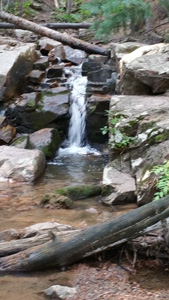
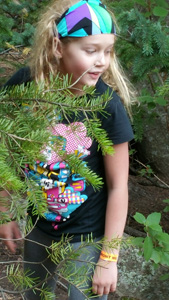
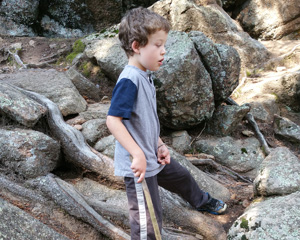
Took Gabe and Ruth to the Upper Maxwell Falls trail yesterday afternoon. We didn’t make it to the falls, instead wandering off on an alternate trail that climbed through jumbles of boulders and large, rocky cliffs. The regular trail is very popular in spite of its out of the way location. Over the summer there have been no fewer than six cars and often twenty parked at the trailhead.
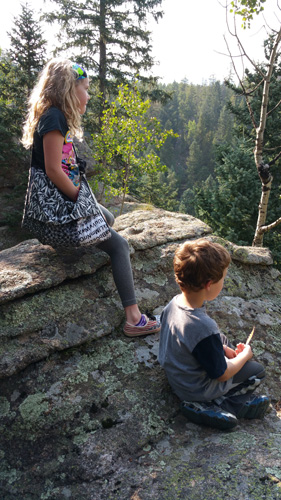
We examined plants. Ruth found a snake (she wants one for a pet.), but it slithered away 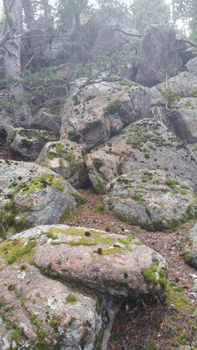 beneath the rocks. We climbed on the rocks and looked out. Nature provides something new, something noteworthy every foot or so. It was a slow hike. Here were lichen, familiar forms from Minnesota. There was a very late blooming Indian Paint Brush, its fiery bloom resting on the ground. The trees, some of them, were huge, trunks so big that Gabe, Ruth and I couldn’t get our arms around them holding hands.
Maxwell Creek exerted the magnetic attraction that water has for humans. We went down twice to be closer to it, the first time we crossed over to the alternative trail that we followed. The second time we crossed back to the Falls trail. Ruth talked about some camp counselors who followed a mountain stream to its source, an artesian spring, drinking from it, since “water is never fresher.”
Being in the Arapaho National Forest has its own version of mindfulness, one in which attention leaves the world of the day-to-day and focuses on an interesting rock, a blooming flower, the sound of water rushing over rocks, the view from a boulder. The eye scans for what is new or unfamiliar, being delighted constantly by a patch of cowslip, a bit of lichen on a lodgepole pine, a small squirrel playing peek-a-book around a thin aspen trunk.
Ruth and I are going back this morning, taking Kepler along in his harness.
Lughnasa Labor Day Moon
Lughnasa Labor Day Moon
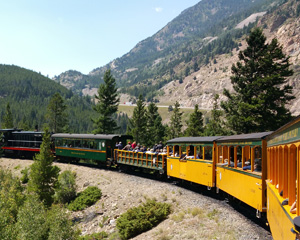 Colorado’s mining culture, essential to the state’s history, has left imprint after imprint on mountainsides in the existence of mining towns like Idaho Springs, Leadville and Georgetown, in dirty yellow tailings runoff like flooded the Animas River a couple of weeks ago, and in now tourist oriented railroads that once carried miners, their supplies and their product, often gold and silver in the early days.
The Georgetown loop railroad, a 4.1 mile trip to a 2 mile away destination, exists because the grade between Georgetown and Silver Plume would be too steep, 7%, without it. Ruth and Gabe spent part of their 2012 ride cowering from the blasts of the train’s whistle, but not this year. This year it was “awesome.”
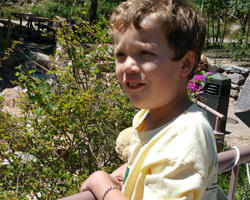 Kate and I are down to our last two days of grandparent immersion, the two week plunge that began last week Monday. Tomorrow I’m taking Ruth and Gabe hiking on the Upper Maxwell Falls Trail, about a mile and a half from our house. Today though, as Ruth said, “Sadly, Grandpop will not be with us.” I have a two-hour marathonman dental session. What a joy.
(Gabe standing on the bridge over Clear Creek, which gives Clear Creek County its name.)
Lughnasa Labor Day Moon
Rain continues to come to the mountains. When Kate and I went out early this morning to Evergreen for our business meeting, there was dew on the grass, tips of the spruce needles and faint wisps of vapor rising from the valley floor. The intensity of green reminded both of us of the Midwest, of northern Minnesota. Usually, Shadow Mountain and its neighbors would be taken over by browns and dull greens. Not this year.
Our lives continue, with each small journey through the mountains, to become more and more embedded here, memories filling us up with Colorado. Not in place of Minnesota, no, but adding to those memories. And calling these new ones memories of home.
We visited IKEA and ordered the last of the bookshelves, 5 more. Cybergremlins have attacked our credit card online, not hackers, but ones making it difficult in certain instances to get websites to accept our valid account. As a result, we had to get in the car, drive down the mountain, go south on Hwy 470 along the Front Range, get off at Yosemite Street and proceed to the large blue monument to Swedish efficiency on IKEA way in Centennial. There, we made the exact same order I had to tried to make online, used the same credit card and had a successful experience.
The whole trip reminded us of the real benefits of buying online. The physical moving is left up to the product, not the purchaser. Of course, while wandering the intentionally maze-like corridors of the IKEA store, we did find that wonderful children’s storage and table combination and a probable small table for our breakfast area. That wouldn’t have happened online. On balance I would rather have stayed home and discovered both another way.
Lughnasa Labor Day Moon
I’m having a moment. It’s immediate stimulus has been reading How Forests Think, by Eduardo Kohn. Kohn is an anthropologist who has done significant field work in el Oriente, the east of Ecuador where the Andes go down into the tropical rain forests of the Amazon drainage. But this book is something else. Though it draws on his field work with the Runa, its focus is the nature of anthropology as a discipline and, more broadly, how humans fit into the larger world of plants and animals.
Thomas Berry’s little book, The Great Work, influenced a change in my political work from economic justice to environmental politics. Berry said that the great work for our time is creating a sustainable human presence on the earth. In 2008 I began working on the political committee of the Sierra Club with an intent to do my part in an arena I know well. I continued at the Sierra Club until January of 2014 until I resigned, mostly to avoid winter driving into the Twin Cities.
Since then, I’ve been struggling with how I can contribute to the great work. Our garden and the bees were effective, furthering the idea of becoming native to this place. The move to Colorado though has xed them out.
Kohn’s book has helped me see a different contribution I can make. Political work is mostly tactical, dealing in change in the here and now or the near future. In the instance of climate change, tactical work is critical for not only the near future but for the distant future as well. I’ve kept my head down and feet moving forward on the tactical front for a long, long time.
There are though other elements to creating a sustainable human presence on the earth. A key one is imagining what that human presence might be like. Not imagining a world of Teslas and Volts, renewable energy, local farming, water conservation, reduced carbon emissions, though all those are important tactical steps toward that presence; but, reimagining what it means to be human in a sustainable relationship with the earth.
Kohn is reimagining what being human is. His reimagining is a brilliant attempt to reframe who thinks, how they think and how all sentience fits together. He’s not the only one attempting to do this. The movement is loosely called post-humanist, removing humans from the center of the conceptual universe. A posthuman world would be analogous to the solar system after Galileo and Copernicus removed the earth from the center. Humans, like the earth, would still exist, but their location within the larger order will have shifted significantly.
This fits in so well with my reimagining faith project. It also fits with some economic reimagining I’ve been reading about focused on eudaimonia, human flourishing. It also reminds me of a moment I’ve recounted before, the Iroquois medicine man, a man in a 700 year lineage of medicine men, speaking at the end of a conference on liberation theology. The time was 1974. He prayed over the planting of a small pine tree, a symbol of peace among the tribes of the Iroquois confederacy because those tribes put their weapons in a hole, then planted a pine tree over them.
His prayer was first to the winged ones, then the four-leggeds and those who swim and those who go on water and land, the prayer went on asking for the health and well-being of every living thing. Except the two-leggeds. I noticed this and went up to him after the ceremony and asked him why he hadn’t mention the two-leggeds. “Because,” he said, “we two-leggeds are so fragile. Our lives depend on the health of all the others, so we pray for them. If the rest are healthy, then we will be, too.”
Reimagine faith in a manner consistent with that vision. Reimagine faith in a post-humanist world. Reimagine faith from within and among rather than without and above. This is work I can do. Work my library is already fitted to do. Work I’ve felt in my gut since an evening on Lake Huron, long ago, when the sun set so magnificently that I felt pulled into the world around me, became part of it for a moment. Work that moment I’ve mentioned before when I felt aligned with everything in the universe, that mystical moment, has prepared me for. Yes, work I can do. Here on Shadow Mountain.
Lughnasa New Labor Day Moon
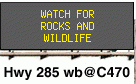 As you head into the foothills on Hwy. 285, there is one of those digital signs. The first night I drove up here to Black Mountain Drive it read: Watch for Wildlife. Seeing that l.e.d. message made me feel like I was going home, even that first night. After all the rain we’ve had this summer, it now reads: Watch for Rocks and Wildlife. This is not Round Lake Boulevard in Andover.
Another sign, at a Catholic Church in Woodland where we were last Saturday: If you’re looking for a sign from God, this may be it.
Bush-hogging. Another term new to me. Someone wanted a bush-hogger for their property. I looked it up. Oh, it’s one of those mower things pulled behind a tractor.
A part of grandparent immersion, this week and next, is taking the kids back, every other day or so, in the late afternoon. Due to rush hour on I-70, “that I-70 mess” as our mortgage banker referred to it, we’ve taken the opportunity to find new restaurants and new sections of Denver.

Last night we ate at Leña on South Broadway. “Leña is a Latin American inspired upscale, casual restaurant with a fun, vibrant atmosphere, focused on sharing and communal dining. The name translates to “firewood”, and a white oak, wood fired grill serves as a culinary focal point, offering a vast asado selection of grilled meats, seafood, and vegetables.”
Good food, buzzy, hipster atmosphere. Another new term to me: check presenter. When we tried to return a book to a customer who had just left, a waiter informed us that the book was, “their check presenter.” Sure enough, when it came time to pay, the same book came to our table with the check in the flyleaf. It contained, too, a note from an apparently very happy gay customer. Somewhat, well, no, a lot, blue.
 After the meal, we walked up Broadway toward the car. Leaning over the sidewalk facing counter at Sweet Action, an ice cream joint a couple of doors away, were a woman and her three kids, eating ice cream cones. I nodded to her since they had been sitting near us in Lena and said, “I thought about stopping here.” She smiled and said, “This is the way you top it off.” There was something warm in her reply, inclusive, and it made me feel welcome in this neighborhood.
Lughnasa Recovery Moon
As in Andover, we share our property and neighborhood with many other critters. Elk and mule deer come regularly to eat the clover in our front or strip bark from the aspens. A fat old fox waddles down the road now and then. Last night coming back from Evergreen on Black Mountain Drive a mule deer doe standing right on the shoulder of the road watched us as we slowly passed her. All of us enjoyed watching her watching us.
On Sunday Kate and I drive into Evergreen to the Lakeshore Cafe for our weekly business meeting. This last Sunday, going down Black Mountain Drive toward Evergreen, two foxes, healthy with beautiful coats, were in the middle of the road, one red and one black with just a nip of silver on its tail. As we approached, they startled and each headed for opposite sides of the road.
In looking for a picture of the black fox I learned they are called silver foxes and are a regular, but uncommon melanin variation of the red fox. They were the most prized of fox fur and according to Wiki were once considered worth forty beaver skins by natives of New England. Seeing the two together, both with fine coats, was a treat and a surprise.
We know there are bears, too, since our Shadow Mountain neighbors have been talking about them opening car doors in search of food, but we’ve not seen any. That’s just as well since any sort of habituation is dangerous for the bears. That’s why we keep our garbage in the garage and take it only an hour or so before pick up.
Where there are deer, the saying goes here, there are mountain lions. Maybe so, but again, we’ve seen nary a one. Of course, they’re very elusive, like bobcats and lynx, so they could be close by and we’d never know.
I do hear coyote yipping at night around 9 pm, but I’ve never seen one of them either.
Lughnasa Recovery Moon
Yesterday finally got Herb, the ex-Minnesota, ex-Andover resident, ex-USAF guy to put in the gas line for our generator install and the gas stove we intend to buy for the kitchen. Under the #thisisironic hashtag our power went out that morning around 3 a.m. It was out all day, not coming back on until around 10 p.m. If we’d been able to get this done last week…
Something happened to a power pole. The problem was, a Colorado mountain problem, that the pole was located at some high, distant location. This means they had to bring helicopters and crews that work from them.
Over the course of the day we heard small town gossip that power was out until today at the earliest. Maybe Wednesday. Doesn’t sound like much, I know. But we’re on our own well, like our neighbors. No electricity, no water. This was the primary reason for our owning a generator in the first place. Of course, it’s also true, no electricity, no heat. And, in our current, pre-kitchen renovation state, no way to cook hot food. Electric stove.
Before surgery I could not eat and thought only of food, yesterday, when we had no electricity, we thought only of the things we were missing. No stove. No lights. No water. No news. No way to recharge cell phones. No internet. No TV. No garage door opener.
We live a life of great privilege. It’s easy to forget that until something basic gets taken away, even for a short while. In Maslow’s hierarchy the very bottom of the pyramid is taken by the Hullian needs: air, water, food, the essentials of survival. If you don’t have them, that’s where your attention is. Electricity, in our technology/appliance dependent culture, is only one step further up the pyramid.
The world is big and most of it doesn’t have dependable electricity, huge swaths of humanity don’t have enough food or water. Like meatless Fridays, an electricityless day now and then is good for the soul.
Summer Recovery Moon
The last few nights the clouds at sunset have been what seem to my eye a color of red peculiar to the west. They remind me of Riders of the Purple Sage or High Noon if it had been made in color. The sun goes down behind Black Mountain from our vantage point, so just beyond it the old west could still be banging saloon doors, its streets filled with dust as the cowboys ride in after payday.
I’m no geographical determinist, but to say that living on a mountain is different from living on the flat lands of the Midwest is only common sense. In Minnesota the variation in the landscape came from beautiful rivers, forests of deciduous trees sprinkled with conifers, lakes and ponds, wetlands and the changes going north wrought on all of these. It was not big sky country, but on the way home to Andover the dome of the sky was large and largely visible.
In the Front Range the variation in landscape follows an altitude gradient, different trees and different plants, wildflowers appear as we drive up from Denver the 3,600 feet that separates Shadow Mountain from the start of the high plains. The sky, once in the mountains, is visible in fragments determined by the height and shape of the mountains. The trees are mostly conifers and firs, green throughout the year, though the aspen grows well even at our 8,800 feet. Along the creeks willows and dogwood grow, deer and elk browse.
The changes are more subtle here and require some to time to absorb though the mountains, in their bulky looming make themselves known like the slow-moving, light blinking semi-trailers that crawl slowly up the highways into them. You have to move around them. In the fall there is no blaze of color, jack frost running from tree to tree calling out magenta, dark red, yellow, subtle browns. In the mountains there is green, the conifers and firs, and gold, the leaves of the aspen finished with their summer’s work.