Category Archives: Mountains

A Western Way

Spring                                          Beltane Moon

Discovered two places that may shape my long term presence here in the West. The first I found in, of all places, the NYT. The article recounts the new mission of the former owners of Denver’s most treasured book store: Tattered Covers.

They gave up the book trade to create the Rocky Mountain Land Library. Here’s a brief explanation from their website:

“IMAGINE a network of land-study centers stretching from the Headwaters of South Park to the metro-Denver plains. Each site will be united by the common purpose of connecting people to nature and the land, but each site will have something unique to share:

South Park’s Buffalo Peaks Ranch will offer a 32,000+ natural history library, along with residential living quarters for anyone who would like to experience the quiet and inspiration of a book-lined historic ranch, set on the banks of the South Platte River, and surrounded on all sides by a high mountain landscape, with some peaks rising to over 14,000 feet.”

As it happens South Park (of television fame) is about an hour from here going west and over the Kenosha Pass in the South Park Heritage Area. It is, oddly, 66.6 miles from here according to Google Maps.

I plan to volunteer here as soon as my medical condition becomes clearer. This will point my life more towards the west, away from Denver. A good thing for me and it will root my life more in the Rockies and the idea of the West.

The second I discovered just today, The Shumei Natural Agriculture Institute in Crestone. Here is a brief explanation:

“Doing nothing, being nothing, becoming nothing is the goal of Fukuoka’s farming method, an approach to agriculture which he has pursued for over forty years with resounding success. With no tillage, no fertilizer, no weeding and no pesticides he consistently produces rice, barley, fruit and vegetable crops that equal or exceed the yield per acre of neighboring farmers who embrace modern scientific agriculture. The basis of his philosophy is that nature grows plants just fine without our interference so that the most practical approach is to get out of the way. In the course of explaining his reasoning and methods, this do-nothing farmer delivers a scorching indictment of chemical agriculture and the human assumption that we can improve on nature. He explains the beneficial role of insects and plants usually characterized as pests, the fallacy of artificially boosting fertility with petrochemical concoctions, the logical error implicit in the use of farm machinery or draft animals, and why pollution is an inevitable result of misguided attempts to improve on nature.” This from an Amazon review of his book: Natural Way of Farming: The Theory and Practice of Green Philosophy.

This is exciting, a form of gardening that appeals to my soul. Crestone is about three hours from here just off 285. I’ll get down there sometime soon and start reading about Natural Agriculture.

Spring                                                    Mountain Spring Moon

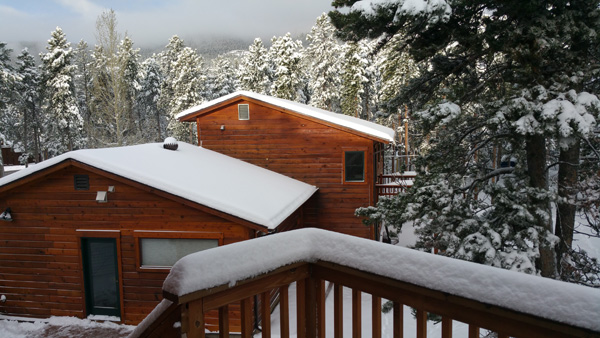
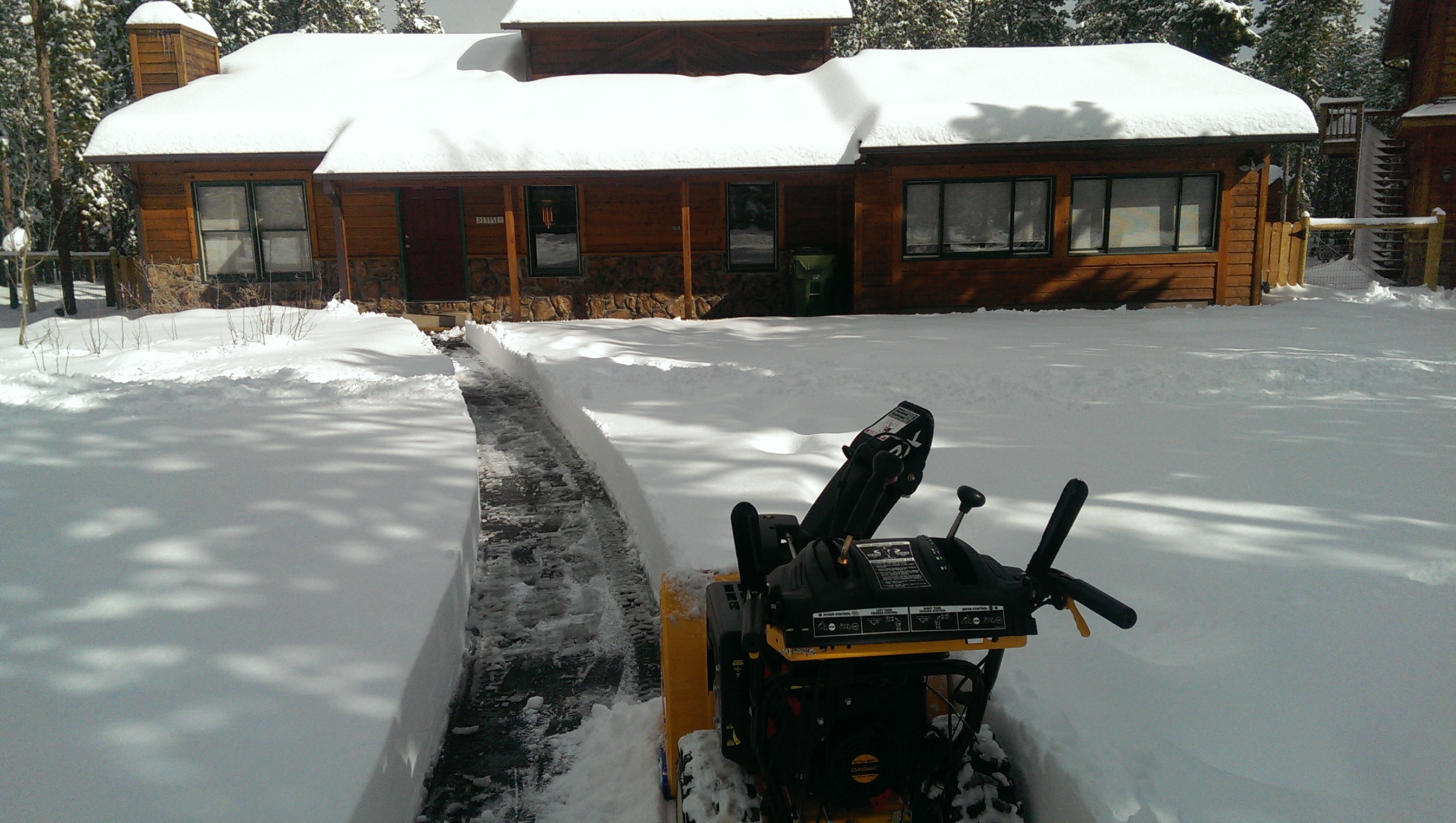
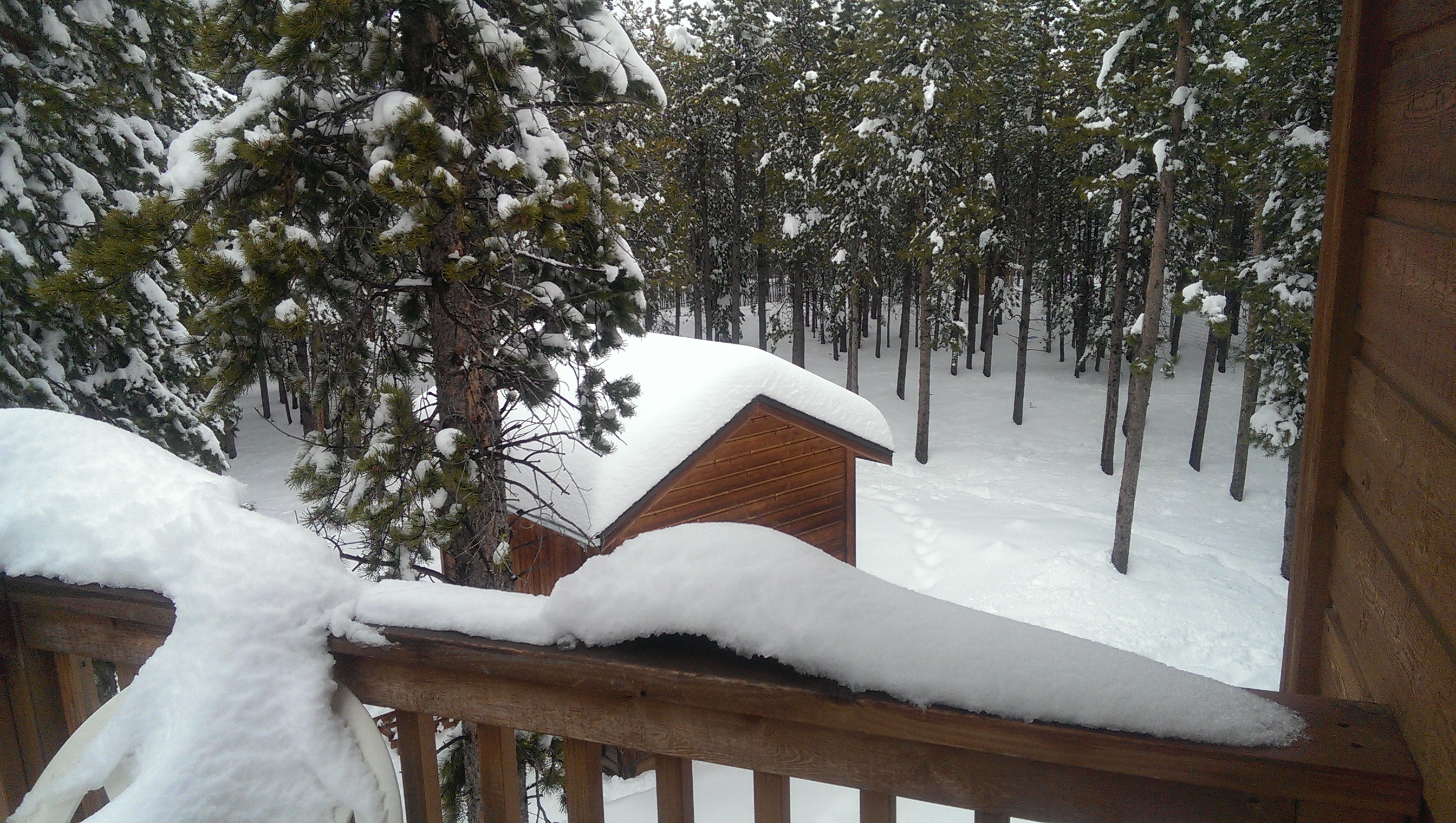
Snow continues, coming down in narrow linear columns like rain and floating down, too, like snow flakes gently drifting. The result is an odd mixture of lightly falling and pelting. We have a motion sensor on the light near our deck and it came on and stayed on during the storm, not sure why.

Now the day dawns, a grey-blue, snow still falling, forecast to continue until tonight at least. The ponderosas look like melted tapers. No paper this morning. Not surprising.

IMAG1108

IMAG1107


Spring                                         Mountain Spring Moon

Snow continues to fall. Straight down, like rain, not sideways as in many Minnesota storms. It gathers, soft and pillowy over stumps, rocks, steps, decks and driveways. This is wet, heavy snow and it weighs down the ponderosa branches.

In the Denver area many trees have already leafed out and the heavy snow will be hard on them. Up here though the aspen have no buds yet. The willows I mentioned the other day are in the valleys, not this high.


Lucky We Live the Mountains

Spring                                                        Mountain Spring Moon

Lucky we live the mountains. Yes, Minnesota is a beautiful state, but the exurban chunk of it in which we lived and the areas in which I usually traveled, south toward Minneapolis, only occasionally reflected the wonder of the northern part of the state. There was the Mississippi, the lakes in the city, the green belt of parks. There was little Round Lake on Round Lake Blvd. That was about it. The rest of it, the beautiful part, including northern Anoka County with its high water table, marshy and wooded terrain, had to be sought out by driving.

Here the 3 mile drive home from highway 73 up Black Mountain Drive winds past a valley filled with grass and pine on the south side of which rises Conifer Mountain. To the north Shadow Mountain gradually pulls the road higher and higher, rocks jutting out, ponderosa and aspen dot the slopes and mule deer sometimes browse. Each morning when I go to the mailbox to retrieve the Denver Post Black Mountain is on my right, guarding the west and the eventual sunset.

Anytime we leave home, whether to go into Evergreen for our business meeting or into Denver to see the grandkids or south toward Littleton for medical care mountains and valleys, canyons and gulches grace the roadways. Small mountain streams run next to the roadways, swift and right now, often violent. Walls of sheer rock alternate with wooded mountainsides. Always the journey is up or down until we get past the foothills onto the beginning of the great plains where the Denver metroplex takes over.

This was my thought while driving home from the doctor yesterday. How short is a human life span. Not even a tick of the second hand to this rock. These mountains have been here for millions of years longer than the human species itself has existed. They will probably be here millions of years after we’re gone. What is one lifetime? What is a few years here or there? Compared to these. This was a comforting thought.

Pulses

Spring                                               Mountain Spring Moon

Under the mountain spring moon various shades of green have slowly, slowly begun to appear. The ponderosa pines have been green all winter but they’ve greened up some. The first ground cover green to appear was the bearberry when the snow melted back. This evergreen ground cover was green all along, just hidden. A shaded patch of moss has gone from a muted pale green to emerald over the last couple of weeks. There are, too, even here at 8,800 feet, dandelions. Some grass, too. Crab grass for sure, another hardy perennial. Tufts of grass that look like prairie drop seed, but are not, I’m sure, remain their winter tan.

Too, the dogs have begun to sniff through the deck, smelling, I suppose, new rodents of some kind. Along with that has come Rigel digging. With the advent of warmer soil Rigel and Vega may begin creating holes in the rest of the yard as well. Another harbinger of spring.

Birds chirp happily around 5:30-5:45 am as the sun begins to rise.

Driving along Highway 78 (Shadow Mountain Drive, Black Mountain Drive (our segment) and Brook Forest Road) the only snow that remains is on the north side of the road or in shaded spots. A pond not far from our house still has ice, but the ice has a shallow layer of water over it. The mountain streams run, burble, ice now long melted and turned into stream. Willows along the streams look fire tipped as their branches turn a green gold. “Like dusted with gold,” Kate said.

The mountain spring is a slow arriver, coming in pulses, alternated with sometimes heavy snows. We have the potential, for example, for a huge snow storm Wednesday through Friday.

While on a drive Sunday, not far from our home, on top of a large outcropping of rock where the sun penetrated the trees, lay a fox, curled up and enjoying a quiet Sunday nap. The fox was a tan spot against the gray of the rock. Mule deer have begun to return as well, we see them at various places along the slopes and valleys. Kate just called and said, for example, that we have four deer in our front yard and “the dogs are levitating.” Sure enough, there they are, finding the green just as I have been.

The Mountain Docent

Spring                                                                Mountain Spring Moon

Two years ago this January I did my last work at the Minneapolis Art Institute, a Terra Cotta Warrior tour. Right after that tour I wanted a rest, so I signed out until June of 2103. By April, two years ago exactly, the thought of making multiple drives into the city a week had become less and less interesting, even with the art reward at the other end. By June I’d decided to step back and concentrate on Missing, the novel I finished about a year ago.

It was the right move for me and one I followed by also resigning my position as chair of the Sierra Club Northstar Chapter’s Legislative Committee. In April of 2014 it was time for another Ira Progoff Journal Workshop, this time in Tucson. The impetus to fall back toward home got another push. Kate and I were still in the process of learning about retirement, hers and mine.

Since this post comes from Shadow Mountain in the Rockies, it’s clear–in retrospect–that the homecoming urge had deeper roots. Family. We changed the entire location of our life to reflect that impulse.

But. Sometime in the summer of 2013 I created a file, Art after the Minneapolis Art Institute. Visit galleries. Go to exhibitions. Read art theory. Do research on individual artists. It’s taken until April of 2015 to find a path. The Mountain Docent is a path of discovery.


Even an encyclopedic museum like the MIA has limitations in its collection. Art is not only long, it is also big. An encyclopedic museum strives to have art from each era and each culture. Of course, few but the very biggest, like the Met, the Louvre, the Prado even come close to depth across all the eras and locations of art making and they still fall very short in certain areas. Often modern and contemporary art are weak due to the encyclopedic museum’s emphasis on completeness in telling the art historical story.

The Google Cultural Institute and its Art Project delivers a different work at regular intervals on blank web pages.  That made me see the direction my work with art could take. Here was an opportunity to transcend the limitations of even the most encyclopedic museums since the Art Project draws on work held in museums across the world. It also has the distinct advantage of introducing me to art, artists and artistic movements with which I’m unfamiliar. (Which is, I admit, a lot.)

Once the Art Project began exposing me to new work, options for gaining access to new work in other ways seemed to multiply. The Met’s Artist’s Project, mentioned below, has contemporary artists reflecting on works held in the Met’s collection. A viewer gains exposure to the artist who’s commenting and the art which they discuss.

Other venues will surface as time goes on. The unpredictable nature appeals to me. It allows me to investigate new artists and new works by old artists and share that learning. That was what I always enjoyed most about being a docent, learning and sharing. So the Mountain Docent will travel the world in search of art and artists that will interest and engage you. All without leaving Shadow Mountain.


Moon Over Black Mountain

Spring                                                            Mountain Spring Moon

1428323496098Snow last night, not much but enough to coat rooftops and give the moonshine a reflective surface in the back. The moon hung directly over Black Mountain for a couple of mornings. Here’s a fuzzy (phone) photo taken from the deck off my loft.

An odd phenomenon with shifting my workouts to the morning. I get more work done in the morning. Then, though, the afternoon, late afternoon, seems to drag.

This will become my reading time for work related material. Right now I’m studying germline gene therapy for Superior Wolf. I’m also reading an older historical fiction piece called The Teutonic Knights by Henryk Sienkiewicz. Written in 1900 it is a great read. Sienkiewicz was prolific, author of many other works of historical fiction, including Quo Vadis. The Teutonic Knights have a role to play in Superior Wolf,so that book is work related, too.

I count Latin, writing and reading to support them as work, as I do gardening and beekeeping. Some people would count these as hobbies, especially the gardening and the beekeeping, but for me they represent the non-domestic parts of my day and have done for many years now.

At least for me a day filled only with meals, leisure reading, volunteer activities, shopping would be lacking a contrast, the contrast provided by labor with a forward progression, aimed toward an end of some kind. As I wrote before, I’m learning to detach myself from the results of this work, but that doesn’t deflate its value. Hardly. Work remains key to a sense of agency, a sense that does not come from merely sustaining life. For me.

Mentioning work, Kate made me a spectacular wall-hanging with vintage Colorado postcards.

Sombra y Sol

Spring                                                          Mountain Spring Moon

Light and shade photographs. Every hour I’m taking shots of our yard, searching for duration of sunlight at given spots. Vegetables need around 8 hours, a pretty high standard for most yards with trees and buildings. Some flowers and other perennials can get by with less, some thriving in part shade.

Of course, there are other factors at play here, too. One is that we’re closer to the sun and have less atmosphere to block out the UV radiation, so plants can burn. Another is that we’re west of the 20 inches of moisture per year line, meaning that in most years we get less than that. Vegetables, again, need plenty of water. Witness the struggle going on in California’s Central Valley to keep the farms watered. Most flowers and perennials can get by with less than vegetables and here in the West there are many species and varieties already adapted to the xeric environment. That’s what we’ll be looking for when it comes to plantings for aesthetics.

As or more important than all of these are temperature fluctuation and maximum temperatures. Temperature fluctuations can be extreme here, but they’re not a huge problem as long as they remain above 32. The average last frost here is early June and the average first frost around September 20th. Maximum temperatures can interact with aridity and UV exposure to increase the likelihood of burning plants. Also, some vegetables, notably tomatoes, need sustained warmth to fruit.

Not sure how much we’re going to get done this year, probably reconnoiter, meet others who garden up here, try a few things. Next year will be bees and garden. Of course, we still have to sell that Andover house.