Category Archives: Plants

Summer Solstice 2016

Summer                                                                     Moon of the Summer Solstice

redagainstwhite cropped
Fairplay, South Park

Light to dark. A continuum and a dialectic. Our inner lives fall, always, somewhere along this line. Our life might be bright, cheery, goals and actions easy to see, our days bouncy and their weight upon us like a feather. Or, our lives might be dark, intense, solemn, our next moves difficult to imagine, our days heavy, weighing upon us like a great rock.

But the Great Wheel shows us a yet deeper truth. Light to dark and dark back to light is the way of life on this earth. In the temperate latitudes this truth is at its most nuanced and its most fruitful. Quite literally. In temperate latitudes, as the Solstices mark out, we go from the Summer victory of light to the Winter victory of darkness.

Though darkness seems to be the dialectical opposite of light-winter the antithesis of summer-in fact darkness gives plant life a time to rest, rejuvenate, prepare for the rigors of another growing season. The light, when it begins to bear down upon the fields and forests, encourages and feeds them, preparing them for the harvest. In the places where the seasons are more extreme, like the tropics where daylight remains equal to night all year round and at the poles where night and day extend for months exuberant plant life can overtake whole regions. Or, at the poles ice can become so thick and vast that it covers hundreds, thousands, of square miles.

The Summer Solstice and the Winter Solstice then are not opposed to each other. The transitions from light to dark and dark to light for which they are the zenith are necessary engines for the well-being of all of us who call this planet home.

Thus we might consider the transitions from light to dark in our psyche, in our soul, as variations necessary for a full and rich life. Of course we need the sunshine of children, of love, of hope, of success. The times in our lives when those can dominate are like the summer, the growing season. Yet, grief and failure are part of our soul’s turning, part of our reaction to and integration of life’s darkness. Also, those practices which can take us deep into our inner life are like the fallow times of fall and winter providing rest and rejuvenation to us.

Today we celebrate the solar equivalent of our live’s growing season. Mark out those matters in your life that flourish, that bring joy and love, that encourage your fulfillment. But, know as well that even events like divorce, like the death of a loved one, like the failure of a dream can enrich the soil of your life, must enrich the soil of your life or else we pretend that the Great Wheel does not turn, but rather stops and becomes one season, to the eventual death of all we know.

The Summer Solstice begins the gradual victory of dark over light, the one we celebrate at the Winter Solstice. Light and dark are not opposite, but parts of a whole, parts of your soul and its ancientrail toward death.


A Taxi to Nirvana rather than a Stairway to Heaven

Spring                                             Wedding Moon

Off to Nirvana with Hameed this morning. Nirvana is a huge columbarium that has intrigued ever since my sister sent me the link. And, besides, if I can get to Nirvana for the price of a taxi drive, why not?

We’ll go on about 10 minutes further to Skygreens, a vertical farm. Some evolution of this idea may well be the farm of the urban future and both Kate and I find it an interesting idea.

We’ve hired Hameed by the hour, $30 Singapore, about $22 U.S. I’ll let you know how Nirvana was when we get back. I think that’s what bodhisattvas do, so both Kate and I will accept the honorific when we return to the mountains.

Somewhat cooler today. But, only relative to 92 feels 102. So…

Have I mentioned that it’s hot here?

Verticality and Aridity.

Mabon                                                                          Moon of the First Snow

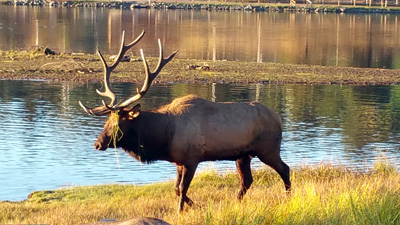
Bull with water lilyWhen I went into Evergreen yesterday, just after turning off Brook Forest Drive I went past a house that had a bull elk and his harem resting in their front yard, maybe 15 does. A stream runs between the highway and this house. The trees gave shade from the brutal morning sun. A domestic scene with wild animals. It came to my attention when a large bulk moving caught my peripheral vision. That’s the paleolithic helping in the here and now.

It amuses me, when I go to Evergreen, to see the number of people who gather at the lake. All these wonderful mountains and the locals come to look at the water. I imagine only a former native of a water rich state would notice the irony.

muledeer2600Vertical and flat. Humid and arid. Those are the big differences between our new home and our old one. Here I drive through canyons, over high passes, around stands of rock with the view often limited to a few hundred feet on either side, sometimes less than that. When we leave Conifer and go into Denver though, we immediately return to the far horizons common to the midwest. We frequently transit between the great plains and the mountain west, living as we do in the borderlands between the two.

Though we have had a wet summer and somewhat wet fall, when the rains cease, things dry out fast. We can go from low fire danger to high in a day. That’s why fire mitigation is constantly on my mind.

Black Mountain
Black Mountain

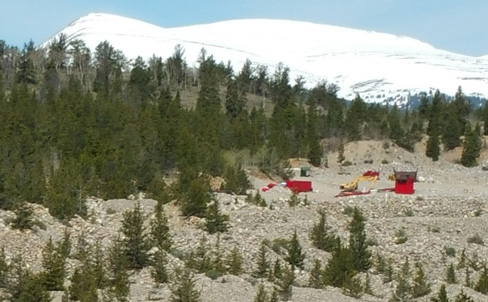
When verticality and aridity intersect, as they do at 8,800 feet and above, a genuinely unfamiliar biosphere is the result. Unfamiliar to those from the rainy flatlands of middle America, that is.  On Shadow Mountain we have two trees: lodgepole and aspen. Along streams there are more species of tree and shrub and there are microclimates that might support greater diversity, but on the bulk of the land that can grow anything, lodgepole and aspen. There are grasses, flowers, a few shrubs as understory, but just as often the rocky ground is bare. The mountains have strict limitations for plants.

The plant limits determine the fauna, too. Grass eaters like mule deer and elk do well, as do predators who eat them. There are small mammals that are prey for foxes and coyotes, but there are surprisingly few insects. That limits the birds. We have raven, crow, Canada and blue jays, the occasional robin, birds of prey that feed off food similar to that preferred by foxes and coyotes and other game birds. There are, as well, black bears. We’ve seen all of these save the bear.

Still learning about the mountains. Will not stop.


Colorado Natives

Beltane                                                                    Closing Moon

Colorado Native Plants. The books are out and water stained: Colorado Flora, Colorado Noxious Weeds, Native Plants of Mt. Falcon. The also water stained plant list for Mt. Falcon has check marks for the plants I need to know. Went through about half of them yesterday, the other half today.

In studying the very specific nomenclature for plant identification, I got a new appreciation for medical jargon. In writing and communication with other doctors and nurses it is necessary to name the various parts of the anatomy with specificity. Otherwise, the wrong limb gets cut-off or the wrong organ removed.

It is a comfortable feeling to take out books, arrange them in a particular way so they can be referenced easily, to create a plan for learning what I need to know and then execute it. This is an ordered world, one I know well. A safe, predictable world. Today, I need that.

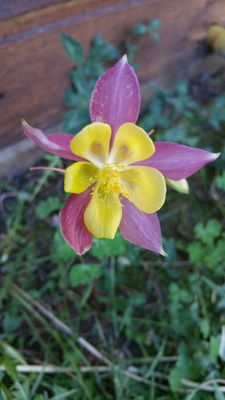
This paintbrush is a beautiful flowering plant, one you may already know, Castilleja integra, the Foothills Paintbrush. It’s in bloom right now, creating impressionist dashes of color as it flowers in otherwise green fields of cheatgrass and yucca.

Permit one thought on mortality. These plants in the foothills of the Rockies have long evolutionary histories, often involving millions of years and thousands of miles, some crossing continents as continental drift shaped and reshaped earth’s land masses. They grown on soil covering rock created in the Archean eon, preceded only by the Hadean. Plants, animals and one-celled creatures have been living and dying on the thin, fertile layer below them for millions of years.

Our own lives are part of that same living and dying, drawing our sustenance from the same thin layer. Yes, each individual life is unique and precious, but each individual life is also ordinary and unremarkable, life and death being not rare, but mundane.


Fist down

Beltane                                                                            Closing Moon

OK. I’m done shaking my fist at fate. At least for now. I’ll wait until the data gets clearer.

We had some sunshine today, helped my overall mood. Colorado has lots of sunshine, but over this month of May, not much.

Right now I’m studying for the test we’ll have during my first Colorado Native Plant Master class on Friday. It rained hard the first class and I left early to make sure Kate had time to make an appointment. Last Friday’s class was the day after my biopsy. My absorption rate is not at its usual high level. Means I have to study harder.

Lot of new terms: drupe, calyx, corolla, receptacle, sepal, dehiscent and many, many more. All part of the extraordinary details, named and differentiated, that make up plant taxonomy. So, I’ll pat my bract, sit on a cuneate leaf and twiddle my axils. Until later.

Hiking Boots. Today.

Beltane                                                                           Beltane Moon

Day after. Feel pretty good. Some discomfort yesterday, not much this morning.

Another native plant class today, one tomorrow in Sterling, about 2.5 hours east on Hwy 76.

After, I’m headed into the Denver REI, the flagship store, for a pair of hiking boots. Gonna check out women’s. Yes, my feet are so small that sometimes I can only find what I want in women’s shoes. No high heels, or stupid shoes as Kate calls them. Just flats with goretex and high tops. Hat, my western hat, soon, too.

O2 saturation up. Looking reasonable at 93% up here. 96% in Lonetree yesterday. Guess that trazadone was the culprit. Whew.

The water torture of closing details continues. This needs to be signed. This needs to get fixed. Yes, you can sign far away. We’ll mail you the documents. Rented Kate’s car on Thursday. We only have one car so we rent cars for trips like this. Saves putting miles on the truck.


Long ago native to this place

Beltane                                                                               Beltane Moon

Up early today. Too early. 3:00 am. Sigh. Still, got blogging done, e-mails sent and my high intensity workout in before leaving for my first Native Plant Master class in Morrison’s Mt. Falcon Park.

On the way I got gas at Conoco rather than the Loaf and Jug (Rumi, Omar?). I did that because I wanted a breakfast burrito from the best breakfast place in town according to reviews. But when I pulled up, the best breakfast place in town was gone. Not there. Vanished. Disoriented me for a bit, even though it was a food wagon. Not sure where it went, but I found it disconcerting to have an entire business, one I’d seen frequently since we moved here, disappear. Not to mention that I wanted breakfast and now no longer had time to stop elsewhere.

The dewpoint/temperature convergence coupled with lots of moisture in the air gave the mountains long tendrils of fog slipping through the pines and white crowns like so many of my friends. Atypical. The effect is very schwarzwald. This could be Bavaria.

In Morrison I turned off 285 North, which heads into Denver, and onto Colorado 8. It goes into Morrison, passing by the Fort, the adobe restaurant I mentioned some time back. Just a mile or two past the turnoff for Mt. Falcon Park where I was headed is the well known Red Rocks Amphitheater.

These Coloradans are a hearty group. Every one came with a backpack, obviously used before, rain gear, hiking boots and some had water repellent, zippered pants over their regular pants. One young woman, recently moved here from North Carolina, had bananas, clementines and granola bars stuck in several mesh pockets.

I say hearty because we each dutifully consulted our Colorado Flora field guide, our plant identification list and the Native Plant Master guide for Mt. Falcon Park (these last two distributed this morning as course material) in the constant and, at times hard, rain. It rained as we investigated a pretty five-petaled plant whose flowers change color after pollination. It rained while we investigated the shrub with trumpet shaped flowers that stood next to it. It poured down rain as we used Colorado Flora to narrow down the two species of cypress that stood next to each other.

Further along the trail, yes, it rained, we found a vetch, one of two species of the pea family we looked at. Vetch takes up selenium from the soil and concentrates the mineral in its stalk and leaves. Horses and cows get the blind staggers from the selenium so, though a native, it’s an unwelcome plant in pastures. Plants that take up soil minerals and concentrate them in their stalk and leaves have created a new discipline, geo-botany. Geo-botany uses plant analysis to find places where toxic minerals are present in the soil.

Did I mention it rained? All the time, from moderately hard to pelting. Not a usual Colorado problem. This is an anomalous May, though May is usually wet. So I’m told.

We had a recently retired geologist in our class. We stopped among shrubs and short trees for a snack. He noted that was a geologically important spot. The Fountain formation, red sandstone and crumbly red shale, the same formation that makes up the Red Rock amphitheater,  gave way to the granitic rock of the true Rocky Mountains only 5 or 6 feet away. “This means we go,” Tom said, “from 250 million year old sandstone to billion year old rock.” To the east the sandstone, remnant of a much earlier mountain range, covers the same billion year old rock exposed during the Laramide orogeny, the mountain building episode that formed the Rockies.

Since Kate had a pacemaker appointment, I had to leave early. I was not unhappy though I look forward to the next class. May it be dry. Of course, then it might be hot.