Category Archives: Judaism

A Birthday Party

Midsommar                                                                Most Heat Moon

Yesterday was hot. Hit 91 I think and the heat lasted through the night. At Marilyn’s birthday party we spoke with her son, Kevin. Kevin lives in Las Vegas and said, “105 is a relief. People say it’s over a hundred degrees, doesn’t matter. No. When it’s 117, that’s worse. 105 is better. 90 is really good.” Well, if he says so. Not a subtlety I want to become accustomed to.

The party was at the home of two of Marilyn’s friends, Jan and Claude. Their home, like the Bernstein’s, is up a long private road, but unlike the Bernsteins, their house sits near the end of a wide valley situated between two shorter mountains. The valley itself is open at the east, looking toward North Turkey Creek road and well beyond that, to Denver. In the distance were mountains, the furthest still carrying some snow, the closer ones, mountains that enclose Evergreen, green with their lodgepole pine contrasted against buff colored rock.

The sun in the mountains is brutal. There is less atmosphere to block out the UV rays and it was a clear, blue morning. Forgot my hat so this bald head needed shade. Jan and Claude’s house has a huge wrap around deck and yesterday it had maybe 20 folding tables setup end to end, the sort used in churches and synagogues across America, with paper tablecloths and silverware wrapped in cloth napkins. A small tent welcomed guests in the driveway with mimosas and orange juice. Nametags, too.

Marilyn turns 70 on July 12th. She and Irv have lived in Conifer for 45 years, all that time in the same house up King’s Valley road. Over that time she and Irv have made a large mass of friends, many of whom testified to the many mitzvahs she’s done over the years. Marilyn is energetic, “This year I’m doing a 7 mile hike each weekend just to show myself I still can.” She chairs the Adult Education Committee at Beth Evergreen and has done so for many years.

Many of the folks at the party were from Beth Evergreen, but there were also many who used to work with Marilyn in the Jeffco School District where she was the public relations director. One, Jennifer, was with Marilyn in that office at the time of the Columbine shootings. Marilyn handled public relations for the school district during and after the shooting. Columbine still has a big footprint on the Colorado psyche, the nation’s, too.


Making Friends

Midsommar                                                            Most Heat Moon

Fourth of July party at Steve and Jamie Bernstein’s. We went to this last year. I knew nobody. Jamie is Kate’s friend from the Bailey Patchworkers and the needleworkers. Since then we’ve become more engaged at Congregation Beth Evergreen, Jamie and Steve are members there, too. They’re both in the kabbalah class I’m taking with Rabbi Jamie Arnold. So this time I knew the hosts, too.

Their home is down a private road, maintained by a resident’s association. It overlooks Pike’s Peak in the distance with many mountain peaks between their home and this famous piece of Colorado history.

Since we showed up very fashionably late, the party was winding down. This meant we had a chance to talk with Steve and Jamie. Their party is big and they are excellent hosts so they move from guest to guest with little chance for in depth conversation. We had a good chat with them, touching on matters Jewish, kabbalistic, Beth Evergreen. I referred to Rabbi Jamie as Jamie and realized I’d been too informal. Gonna have to stick to Rabbi, though it seems over done for me. But, in the Jewish world, the Rabbi is the Rabbi.

Gradually, slowly making friends here. A week from today we’ll attend Marilyn Saltzman’s 70th birthday brunch. Marilyn is the chair of the adult ed committee at Beth Evergreen. We had dinner at her house with Irv and two of their friends a few weeks back.


Simcha

Midsommar                                                                     Most Heat Moon

mazeltov3_0Danced the hora last night, mixing up my feet as I normally do while dancing, but enjoying myself anyway. Joy, it turns out, is a character trait in mussar. “It’s a mitzvah to be happy.” Rabbi Nachman. Judaism constantly challenges my Midwestern protestant ethos, not primarily intellectually, but emotionally. Last night was a good example.

I’d spent the day feeling punk, stomach a bit upset, tired, exercise was hard. Told Kate, “I feel like I can’t my motor started.” Didn’t really want to go to this once a month mussar havurah (fellowship), but I’d decided to make gazpacho for the meal and had finished it. So I went, pretty sure I’d feel better if I did. Which, if you think about it, is an interesting sign.

When we got to Beth Evergreen, it was a small group, seven. Becky was new and Lila, a friendly pug/boxer mix, Rabbi Jamie’s dog, strained at a yellow leash tied to a picnic table on the patio. Tara, the cantor/director of education, Rabbi Jamie, Judy, the social action chair, Mitch, a long haired man in his early 50s, Kate and me made up the rest.

20170531_161806We ate our meal together outside, all at one picnic table. Tara’s Hebrew school students had decorated it and it was colorful underneath our paper plates and plastic bowls. The evening was a perfect combination of cool warmth and low humidity. The grandmother ponderosa stood tall, lightning scarred against the blue black sky. Bergen mountain had already obscured the sun which still lit up the clouds from its hiding place.

While I ate my own soup, not feeling hungry since my dis-ease earlier, Rabbi Jamie got us started on the evening’s conversation, suggesting we focus on hope and joy in the present.

“When I read that tonight was about joy, I first thought about dogs. How unrestrained they are and how in the moment with their feelings.” Lila, I said, had greeted me fondly, showering me with kisses, a stranger. I like that about dogs.

100008 28 10_late summer 2010_0180We all laughed when Rabbi Jamie asked if I hoped (another middot, character trait, clustered with joy) to be able to greet strangers the same way. “Well, not by kissing them on the lips or licking them.” I was thinking, but yes, I hope I can add that level of uncalculated joy to my meetings with others.

Becky said she had problems with hope, naming the carelessness of humans and the destructive presence we are on the earth. “I think about how we might destroy ourselves, but after some time, the planet will be fine. That makes me feel better, oddly,” she said. Rabbi Jamie mentioned then something I’ve heard him voice before, a Talmudic argument over whether it would have been better if humans had not been created. Yes, the rabbis decided, it would have been better. But, since we are here, what will we do?

Judaism has that sort of no nonsense approach to heavy existential issues. Yes, we’ll die. So the question is, how will you live; not the understandable response, OMG, I’m gonna die!

In the remaining discussion it became clear to me that Judaism has joy at its core, an embrace of life even in the midst of struggles and despair, an embrace of life in community, with known others. Joy, one quote offered for the evening suggested, comes from deep connection.

Calvin
Calvin

This is so qualitatively different from Presbyterianism. When Rabbi Jamie led us in song, then got us up to dance, I tried to imagine the same thing happening during a Presbytery meeting. Nope. Wouldn’t happen. It’s a cultural difference of substantial proportion.

I want to like this, I may even need to like it, but it’s hard. Being hesitant, reserved, especially physically, came with my Midwest protestant raising, reinforced by my Germanic father and the often dysfunctional nature of my mother’s extended family.

Still don’t want to be a Jew, but these challenges, to experience deep joy and hope rooted in community, are good for me. Necessary, even. When we came home through the darkening June night, driving up Black Mountain Drive, I no longer felt dis-eased. An odd sense of hopefulness had crept in. Maybe a bit of joy.


Krishna Janma

Midsommar                                                                   Most Heat Moon

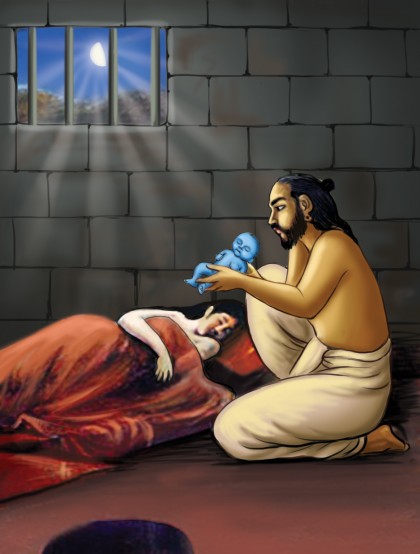
Krishnas-birth-in-prisonLooking for light in prison. An assignment for the kabbalah class tonight. Rabbi Jamie suggested watching a movie like Hurricane, about Rubin Carter. I thought of MLK and Letters from the Birmingham Jail and Nelson Mandela, too. Then I remembered a portion of the Mahabharata I’d watched. This DVD version, 94 episodes, aired in India in the late 1980’s. Bought it to watch while doing long sessions on the treadmill.
Krishna Janma was episode 11. A prophecy tells Kansa, a king, that his sister Devaki’s eighth son will kill him. At first he looks for the easiest solution. Kill Devaki. Vasudeva, her husband, pleads with Kansa not to kill his sister. “I will bring you each child to destroy.”

Kansa considers this and agrees with a condition. They have to live in chains in his dungeon. Six sons are born. Kansa comes in their cell after each birth, grabs the newborn and throws it against the wall. When the seventh son is born, a friend of Devaki’s visits her in the cell and takes her pregnancy as her own. This causes Kansa great consternation but he can’t do anything since the seventh pregnancy seems to have mysteriously ended.

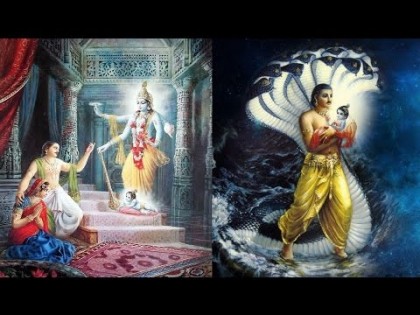
krishnaFinally, nine years later, Devaki is pregnant again, this time with the eighth son Kansa dreaded. This son is Krishna, an avatar of Vishnu.
“Whenever righteousness wanes and unrighteousness increases I send myself forth.
For the protection of the good and for the destruction of evil,
and for the establishment of righteousness,
I come into being age after age.”

— Bhagavad Gita 4.7–8

Happy-Janmashtami-Images-Wishes-Quotes-SMS-Status-Greetings-09

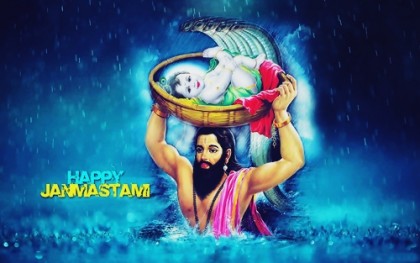
When Devaki gives birth to Krishna, a light shines in the cell and a voice, presumably Vishnu, tells Vasudeva to take baby Krishna out of the dungeon to another couple. Vasudeva wonders how he can accomplish this but the dungeon’s many barred doors swing open, the guards are put asleep and he walks out into a raging storm with his eighth son held over his head.

Krishna Janmashtami is a Hindu holiday that celebrates Krishna’s birth. It’s a lunar holiday so the date changes from year to year, but this year Janmashtami is on August 14th.

Ohr

Midsommar                                                                      Moon of the Summer Solstice

ein sofKabbalah. Reread Genesis 1-2:3. Now, ask yourself a question that occurred to a long ago kabbalist. What is the light created on the first day of creation? We know it’s not the sun or the moon or the stars because they don’t blink on until the 4th day, 1:14-19. So what is the ohr (light) of verse 3. “And God said, “Let there be light,” and there was light.”?

Kabbalists pay close attention to details like this. They poke and tease at them, using reason-it can’t be the sun-and playing with gematria. In this instance an equivalence is discovered between the 207 of ohr’s three Hebrew letters and raz, also 207. Raz means hidden. Aha! Rabbi Jamie would say. This ohr could be a hidden light. I’m not going to follow this thread much further because the argument quickly becomes nuanced and frankly still not altogether clear to me, but it moves quickly toward the many-worlds hypothesis of string theory and an early intuition of quantum mechanics. All this from some early medievalists.

Remaining open to new ideas can be frustrating, confusing, but as a quote I discovered a while back says, confusion is the sweat of the intellect. Right now I’m sweating a lot as we review the very basics of kabbalistic thought. I did buy a copy of the first volume of Daniel Matt’s translation of the Zohar, kabbalah’s bible. This is a brand new translation from the original Aramaic and one done by a preeminent scholar of Jewish mysticism. It’s both clear and very difficult.

Here’s an example. In his translation Matt quotes an early kabbalist who retranslates the first verse of Genesis to this: With beginning the ein sof (the infinite ohr-light or energy) created God. Now that’s unexpected.

bonfireIt’s a very bright group around the table: a historian, a Berkeley trained lawyer, an organizational consultant, a Hebrew scholar, a rabbi in training, a second lawyer, a teenager with a good grasp of theoretical physics, two retired hospital administrators. This makes the conversation sparky, inspirational.

Rabbi Jamie’s pedagogy is excellent. He asks questions, probes answers, supports new directions, invites us to retrace the pattern of thinking used by these early rabbinic radicals. It’s fun. Too, the kabbalistic project was exactly reimagining faith. It’s giving me a prod for how to go about the task in my own work.


Kate, Judaism and Pine Pollen

Beltane                                                                             Moon of the Summer Solstice

20170405_152848Kate continues to struggle with dry mouth, a very sore throat and other symptoms of Sjogren’s syndrome. She’s lost weight as a result. Lab tests don’t suggest anything terminal going on, but her distress is significant. If you know Kate, you know she has an energizer bunny mode, but she’s been on the battery depleted side of that equation for a while now.

Lots of Jewish stuff this week: Star Trek and Judaism on Tuesday, kabbalah on Wednesday, mussar and a meeting with Rabbi Jamie yesterday, and a Grateful Dead shabbat service tonight. I’m learning a lot and slowly integrating into the congregation. When I mentioned the possibility of an Evergreen Forum, a quarterly series of speakers somewhat analogous to the Westminster Forum in Minneapolis, I somehow ended up on the adult education committee, too. In that role I’m now helping coordinate the forum. As I said here earlier, I’m happy to have a place in a religious community with no leadership responsibility. A novel and fun experience for me.

20170613_203228A new seasonal reality for us: pine pollen. All these lodgepole pines insist on involving on us in their reproductive orgy that happens this time of year. A fine yellow dust settles on everything. Coming in easily even through screens, it’s especially apt to settle on things electrical, so the computers and the tv and the microwave all have a coating. It also coats our solar panels, reducing their efficiency. If it rains, a yellow scrim settles over the driveway, pooling where the water does. I wish these pines could figure out a more direct way to make more pines.


Gematria

Beltane                                                              Moon of the Summer Solstice

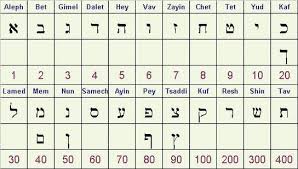
gematria chart

Wandered into strange territory last night at Beth Evergreen. Gematria. Each Hebrew letter has a corresponding number. The chart shows the correspondences. Kabbalists, especially, use these numbers to determine the numerical value of words. After calculating a word’s value, it can be used to compare that word to another with the same value.  This comparison is another method of peeking under the garment of the torah.

An example comes from the story in the garden of Eden. The snake is the usual suspect in an ancient story of how humanity lost its way. But. In Hebrew the numerical value for the word snake and the word messiah are identical. Early Kabbalists used this correspondence to suggest that the meaning of eating from the tree of knowledge was very different from the usual interpretation, that in fact it was the first step in humanity’s liberation.

Rabbi Jamie had asked us to do some reading on gematria, discover some things on our own. When he asked us what we’d learned, I said, “This whole idea seems strained, strange.” Not being one to mince words, as some of you know. A history professor in the class agreed with me that her reading had produced the same thought. Others were intrigued.zodiac

Staying open, of course, is the only way new learning can occur, so I attended to the ideas in spite of my skepticism. As the evening progressed, I began to find the idea a bit less odd. The kabbalists use gematria as a tool, a tool similar to the Zen koan. At first its results may not make sense,; but, that’s the point, the frisson between the snake and the messiah which opens a new mode of thought about the story. It also undermines any tendency to take the torah literally, an essential first step toward searching for the primordial torah.

Garden of Eden, Lucas Cranach the Elder

So although I find the method strained and strange, I still do, I believe I understand at least part of its purpose. That’s enough for now. I’ll learn more as we go forward.

Live long

by Gage Skidmore
by Gage Skidmore

Beltane                                                                          Moon of the Summer Solstice

Pushing myself. Up to 10,000 steps on the four days I don’t do resistance work, 5,000 on those days. Feels good, so I’ll probably stay at it. The resistance work is helping, too. Less knee pain, less stiffness, better balance.

Looked at lilacs on Monday. After reading some material online, it looks like Syringa vulgaris (guess what? common lilac) and Syringa x prestonia, a Canadian cultivar, work well at our altitude. Gonna put in two bushes this year and see how they do. If they do well, I’ll add more next year. Cautionary note: don’t add fuel where it might feed a fire in the trees. They both need full sun and at least some amended soil. That we can provide.

Blessing that is the origin of the Vulcan salute
Blessing that is the origin of the
Vulcan salute

Last night I went to an interesting session, Star Trek and Judaism at Beth Evergreen. Several original cast members were Jewish, most prominent among them William Shatner and Leonard Nimoy.

A fascinating take away was the origin of the Vulcan salute. Nimoy, as the sole Vulcan in the main cast, got to have a lot of say about developing Vulcan culture. He attended a service in which the shekinah, the feminine aspect of God, gets invited in. She’s so powerful that everyone shields their eyes and a group of men upfront were wailing, according to Nimoy in a video clip. He decided to peek and noticed that they were holding their fingers in what you would immediately recognize as the familiar Vulcan greeting. It’s the Hebrew letter shin, the first letter of shekinah, shalom, sabbath.


Bound

Beltane                                                                     Moon of the Summer Solstice

Second hike at Staunton. Chose the Mason Creek Trail. It goes up, then up and finally it turns into switchbacks, going up. Huff and puff, not at Hogwarts but here in the Front Range. The Mason Creek Trail will provide a consistent challenge, plus it has meadows, waterfalls (see video) and large rock formations.

methodology-sight-size-827x399While hiking and thinking about Reimagining, I realized I’m taking an atelier approach to it. Ateliers train would be artists in the classical mode, using lots of drawing, life models and work with perspective. They’re considered conservative in today’s art world, a sort of throwback to the artist/apprentice studio that dominated art education for so many centuries.

In my case I studied Christianity and the Christian ministry in a seminary, United Theological Seminary, and earned the world’s most outrageous degree, Master of Divinity. In the late 1980’s I took a doctorate at McCormick Seminary in Chicago’s Hyde Park neighborhood. The Presbyterian ministry occupied me for 15 years and afterward I dabbled in the Unitarian-Universalist ministry. Now I’m in my second year of Jewish immersion, not a convert, but a close student of this ancient tradition.

bound to the earthYet what I really want to do is rethink what faith is, why we go to the places that we go to for spiritual nourishment and whether there might be a real faith, an approach to the religious life, that emerges naturally from the world in which we live and carry on our daily lives. That is, one without a charismatic founder or an ethnic base, a faith which would help us see the holy ordinary, that would expose the ligatures that bind us to this planet, to the plants and animals and minerals and atmosphere, expose them and help us see them as the loving embrace that they are, not only as limits to our lives.

 

As the World Burns

Beltane                                                                  Moon of the Summer Solstice

images (2)While the world burns, at least the Trump world, kabbalah suggests a bigger world, more worlds, right next to this one. There is, as Rabbi Jamie said, a bigger picture. I learned a similar lesson from Deer Creek Canyon during my cancer season two years ago. These Rocky Mountains, still toddlers as mountains go, were and will be present when we are not. In their lifetime humanity will likely have come and gone.
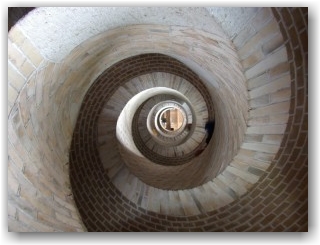
It’s tempting to use this perspective-and I believe it’s real, I want to emphasize that-to diminish the swirl of issues like climate change, decent health insurance, jobs that no longer pay a living wage. In time they will be finished, one way or another. We were neither present during the Rockies orogeny, nor will we be present when they become as smooth as the Appalachians. Just so, you may say.

38d9f3b4e2e64361ce68ca237f270a42Yet. We do not live either in the deep geological past nor in the distant geological future, we live now. Our lives, our mayfly lives from the vantage point of geological time, come into existence and blink out, so we necessarily look at the moment, the brief seventy to one hundred year moment into which, as Heidegger said, we are thrown.
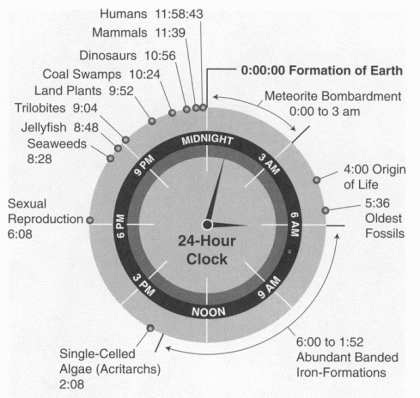
This is all we know of life, this moment. In it our whole awareness comes into existence, matures, then winks out. From that mayfly perspective then climate change, decent health insurance and a living wage are not insignificant. Albert Camus spoke of the great river which carries us toward the ocean of all souls. Ram Dass reminds us we’re all just walking each other home. And Lord Keynes famously said in the long run we’ll all be dead.

Time_Clock-620x587Somehow we have to realize that though our lives are small compared to the immensity of the universe and the imponderable nature of time, they are everything while we have them. As for me, I find all this comforting. Putting my efforts in the larger perspective gives me peace, putting them in the immediacy of my life gives me energy. We will not complete the task, no, we will not. But we are not free to give it up either.