Beltane Sumi-e Moon
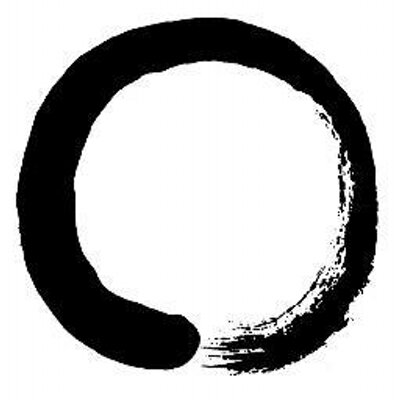 My presentation on time falls under the sumi-e moon and I plan to use sumi-e. I’m taking my brushes, ink, ink stones, red ink pad, Kraft paper, and rice paper. As well as my hourglasses. I will do Shakespeare’s soliloquy from Macbeth as a counter point. Each person will first practice an enso on the Kraft paper, then do one on rice paper.
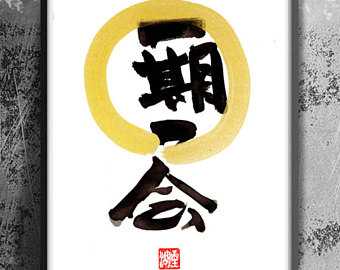 What is an enso? The word means circle in Japanese. In Zen it has a much more expansive meaning.* Zen is, of course, Chan Buddhism, a curious blend of Taoism and Buddhism created in China. Monks from Japan went to China to learn about Chan and brought it back to Japan. They also brought back the practice of drinking tea, which initially was a stimulant to help with long meditation sessions. It later transmogrified into the Japanese tea ceremony with its beautiful idea of ichi go ichi e, or once in a lifetime.
*”In the sixth century a text named the Shinhinmei refers to the way of Zen as a circle of vast space, lacking nothing and holding nothing in excess. At first glance the ancient ensō symbol appears to be nothing more than a miss-shaped circle but its symbolism refers to the beginning and end of all things, the circle of life and the connectedness of existence. It can symbolize emptiness or fullness, presence or absence. All things might be contained within, or, conversely, excluded by its boundaries. It can symbolize infinity, the “no-thing”, the perfect meditative state, and Satori or enlightenment. It can even symbolize the moon, which is itself a symbol of enlightenment—as in the Zen saying, “Do not mistake the finger pointing at the moon for the moon itself.” In other words, do not mistake doctrines, teachings or explanations, which are intended to guide one toward enlightenment, for enlightenment itself. Ensō can also represent the moon’s reflection on water, thereby symbolizing the futility of searching for enlightenment outside oneself.” Modern Zen
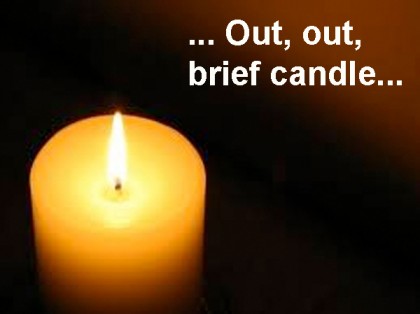 “Tomorrow, and tomorrow, and tomorrow,
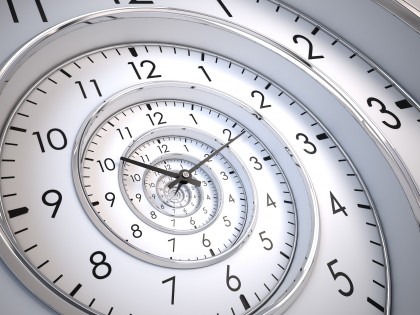 We’ve been pulling at the strands of various ideas about time, from measured time to eternal time to shabbat moments and the radical obvious, time is only ever the present. The past and the future have no reality, no agency, save in the present.
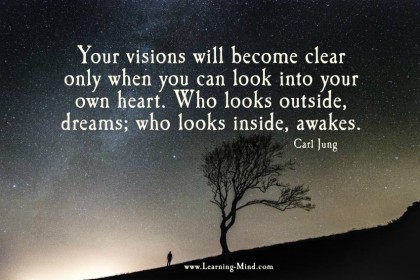 The answer he gave to his own question, with which I agree, was this. I’m not quoting. We do it to hold our notion of self more lightly, to give the ego a rest from its orientation to survival, to making it in the world. At the soul level, the most basic level of our human existence, we all connect. Think the collective unconscious, the divine spark, in the image of the sacred. In effect qabbalah posits an Oversoul, or better, an under or inner soul, the quality of which is the same for all humans.
 Started a long project yesterday. I’m printing out all of Ancientrails. Been wanting to do a total backup and I will at some point, but if it’s going to be useful to my ongoing work, hard copy is better. Besides, think how satisfying it will be to hold a copy of all this. Then, I got to thinking. Oh, but a fire! I’m going to make a copy of the copy when it’s done, then make copies of all my hard copies of my novels. I’m going to ask Jon if I can store those copies in his garage in Aurora. Yes, all the novels are on flashdrives (and in a safety deposit box, all except my work on Jennie’s Dead and Rocky Mountain Vampire) and all of Ancientrails is in the cloud, but the hard copies are important, too. The things that come up before we fall asleep.
 If I’m understanding his primary argument, time at the Newtonian level is a result of blurring. This may seem like an odd idea, and it is, but it’s not so hard to grasp if you think about the blurring that is necessary for us to perceive the world around us. Example. If you shrank to the atomic level and tried to walk across a table top, you’d fall in. It’s blurring of the quantum world that makes the table seem solid to us. Time is a result, again if I’m getting this, of the blurring of the transitions from event to event which, at the quantum level have no prescribed order.

 In the present, which has never existed before and will recede as if it were never there, all things can be made new. This is a subtle idea, at once obvious and at the same time almost impossible to grasp. Yet it is true that the 71 years of my life have passed in moments, always in the now. Even in 1947 my life passed moment to moment in increments, the very same as the increments I experience today in 2018.
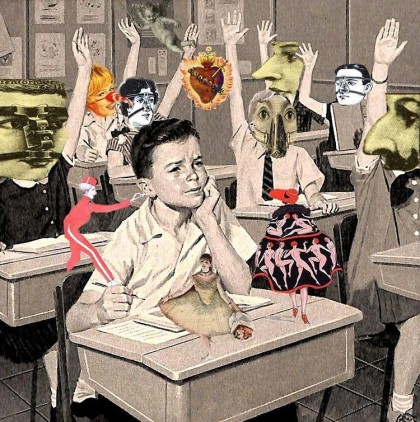 Back in the day, the now further and further away day, I always went to class. I might have missed a few, but it was rare. I enjoyed learning from lectures, getting in the mix of dialogue, thinking out loud. Last night I was the only student in the qabbalah class on Time.
 Being human is a daunting task, steeped in misdirection, existential isolation, perception clouded by tradition, by language, even by our body. Qabbalists and taoists and ch’an buddhists have worked, hard, to peel the onion of our awareness. They are subtle, in their own way as subtle as particle physics or genetics or neuroscience, attempts to understand this task, the one none of us can jettison, save through suicide. They differentiate from the narrowing tendency of science by insisting on a full, a comprehensive positioning of this strange creature that we are in the wild.
 Thought experiments like taoism, qabbala, ch’an or zen buddhism try to shock us out of our stupor, the life lived without seeing the wilderness for what it is, the life lived within the conventions of a particular time, a particular language, a particular place, a life lived without knowing what life is. Most people find little reason to peak behind the curtain of this emerald city that we think is what is. The apparent life, the one with family and money and the NFL and food and houses and sunlight and night, seems to be all that could be. We do not question, we try to paddle the little barque of our body on this river (life) often using only our hands over the edge of the boat.
 And yet there is more, not more in the sense of more layers or more depth, for those layers and depths, the wilderness, always surround us, are the water to which we are the fish, but more in terms of what we can know, what we can access, what we can use to help us become awake. Woke, in the current vernacular, not woke to racism and sexism and oppression in this instance, but woke to the true majesty and wonder of life itself, of this wilderness journey, this most ancient of ancientrails.
 Yesterday was d-2 of the new dishwasher era. I have now seen the wonderful word, CLEAN, on its external panel twice. And, after checking, it’s true! I believe, barring trouble, that this brings the dishwasher saga to an end. Blessed be.
 After the initial overwhelm (what’s a whelm*, I wonder?), I’ve been surprised by the good feelings that have come from my part in Kate’s recovery. Doing more, enjoying it more. Though. I will be happy when Kate’s back to full functioning.


 Besides the quirky reputation of Atlas Obscura, which draw me in, I also went because Joy said she would discuss qabbalah and the tarot. Only a couple of mentions but they were there. Here’s a for instance in this blurry photograph of one of her slides. In another spot she mentions the correspondence between qabbalah (translation note: Rabbi Jamie says the q is the correct translation) and the qabbalistic Tree of Life with its ten sephirots. Not a detailed examination of the relationship, but enough to make me want to explore it further.
 Tarot by itself has fascinated me for a long time and I have three decks of my own. I like the iconography and the mythical, archetypal leanings of current Tarot readers. That doesn’t mean I put much stock in the readings themselves, though I do believe any sincere examination of self, whether occasioned by a hallucinogen, meditation, an analyst or a Tarot reader can be of benefit.
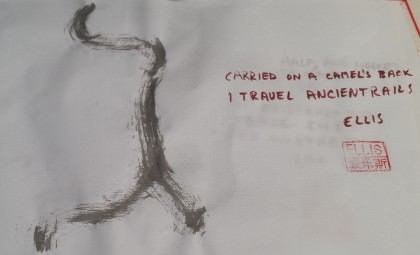 Under the New Life moon a new life has emerged, related to the old one, but different nonetheless. The trajectory and the distance of the change got a marker last night on the final evening of the kabbalah class on the mysticism of the Hebrew letters.
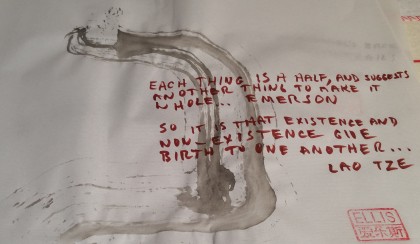 Too, under the new life moon I’ve become the regular dinner cook at our house, experimenting at times, at other times (mostly) using recipes, but enjoying myself immensely. Added to my long practice of working out, even that has a new flavor with the workouts every six weeks or so from On the Move Fitness, I’ve got tactile time each day. I’m using my hands and a non-verbal creative impulse.
 It is no accident, though in real time it was, that this period was also the time of the middot of joy. Joy and sadness are not enemies, rather they are a vital source of learning if we don’t suppress them. Steering away from grief, tamping down joy in favor of a false stability, a false calm defuses the opportunity our soul offers to us through these emotions. They signal the soul’s gladness, the soul’s mourning, both key to a depth appreciation of our journey.

