Category Archives: Aging

Got a Habit?

Lughnasa                                      Waxing Harvest Moon

“We are what we repeatedly do; excellence, then, is not an act but a habit.” – Aristotle

Good old Aristotle.  A subtle mind, tutor to Alexander the Great and foe of Platonic idealism.   His work is dense to the point of impenetrability, at least to me, which did not augur well for a future in philosophy.

This quote sounds like 7 Habits of Highly Successful People material, but Aristotle wrote way ahead of the 20th century obsession with self-help.  It would be interesting to know what he would make of Covey’s material.

Philosophical training sharpens the mind, enhances the ability to understand and appreciate the arguments of others, aids in the construction and self-critique of ideas and puts a solid platform under a life, a platform strong enough to withstand the ebb and flow of others opinions and one’s own inevitable missteps.

Let’s take Aristotle at his out of context quote for a moment.

Hmmm.   What happens over and over in my life?

Reading.  Writing.  Politics.  Working with art.  Gardening.  Bee keeping.   Dog tending.  Travel.  Driving.  Watching TV. (does excellence fit in here?)  Spending time with family.  Grocery shopping.

This one will repay a bit more pondering.  What happens over and over in your life?  What are your areas of excellence?


Fall-ing

Lughnasa                                                  Waxing Harvest Moon

As August slides away and the sky shifts its colors toward deeper hues, an inner barometer detects higher emotional pressures.  The atmosphere weighs more, cuing those momentary pauses, breaks in attention.  It may signal a storm ahead, but more likely the prediction carries gray skies and mist, perhaps early morning fog.

Melancholy comes calling this time of year, an acquaintance, maybe a friend, of long standing.  Mom died in October, 1964, 47 years ago, a year longer than she lived.

Her death came at different moments in life for all of us.  Mark, 5 at her death, has few memories of her; she lingers in his past as a faint spirit, an enigma.  Mary, 12, has more, a young girl heading into adolescence, becoming a woman, missed the guidance a mature woman could give as she made that critical transition.  At 17 my life had already begun to pull away from the family, in my senior year of high school, the last, college plans in the making, I had her longest of all, only a brief time less than Dad.

When that dark angel comes, and he comes for us all, finality is the hardest lesson to absorb.  No more mom.  No more.  Memories, yes, but memories fade and change as life goes on and here all three of us are, 47 years later.  47 years.  A lifetime.

Why a friend?  How could melancholy be a friend?  Well, in this way.  As life patters on, this event following the other, we can become accustomed to its rhythms, lost in its small decisions and its casual absorption of our energy.  So lost, in fact, that we forget the Self that carries us forward, the Self into which we live and which lives itself into us.

Melancholy can turn us away from the day to day and cause us again to walk down the stairs leading to what Ira Progoff calls the Inner Cathedral.  We often forget this quiet place within, our own sanctuary, and melancholy can call us to visit it again.

So, yes, melancholy can be a friend of the Self, a guide back into the depths and resources of your Self.

Is There a Prophet In the House?

Lughnasa                                                                                                  New Harvest Moon

NB: prophet is a gender neutral word as I use it.

Kate.  Always ahead of her time.  When Kate was in high school in Nevada, Iowa, she arranged a deal to take most of her senior classes at nearby Iowa State.  She’d run out of classes in the high school, at least classes that could keep her interest.  In her senior year, just as the deal was to kick in, the high school changed their mind.  Later, as a nurse anesthetist, she insisted on better pay for her position at Mt. Sinai.

After that, too long in the role of helper, she decided, at age 34, to go to medical school.  The medical school thought that since she was already a doctor’s wife, she should be happy with that.  She graduated and became a board certified pediatrician in the best medical delivery system in the US.

After a serious illness and poor treatment at the hands of her then partners at Metropolitan Pediatrics, Kate moved to Allina, its Coon Rapids’ clinic.  While there she became frustrated with corporate medicine and chose to become lead physician for her group.  Over her time there she integrated pediatric and family practice offices, initiated (by doing it herself) after hours care and agitated for a better deal for primary care docs in general.

Now, several years after she pioneered it, Coon Rapids’ peds has regular after hours clinic and the Clinic has an urgent care unit providing after hours non-emergency medicine.  Kate works in the urgent care, part-time.

She has been tireless in haranguing me about the stupidity of pediatricians treating psychiatric problems for which they have little to no training. (see today’s Star-Tribune)  The arguments about vaccine that I read in this months Scientific American I first heard over the breakfast table.  She also campaigns against the overuses of anti-biotics, the over prescription of pain-killers and, most passionately of all, the need for a single-payer health system.  An equitable distribution of health care services has been at the top of her need list for a long time.

She is a prophet in a system that, though excellent in its care, has become sclerotic in its administration.  The current over managed (way too many administrators with way too much power) model, corporate medicine as she styles it, focuses its efforts on the bottom line (money), on standardization (easier to manage), on patient satisfaction (results would be a better yardstick) and on turning physicians into employees.  Those who run these systems should listen to this practical, intelligent critic and change their ways.

Degree of Difficulty

Lughnasa                                                                                    Waning Honey Extraction Moon

I have grasped the swallow’s tail, offered a shoulder strike, wielded a single whip, pushed and pulled, brushed the leg, deflected, parried and thrust.  All moves in Tai Chi.  I have made real progress over the last 20 weeks, nearing the real end of the first third of the form.  Once I finish the first third, I can practice it three times in a row and will have a feel for the time it takes to do the entire form.

At some point I will have the entire form under my belt, perhaps in the next year, though I will have a month and a half hiatus while rounding South America.  Then, I can continue the form as a means of meditation, relaxation and conditioning.

With the single exception of some modern dance I did while in college, this has been the most difficult, by far, physical work I’ve ever done.  Not difficult as in strenuous, but difficult in the care and precision needed, the execution of movements which do not come naturally to me.  The degree of difficulty has surprised me, but only because I was so ignorant of Tai Chi.

Mastering a difficult physical project has been satisfying for me, satisfying in direct proportion to its difficulty.  I tried piano for quite a while about ten years ago, but I just didn’t have the skill or the real interest.  This I can and am doing.  New for me.

Gifts and Talents

Lughnasa                                                                            Waning Honey Extraction Moon

Kate and I had a conversation the other day about talent.  Two of her sisters make their living playing classical violin.  They have talent.  A lot of it.  BJ went to Julliard and Sarah to Curtis, both academies for topflight talent.  They both graduated and have been able to work using their training.  BJ makes a living as a classical musician in New York City, the hotspot for classical music today in the same way Vienna was at one time in Austria.  Sarah teaches violin and does the occasional solo spot with orchestras of the second tier.

Kate and I had/have above average intelligence and have been able to work making use of  those gifts, Kate in pediatrics and me in various religious, political and artistic positions.

Even so, in all four of our cases, we had enough talent to peer over the transom into the gifted realm, but not enough to participate in it.  This is a ruling contradiction of life, no matter what your level of talent, wealth or status, there is always someone more talented, more gifted, wealthier and higher up the status ladder.  Always.  Even if you’re Itzhak Perlman or Bill Gates or Merrill Streep, you have to contend with Paganini, Andrew Carnegie or Sarah Bernhardt.  History can always serve up an exemplar who achieved more, acted better or accumulated more wealth than thou.

This problem cannot be solved by saying don’t peek, don’t stand on the chair and try to see into the room where the door closed before you.  No, we all peek because we can’t help it.  We imagine, fantasize, try to pull ourselves up a little bit, maybe we can squeeze through, even if it’s only to the room where the jobs pay $15.00.  Or maybe to the room where the cool kids are.  Or the ones with enough food.  Or the Noble Prize.  Or authors with books on the NYT bestseller list.

Here is the one and true solution.  Know thyself.  Work within yourSelf, demanding from that Self the best it has.  Not the best it wishes it had, not the best others seem to have, but the best Self you have.  In this way you offer the world that unique gift, you.

This solution also solves the problem of transom peeking.  You will still wonder, fantasize perhaps, what might have been, but you will not be driven to either envy or despair because you have as much as work as you can handle already.  Being you.

Neither does this mean that you settle for mediocrity, less than the person you have the Self to become.  One of the most negative aspects of envy or despair is the demotivation it produces.  The, if I can’t be like her, or him, then I just won’t bother path.

No, your path, the ancient trail that you must walk is this:  know your Self and follow its lead, only that ancient trail can lead you to the gift only you can offer the rest of us.

Humanity needs all the gifts of the whole species.

We have enormous challenges today.  Climate change.  Hunger.  Religious and racial discrimination.  Wars.  Economic ups and downs.  We cannot afford to leave the talents and vision of even one woman, one ethnicity, one age to waste.
Bee Diary: August, 2011

Lughnasa                                                                   Waning Honey Extraction Moon

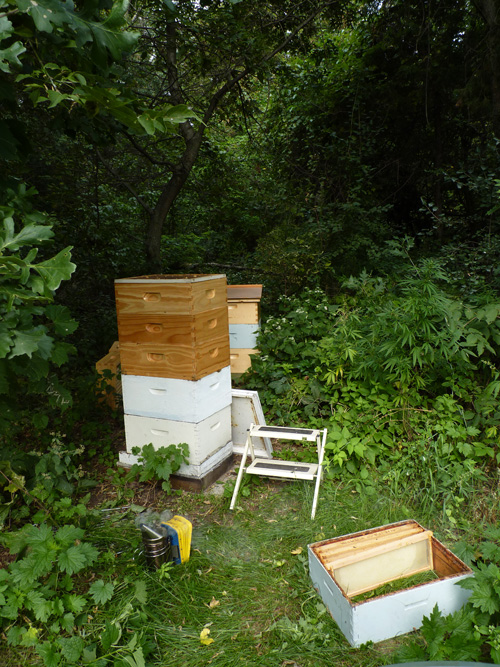
Checked the honey supers this morning.  On the two package colonies that I do not intend to overwinter, we have approximately four full honey supers.  That is, we have for harvest the amount of honey they would have needed for the winter, close to 200 pounds.  Figure that 40 pounds is not recoverable due to drips, stuck on honey comb even after extraction then that should leave around 16o pounds to harvest.

If we chose to sell it at, say $7 a pound, that would create around a $1,ooo in sales after keeping some back for own use and gifts.  After the bee packages at $60 each and amortizing the honey extractor, supers and hive boxes, syrup, hive tools, smoker, pollen, queen excluders, honey jars, top and bottom boards and telescoping covers, we’d still be in the red for the first three years.  Don’t know what we’ll do with it this year, probably give away a lot again.  It’s good for barter and gifts for sure.

Artemis Hives has produced honey two years in a row now, an artisanal honey created by bees aided by the beekeeper, me, and the bee equipment and harvest partner, Kate.

Looking at the gardening year in total we will have a good, not great honey harvest, a good potato harvest, leeks, beets, chard, beans and possibly a decent tomato crop.  Kate has good success with her zucchinis and the decorative gourds have bloomed but produced no fruit yet.  The gardening and beekeeping year will wind down in September, just in time for us to finish our cruise preparations.  Caring for gardens and bees requires a lot of face time with the plants and hives, visits to nurseries, attendance at Hobby Bee Keeper meetings, not to mention all the work of harvesting and putting food by.

I’m at the point in the year when my enthusiasm has run out a while ago and the only thing that keeps me active now is the need to finish, to harvest.  When it’s done, it’s over for the year.


There and Back Again

Lughnasa                                                 Waning Honey Extraction Moon

A birthday really marks the spot on the earth’s orbit where you were born.  So, it is not necessarily a function of time in a linear sense, but the count of revolutions on the (roughly) same path.  In other words even the years of our lives do not, at least in this sense, refer to the passage of time so much as they do the passage of the earth around the sun.  I like this because it helps me have a concrete understanding of my years.  I have, for example, gone round the sun 64 times and am about halfway through my 65th.

A space-time co-ordinate.  When we add in our linear sense of time, occasioned by the evident aging process that ends in death (entropy at work), our birthday becomes a space-time co-ordinate, fixing our birth in the 4-dimensional reality of space and time, or Minkowski space.   Our birth date locates not only the 3D version of our birth–the physical locus of our birth–but establishes a reference point in some standard measure of linear time.  In the West we tend to measure time in relation to a fixed point occurring around the birth of Jesus, but it could have as easily been the birth of Socrates or Alexander or Cleopatra.

Linear time, as we measure it, has this odd pliability.  We have no fixed point in reality against which to mark its passage, unless you count revolutions around the sun; but, then we end back in the cyclical view of time, the type of time measured by the Great Wheel, because to indicate linear time we still have to agree on which particular revolution starts our series.

How many revolutions ago was Caesar murdered?  How many revolutions ago was Confucius born?  How many revolutions ago did Homo sapiens emerge out of Africa?  We still have to place our tent peg, our starting point somewhere and it will still be in revolutions around the sun.

No matter how hard we try to escape into chronological accounting, our human estimates still return to our revolutionary experience, the root source, which is, and always will be until we leave this planet for the stars, cyclical.

Happy Birthday, Kate

Lughnasa                                                          Waning Honey Extraction Moon

“Through the years, a man (sic) peoples a space with images of provinces, kingdoms, mountains, bays, ships, islands, fishes, rooms, tools, stars, horses and people. Shortly before his death, he discovers that the patient labyrinth of lines traces the image of his own face.” – Jorge Luis Borges

As the sun retreated behind the spinning earth, Kate and I sat outside at Buona Sera, an Italian restaurant in Champlin.  There was an umbrella over our table and pit a pat from time to time fell acorns, the harvest of fall already underway.  Kate’s birthday itself is tomorrow, but she works, so we celebrated today.

This is my 22 birthday celebration with her and I look forward to 22 more.  We met each other at a point where both of us needed some good luck.  We found it.

There is something satisfying about a dinner with a long time friend, especially on an important event like the day of her birth.  She is a long time friend now and my long term love.  There is a sort of patina that gathers with age and repetition, perhaps akin to the wabi-sabi aesthetic of the Japanese.  After long use, an item, say a humble tea scoop or a water ladle, takes on the character of the one who scoops tea or ladles water with it.

Our bodies, and our faces, are the same; so are the relationships most dear to us.  They take on the character of the two who create them, a lustre of careful attention and loving touch.

As the sun set, we listened to the acorns, drank our coffee and enjoyed the patina of our life together.

Charred meat, cooked on propane, outside

Lughnasa                                                          Waning Honey Extraction Moon

The herd tramped out to Roseville, to Warren’s second house, a gift to be that never found its receiver.  A broad curve of land on a first ring suburban street holds this late 40’s, early 50’s rambler with dark wood, scrolled book cases, formica kitchen counters and an outdoor fireplace built into a concrete patio.  It was someone’s dream, back in the long ago, the second millennium, after the second Great War when we all wanted to huddle down, have kids, read the newspaper and go to church.

This evening it housed this a congregation of graying, even whitening men, who met to discuss at Warren’s call, gratitude.  Who did we feel grateful for in our lives?  Who reached out to us and saw something special in us, something we may not have seen in ourselves?  Who touched us?  Three wrote letters to dead men:  a seminary father figure, a partner in a business, a great-grandfather of many gifts.  One wrote to or about his father, another to his brother.  Two letters were written to former bosses.

We had charred meat, cooked on propane outside, as men’s dinners must be on quiet summer evenings when the weather still has warmth.  We ate together, swapped stories of Maine,  Saudi Arabia, grandkids and grandfatherliness.

After a moment they came up to the counter and said, ‘We go around the country walking into places and visualizing people naked.”  How ’bout that?

He also recalled a George Carlin sketch in which Carlin noted that he was not an atheist, nor an agnostic.  Instead, he said, I think I’m an acrostic.  We all agreed to put that down as our religious preference next time we were asked.

This was the fourth Woolly session that Mark has attended, perhaps the last one for a good while.  He seemed glad to be there and I was glad he had a chance to see this group of adult men who love each other.  Our congregation.

A Beautiful Moon

Lughnasa                                                                 Full Honey Extraction Moon

The moon.  Tonight.  A darkening sky, blue behind the openings in the clouds and peeking out from behind a modest veil, a full Honey Extraction Moon, its color a silvered gold, honey-like and mysterious.  I love the surprise of a beautiful moon in the sky, looking out on a familiar horizon to see it transformed by the ordinary extraordinary moon.  The moons from now through the end of the year often have a wow factor.  The Harvest Moon.  The Thanksgiving moon rising over stubbled fields coated with snow.  The Winter Solstice moon, sending lambent light onto the snow, casting faint shadows of trees, houses, people.

This moon shone in the eastern sky as I returned from Tai Chi.  This was the 20th week and the teacher, Cheryl, announced, again, that we were close to a third of the way through the form.  “It’s a milestone,” said Cliff, a 13 year practitioner.  A third of the way through.  20 weeks.  At this pace it will be a year before we have worked our way through the whole form.  Being patient with myself.  Learning that in this class.

At points now I feel a grace coming into my motions, a fluidity beyond learning the choreography, beginning to make it mine, to work from the inside out rather than the outside only.  Not often.  But I have felt it.

Thought about Cliff, a younger guy, maybe in his forties, having practiced 13 years.  Realized I’ll be 77 by the time I hit 13 years.  Whoa.