Category Archives: Art and Culture

In the Jungles of Northern Andover

Lugnasa                                                        Garlic Planting Moon

Living out here, in the wilds of exurban Andover is very peaceful.  Quiet, except for the neighbors who occasionally try out their motorcycles and dirt bikes on our street–not all that often.  Spacious, we have one hectare or 2.5 acres with woods, flower and vegetable beds and an orchard, plus a large reasonably useless yard.  Roomy, with rooms for Kate’s sewing and quilting, exercise, reading and for my writing and study.  Memories, we’ve been here 18 years and have many birthdays, Thanksgivings and holidays in our past plus visits from the kids and grandkids and all the dogs.

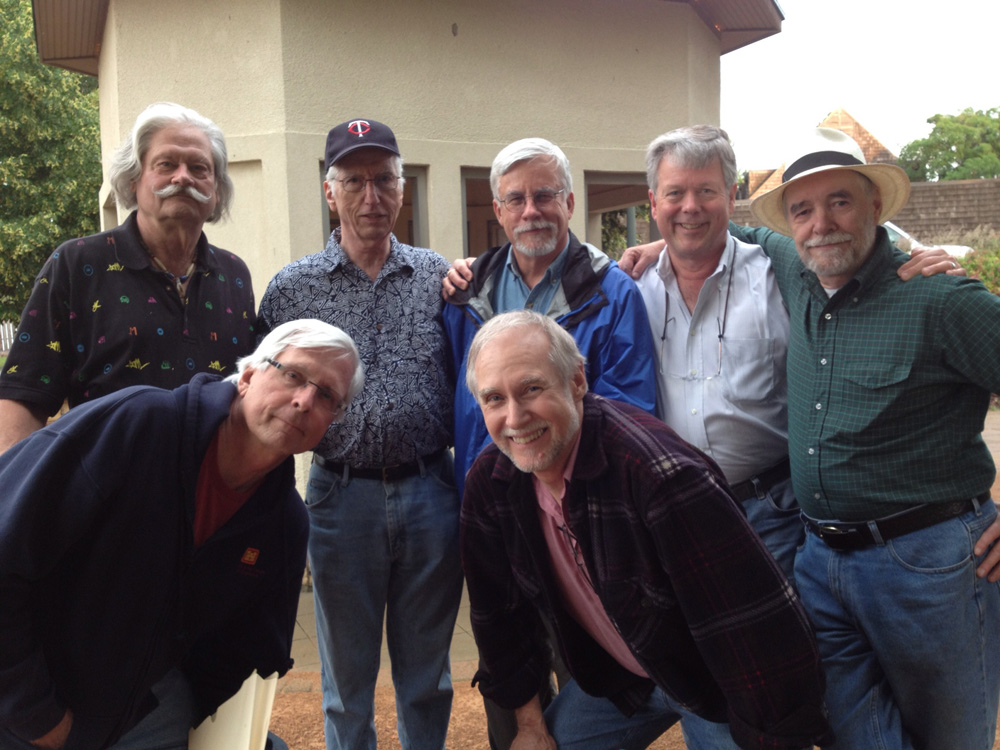
Yet peaceful has its limits.  When we met last night with all the Woolly wives and discussed books on a clear, comfortable evening, it was wonderful.  The buzz, the casual conversation, the different personalities.  People I’ve known for years, shared intimate parts of their lives.  That we don’t have out here.

I’ve never found my people in Anoka County, though I love it out here.  That’s partly because I’ve refused to give up my urban connections, working in politics for the Sierra Club, volunteering at the MIA, visiting museums, meeting with the Woollies.  It’s partly because I’m an introvert and starting over with new friends is tough for me.  It’s partly because my politics don’t have company here.
I suppose another way to look at this is that I have the best of both worlds, a peaceful refuge and cosmopolitan friends.  I’ll stick with that one for now.


Good Enough

Lugnasa                                                                    Hiroshima Moon

When Kate and I visited our money in July, our financial planner, R.J. Devick, made an interesting observation.  Responding to the deluge of financial information–there are so many sources newsletters, private websites, newspapers, books, information services for financial professionals–he decided to have just four sources on which he relied, to the exclusion of the others.  I don’t recall the specific four, but they were high quality one private, one newspaper, one financial analysis group and something else.

He said he realized he could spend all his time reading and come away more confused.  Probably so.  There is, of course, a need, and I’m sure he does this, to check the continuing reliability of your sources, but overall this was an early information management strategy. Pare down your resources, make sure they’re high quality, then rely on them.

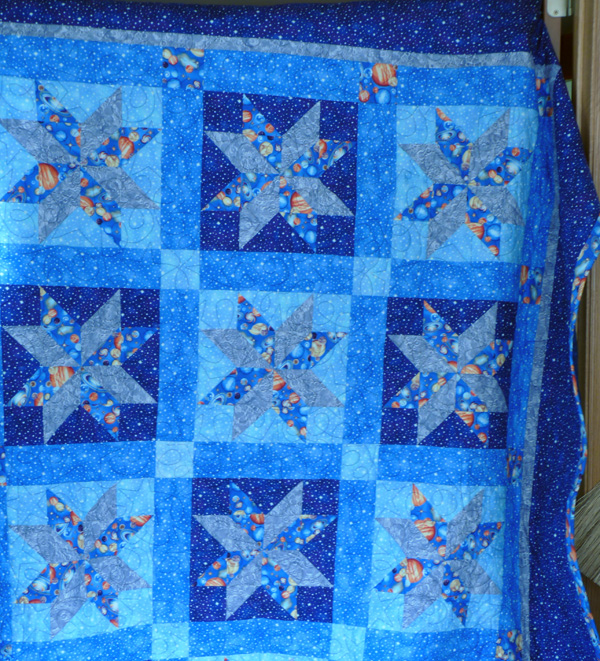
This struck me when Kate told me about seeing the quilt display at the MIA.  One of the artists dyed their own wool in slight gradations of hue in the same color, then used those variations as the design element in her quilts.  I asked Kate if she had any interest in learning to dye and she said no, quilting and piecing were what interested her.

Kate’s made a decision not unlike R.J.’s, an intentional choice to limit her range of interest in the service of getting higher and higher quality out of her work.  It’s a strategy some of the most creative folks apply, going back to the same well over and over again, though with infinite variation in treatment.

It may see obvious to you, probably does, but to me this is anathema.  And probably to my detriment.  I’ve written before about the valedictory life, the kind of life lived by valedictorians.  Once in awhile I check up on research about this topic because I was a valedictorian in the long ago faraway.  Mostly valedictorians don’t become famous experts, great writers or over achieving corporate climbers.

Why?  Because to be a valedictorian, you have to pay similar attention to all the classes that you take.  Or, at the least, in those classes that don’t come easiest, you still have exert enough effort to get an A or 4.0.  Apparently that style continues throughout life for most valedictorians.  That means we don’t achieve the kind of focus that designs the first computer, tracks down the most efficient way to manage information, builds the deep knowledge to become an artisan in cloth or paint.

Nope, we’re happily reading Scientific American, being a docent at a museum, writing a novel, translating Latin, putting in a vegetable and flower garden, doing all of these things at a reasonably high level but not high enough to stand out.  This is a hard life to accept, in one way, when achievement has been important, but it tends to not be the type of world beater achievement others expected.  On the other hand it meshes pretty well with the good enough life.  Good enough.

Latin Fridays. (Maybe I Should Eat Fish, Too?)

Lugnasa                                                       New (Garlic Planting) Moon

Down in the pits with Ovid this morning, rasslin’.  I’m not moving as fast as I did a month ago, but I believe that this stretch is more difficult, not that I’m slower.  There are many small satisfactions in translation:  learning new words, puzzling out word order, identifying conjugations, putting phrases together to form a sentence and sentences together to form a narrative.  I enjoy it.

Today is a Latin day, so I’ll whack away at Ovid in the afternoon, too, before I work out.  Tomorrow it’s back to Missing though I hope I can work some short Ovid sessions along the way, too.

I had two different couples stop me after the Rembrandt tour yesterday, none of them part of the home school group who were my primary tour.  They both said I was an excellent docent.  Used those words.  That felt good.  I thanked them and said it was good to hear.

Kate’s roasting peppers this morning.  That set off the smoke alarm and the co2 detector.

A Peat Bog

Lugnasa                                                        Hiroshima Moon

This has been a down August for me.  Still slogging through molasses.  Only bursts of energy, clarity.  Don’t like it.  Doesn’t seem to be much I can do about it.  One foot in front of the other.

Worked all morning on Missing.  Right now I’m summarizing chapters, creating character bios and defining scenes.  The result will be an outline with chapter summaries and a read through, quick, yes, but still a read through.  Once the read through is done and all chapters summarized, I’ll be ready to start working on Loki’s Children.

When that comes, my days will be Missing revision, writing Loki’s children, translating Latin and the occasional tour.  Hoping that I will get assigned to the terracotta warrior show since I’m prepared already for Qin Shi Huang-Di and the rise of the Qin dynasty.

Right now all this sounds too much, but a hold over from the days of salaried work is a good work ethic once I’m clear on where I’m going.  That means I’ll keep going.

The bees.  Dejected, yes.  Defeated, no.  Last year I decided I would buy packages, build up the colonies and take the honey they produced, all of it, including their winter stores, then start over again the next year.  This was partly a response to difficulty over-wintering bees, partly to mite loads.  Fail.

So.  I have to look at this a first year project, in which case I have one colony, the aggressive one, that will have plenty of honey and brood for the upcoming winter.  The other, the less active one, had, today, brood.  Surprise!  They must have swarmed earlier and created a new queen.  Not sure right now how to encourage them through the winter, but I’ll find out.  If the strong colony produces any extra honey, I’ll give it to the weak one.

Lugnasa                                                                  Hiroshima Moon

Rembrandt tour today with another group of developmentally disabled folks.  This time a simpler approach.  What’s a painting?  What are colors?  Eyes?  Mouth?  Ears.  Can we find them?  More appropriate for this group.


Rembrandt

Lugnasa                                                 Hiroshima Moon

Rembrandt tour this morning with some developmentally disabled adults.  These were severely disable folks, four responded with only token replies to questions, not out of shyness but out of lack of cognitive resources.

We concentrated on faces, seeing if any one was there.  We also investigated the things Rembrandt did really well such as eyes, background, clothing, jewels, black.  One young man, Kong, had a piece in the foot in the door show.  He followed much of what went on, at some level.

We talked several times at Rembrandt self-portraits about Kong using a mirror to paint himself.  I think he might try it.

It was a tough tour in some ways, but gratifying, too.

Art for the Blind

Summer                                                 New (Hiroshima) Moon

Today a large group of docents will give tours to an even larger group of kids from the Minnesota State Academy for the Blind.  Should be an interesting time, fun.  I’m using the Roman torso touch, verbal description of Doryphoros, rock garden of the scholar’s study touch, Bacchante and Satyr, the Kimbles, verbal description of St. Croix Gorge with the Cora, verbal description of Cream of Wheat posters, touch Stampede.

When I first lost hearing in my left ear, which happened suddenly over a period of six months when I was 39, I read a lot about deafness, not knowing whether the problem would over take my good right ear or not.  The reading surprised me in that most disabled people said they would rather lose their sight than their hearing.  Why?  Because hearing is the relational sense, it’s how you make and retain human relationships.

Sight, of course, is important, too, but it doesn’t have the level of isolation from the rest of the world as deafness.  Or so the reading I did suggested.

I can’t say.  But, I can say this.  When in a crowded, noisy room or near a source of noise like a waterfall or constant sound in that range, I tend to move toward the corners or leave. Again, why?  In a quiet room I can hear well enough; you would not notice I’m deaf in one ear; but, in those situations I can’t understand human speech.  When I try to, I have to make up what people have said, guessing from the bits that get through and the context.  I am, I have discovered, often wrong.

Tour Day

Summer                                                     Under the Lily Moon

Today I give my first Rembrandt tours.  Two public tours at 11:30 am and 1 pm, then another for the Woolly’s at 6:30 pm.  By the end of today I should have a good sense of what works and what doesn’t.  My tour is overlong right now, too many objects, too much information.  So, some pruning is necessary.

To that end I’m going in early today to spend some time in the exhibit before my first tour.  Wander around, look closely.  Check out the crowds.

Maybe I’ll see you there.

A Day Off From Rembrandt

Summer                                                         Under the Lily Moon

Taking a day off from Rembrandt.  I finished all the reading I had laid out, looked up a lot of paintings on the net and am now letting it all soak in.

The garden work this morning was a nice break and I spent the rest of the day on Philemon and Baucis.  I’m not going to finish it by Thursday, still too much to do on putting together my tour, but I can see finishing it in the next week or two.

I’m moving at a much faster pace now since my aha last week.  It was a real breakthrough, both in method and in understanding.  Nice to know this old mind still has an aha or two left.

Gonna work out now, short burst.  I’ve cut back to two of these short-burst workouts instead of three.  They were wearing me out.  On Wednesday’s I’ll do a modest cardio workout with resistance instead of short-burst plus resistance.  The other three days I do a light cardio workout for 50 minutes.

10,000 Hours

Summer                                               Under the Lily Moon

OK, I’m late to the 10,000 hour rule.  You probably know about it from Macolm Gladwell’s book, Outliers.  I missed it or, if I noticed it, I passed it by.

It did make me think when I ran across it recently.  What would be worth spending that much time to polish?  First question, is there anything I’ve done repeatedly, for hours at a time, over several years?  Yes, writing.  Being a student.  Engaging in political activity.  Studying Art.  And most recently, translating Latin.

Second question.  Are there any of those that I want to continue that I might pursue at a pace to reach 10,000 hours or so?  I’ve already reached that level in being a student and, I’m sure, in political work.  That pares the question down to writing, art and Latin.

I will continue writing, so writing at an increasing pace makes sense to me.  Studying art is fun, but I’m never going to put in 3 hours a day at it.  Just not that interested.  But.  The Latin?  Maybe so.  Maybe so.

That would mean pruning my close attention and active time to two activities, writing and Latin.  Might make sense.  Hmmm.