Category Archives: Garden

Laborers for the Great Work

Summer                            Waning Summer Moon

There was a pagan feel to the gathering at Seed Savers Exchange.  Ironic, since Luther College in nearby Decorah represents a conservative brand of Lutheranism.  There was at least one obvious symbol, a man wore a t-shirt with a Wiccan theme, but the more pervasive and more subtle expression came through in conversations like the one I had with Virginia Nowicki, soon to be Gardener’s Supply Catalogue official national garden crusader.

“In the garden we feel a connection to the divine, the sacred,” she said while we ate organically raised chicken and pork, kohlrabi salad, heirloom green beans and mashed potatoes.  “We feel authentic.”

“Yes,”  her husband said, “We belong to that land.  It’s our home.  We feel like we’re just one of the animals that live there.”

Virginia will begin promoting Liberty Gardens in a couple of weeks on a website she’s producing and through  the network of those connected to Gardener’s Supply.

Virginia and Bob live in Downer’s Grove, Illinois.  Their home serves as a demonstration site during Permaculture Design classes.  They moved in thirty years ago.

“When the city inspector came, he asked when the lawn would come.” Bob said.  “I told him we weren’t planning on a yard.  He seemed taken aback.”

“Well,” he asked, “how will you deal with the mud?  I can’t give you an occupancy permit until you do something about that.”

“Woodchips,”  Bob said.

“What?”

“Woodchips.  We’ll put down woodchips.”

“Oh, all right.  When the woodchips are down, I’ll sign your permit.”

“We put in eight inches of woodchips,” Virginia says, “eight inches.  We imagined where the paths would go, then put  trees and garden beds in the places that weren’t the path.”

There home is in the midst of Downer’s Grove.

There were many examples of this kind of extraordinary devotion to the land and to growing food in concert with the cycles of nature, rather than against them.

Another man from Champaign, Illinois told me he fed himself and his wife and his son, his wife and their three kids.  Deborah Madison, the vegetarian cookbook maven, signed her books.  She’s on the board of SSE.  Eliot Coleman, a man who bought land from Helen and Scott Nearing–Living the Good Life, has a success story of intensive gardening.  He times his four-season gardening in concert with the Celtic cross-quarter holidays.  Mike McGrath, former editor of Organic Gardening and host of a garden show on NPR, is a garden crusader himself.

A Seedy Weekend

Summer                                    Waning Summer Moon (7% illuminated)

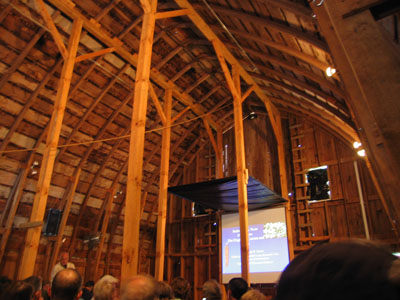
Ancientrails spent the weekend in the company of gardeners and small farmers.    They blur the line between horticulture and agriculture, not to mention the line between 2009 and 1969.  Seedsavers Exchange in Decorah, Iowa had their 29th summer conference.

This was the largest of their conferences to date with 400 +  attendees from all over the country.

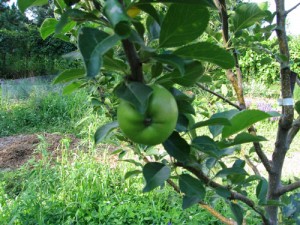
Today we learned how to graft a bud from a scion onto a trunk of root stock and came home with a new apple tree.  We also learned about methods for extending the garlic harvest:  dry sliced garlic then use a cheap coffee grinder to create home made garlic powder and why we should eat 5 pansies a day:  ruthin.  A.T.  is a skeptic about medicinal claims so we’ll have to check the data.

Yesterday a lecture traced both garlic and carrots from their homelands in central Asia to their current locale  in our gardens.  Here’s an interesting piece of information.  Though garlic does sometime reproduce from seed in the wild, it never does in our gardens.  This means that garlic can be said to be cultivated but not domesticated.

A.T. toured the Seed Savers operation.  They offered back office tours during the conference.  We saw the room where 500 to 7oo hundred thousand seeds go from store room to seed packet–by hand.   A seed sorting machine is on the way that will automate this task. We also saw the seed sorting operation, the root cellar and the greenhouses where the preservation plants go to seed.

There are two different streams to the SSE operation:  commercial and  preservation.  They inter-relate though the commercial side supports the preservation side.  Preservation of heirloom varieties is a key mission of SSE so they have a huge seed vault, a regular germination rate check program for the vault and a regular grow out operation so the seed stock gets replenished on a rotating basis.

If  you love gardening, you would enjoy a trip to the Heritage Farm.

Speed Bumps Ahead?

Summer                                   Waning Summer Moon

Life has begun to take on some speed again.  The garden work.  The conference this weekend.  Sierra Club work later this afternoon.  Tours to design for the first of August.  That sort of thing. Along with the cool weather, 64 here this morning, it feels good.  (check me out on this 3 to 4 months from now and see if I’ve stressed myself out.)

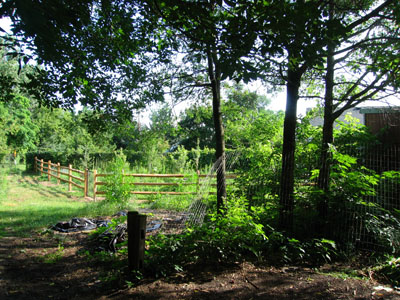
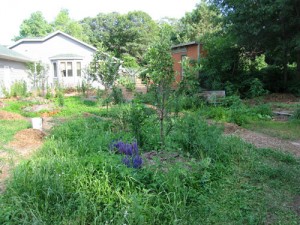
We now have a gated orchard, free from the marauding Vega.  The split rail defines the orchard, gives it a secluded look.  I’ll post a photograph at some point.

Gotta go right now.  Up to Elk River for dog meds, then I have to read material so I can look modestly informed while I represent the Sierra Club at the Minnesota Environmental Partnership’s agenda setting process.

My life, now

Summer                                  Waning Summer Moon

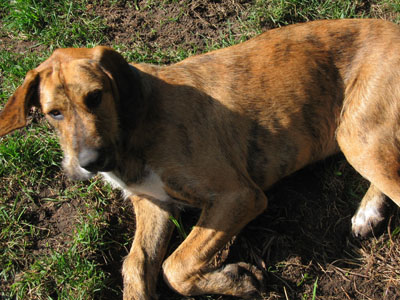
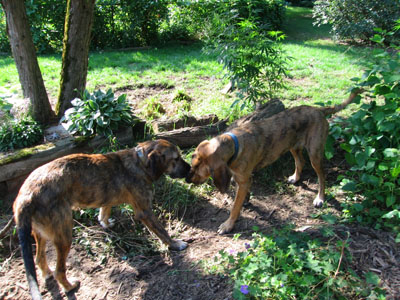
Vega the wonder dog has:  shredded the netaphim irrigation,  chewed up a length of high quality hose, swallowed my wedding ring, peed on the bench cushion Kate made and, most recently, peed on our oriental carpet.  As a result we have:  put up a split rail fence, done loads of laundry and taken the oriental in to the rug laundry.

On the upside, she’s irrepressible, enthusiastic and downright funny.  Her sister Rigel, a sweet girl and a lover, seems bland in comparison, but they have the same parents.

This weekend I’m off to Decorah, Iowa for a conference at the Seed Saver’s Exchange farm.  There will be lots of information on organic farming/gardening, wagon rides, two speeches on heirloom vegetables, a presentation on Heritage Poultry and a barn dance.  There will be workshops on saving seeds, garlic, potatoes, hand-pollination and bud grafting.

This turn toward permaculture, horticulture, gardening was a gradual process.  It sort of snuck up on me as I dabbled in perennials on Edgcumbe in St. Paul, grew some vegetables, then did a bit more after we moved to Andover.  Later, I took a horticultural degree by mail from London University in Guelph, Ontario.  At some further point I began to read about permaculture, picked up Bill Mollison’s book and began to make contacts locally.

The real spur to push further on all this was a conference Kate and I attended in Iowa City three years ago now.  Run by Physician’s for Social Responsibility it convinced me that I needed to turn my activist attention toward environmental matters.

It took a while to get going but I got myself on the Sierra Club’s political committee last year in the summer, then followed up with work on the Club’s legislative committee this last session writing a blog.  Last September we hired ecological gardens to do a permaculture design for the whole property and made a push to get the orchard planted that fall so it would have the benefit of a full growing season this year.

This gives me work outside, in the political arena and, as a Docent, in aesthetic and intellectual realms.  A really good deal for me.  As always, thanks, Kate.

Being Native To This Place

Summer                                Waning Summer Moon

Weeds.  Weeds, by definition, are a plant out of place.  This is, if you think about it, a curious definition.  Why?  Because the hardiness and persistence of most weeds indicate that it may be everything else in the garden that is out of place.   So, we may have to admit that the true definition is anthropocentric one.   Weeds are plants out of place in the horticultural preserves we call  gardens and landscaping.

An article in the Scientific American got me thinking about this, as did this mornings work removing quack grass and other hardy locals from the clover in our orchard.  The Scientific American article has the provocative subtitle:  The Real Price of Flowers.  The underlying message is this:  plant what grows where you live.  This means you will have much fewer energy inputs than if you maintain out of zone plants.  Most experienced gardeners know this, though some pride themselves on their ability to grow out of zone plants.  Here the trick is to get them to survive our tough winters.

The Minnesota Zoo, when it began, had a similar zoological mission:  contain animals that live in the climate of the 45th latitude.  They had (and have) a smaller tropical indoor exhibit that includes Komodo dragons, Gibbons, Tapirs and Toucans, for example, plus a coral reef, but in the main they have native Minnesota animals:  moose, wolves, beavers, wall-eye, muskie, pileated woodpeckers.  There are also many that thrive in our climate:  pumas, wolverines, lynx, otters, fishers, musk ox,  Amur tigers, grizzly bears, snow leopards, sea otters.    I say had because it now has a summer African exhibit and I wish it didn’t because I like the original mission.

Permaculture attempts to take this general notion and apply it to our horticultural and agricultural practices.  That is, permaculture emphasizes plants that work together, that live in the climate, soil type, eco-system native to the location of the garden or farm.  This allows the least outside inputs like fertilizer, pesticides, even tilling and other mechanical techniques.

We need to know more about the plants we call weeds.  After all, they live here, too.

The Harvest Has Well Begun

Summer                      Full Summer Moon

The garlic harvest is in the shed drying.  The mature bulbs now lie, a bit dirty, on an old screen I use for drying vegetables we intend to store.  It was a good harvest and, if last year is a rule, it is enough garlic to last us the full year until next July.  Some of these bulbs, about half, come from cloves I grew two years ago.  Very satisfying.

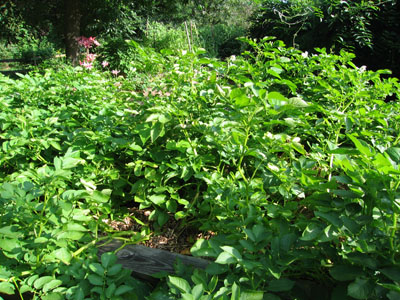
I dug up a bit of a potato plant to see if they’re ready to harvest for new potatoes, but they are not..  The potatoes ranged from tiny, about the size of the tip of my little finger, to one that would cover about half of my palm.  The last time I grew potatoes was on my farm, The Peaceable Kingdom.  One fine September evening I took a hit of mescaline and lay among the potatoes, the sky blue overhead.  The potatoes grew, visibly, as I lay there, shaking gently and rising slowly from the soil.  I could feel the tubers beneath me swell.  It was a direct and wonderful connection to a garden.  Wish the rest of the time had been that pleasant.

Moving stuff around in the basement so Jon can build us a wall for our storage cellar.  That’s next.

123456789 Tomorrow

Summer                           Full  Summer Moon

Woolly Mammoth Tom Crane sent this interesting note:

I’ve been alerted to an event that will take place later this week, something that happens once and only once over the course of history. Shortly after noon on July 8, comes the moment that can be called 12:34:56 7/8/9.

Don’t forget.  A once in our calendar moment.

Now that the mulch pile has been moved I can turn my attention to other garden tasks like weeding the clover, checking for new potatoes and looking at the garlic.  Weeding vegetables and perennial flowers.  Harvesting vegetables.  Thinking about how to fill in that spot in the year, late June, with flowering perennials next year.

Jon has one more carpentry task.  We want him to wall in a portion of our utility room to create a cool storage area for fruits and vegetables, an inside root cellar.  I don’t think it will be too complicated for him.  He’s very skilled when it comes to handyman type work.  Thank God.

One of these morning we’re going to the zoo to see the grizzly bears.  I love to go to the zoo but its so far from here in Andover, almost 50 miles.

Mulch

Summer              Waxing Summer Moon

The six cubic yard of mulch pile has become several piles of mulch at strategic locations along the paths and beds of last year’s orchard installation.  Now it awaits distribution, looking like debris fields from some recent wooden mountain slide.  Mulch serves many purposes in the garden.  Winter mulch keeps the ground cold during spring’s heaves as the earth thaws and refreezes.  Summer mulch helps in weed suppression, keeps the ground cool to avoid plants getting overheated and helps hold moisture in the soil during hot weather.

Mulch in the orchard serves mainly to suppress weeds and to give a uniform look to the beds and paths, but it has one important purpose that Paula Westmoreland of Ecological Gardens taught me.  She says the breakdown of wood chips gives a different boost to soil chemistry, one more favorable to perennial plants while straw works better for annual plants like vegetables.  I don’t understand it, but she seemed very confident.

I drove into Panera’s in Northeast for a meeting with Dan Endreson, outgoing legislative committee chair of the Sierra Club and Margaret Levin, its executive director.  We went over the past patterns of developing agendas for the upcoming legislative session.  Dan made me a disc of all the documents that had been useful for him and the committee over the last four sessions while he’s been active.

It’s fun to get into a responsible role in an issue area I feel is important and in an aspect of the work that involves politics.  The future looks like lots of meetings, phone calls and work in or around the capitol.

The kids are on their way back here from a 4th of July spent in Chicago with Jen’s family.  Herschel will be happy to see his family again.

As American As …

Summer                                   Waxing Summer Moon

As american as stock-car racing, country music, Walden Pond and the Beach Boys, another long hot summer is well under way.  The neighbors love fireworks and each fourth of July they show off the good stuff they’ve picked up.  Some of it is impressive for local effects.  Flowering showers with a boom at the end.  Fiery pinwheels with whistles.  Percussive blasts.

Rigel and Vega did not get as upset tonight as they did last night.  Reassurance and familiarity are a powerful antidote.

The harvest continues and picks up speed.  Tonight I made a dish with chard and beet greens, topped with baked beets in Balsamic vinegar.  There was, too, roasted turnips covered in olive oil, pepper and Kosher salt.  Potato crusted wild Cod finished the meal.

The Seed Saver’s Exchange calendar that hangs on our kitchen wall has this quote under July’s photograph of heirloom tomatoes, onions and bell peppers:  “When the harvest begins to flow is the gardener’s joy.”  It’s true.

Digging up turnips and beets, cleaning and cooking them feels so good when they’ve come direct from the garden.  Though there are political reasons for having one, ecological reasons  and aesthetic reasons, the real payoff from a garden is fresh food, grown in a manner you know and in a place with which you are familiar, even intimate.

There are certain activities that just seem congruent with life.  Among them are picking, cleaning and cooking your own vegetables.  When I dig up the turnips and the beets, I remember the day their seeds went into the ground, one at a time.  Their first shoots.  Their growth over time.  All part of my life and theirs.

Another tradition of the fourth at our house is a meal with dishes cooked from our own sources.  Hope yours went well, too.