Category Archives: Great Work

Please Help Stop This Mine

Samhain                                                           Winter Moon

Today’s Star-Tribune has an excellent article by Lee Schafer, business columnist:  PolyMet mine report has a giant hole in it.

An excerpt:

“Late last week, the voluminous environmental impact report for the first project in what could be a major expansion of mining in Minnesota, PolyMet Mining’s proposed copper-nickel mining operation near Hoyt Lakes, was released, but without much that was meaningful about financial assurance.

(William Ervin)

It’s baffling that over a decade into the project’s evolution, the public still knows next to nothing about the financial assurance provision. It’s hardly trivial, given that the proposed mining and processing operation could require the treatment of water for more than 500 years.

The idea behind requiring financial assurance to make sure there’s money to contain and clean up polluted sites is really pretty simple. A mine is operated by a corporation that could go bankrupt, or fold up like a circus and leave town once the money has all been made and the mine is played out…

It takes up a little over three pages in a report so big that just the glossary alone is nearly five times bigger. It has a one-line table, showing estimates of cost if the mine were to close at the end of year one, at the end of year 11, or at the end of year 20. The high end of the cost-estimate range is $200 million….

If operating a water treatment facility costs $1 million a year, the financial assurance for PolyMet should be easily manageable, he said. “But if that operating cost got up to $10 million a year, that is pushing $1 billion to pay for that. That’s why at PolyMet it becomes an issue.””

Financial assurance connects directly to the question of tailings runoff.  PolyMet will claim that its estimates are correct because their new, never-before-proven technology will create safer tailings and tailing’s ponds.  No sulfide mine ever, anywhere has created a safe tailing’s situation.

The basic problem is simple.  The overburden and the rock not containing copper, nickel and other valuable metals contains sulfur. When rain and snow and sleet fall, melting water runs through the massive hills of tailings.  The water which runs off the tailings creates a sulfuric acid load.  But, it’s water, too.  So it flows into the watershed around the Hoyt Lake’s plant.

That sulfates can kill manoomin is evidenced by the Wild Rice Dead Zone – a stretch that begins where the Bine-ziibi (Partridge River) enters into Gichigamiwi-ziibi (St. Louis River) and extends 140 miles to the Anishinaabeg-Gichigami Maamawijiwan (Lake Superior Basin). The Wild Rice Dead Zone is the result of extremely high concentrations of sulfate released by U.S. Steel’s Keetac and Minntac taconite mines. Sulfide mining will add yet more sulfates into rivers and lakes thereby affecting the food that grows on water.”   (IC Magazine, Supporting Indigenous People)

A bonus feature of this area is that a confluence of continental divides makes some water head down the Mississippi to the dead zones of the Gulf, some water heads into Lake Superior on ies way to the Atlantic, while other water drains out of the tailings ponds into streams headed for Hudson Bay.  That way one mine can pollute three different large bodies of water and streams and rivers along the way.

Thus, to prevent acid drainage over the potentially 500 year long exposure to toxic runoff either requires a lot of money or excellent unproven technology.  Or, ideally, both.

As Schafer points out in a video discussion, Shakespeare was writing 500 years ago.  500 years is a long time.  The iron range gets 20 years of jobs against centuries of ruinous pollution.  Public policy must weigh the balancing benefits.


Bunny Lives Close By

Samhain                                                     Winter Moon

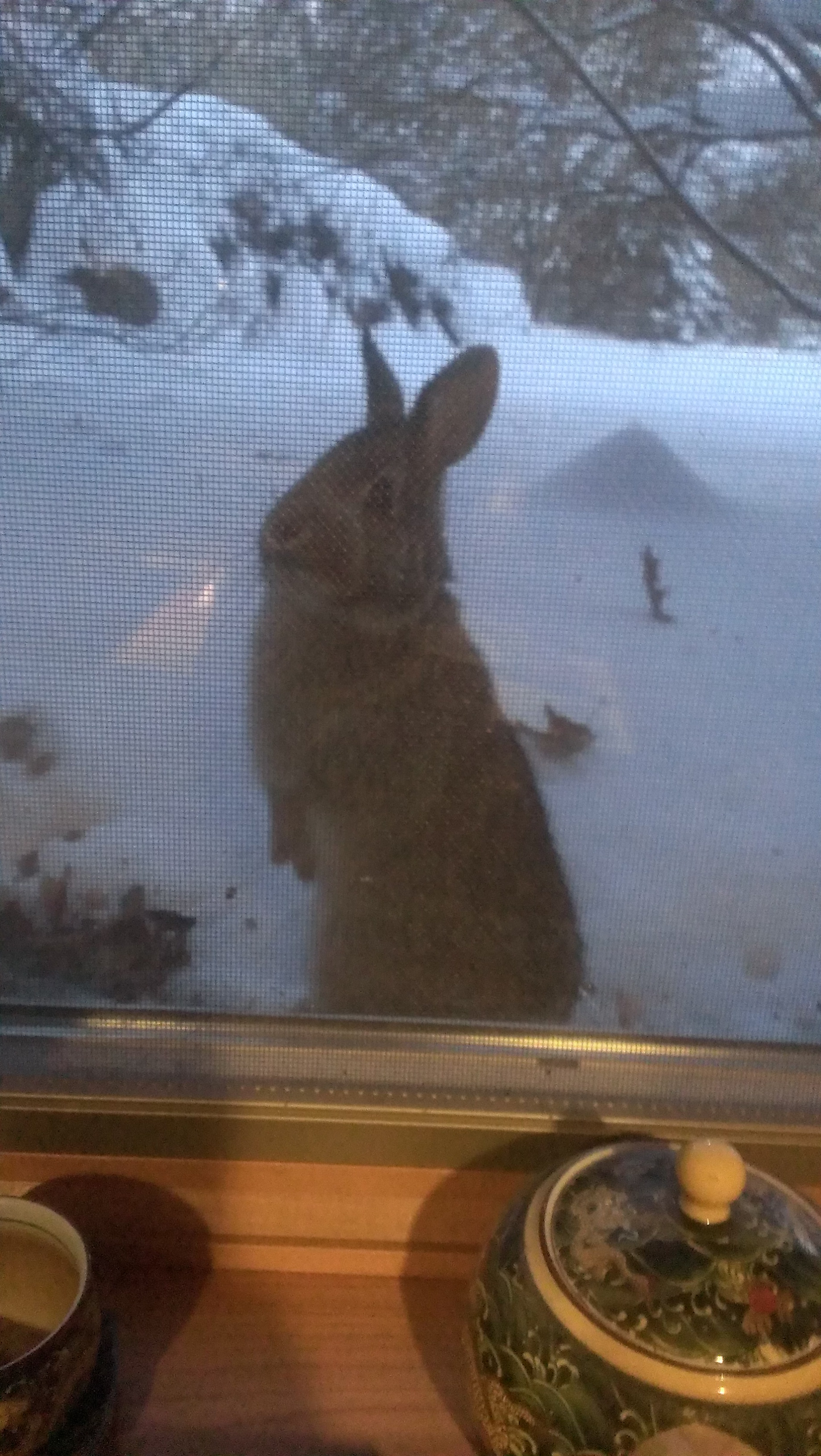
That bunny buddy lives under the boulder wall just to the west of my north facing IMAG1224window.  He came out this morning, stopped to look in the window a couple of times, stared at me, then proceeded on down the bunny trail.  This not so ancientrail takes him along the north side of the house and out to a part of the front which slopes up to seven oaks.  At least I imagine that’s where he’s headed since there are dogwoods, spirea and new ash saplings on the hillside.  Good rabbit food.

This entire week stays cold, then we hit some mid-twenties next Saturday.  Plus new snow today.  This could be another old-fashioned Minnesota winter.  I hope so.  It shaves off some of the pain of global warming.

Holding the reins for the four horsemen? Humanity

Samhain                                                                   Winter Moon

“Man is the unnatural animal, the rebel child of nature, and more and more does he turn himself against the harsh and fitful hand that reared him.”

H.G. Wells

I’ve seen several positive developments in the war against the war on Mother Earth. 11,000+ Minnesotans asked the Public Utility Commission to shut down the Sherco coal-fired electrical generation plants.

Another 12,000 have questioned the optimistic analysis of the Polymet Corporation in their Environmental Impact Statement for a copper-nickel mine on the border of the Boundary Waters Wilderness.  They claim to have a technology that will do what no other sulfide mine in the world, ever, has done:  control sulfuric acid runoff from mine-tailings.  Prove it first makes sense to me.  Pay for the probability of failure up front with a bond equal to the amount the state calculates will be necessary to contain the tailings also makes sense to me.  Meet these two criteria then we can talk.

There is, too, an article in the Economist that suggests large corporations expect to pay a carbon tax and will do so willingly.  This is good news.

Here’s the link to H.G. Wells.  If we don’t do these things, and the items mentioned here are minimums and much, much more will be required of us, it is not the earth that will suffer.  The natural world changes.  That’s what it does.  It always changes.  If we accelerate change in a particular direction, then it is not the planet but humanity that is at peril.  The risk in all these matters is the extinction of the human race.

This may be the apocalypse so often bruited as caused by an angry god.  The hand holding the reins for the four horsemen is not divine, it is all too human.

Be Glad You Exist

Samhain                                                            Thanksgiving Moon

Thankful.  Grateful.  Still here.

Yes, that’s the  prerequisite to all that follows, my living presence to write these words. And, yes, damn it, I’m grateful to be alive.

When I visited Constanta, Romania a year and a half ago, I went there as a pilgrimage to the place of Ovid’s exile.  This is a city that has Roman (Romania!) roots.  Outside an excellent museum of Roman and Greek antiquities (it was a Greek trading port first.), there was a collection of grave markers.  On one of them was this line:  Be Glad You Exist.  That’s what I would call ur-gratitude.  Thankfulness for living.

It’s where I’ll start.  Beyond consciousness and good health in my own case I’m thankful for the same in Kate, the dogs, family, friends and even a few others.  Our home.  Our buddies and colleagues the bees, the soil and the plants which grow in it, those past and those to come.  The orchard and the trees in our woods.  All the critters, sleeping and active that call it home.

Extending all that in a generally cosmic direction, I am grateful for the physics that allow us to exist at all, the sun for its energy, the planet for its hospitable climate (sorry about that hot pack, Gaia) and the North American continent for its wildness and its cities and towns.  Yes, the suburbs, too.  Even Andover.

Language.  English.  Being able to communicate with each other, even through such a flawed and miraculous medium.  What would life be without language?  Western medicine.  Often maligned, but my fav.  Western civilization.  Also often maligned, but mine and yours.  At least most of you who read this.  And just as worthy a human artifice as anyone else’s.

Of course the internet.  Cyberspace.  What a wonder to an old man raised with bakelite phones, 6 digit phone numbers, a time before tv.  So much.  So much to say thank you for. More than can be expressed in any list, no matter how long.

How about, for example, oxygen?  Or the properties of water?  We are made of stardust, animated elements spun out so long ago at the birth not of our nation, not of our planet, not of our solar system, not of our galaxy, but of our universe.  And now they walk, talk, consider their origin.  How damned amazing is that?

So.  Thanks.


Black Fish

Samhain                                                              Thanksgiving Moon

In a way I didn’t want to watch it.  Black Fish.  I knew from the trailer that it would make me mad and sad in equal measure.  But we watched it tonight anyhow.

It made me hang my head in shame as a member of the human race.  Tilikum, the raked male who pulled a SeaWorld trainer to her death in 2010, had been taken from Puget Sound as a youngster.  These are animals that never leave their mother’s side, remaining in pods that are like small aquatic nations with differing cultures and language.

It screams slavery.  Families broken up, individuals bought and sold for their ability to entertain or, in Tilikum’s case, provide consistent semen for artificial insemination.  Animals who might swim 100 miles in a day in the wild are confined for life in concrete pools, and shut away at night in even smaller pens with no lights and no access to the sky.

In the wild males like Tilikum are kept at the margins of the pods, ruled by the mothers with matriarchal dominance.  In captivity, unable to escape, Tilikum suffered repeated attacks by the females, especially at night when shut up with them in the smaller pen.

By the end I was crying and wanting to hold someone accountable.  This is an outrage.  It’s not the only one and it may not be the worst one, but it is unconscionable and wrong.  The orca brain has an extended organ within it, a larger element than similar organs in humans.  A neuroscientist who studied orcas under magnetic resonance imaging and in autopsies said their brain just shouts emotion.  They are very social animals who appear to have taken life together a level beyond what we can understand.  And we put them in pens so we can sell plush toys?

Around and Around and Around We Go

Fall                                                                       Samhain Moon

Interesting convergence.  In Ovid today I translated some verses about the silver age in which Jupiter created four seasons from summer, brief spring, winter and autumn.  After finishing this work, I went out and joined Kate, already at work in the garden.  Small pellets of snow fell.

(The Close of the Silver Age by Lucas Cranach the Elder, c. 1527-35)

We went into the orchard.  Kate pulled back the landscape cloth around the remaining trees while I broadcast the fertilizer, sprayed with biotill and then worked them both into the top three inches of soil.  While she replaced the landscape cloth, I shoveled soil, mostly sand, back into two large holes dug by our energetic girls, Vega and Rigel.

At one moment I looked up at a tall Norway pine and felt a kinship with Ovid and those farmers in long ago Latium.  We had similar things to do at similar times of year.

The word annum popped up from today’s translating.  You know, I imagine, that it translates as year, but you might not know that its primary meanings are: a circuitcircular courseperiodical return.  In one sense this is obvious of course, but that term we use frequently could orient us not to linear time, as we tend to use it, but to cyclical time.

When I say, I am 66 years old, we tend to think, oh.  Born 66 years from this date.  But that’s not what it really means.  It really means I have experienced a full year 66 times.  The year itself, if we’re true to its Latin roots, is not a one after the other marker of chronos, but a complete set, 4 seasons here in the temperate latitudes, finished and done with each winter, begun anew each spring.  Or whenever you want to break beginning and ending.

We then start over again.  Another year as we often say.  Yes, just so.  Another year.  This time in the next year I’ll be fertilizing the orchard.  As I have this year.  So that moment of apocalypse when the earth becomes changed and brand new?  Spring.  When the earth becomes desolate and barren?  Late fall.  Happened before, will happen again.  Amen.


A Riff on Rain That Got Away From Me

Fall                                                                    Harvest Moon

Rain.  Creates a hole up in the burrow and sleep, slowdown sort of feeling.  We went out for a small lunch, took a nap.  Business meeting in the morning, partly dividing up money from the recent stock surge.

The soil here in the Great Anoka Sand Plain (a former river bank for the Mississippi as it detoured around the Grantsburg Lobe of the Wisconsin Glaciation) allows rain water a clear path to aquifers beneath it, including one from which we get our water.  Not great for gardening unless there happened to be a peat bog atop the sand like the Fields Truck Farm that surrounds our development.

So, there’s a trade off.  Good water resources for tillable soil.  The small crop vegetable grower and orchadist, however, can amend the soil with organic matter and top soil. We’ve done that.

The aquifer from which we get our water, the Franconian Ironton-Galesville, (see pic) underlies much of eastern Minnesota, much of Wisconsin, some of Michigan, Illinois and Indiana is hydrologically connected to Lake Superior as you can see by the map on the right.

In case you think the olden days have no impact now, you might consider aquifers.  The Franconian Ironton-Galesville aquifer came into existence during the middle Cambrian period of the Paleozoic Era, beginning some 540 million years ago and continuing to about 485 million years ago.  The water in this aquifer circulates around and among the area under all these states, providing the water from municipal wells throughout the region get the bulk of their water.

Here’s another matter to consider.  Water cycles up and down, into the earth then up to the sky and back to the earth, sometimes ending up in aquifers and sometimes in lakes and oceans and rivers and streams and ponds and lakes.  This material from the Coon Creek Watershed District interests me.

“The ultimate source feeding groundwater is precipitation. Actual
aquifer recharge rates are not well quantified within the watershed
which leads to uncertainty in assessing sustainable withdraws.
Over appropriation is the result of removing water at a rate and or
volume faster than the aquifer can supply. In cases where a water
source takes 100 of years to recharge, appropriations are an
irreversible withdrawal.”
An important thing to note here is that in cases of drought, as now, there is no recharge possible.  That means that any climate change induced reductions in rain fall directly impact our long term capacity to draw our water needs from these ancient sources of water supply.


I Like Getting Old. Patti Smith

Fall                                                                     Harvest Moon

Something’s happening here.  What it is is not exactly clear.  At the end of this gardening year I feel like I’ve finally gotten it.  That is, I believe I now understand how to grow fruits and vegetables in quantity and of high food value. As Kate said, moving her hand in a low but upward swoop,  “Sometimes the learning curve is long.”  And it has been.  Over 20+ years.  Today though I feel good about my gardening skill.

On the writing front I’ve rounded up several agents to query when Missing comes back from its beta readers and has gone through the copy editing process.  I’m deep in the research phase for Loki’s Children, focused right now on the text, Loki in Scandinavian Mythology.  No matter how all this turns out in the matter of publication, I’ve let the inner and outer censors go.  I don’t know how or why, but I freed them and they left.  So now the process is all good.  Research.  Critique.  Feedback.  Submission.  Writing.  All good.

The MOOC’s have retaught me a valuable lesson.  When I’m engaged in scholarship, I’m happy, in my element.  I hit flow most often while learning.  That means the work with Ovid, which begins again on October 4th, is another chunk of the same.  Happiness is a warm book.

Last night I had a dream in which a person ridiculed me for not being spontaneous, being disciplined to a fault.  It bothered me as I slowly rose to consciousness this morning.  Am I so focused on a few things that I’m missing life?  Has my willingness to change directions, chart a new path receded?  Been suppressed by all this?

No.  I don’t think so.  But I’m open to other perspectives.  To me my life is full, rich.  There are friends and family whom I see or communicate with regularly.  There is a creative life partnership with Kate here.  The dogs alone provide many spontaneous moments because dogs live only in the now.  In the past I have initiated change in the world through political action.  Now the action is more at home and in the family.  Seems just right for the third phase.


A Good Year for the Crops

Fall                                                                       Harvest Moon

Got my soil tests back and the recommendations for next year’s garden.  This time I asked IMAG0650cropped for specific information about beets, allium crops (onion, garlic, leeks) and tomatoes.  I will use a broadcast for all the beds but use special supplements for these three crops.  That way I can keep them in the same beds year after year unless some kind of disease problem occurs.

This time I included soil samples from the orchard, so I have recommendations for broadcast and sprays for it, too.  With a winter pruning that Javier and company will do we should have a better and more consistent fruit crop next year.  This year the cherries, currants, honey crisp and sweet tango were good.  Plums and pears and blueberries not so much.

Since I decided a couple of years ago to get more and better crops from our limited space, I’d rate this last year a definite step in that direction.  It was IMAG0689a weird year weatherwise and I have no way of knowing how that helped or hurt us, but the International Ag Labs feeding program did help.

A key aspect of the International Ag Labs program is its movement toward biosustainability so as I use their products my soil becomes better and better, not poorer and poorer as happens in much of U.S. agriculture.  There are two primary goals here: soil made better by our growing and the production of higher nutrient quality produce.  That’s a solid win for us and the planet at the same time.  It is the Great Work in miniature, right here in Andover.

Given the outsized (for us) honey crop this year I’ve also decided to scale back my bee plans.  Provided this colony survives the winter, and I think IMAG0873it will, I’ll just divide it next year and not buy another package in 2014.  Maybe in 2015.  2015…geez.  That still seems like flying cars, shuttles to the moon and computer created meals at home.  Guess I’m now the 20th century, second millennium guy anachronistically positioned in the future.

Kate uncapping the honey.  We’ve developed a rhythm, a working partnership when it comes to caring for the land and our plants.  We share the space and the work with bees, the living organisms of the first six inches of the soil and the dogs who keep critters out of our garden and orchards.

A Coarse, Tactile Spirituality

Lughnasa                                                                    Harvest Moon

While out preparing beds for bulb planting later this fall, I thought over the post I’d made below.  Spirituality is not the best word for describing what I was talking about, I realized. At least it’s not in metaphysical terms.  I’m talking about a here and now, sensory delivered experience.

In a broader sense, and as I think it is often used, spirituality refers to a mode, event, ritual that makes present, even if momentarily, our connectedness.  In traditional religious circles that connectedness links up to what Kant would have called the noumenal realm, the realm beyond our senses.  Nietzsche put a stop sign to philosophical consideration of the noumenal, a problem for Western philosophy since the Platonic ideal forms, when he said God is dead.  That is, the noumenal realm is not and never was accessible.  If it ever was at all.

Using spirituality in this latter sense–the revelation of connectedness however it comes–then my use of it was just fine.

Just now I looked out my study window and to the north the sky was black and to the east a sickly green cast hoovered near the horizon.  When my eyes read that green, my stomach sank, just a bit, the fear engendered by growing up in tornado alley struggling to assert itself, demand my attention.  Survival at stake!   Red alert.  This was a moment of awe, a reminder of the power nature can bring to bear.  It was a spiritual moment in its sense of immediate connectedness between my deepest inner self and the world within range of my vision.

These are small epiphanies, yes, but they are available. This coarse, material spirituality, tactile in its immediacy reminds me, in definitive manner, of who I am and of what I am a part.  Do I need more?