Category Archives: Great Work

The Growing Season Begins to Wind Down

Summer                                                             Hiroshima Moon

On Wednesday we move from the growing season emphasis of early summer to the harvest emphasis of late summer.  The Celtic calendar marks that change on August 1st which begins the season of Lughnasa, a first fruits time.  Yes, harvesting has happened before this, but now the inflection is on crops for sale, trade or preservation.

[ in precipitation in during the growing season (after Meehan et al. 2004 and Bowen et al. 2005)]

If any of you saw the opening ceremony of the Olympics, the first, agrarian phase of Great Britain before the industrial revolution is the time the Celtic calendar marks.  It is not a calendar for an industrialized or a technological society though it has an important place in both.  Industrialization and technology both move us away from direct experience of the
natural world and especially from the source of our food.  The Celtic calendar gets its seasons from the botanical and meteorological rhythms, not the work day or the academic year or the never asleep world of the internet.

Those other rhythms, the Taylorized day or the instantaneous cyber world, lead us away from natural rhythms into a cultural space dominated by rationality, science and human control.  In the Celtic calendar the natural world rules, just as it does yet today, though we hide ourselves from it with thermostats, electric lights and high speed broadband.

This is not an either/or situation; there is a dialectic between the world of human artifice and the world which brings the thunder and the lightning and the rain, which grows the food, which gives us night and day.  Yet.  So many of us, in our air conditioned, wired, well-lit by electricity homes, obscure or forget or ignore that our food grows in the soil, the flesh of mother earth.  That it depends on water either from rain or from irrigation, this dependent of rain and replenishment of hidden aquifers.  That the sun which gives food the energy we need does so without human intervention or assistance.

All of our civilization has as its foundation, its literal without which nothing support, the vegetative world.  And we do not control it.  We can help it, nurture it, bless it, curse it, but we cannot make plants grow.  We can only provide or protect the conditions under which they do so.  In our amnesia about this simple, stark fact we pave over farmland, alter the chemical conditions under which plants grow, change their genetic patterns trying to extend our control, but all this begs the question.  How did the vegetative world get along without us?

The answer?  Just fine.  This is not a rant, this is a reflection of our current reality.  It is the hope of ancientrails that it can serve as one reminder.  One reminder of the essential, unique and healing power of the world beyond our control.
A Dream, Become Real, Become Dream

Summer                                                Hiroshima Moon

“Dreams pass into the reality of action. From the action stems the dream again; and this interdependence produces the highest form of living.” – Anais Nin

Horticulture.  When we moved in here now 18 years ago, we decided to spend money upfront on landscaping, figuring we could enjoy it over the life of our tenancy rather than putting in as an amenity at the time of a sale.  We hired a landscape architect from Otten Brothers and he put in a basic plan.  Two wild prairie patches on either side of a manicured lawn.  Norway pines, a spruce or two, some amur maples, a genus maple, an oak, some river birch.  Near the house he put on narrow beds planted with shrubs like euonymus, a dwarf lilac, shrub roses, viburnum among others.

A boulder retaining wall in the front shored up a long bed like a peninsula into the green ocean of our yard.  In the back we had them cut a three tiered garden, each tier marked off with boulder retaining walls and divided near the house by steps made of rail-road tie size square lumber.

The rest of our property, all now that is our “backyard”, was part woods and part scrubland covered with black locust trees, thorny and not visually appealing though very good for fence posts.  The first two years after our move I spent cutting down trees, using a commercial wood-chipper to  grind them up and hiring a stump-grinder to come in and rid us of the stumps.  The scrubland became, gradually, a place where we could build a shed, plant a vegetable garden and I dreamed of making it an expanse of prairie, as I had wanted to do with the entire property when we moved. Continue reading A Dream, Become Real, Become Dream →

Tigers and Bees and The Great Mesh of Being

Summer                                                   Under the Lily Moon

Thursday night Kate and I watched Conflict Tiger, a movie by Sasha Snow that followed the same story retold in the book, Tiger.  It’s a powerful, gritty movie about the reality of life in the taiga.  The characters in the movie, especially Yuri Trush and Ivan Dunkai, have a powerful presence, Trush as the hard-bitten but compassionate eco-policeman and Dunkai as a shamanic character with intuitive grasp of the tiger and taiga learned practical wisdom.

(Ivan Dunkai, Sasha Snow)

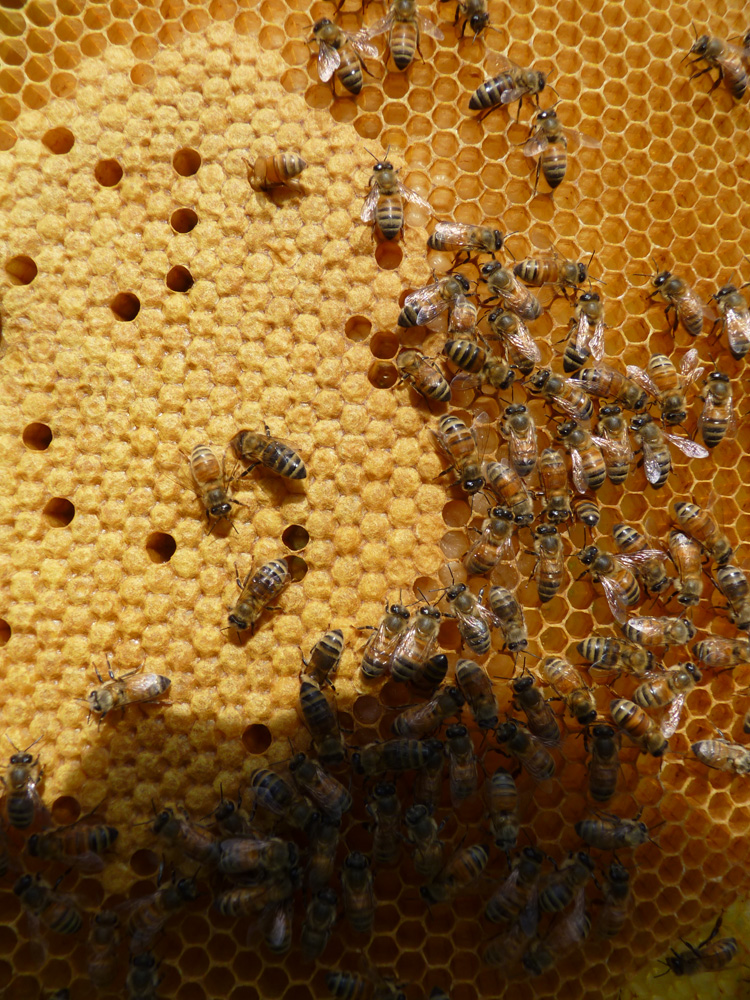
Today I did bee business.  Moved six honey supers, put two on the south colony and took the remaining four into the third garage bay.  The trailer on our lawn tractor is a handy piece of equipment.

Two colonies:  the south, filled with bees, boiling up out of it like angry vengeance, not wanting a stranger pawing around in their home; the other, docile and less populated.  When the south colony residents went into their angry buzz and started slamming against the veil and gathering on my right glove, my body zoomed back to last fall when I made a mistake.  You may recall that I decided to replace a honey super on a hive without veiling up?  OMG.  WTF.  OUCH.  My heart rate went up today.

Since I use nine frames in ten frame hive boxes, the bees often construct comb in the empty spaces and they had done this in the south colony.  Since I had to reverse the hive boxes on that colony today–this forces the bees to fill up both hive boxes with brood which makes for a better crew to harvest and make honey–one of the chunks of non-frame comb fell off.  It had honey it.

It’s now on the kitchen table.  Fresh honey in the comb.  Worth that bit of pit-a-pat.

Bee keeping is a collegial activity.  I keep the frames clean and coming while the colony builds up, adding sugar syrup if necessary.  Once the honey flow starts, if the colonies are strong enough, I put on honey supers and harvest the honey they make that is in excess of what they need to survive over the winter.

In other words I provide a home and its maintenance, they pay the rent with honey.  It is nothing less than a partnership with both parties putting in their own labor and each party getting benefit.

It is, in that way, a very tangible micro-instance of the relationship we have with our mother, the earth.  In that macro relationship we are the dependent party, yet we have work we put into the relationship, too.  It can be constructive work or destructive work, we choose, but the feedback systems in play make destructive work dangerous, too often causing mother to remind us of our place in the order of things, the great chain of being.

In fact the great chain of being does not run from earth to heaven, rather it runs around the skin of the earth, more like a great mesh.


Tyger, Tyger’s Dying Light

Beltane                                                  New Lily Moon

Finished Tiger by John Valliant.  It has so many great lines.  Hope dies last.  Russian proverb.  The only other warm blooded animal that rivals humans in total numbers?  Chickens.  The native people tell me I’m now marked by the tiger, Yuri Trush.  Trush is the dominant figure in the book who survived a direct assault by a tiger.  The story of that tiger and its death is the strong lineament of the book.

Because the tiger is an apex predator in the eco-systems it inhabits, the health of the tiger population serves as a, perhaps the, key indicator of the health of that eco-system. If the tiger population is healthy, then the prey species are healthy as are the complex network of plants and other animals that depend on these two, predator and prey, for their survival.  The sad news is that the apex apex predator, humans, has begun to push its competitors out of existence in the wild and that includes tigers.

A good book, well written and provocative.

Presentiment?

Beltane                                              Garlic Moon

Cleaned off the air conditioner, mulched the blueberries, asparagus, onions, mounded the leeks (2nd time), mulched the chard and the beets.  Also took notice of the garlic scapes.  Soon it will be time for spaghetti with olive oil and the scapes.  Put a bit of mulch down in the perennial garden.

Any particular day can be hot just because, but when a whole year, in fact, a whole millennium, think of that for a minute, trends warmer then it’s not just because.  A jump to 7.4 degrees above average points a bony finger at anthropogenic causes and if you can’t see that you haven’t been outside lately.

Strawberries and Bull Snakes

Beltane                                                      Garlic Moon

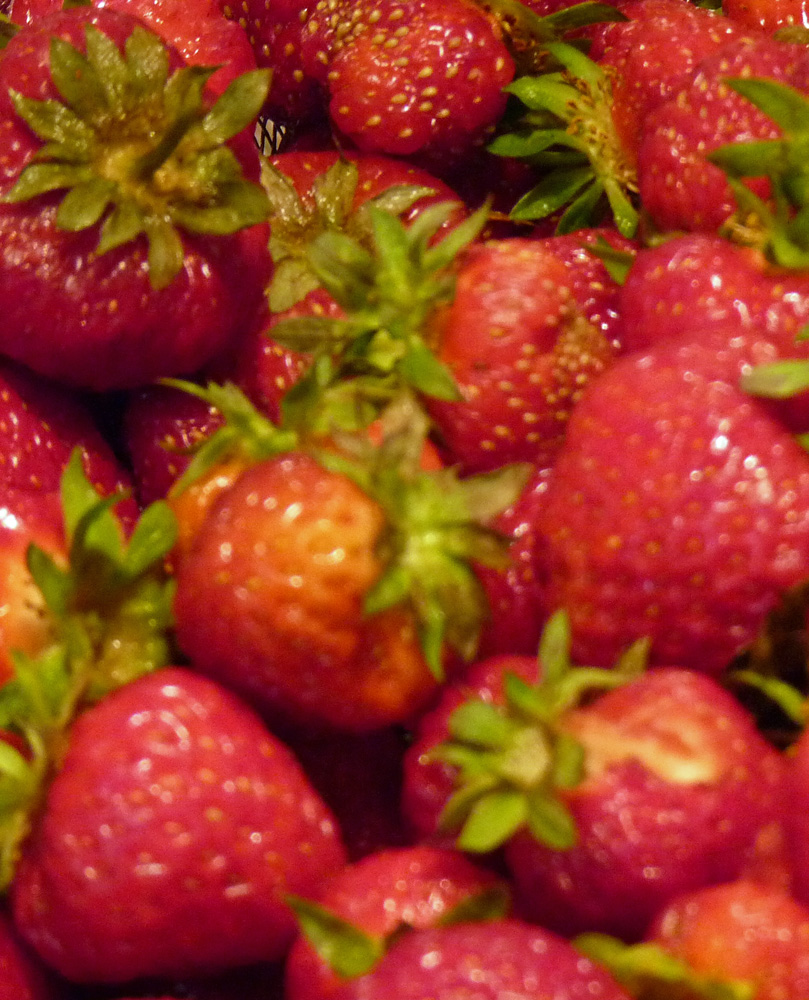
Kate picked strawberries and rhubarb yesterday.  Two pies later we still have a plastic container filled with strawberries.  We have two separate strawberry plantings, the ones that are only June bearing have not begun to mature quite yet.

With well over 150 apples and four pears bagged over the last three or so days, the currants, blueberries, cherries and plums still come and the raspberries arriving in the fall, we’ll have an abundance of fruit this year and for years to come.

We’ve also had asparagus already, are eating green onions and small shallots now and I had a sandwich filled with young beet greens.  Though we’d starve if we had to depend totally on our own produce, still we grow more and more each year; the variety of what we grow has lessened somewhat as we get more intelligent about what it makes to sense to grow and what to buy.

This morning we got up early and drove over the Red Ox, a real old timey restaurant and had breakfast.  When the waitress asked if we’d like homemade bread, we said sure and I asked who makes it?  Robin.  She’s here 7 days a week and she opens and closes five.  Wow.  That’s a lot.  She must like it.  The waitress gave a low chuckle, Yeah or she doesn’t like it at home.  That’s what I’m beginning to think.  Made sense to me.

After breakfast we drove over to the Cedar Creek Nature Preserve, a University of Minnesota outdoor lab and nature center that trains ecologists, botanist, biologists, entomologists, herpetologists and the like.  It’s usually close to the public, but this weekend they’ve partnered with the Bell Museum to put on naturalist oriented programs for an evening and a day, last night and today.

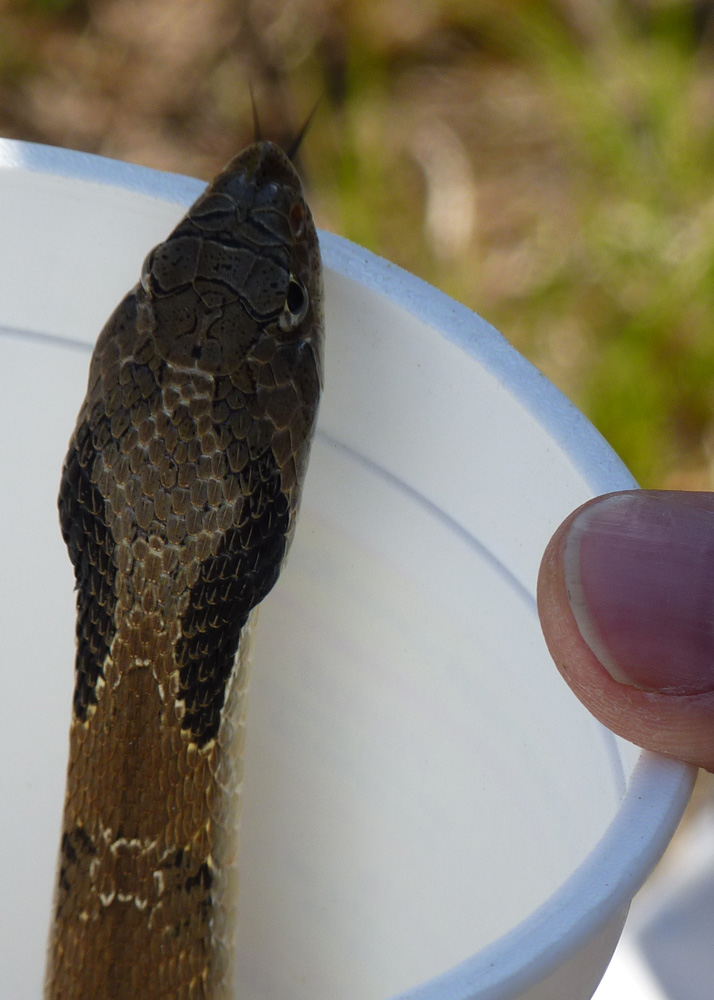
We went on the snake walk.  Our guide, Brian, a totally hairless biker, knew a lot about snakes.  He works as an engineering tech for a pharmaceutical company, but spends his off years hunting for and tending snakes.  The picture to the right is a bull snake, a rodent eater.

They are, apparently, mistaken for cobras because they fan out their head when threatened.  (Why anyone would fancy a cobra in Minnesota is beyond me.  But, hey.)

A walk along a shaded trail produced a sighting of a prairie skink.  It released its tail after capture, the tail continuing to wiggle, looking for all the world like a tasty earth worm.  Clever trick.  Sacrifice some body mass and live to eat another day.

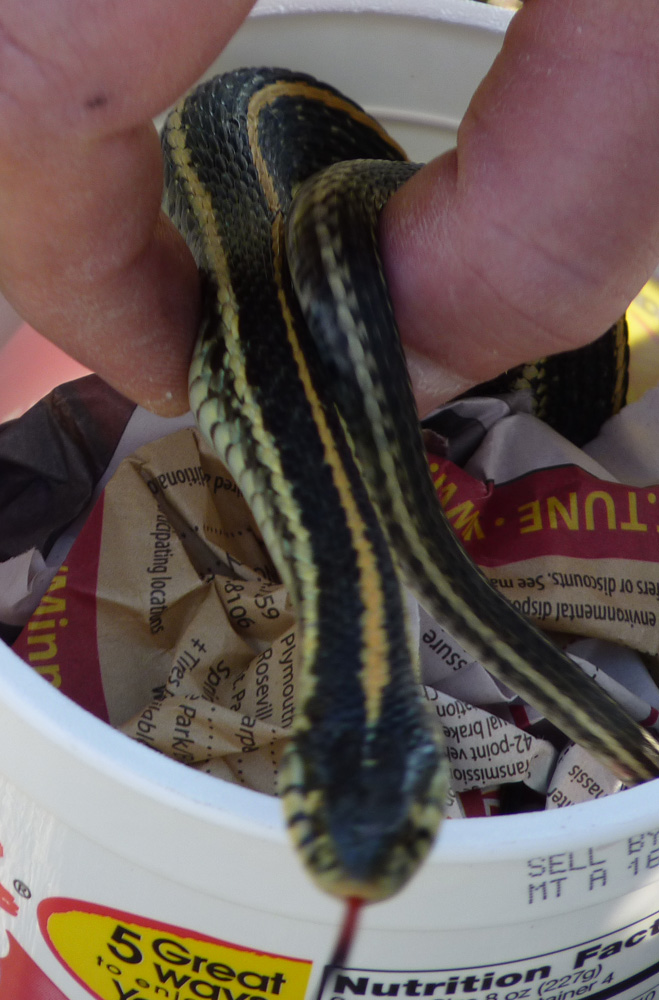
This snake is a prairie garter snake, identifiable by the black stripes down from its mouth.  She looked gravid.

Anyhow, the outdoors providing a lot of the entertainment this week with the transit of Venus, fruit and bee tending and Cedar Creek today.

Over

Beltane                                                      Garlic Moon

Over.  The last Sierra Club legcom meeting, the end of the 2012 session, a wrap up meeting and evaluation.  Over.  My return to politics, which lasted a bit over four years.  Out because after the cruise I wanted to focus on work only I could do.  That means, to me, bee keeping, garden tending, novel writing, Ovid translating and reimagining faith.

A combination of sadness and exhilaration.  Sadness because a time with good people, working on important matters, in an arena I have loved all of my life has passed for now.  Yes, a choice, a personal choice, yet, still a loss and some grief.  Exhilaration. I have made a choice and decided to guide my life in a particular direction.  That’s a positive.

Now we’ll see if the things I mentioned above and the work at the MIA is enough to hold my life together.  I think it is, probably more than enough, but more than enough in a way that will give me some synergy.

The Sierra Club work, no matter how good, involved drawing my attention away from the novel, from the Latin, from the garden and the bees.  Both the distance and the time commitments had begun to chafe.  It’s time for someone else to step up and time for me to step back.

A Consolation of Philosophy

Beltane                                                         Garlic Moon

The philosophy department at Ball State resided in a brick building littered with the remains of other days.  Religion was there too.  The chair of the Philosophy department Robert (his last name has fled for the moment), a buzz cut positivist, an ornery, no see it, no believe it kinda guy.  Let’s just say metaphysics were taught under sufferance in this department.

Bob drove me out of philosophy, convincing me that the most pressing questions of the day were what hot meant, or cold.  Couldn’t see it.  Not then, not now.  But then I didn’t explore much more, now I’ve been in the wide world and know there are more things than that dreamt of Bob’s dreary positivistic philosophy.  Much more.

In fact, if I’d listened to my self, I would have known it then, did in fact, but didn’t know I knew.

Many of us disenchanted with postivism found a real ally in Alfred North Whitehead, the creator of process philosophy.  I used to think I understood it, now I’m not so sure; but, I knew this about it, Whitehead said the universe was alive.  And that made sense to me.

Still does.  In some deep place it made a whole lotta sense, because one October morning a chill hit me as I left that brick building, a class in metaphysics just finished.  The next step, the one over the threshold into the quad, never happened, at least not in my consciousness, because my consciousness was otherwise occupied.

My heart filled up, my mind expanded, the whole of myself plugged itself into the throbbing matter of the cosmos.  I was one with the whole and it with me.  A sensation of light and vastness and yet intimacy became my reality.  Just for a moment.  I don’t know how long it lasted and at this remove, some 45 years later, I couldn’t reconstruct that aspect if I had to.

Since that time, if I remember to recall this, I have never felt alone.  The universe can be known through one flower, one bird, one puppy, one rock, one college sophomore, that much I learned for sure that day.  And more.

The universe can not only can be known (or felt); it knows (feels) back!  Now this is not revolutionary nor advance news.  Mystics before and after me have had similar experiences, remarkably similar, in fact.  The positivists and their ilk might explain this away through brain chemicals, but even if that were to turn out to explain this experience, it would only serve to under write its power.

It just occurred to me today that long ago moment on the quad, in the chill of an October morning, might have hints for how to live my third phase.

Legislature Lurches

Spring                                                                      Beltane Moon

The legislature lurches toward adjournment, up ending decades of environmental legislation as it goes, e.g.  permitting relaxation, a transfer of school trust lands out of the DNR’s purview (about 50% of land currently under their management), a probable wolf season.

A major reason for the bad outcomes (from my point of view) is the legislature’s focus on three big issues:  Viking stadium, a bonding bill and the Republican tax legislation.  These are the issues with which the governor has engaged and around which he has used his leverage in negotiations.  Our issues have not risen to the top of any of these debates.

This session, my third as chair of the Sierra Club’s legislative committee, is my last and I don’t like going out on this note, but there you are.  The next big target for all environmental activists has to be the 2012 elections where a concerted effort will be made to change control of both chambers of the legislature.

The ebb and flow of political fortunes, effected as always by many factors outside anyone’s direct control–economy, world military engagements, current social issue orientations–will give us a favorable climate at some point.  We need to work to make that point the 2013-4 legislative session.

See the Heads?

Spring                                                            Beltane Moon

Coming north on Highway 10 (or east, I can never figure it out and I’ve lived up here 18 years) just before the big Lowe’s store, it’s no longer unusual to see cars parked along the side of the road, drivers clomping out through the high grass, camera with a big telephoto lens in hand.  They’re headed toward a dead tree with a big clump of sticks in a high fork.

Kate told me she saw heads there a month or so ago.  I began to look, too, and finally saw a bald eagle circling the nest, coming in for a landing, presumably with food for the young’uns.  I’ve seen a head or two though I’ve never been able to suss out whether they were chicks or adults.

We hunger for peeks into the wild world, a personal glimpse of the life and times of creatures that live among us, but we rarely see.  Over the last 18 years Kate and I have a great horned owl hooting at night in our woods.  I’ve seen him/her once, it’s giant wingspan remarkable, yet hardly ever observed.

We have opossum, raccoon, woodchuck, rabbit, deer, coyote, skinks, snakes, frogs, pileated woodpeckers, bald eagles, great blue herons, egrets, too.  These last three we see from time to time, usually in flight, though the egrets are often there, serpentine necks ready to dip suddenly into the water.  The rest, almost never.

Around Christmas tree three or four years ago, back when I still fed the birds, a opossum took to visiting the bird feeder around midnight.  I happened on him one night and checked back frequently after that.  His small pink paws looked almost like human hands and I delighted in watching him do his opossum thing.  Why?  Because it was a glimpse of a neighbor, a close neighbor, one who shared the very land I claim to own, but whom I rarely–up till then, never–saw.

This takes me back to the discussion of mystery I had here a few weeks back.  We do not need to imagine a world beyond the one to which we have ready access; there is a large, unimaginably large world shrouded in mystery that lives near us, with us, within us.  Take the billions of one-celled entities that share our bodies, help us live our lives in return for some benefit derived from the eco-system that is our body.  A mystery, certainly.

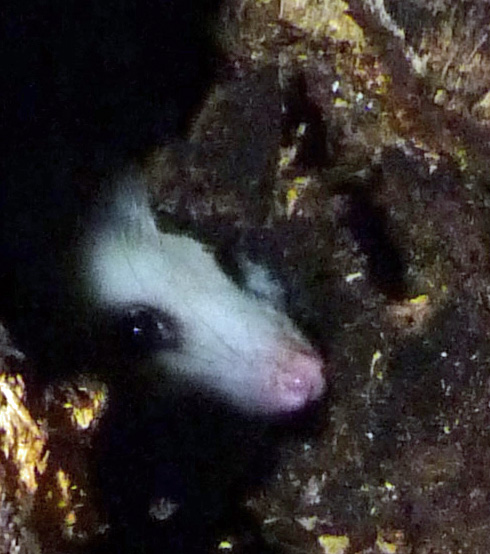
Or the baby opossum I found huddled up far inside a dead tree, doing what all prey does when confronted by snarling predators–Vega and Rigel–hiding in an inaccessible location. If Vega and Rigel hadn’t been obsessively interested in this tree, I’d never have known the opossum was there.

The morels that visited us once 18 years ago, never to return.  Or, at least never to be found.  A mystery.  This is a revelation to us, the way for us to an original relation with the universe.  And, it’s in our backyard.