Category Archives: Great Work

The Great Wheel in the City

Fall                               Waning Back to School Moon

How can city dwellers, big city dwellers, stay in touch with the natural cycles, with the rhythms of the Great Wheel?  This was on my mind yesterday as I walked around the loop.  There are, of course, the occasional plantings decorating outdoor cafes, the greenery of Grant Park and Millennium Park, even a lushly planted median on the boulevard of Michigan Avenue, yet these seem like captive specimens, botanical exhibits in a zoo for denizens of concrete, stone, metal and glass.

When I went out for a walk this morning, wandering down Jewelers Row, out to Michigan Avenue and down to State Street, building facades began to show themselves.  Here there were floral inspired Prairie School designs.  There were viny elements in tile and plaster ascending the column of a building.

At 30 Michigan Avenue an idea began to form.  There on a frieze perched above a  soulless slab of polished marble that defined a Walgreens were small medallions punctuated by a familiar face, the Greenman.  He looked like this one.  There were four, separated by the flowery medallions.  After that, the plant inspired architectural design appeared, as if by magic.  For those who have eyes to see, let them see.

In a flash I realized what I dislike so much about Modernist architecture.  It does not acknowledge the real context in which it exists.  This Bauhaus influence attempted to rid the world of the Greenmen, the vines, the flowers, the sinuous riverine shapes that the late 19th and early 20th century architects considered essential.

And they were essential.  Why?  In our cities we put on a brave front, raising  our forests of buildings that shade out the sun, paving over the earth so trucks and cars can move about with ease.  Tunneling electricity so even the night cannot dominate us.

We still need to eat. Our lives depend on the vast unbuilt land where the primary things that spring from the earth are corn stalks and wheat fronds.  Where animals may outnumber humans and the humans work with and for the plants.

We still need to breathe.  The lungs of mother earth, the circulatory system that cleans our air consists in large part of trees.  The forests lie outside our urban boundaries, though they do join their city cousins in their work.

We still need to drink.  Fresh water comes from rivers, lakes, streams and aquifers either far away from city centers or buried deep beneath them.  Care for the source of our drinking water means  caring for those ends of the earth from which it comes.

Thus, it is not an idle question to wonder how we connect with the Great Wheel, with the changes of season and the growing of food, the cleansing of water and air.

The design motifs inspired by green leafy beings recognized that dependence and writ its continuing message on the walls of the buildings which we use and which we see each day.  They inspire us and help us recall mother nature in  her beyond the city state.

There was. too, another reminder.  I looked down Washington from Wabash and my gaze carried up the  building led me to a patch of blue sky.  There was the moon, a half moon, the Back to School moon, framed by buildings with leaves and greenmen and flowers.  These are enough.

One thing more.  Remember Ozymandias, King of Kings.  Recall the ruins of Babylon, Xi’ang, Epheseus, Athens.  Cities do not last.  Nature reclaims them all at some point.  What seems so permanent, so imposing, so there only awaits its end.  Which will come, sooner or later.

Following the Old Religion

Lughnasa                                            Full Back To School Moon

Summer has three endings:  Labor Day which marks the end of summer vacation for many school children; and, for many adults like myself, kicks us into serious mode as all those years of conditioning continue to affect our attitude;  Mabon, or the Fall Equinox, which comes tomorrow, that point when day and night balance each other, neither claiming dominance, though the trend matters and at this equinox, the balance tips toward night as the darkness increases, pulling us toward the longest night, the Winter Solstice on December 22nd and Samhain, or Summer’s End according to the old Celtic calendar which divided the year in half, Beltane-Samhain or the growing season, and Samhain-Beltane or the fallow season.  Samhain comes on October 31st and, like all Celtic holidays lasts a week.

The growing season has this triple farewell reflected too in the holidays of Lughnasa, the festival of first fruits, Mabon, the peak of the harvest and harvest home, and Samhain, the end of the harvest season and the end of the growing season.  No matter how you notice or celebrate it these real changes in the agricultural year still happen, they still have critical importance for our human community, and they still deserve our attention.  Why?  Because our ages old relationship with agriculture is what separates us from the hunter-gatherers.  Agriculture allows us to live in villages, towns and cities by producing surplus food on farms in much the same way that the honeybee produces surplus honey while still making enough for the colony to survive on throughout the winter.

Without those who farm, there would be no surplus food.  With no surplus food we would have to revert to subsistence agriculture, growing what we needed every year or hunting and gathering.  This would prove daunting since most of us have forgotten or never been taught how to grow food, how to hunt, how to identify edible plants.

This is the great hidden reality for many, if not most, urban dwellers, who make up, since 2008, over half of the world’s population, a projected 5 billion people by 2030.  Without  a healthy eco-system, one that can support intense tillage, that is, sustainable tillage, the world’s urban dwellers will be bereft of something they cannot do without:  food.  Add to that the pressure on the world’s fresh water supply and two fundamental sustainers:  food and water are at peril.

Granted following the holidays of the Great Wheel will not work magic–sorry to all my Wiccan friends–but it would remind us all, 8 times a year, of the source of our sustenance.  That would help.  Naming our days after these holidays (I do it in the upper left of each post) keeps that reminder fresh.  Our sustainers, mother earth and father sun, do not require us, do not need anything from us, yet they will support us if we live within their limits.  These holidays began when our ancestors realized the need to remind themselves of the delicate, fragile harmony required for human life to flourish.

Over the course of the years and centuries and millennia since, hubris has lead us further and further away from the old religion; we have replaced it with  idols, fetishes, really.  We will, at some point, pay the price for our blasphemy as we upset that harmony, creating an environment that will no longer sustain human life.  Only if we step back from our profligacy can we ensure our survival.

Knowing the rhythms of the natural world, of the agriculture that feeds us, of the systems that keep water fresh and available, is our only chance to avoid apocalypse.  Will we do it?  I don’t know.

A Green Neighbor

Lughnasa                                               Waxing Back to School Moon

Early am picked wild grapes.  Kate makes them into a grape jelly.  The harvest was not as bountiful this year because we arrived about three weeks late to the banquet.  Others had gotten there first.  So it goes.  More than compensated for by the abundance of raspberries.

After the wild grapes I had an hour long session over skype with United Theological Seminary student.  I’m her mentor as she starts out on the long road to becoming a minister in the UU tradition.  The fact of listening to her, helping her sort through feelings and plans as she begins her internship, helped me remember why I agreed to do this.  Each person in a new endeavor needs someone who has walked roughly the same ancientrail.

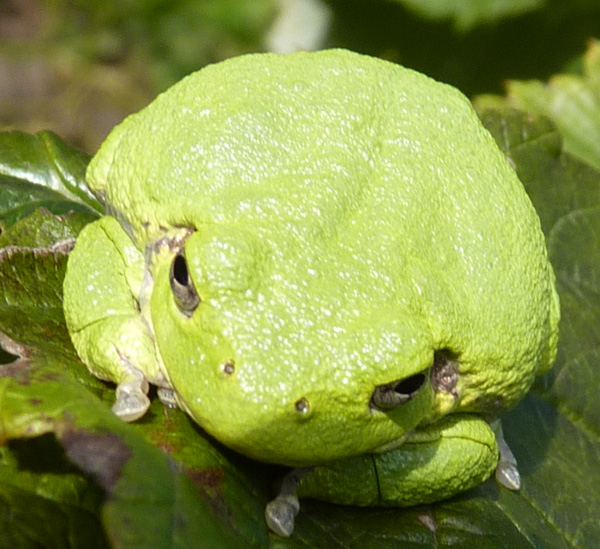
After that time I went back into the garden and picked yet more raspberries, greens and some tomatoes.  While working in our raspberry patch, I came across this guy sitting high atop one of the raspberry canes.  frog6002_2010-09-18_0292He kept me company while I picked the ripe red and golden fruit.  He waited yet longer while I got Kate.  He waited even longer when I went back inside and got the camera.

One invasive close-up to many got him to move.  He leaped away and I lost my friend.  After a quick search, he appears to be a gray tree frog, Hyla versicolor.

We also have skinks, salamanders and toads, all reflecting a healthy eco-system here where no pesticides or artificial fertilizers contaminate the plants and wild life.

Having a chance to visit with this guy is one of the perks of that choice.

After lunch, I popped the garlic cloves from my largest garlic bulbs.  They go in the ground this afternoon or tomorrow.

Busy, Busy

Lughnasa                                  Waxing Back to School Moon

Whew.  The new queen came today in a perforated UPS box, complete with a court of five worker bees.  After spraying them with sugar water, I took them out to the honey queen-bee-mdhouse where I pushed in the cork at the end of her wooden home, inserted a marshmallow (tiny) into it firmly, then opened the divide, took off the honey filled top hive box and inserted the queen in the middle of the second box.  This is called a slow release.  The queen and her workers eat away the marshmallow from one side, workers in the hive from the other.  Over the time this process takes, so the theory goes, the new queen becomes less threatening to the workers, who then allow her to come out and become their new monarch.  If it doesn’t work, they kill her.  I won’t check for another week.

With the queen in her new castle (hopefully), the grocery store was next on my list since Kate has a cold and she likes my chicken noodle soup when she’s sick.  While I made the chicken noodle soup, I also cooked lunch.  After we ate lunch, Kate went back to rest and I went outside and picked yet another several cups of raspberries.  Our bushes have been prolific this year.  The chicken noodle soup had our carrots, onion and garlic.

When the raspberries were inside, I worked downstairs answering e-mails while I waited for the soup to finish cooking so I could add the egg noodles and the peas.  At the end of that.  Nap.

After the nap I had to sort out a vote on legislative priorities for the Sierra Club and respond to a few more e-mails.  This took me up to the time to leave for the Minnesota Hobby Bee Keepers Meeting at the University of Minnesota.  The man who runs nature’s nectary, Jim, was there with a refractometer to measure moisture levels in honey.  Our capped honey was 16.9%, a little thick and the uncapped honey was 18.3%.  Since honey is anything below 18.6%, both of our batches were fine.

Home again where Kate and I ate some soup, watched a little TV, put the dogs to bed and then headed there ourselves.

A Real Boy

Lughnasa                                               Waning Artemis Moon

Had an odd experience as I rode the lawn tractor back to the garage after putting all the no longer needed honey supers in the shed, putting the spun out frames back on the hives and heading back along the vegetable garden toward the truck gate.  I felt like a real boy.

A la velveteen rabbit, that is.  Something about having followed the bee-keeping from last year’s single colony, a package that Mark Nordeen helped me hive into hive boxes he loaned me, through the divide and hiving a package on my own this spring, over the course of the summer and the nectar flow, through to this moment, with the honey in jars, stored now at home, in the bee’s care no longer, triggered a gestalt, a deep link between my Self and this cycle of nature in which I had participated.  Somehow that made me feel real.

Now, I don’t go around in skeptical philosophical clothing all day wondering whether or not I exist.  At least not any more.  Joke.  I mean I have a developed sense of who I am and what I am, but this particular feeling, a oneness, an at-one-ment with this place and the work of another species, I’ve never experienced.  It may relate to my relatives who farmed, a now, finally, getting it, what it meant to milk the cows or bring in the corn harvest, even to gather a clutch of eggs in the morning.

Whatever it is, it felt good.  Right.

Chicken Wings, Legislators and a Wolfman

Lughnasa                                        Waxing Artemis Moon

More napping.  Still getting the body back to its old form.  Maybe tomorrow.

Into the Sierra Club for the Legislative Awards.  It was the first time these awards have happened.  Justin’s idea and a good one.  Speeches, good strokes.

Ran into Randy Neprash.  From days gone by.  He was part of Phoenix Builders who worked with the West Bank Community Development Corporation.  I remembered him, he didn’t remember me.  He’s now doing some multi-city storm water drainage project as a civil engineer.  I knew him from somewhere else, too, but it didn’t come to me.

Back home after picking up fried chicken wings from the Wing’s Joint.  It used to be on Nicollet, a ways past Lake Street.  How it ended up in Blaine in a strip mall, I haven’t figured out, but I’m glad its there.  Best wings in town.

Watching the Wolfman with Benecio Del Toro spent the first half of the movie–what I’ve seen so far–trying to capture the heaviness, grief-stricken weariness and stolidity of Lon Chaney.  He’s just not Chaney.  Anthony Hopkins is, as one reviewer said, Anthony Hopkins.  It’s easy to see where they were heading with this.  The set, the costumes, the whole ambiance is right, but the story is draggy, too complex, too frilly.  With Hopkins and Del Toro there are enough acting chops here to produce a good film, but it likes a great story line.  Too bad.

Seeing What We Really Have Here

Summer                                             Waxing Grandchildren Moon

We are well past midsummer here in the northern latitudes.  The garden’dicentra09s peak bearing season will commence although we have already had blueberries, strawberries, raspberries, currants, garlic, lettuce, greens, onions, parsnips, beets and sugar snap peas.  Ahead of us are tomatoes, green peppers, potatoes, more greens, onions, beets, lettuce, butternut squash, leeks, wild grapes and carrots plus the odd apple.   Our orchard has a ways to go before it matures.  And I have a ways to go before I can care for the fruit trees in the manner to which they need to become accustomed.

All of which opens up the purpose of this little experiment in permaculture and the tending of perennial flowers and plants.  A long while back I bought three quarter-long horticulture classes from the University of Guelph in London, Ontario.  It took me a while to complete it, maybe a year all told.  The course helped me integrate and deepen what I’d learned by trial and error as I cared for the daffodils, tulips, day-lilies, hosta, croci, roses, trees and shrubs that then constituted our gardens.

In its salad days (ha, ha) the notion involved a root-cellar and the possibility of at least making it part way off the food grid.  Fewer trips to the grocery store, healthier food, old fashioned preservation.  A mix of back-to-the-land and exurban living on our own little hectare.  Last year the notion began to include bee-keeping.  Now called Artemis Hives.

As the reality of the size of our raised beds, the likely peak production of the fruits and vegetables possible has become clear to me, I have a more modest though not substantially different goal.  We will eat meals with fresh produce and fruits during the producing part of the growing season.  We will preserve in various ways honey,  grapes, apples, pears, raspberries, strawberries, blueberries, tomatoes, potatoes, onions, garlic, squash, beets, greens and parsnips.  These we will eat during the fallow days that begin as the garden goes into senescence in late August and early September and last through the first lettuce and peas of the next growing season.  We will supplement these with greens grown hydroponically and use the hydroponics to start seeds and create transplants for 2011.

None of this will remove us in any major way from the store bought food chain.  We will not solve or resolve much of our carbon footprint.  But some.  More than most perhaps, but far too little to claim even a modest victory.  So, should we give up?

Not at all.  Why?  Well, there is a richer, deeper lesson here than living wholly off our own land.  That lesson, taught again, day by day and week by week, and again, lies in the rhythm of the plants, the bees, the land and the weather.  An old joke from the 50’s asked, “What do you call people who practice the rhythm method?” (Catholics at the time)  Answer:  “Parents.”  The permaculture and perennial flowers here at Seven Oaks is a rhythm method.  What do you call folks who practice this rhythm method?  Pagans.

Ours is a life that flows in time with the seasonal music of the 45th latitude, the soil on our land, the particularities of the plants we grow, the energy of the bee colonies that work alongside us, the various animal nations that call this place home.  This is the profound lesson of this place.  Seven Oaks is a temple to the movement of heaven and the bees of Artemis Hives are its priestesses.

Whew

Summer                                      Waxing Grandchildren Moon

OK.  This will be last of this.  But.  Kate reminded me of her surgery on June 30th.  Which preceded preparation for and the arrival and stay of Jon, Jen, Ruth and Gabe followed then, as I said yesterday, by our too inclusive preparations for the Woollys. No wonder I wore out yesterday.  Let my prop it up and keep going inner coach have the day off.  Better rested and more clear-eyed today.  Ready for ancient Rome.

These two paragraphs came my way in the last two days.  Their conjunction speaks for itself.

“Speaking of heat, NOAA reports that June was the hottest  month in recorded history, worldwide. That is the fourth
month in a row of record warmth for planet Earth. June also marked the 304th consecutive month “with a global temperature above the 20th century average.” The last month with below-normal temperature worldwide? February, 1985. 2010
temperatures from January to June were the warmest ever recorded for both land and ocean temperatures, worldwide. Stay tuned.”
Check out Paul’s blog startribune.com/pauldouglas

(I imagine it’s photoshopped, but still…)

Mark Odegard found this quote in a book he’s reading about walking with caribou:

Henry Beston in the beginning of book.

“We need another and a wiser and perhaps a more mystical concept of wild animals. Remote from universal nature and living by complicated artifice, man in civilization surveys the creatures through the glass of knowledge and sees thereby a feather magnified and the whole image in distortion. We patronize them for their incompleteness, for their tragic fate for having taken a form so far below ourselves. And therein we err, greatly err, For the animal shall not be measured by man, In a world older and more complex than ours, they move finished and complete, gifted with extensions of the senses we have lost or never attained, living by voices we shall never hear. They are not brethrern, they are not underlings; they are other nations, caught with ourselves in the net of life and time, fellow prisoners of the splendour and travail of the earth.”

A Herd Remnant

Summer                                               Waxing Grandchildren Moon

The thundering herd of 11 Woolly Mammoths had dwindled to 5 by the time it found the outer reaches of urbia, the ex part.  Tom, Bill, Frank, Mark and Stefan joined me to make 6 of us for the July 2010 meeting.  Kate put together sandwiches, hor d’oeuvres, her rhubarb pudding with nutmeg cream sauce and various vegetables.  The food kept us all this side of the tar pit for another 24 hours.

We had a pre-meal excursion through the dog-proofed garden and over to Artemis Hives.  Various questions were asked and some were answered.  Most kept a respectful distance from the now upwards of 100,000 total bees at work.  It was fun to share the bee keeping work and the colonies with the crew.

Since I learned the cut comb method of honey extracting from Linda’s Bees, I gave each Woolly an aluminum foil square with the first ever Artemis Honey to leave the hives.  It was a signal moment for me and a highlight of my evening.

We checked in, discussed the natural world and listened to a couple of excerpts from “Hair”, reminiscing as we did about the 60’s, that moment in our lives, the unusual and powerful forces at work then.  Woolly Scott plays drums in a rendition of Hair directed by his son in Carbondale, Colorado.  He will be out there the whole month of July and shared some powerful emotional moments he has already had mounting this late 60’s classic musical.

The second picture itself took me back to those times.  I had forgotten the pure, animal joy of having long hair and flinging it around to the Doors, or Led Zepplin or the tunes from Hair.  Being stoned helped, too.

Mark Odegard, our only dam lock keeper, reported on his 7 pm to 7 am shifts at the #1 lock and dam.  There is a peregrine falcon nest nearby and he has observed the rearing of two peregrine chicks, including a late phase in which they peck so fiercely at their parents that the parents stand outside the nest and drop food into the razor beaked young.  I have known parents of adolescents who might have benefited from the example.

He also saw one chick’s first flight, a tumbling, gliding, clumsy landing affair.  Night on the river casts a spell, he says, and all down there succumb.

Kate and I, introverts by nature and preference, have just finished a week with the grandkids and their parents followed immediately by several days of preparation for visitors.  It wore us out.  We got up, ate breakfast, went back to bed and got up again around noon.  I’ll probably get another nap in before workout time.  Next time we’re going to have a cook, a cleaner and a gardener.

It is quiet here now.  Blessedly so.

We Call This Place Home

our-woodsSummer                                New (Grandchildren) Moon

Outside this morning, finishing my tea on the patio, a hummingbird darted in and out of the lilies, gathering the last bits of nectar, passing on final touches of pollen.  Like the possum from yesterday’s adventure the hummingbird shares this patch of land with us, too.  Possum, groundhogs, gophers, chipmunks, squirrels, raccoons, rabbits, deer, hummingbirds, blue jays, goldfinches, red-headed and pileated woodpeckers, a great horned owl, crows, grosbeaks, dogs, mice, skinks, salamanders, garter snakes, garden spiders, wolf spiders, worms, bees, moths, wasps, caterpillars and butterflies and many others, most one-celled or many-celled, I imagine, live here.

They live here as we do,  making a home, finding and preparing food, eating their meals, raising their young, growing to old age, dying.  Our home takes up more space, yes, and our decisions impact the land in dramatic, sometimes even drastic ways, but that we are only one species among hundreds that live here is beyond question.

When we leave, either through death or otherwise, the generations yet unborn of these animals and insectshighrise and other life forms will, perhaps, know no difference.  If fact, if the house became abandoned, many of them would find a use for it as shelter, as a place to raise their families, perhaps as a source of food.

All of us, all of us who live here, are only here for a while.  It is so important that we leave this place a better one for all its inhabitants.  If each of us only took this one objective, a prime objective?, to leave our places better for all those who live in them, wouldn’t the world be safe now and into the future?