Category Archives: Great Work

Becoming Native To This Place

Summer                        Waxing Green Corn Moon

westorchard709

The next meeting of the Woolly Mammoths will be here in Andover.  That means it’s theme and subject matter time.  The theme will be, Becoming Native to this Place, the title of a book by Wes Jackson of the Land Institute.  The subject matter will focus on the gardens, permaculture and the local food (slow food) movement.

At the Seed Savers Exchange conference held two weekends ago in Decorah, Iowa a commercial grower told of his change to the local foods idea.  A grower of greenhouse foods for various distributors who took his foods far from northern Iowa, he recounted attending a meeting sponsored by folks whose agenda was local foods.  They showed that, due to commodity based agriculture, northern Iowa was a net importer of food.  That astounded him.  He switched his focus then to growing vegetables for local consumers, working on niche markets like institutions, restaurants and grocery stores in the northern Iowa area.

He didn’t mention Michael Pollan by name but the subject matter was similar to Pollan’s recent work, In Defense of Food.  The Woollys have read the Omnivore’s Dilemma and the Botany of Desire.  We’ve also looked at the notion of Homecoming and the Great Work by Thomas Berry.  This August meeting, only 17 days after Lughnasa, the first fruits festival of the Celtic calendar, will celebrate the Woolly’s interests in home, food and continuity.    southgarden709400

Continuity?  Yes.  The Woollys have a 20+ year record of perseverance with each other and, by implication, an interest in this place we have  chosen to call home for those same number of years.

To the Woollys who read this:

Please choose one of the books or websites indicated and take a look.  While looking pick out two things:  what surprised you?  what would you like to know more about?   If you want, also look for something that seems off or misguided to you.

Dinner Straight From the Plant

Summer                        Waxing Green Corn Moon

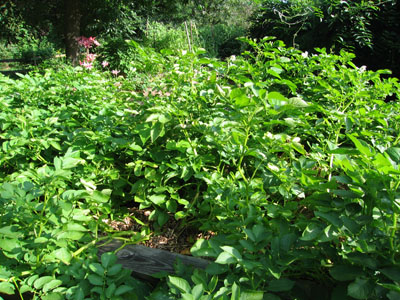
Dinner with vegetables straight from the garden is a treat and can be a surprise.  It was tonight.  We had potatoes, new potatoes-709042potatoes, dug just before cooking.  They had a distinct flavor, a nutty earthy  tone unfamiliar from the long since harvested potatoes typical of both home and restaurant cooking.  This meal included our garlic, our kale and chard, the potatoes garnished with our flat parsley and a bowl of sugar snap peas as an appetizer.

Digging potatoes involved a spading fork to loosen the soil, then searching around under the earth for these lumpy  treasures.  They grow well in the sandy soil here in Andover.

(pic:  potatoes before harvest)

Kate takes off for the Grand Teton’s tomorrow, a CME conference.  BJ is also out there, playing in the Grand Teton music festival as she has for the last several years.  The Tetons have an incredible beauty, the American Alps, a very young mountain range.  She’s back on Wednesday, then we go to see a micro-surgeon who has perfected the technique for cervical vertebrae.  He’ll evaluate Kate’s candidacy for that surgery.

Lots of weeding today and more tomorrow.  A normal task in late July, early August.

Laborers for the Great Work

Summer                            Waning Summer Moon

There was a pagan feel to the gathering at Seed Savers Exchange.  Ironic, since Luther College in nearby Decorah represents a conservative brand of Lutheranism.  There was at least one obvious symbol, a man wore a t-shirt with a Wiccan theme, but the more pervasive and more subtle expression came through in conversations like the one I had with Virginia Nowicki, soon to be Gardener’s Supply Catalogue official national garden crusader.

“In the garden we feel a connection to the divine, the sacred,” she said while we ate organically raised chicken and pork, kohlrabi salad, heirloom green beans and mashed potatoes.  “We feel authentic.”

“Yes,”  her husband said, “We belong to that land.  It’s our home.  We feel like we’re just one of the animals that live there.”

Virginia will begin promoting Liberty Gardens in a couple of weeks on a website she’s producing and through  the network of those connected to Gardener’s Supply.

Virginia and Bob live in Downer’s Grove, Illinois.  Their home serves as a demonstration site during Permaculture Design classes.  They moved in thirty years ago.

“When the city inspector came, he asked when the lawn would come.” Bob said.  “I told him we weren’t planning on a yard.  He seemed taken aback.”

“Well,” he asked, “how will you deal with the mud?  I can’t give you an occupancy permit until you do something about that.”

“Woodchips,”  Bob said.

“What?”

“Woodchips.  We’ll put down woodchips.”

“Oh, all right.  When the woodchips are down, I’ll sign your permit.”

“We put in eight inches of woodchips,” Virginia says, “eight inches.  We imagined where the paths would go, then put  trees and garden beds in the places that weren’t the path.”

There home is in the midst of Downer’s Grove.

There were many examples of this kind of extraordinary devotion to the land and to growing food in concert with the cycles of nature, rather than against them.

Another man from Champaign, Illinois told me he fed himself and his wife and his son, his wife and their three kids.  Deborah Madison, the vegetarian cookbook maven, signed her books.  She’s on the board of SSE.  Eliot Coleman, a man who bought land from Helen and Scott Nearing–Living the Good Life, has a success story of intensive gardening.  He times his four-season gardening in concert with the Celtic cross-quarter holidays.  Mike McGrath, former editor of Organic Gardening and host of a garden show on NPR, is a garden crusader himself.

A Seedy Weekend

Summer                                    Waning Summer Moon (7% illuminated)

Ancientrails spent the weekend in the company of gardeners and small farmers.    They blur the line between horticulture and agriculture, not to mention the line between 2009 and 1969.  Seedsavers Exchange in Decorah, Iowa had their 29th summer conference.

This was the largest of their conferences to date with 400 +  attendees from all over the country.

Today we learned how to graft a bud from a scion onto a trunk of root stock and came home with a new apple tree.  We also learned about methods for extending the garlic harvest:  dry sliced garlic then use a cheap coffee grinder to create home made garlic powder and why we should eat 5 pansies a day:  ruthin.  A.T.  is a skeptic about medicinal claims so we’ll have to check the data.

Yesterday a lecture traced both garlic and carrots from their homelands in central Asia to their current locale  in our gardens.  Here’s an interesting piece of information.  Though garlic does sometime reproduce from seed in the wild, it never does in our gardens.  This means that garlic can be said to be cultivated but not domesticated.

A.T. toured the Seed Savers operation.  They offered back office tours during the conference.  We saw the room where 500 to 7oo hundred thousand seeds go from store room to seed packet–by hand.   A seed sorting machine is on the way that will automate this task. We also saw the seed sorting operation, the root cellar and the greenhouses where the preservation plants go to seed.

There are two different streams to the SSE operation:  commercial and  preservation.  They inter-relate though the commercial side supports the preservation side.  Preservation of heirloom varieties is a key mission of SSE so they have a huge seed vault, a regular germination rate check program for the vault and a regular grow out operation so the seed stock gets replenished on a rotating basis.

If  you love gardening, you would enjoy a trip to the Heritage Farm.

A Meeting

Summer                             Waning Summer Moon

Today I went over to the Westside (St. Paul) to Neighborhood House for a meeting.  In days now long past I use to go there quite bit when Eustolio Benavides was its director.   We worked on a few projects together.  He got bounced out, I think, but nobody I talked to remembered him.

This meeting was an initial one to get the legislative agenda setting process underway for the collaborative structure, Minnesota Environmental Partnership.  The Sierra Club is a member and as the new legislative committee chair I attended.  I haven’t been in a large room filled with people like this in quite a while.  I knew only Dan Andreson, now the lobbyist for Clean Water Action and my immediate predecessor as chair of the LegCom as the Sierra Club names its legislative committee.

Since the players are new to me, the individuals new to me and the politics of the environmental organizational community still pretty opaque to me, I just sat there, took notes and listened.

The meeting finished at 4:30 p.m., putting me right in the middle of the evening rush so I drove up to Saji Ya on Grand Avenue and had some chirsahi as the highways untangled themselves.

In the old days I used to say, “Another day, another meeting.”  Now they’re a bit unusual.  I don’t dislike meetings.  A lot of folks I know profess a dislike for them, but I consider them one way of getting work done.   This one was the start of a long process.

Being Native To This Place

Summer                                Waning Summer Moon

Weeds.  Weeds, by definition, are a plant out of place.  This is, if you think about it, a curious definition.  Why?  Because the hardiness and persistence of most weeds indicate that it may be everything else in the garden that is out of place.   So, we may have to admit that the true definition is anthropocentric one.   Weeds are plants out of place in the horticultural preserves we call  gardens and landscaping.

An article in the Scientific American got me thinking about this, as did this mornings work removing quack grass and other hardy locals from the clover in our orchard.  The Scientific American article has the provocative subtitle:  The Real Price of Flowers.  The underlying message is this:  plant what grows where you live.  This means you will have much fewer energy inputs than if you maintain out of zone plants.  Most experienced gardeners know this, though some pride themselves on their ability to grow out of zone plants.  Here the trick is to get them to survive our tough winters.

The Minnesota Zoo, when it began, had a similar zoological mission:  contain animals that live in the climate of the 45th latitude.  They had (and have) a smaller tropical indoor exhibit that includes Komodo dragons, Gibbons, Tapirs and Toucans, for example, plus a coral reef, but in the main they have native Minnesota animals:  moose, wolves, beavers, wall-eye, muskie, pileated woodpeckers.  There are also many that thrive in our climate:  pumas, wolverines, lynx, otters, fishers, musk ox,  Amur tigers, grizzly bears, snow leopards, sea otters.    I say had because it now has a summer African exhibit and I wish it didn’t because I like the original mission.

Permaculture attempts to take this general notion and apply it to our horticultural and agricultural practices.  That is, permaculture emphasizes plants that work together, that live in the climate, soil type, eco-system native to the location of the garden or farm.  This allows the least outside inputs like fertilizer, pesticides, even tilling and other mechanical techniques.

We need to know more about the plants we call weeds.  After all, they live here, too.

Zoos and Us

Summer                              Full Summer Moon

Zoos have their detractors, but to this guy they stir a sense of wonder.  Two star tortoises walked their sandy space at an elegant trot.  Made me wonder what speed seems like to a tortoise.  Were they flyin’?  Hey, dude, slow down.  Not sure, but when the tortoise in front slowed, the other, tail-gating so close that his head was under the rear of the others shell, would bite the leader on the right leg.  This always made the other guy surge ahead.

Not far from these guys a lone komodo dragon hung behind a tree, his forked tongue flicking in and out, carrying scent inside to his olfactory sensors.  He looked ornery and ready to act on it.  Just beyond him otters slept next to each other, a couple belly up, legs splayed out, the picture of contentment.  Gibbons swung on their impossibly long limbs from branch to branch, occasionally letting out their ear piercing and maniacal cry.  Right next to them was a tree kangaroo.  You’ve never heard of them?  Neither had I, but there he was, up in the tree no less.

On the Minnesota Trail the wolverines were active.  They dug in a hole with great vigor, one pacing in the stream while the other worked, then shifting places.

Ruth and Gabe loved  the coral reef tank filled with all manner of fish in colors so exotic no painter could accurately depict them.  They would be called slaves to bright colors if they did.

After lunch we went on a mono-rail ride.  That’s ok, a novelty, but better for the little ones than for me.

Our last stop was the Grizzly Coast exhibit, a batch of animals native to the Kamchatka Peninsula.  The grizzly bears captivate every one.  One guy swam in the water, making a play for the salmon at the bottom of the pool, but not a  very serious play.  He had been fed earlier.  Just keeping his reflexes sharp.

We were there right at four hours which wore Grandpa out.  Now a nap.

Under the Full Summer Moon

Summer                               Full Summer Moon

The extended family got in the car and drove to the Osaka this evening.  Ruth, three  years old, downs sushi without aid of soy sauce and extra wasabi.  Gabe distributes food put before him in an arc around his high chair, smiling and gracious the whole time.  Jon, Jen and I share a common liking for raw fish prepared by Japanese chefs.  Ruthie may be part of that, too, but I wonder what she’ll say when she discovers its raw fish.

The big puppies are inside tonight.  Another test of their domestication.

Tuesday night the trash goes out here and I took the large plastic container down to the end of the driveway.  As I did a whitetail deer, a doe, perked her ears up and looked right at me, about 150 feet away.  We both stood motionless, with the exception of her ears, for five or six minutes.  I looked at her, she looked at me.  It was a sweet, natural moment between two species that have thrived in the suburban environment.  She will, no doubt, try to gain nutrition from our vegetable and flower gardens, but, then, so do we.

The domesticity of the setting does not change that she is a wild animal.  She comes and goes with no permission needed or given.  Her visibility has its limits, usually we see deer around dusk, as tonight, but they are always somewhere nearby, tucked into a grassy bed or browsing in a hidden meadow.  The same is true of the groundhog, the Great Horned Owl, the gray squirrel, red fox, rabbits, mice, snakes, salamanders and frogs. Without the wild animal we would have no other against which to measure the degrees of our taming.  We, too, were once wild.  Now we live our lives inside right angles, with imitation suns and recorded music.

There are, though, those moments, like tonight, when the domestic and the wild come close, brush each other in passing.  We can stand for a bit, gazing into one another’s realm, but the moments are fleeting, tendrils of time like the high cirrus clouds.   We return to the house or the brush, relieved we had a place to go, a safe place, a familiar place.

Some of the same occurs each night when we look at the moon or the distant stars.  They represent places that, until 1969, no human had ever reached, even now the numbers are tiny.  12 men have walked on the moon, all between 1969 and 1972.  The moon is a wilderness, as is the deep space that surrounds it.  Wilderness will tolerate a human presence, but only if we agree to limit ourselves.  If we do not, we can destroy the wildness and once gone it is difficult to retrieve.

Except, there are times when we stand and look wilderness in the eye until it twitches its white tail and gracefully exits.

The Harvest Has Well Begun

Summer                      Full Summer Moon

The garlic harvest is in the shed drying.  The mature bulbs now lie, a bit dirty, on an old screen I use for drying vegetables we intend to store.  It was a good harvest and, if last year is a rule, it is enough garlic to last us the full year until next July.  Some of these bulbs, about half, come from cloves I grew two years ago.  Very satisfying.

I dug up a bit of a potato plant to see if they’re ready to harvest for new potatoes, but they are not..  The potatoes ranged from tiny, about the size of the tip of my little finger, to one that would cover about half of my palm.  The last time I grew potatoes was on my farm, The Peaceable Kingdom.  One fine September evening I took a hit of mescaline and lay among the potatoes, the sky blue overhead.  The potatoes grew, visibly, as I lay there, shaking gently and rising slowly from the soil.  I could feel the tubers beneath me swell.  It was a direct and wonderful connection to a garden.  Wish the rest of the time had been that pleasant.

Moving stuff around in the basement so Jon can build us a wall for our storage cellar.  That’s next.