Cancer and Metaphor

Beltane                                                                  Early Growth Moon

An odd twist in emphasis in the usually technological triumphalist (which I enjoy, even if I don’t always agree with it) Wired Magazine: a sensible article on cancer, one that illustrates modesty in the face of evolution and the dangers of metaphor.

Cellular multiplication and cellular death occur over and over again in the human body from the moment of birth onward. (before birth, too? don’t know)  As cells multiply, necessary to keep replacing the cells that die, mutations creep in.  Cells have elaborate defenses against mutations that bloom into their own activity program–cancer and these work well, as the Wired article points out, most of the time.

But, two factors work against the body’s defenses:  the first is the sheer number of mutations that occur in a lifetime, live long enough and one or two will sneak past the cells defenses, the second I snuck in the last part of that phrase, time.  The longer we live, that is, the more successful we are pushing back disease, certain cancers, too, the more time we have to acquire new mutations that a weakened cellular defense system cannot handle.

Here’s where the Wired article goes radical.  Cancer, it says, is not a bad actor, it is, simply, the bodies on agents acting without proper restraint.  And, given the two factors mentioned in the above paragraph, it must be seen as a normal part of the aging process.  Cancer, then, is not an enemy, but friendly fire.

This matters.  And here we get into the power of language and metaphor.  Remember Nixon’s War on Cancer?  Well, guess what?  Cancer won.  Yes, we’ve developed many treatments that fend off this cancerous assault or another, but in this understanding, all we’ve done is delayed, not defeated cancer.

When we go to war against our body, we end up with the dire consequences of chemotherapy.  All along here, I’ve been thinking about Regina Schmidt, Bill Schmidt’s wife, who died of complication relating to cancer treatment.  She refused to see the cancer as an enemy that she needed to fight.  She did engage in a battle with her cancer.

Yes, she used the tools available to slow it down, stave it off, but when the tools began to overwhelm her as well, she decided to not use them anymore.  This is not the kind of decision you make in a war; it’s the kind of decision you make in a life.

And that’s exactly where the war metaphor gets us in trouble with cancer.  We feel like if we don’t battle valiantly with all the weapons deployed, never mind the battlefield, we’ve admitted defeat.

No.  We admit to being human.  To having a body that cannot defend us forever.  To having cells that mostly, in fact, almost perfectly, recreate us every seven years or so with no major problems, but which eventually face odds they cannot overcome.  That’s not war; it’s time and fate.

We know the dangers of metaphor, those of us have lived through the reaction to 9/11.  Bush invoked the war metaphor and trillions of dollars, thousands of lives and a wasted international reputation later, we’re still fighting.  How much more sensible if we recognized terrorism as a mutation of the body human, not compatible with life, but not something we need to go to war against either; treating it rather as a cell treats a rogue cell, with localized defenses, something more resembling law enforcement than military engagement.

Words matter; lives matter.  Let’s not waste either one.
Ogallala Blue

Beltane                                                                                Early Growth Moon

A post written this time by Woolly Bill Schmidt.  My comment below.

From Bill:

We may be able to ignore the effect that humans have on global warming or even deny that it is happening.  It is difficult to explain away the effect that we humans (farmers in this case) are having on an important earth resource.  And the farmers are crying because they can no longer farm in ways that don’t make sense relative to what they are given.  Maybe it is time to pay attention to our local environments and live/farm within the limits of what is provided by earth environments.  Tapping the aquifers to irrigate farm land is like shooting yourself in the foot.  The aquifer is not infinite and pretty soon you don’t even have enough water to drink.

Here’s a link to a New York Times article about the plight of Kansas (Midwestern) farmers who have robbed the aquifer and now it is drying up.

“And when the groundwater runs out, it is gone for good. Refilling the aquifer would require hundreds, if not thousands, of years of rains.

The irony of using insane amounts of water for fracking to get more oil would be laughable if it were not so sad. Literally hundreds of millions of gallons of water per day are being used for this process, poisoned by who knows what chemicals and with a fraction, if any, of that water being recovered.”


This is the cost of pumping 1,600 gallons per minute to irrigate farm land.  And on page 2 of this article, the same farmer is continuing to drill more wells.  Reminds me of a song:  Pete Seeger “Where have all the flowers gone” —  “When will we ever learn.”


My Willa Cather Moment With This Problem

I’ve told this story to the Woollies and others many times, I imagine, a sort of recurring tale like so many offer to others, unaware of their repetitiveness.  But, it’s worth retelling.

Twice I’ve visited Red Cloud, Nebraska, a small town on the Kansas/Nebraska border, and home to Willa Cather, a favorite American regional author of mine:  Death Comes for the Archbishop, O’ Pioneers, The Professor and many others.

In the Willa Cather Center there I remember, back in 2005 or so, speaking with the folks behind the desk.  It was really hot, 107 or so, and we got to talking about climate change and agriculture.  Since I have a long standing interest in the Ogallala Aquifer, I asked about irrigation.

The conversation became animated because it turned out that in the spring, when the farmers began irrigating their fields, the towns wells would go dry.  It seems they’ve pumped the aquifer out enough that the volume of water available in their area can’t sustain the needs of both town and country.

Here’s a good resource on this issue, which nuances it:  Ogallala Blue.

A Grounded Faith

Beltane                                                                         Early Growth Moon

I walked through the garden alone, while the dew was still on the beet seedlings and apple blossoms.  Oh, wait.  That was roses, wasn’t it, from the old gospel tune.

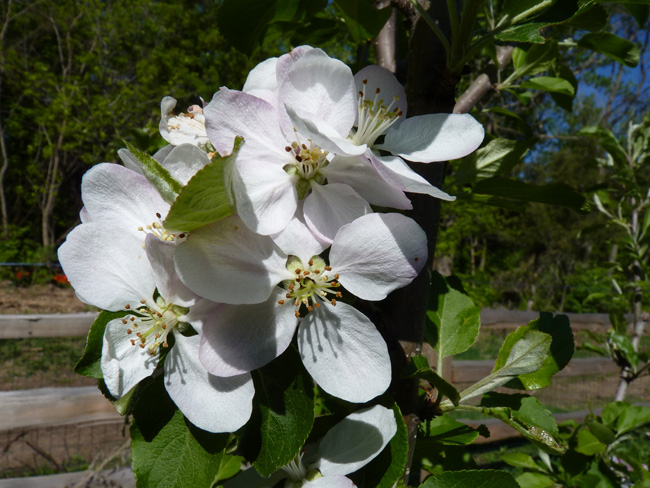
If you want a moment of intense spirituality, go out in the morning, after a big rain, heat just beginning to soak into the soil, smell the odor of sanctity, in this case fertility, coming up from the plants and their medium, see the beets and kale and carrots and cucumbers and sugar snap peas on the rise, look at the onions and garlic and leeks filling out, getting greener, taller and fatter.  Take a stroll past the cherry blossoms, the pear and plum blossoms, the apple blossoms that came out yesterday, past the bee colony hard at work, over to the blueberries and check out the new growth on the hard pruned wild grapes.   The sand cherries and quince and even the currants with their modest, tiny green flowerettes, all showing to the bees their best and sweetest offerings.  Each petal, each flower, each stalk, each leaf is a miracle, a wonder of the evolutionary path on which that particular organism travels, its genetic ancientrail.

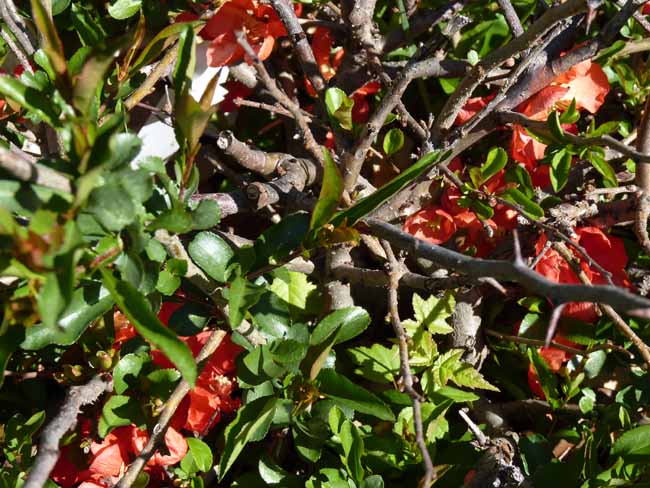
(our quince)

That walk, by the way, is not the walk of an individual, self-reliant and independent, but of a dependent creature glorying in the symbiotic relationship between his cells and these plants.  This is a community enterprise, the humans here, Kate and I, in partnership with the vegetables, the flowers, the fruit, the bees.

(our honeycrisp tree in bloom)

Which reminds me of the other partners, or co-habitaters at least, all the wild animals that live in the soil here, the gophers and earth worms and grubs and snails and voles, those who use the trees the squirrels, the woodpeckers, pileated and red-tailed, crows, hawks, Great Horned owls, robins, chickadees, blue birds, those who live on the land, under buildings and in brush piles the rabbits, chipmunks, woodchucks, opossums, raccoons, mice, the interlopers the wild turkeys, the deer, the coyote.  And of course, the woods themselves the ironwood trees, the poplar, ash, cottonwood, red oak, burr oak, cedar, spruce, yes even the black locust and the buckthorn.  The grass, yes, the dogwood yes, the amur maples yes, the alicanthus yes.

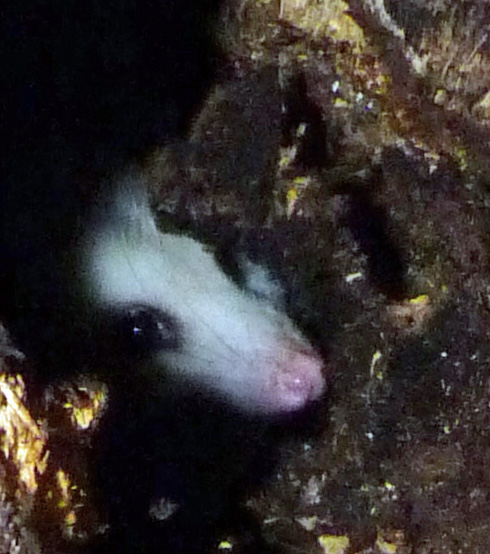
(a baby opossum in a dead tree in our woods)

We all share this land, to which we have the deed, but so little else.  When Kate and I leave, as we will one way or the other, the rest will continue, unaffected, unmoved by our passing.  Land is not for owning, but for cohabitation.  We know this, if we bother to look.