Beltane Early Growth Moon
Nostalgia. Ran across the word today and it made think about Alexandria and about the Simone Weil quote: “To be rooted is perhaps the most important and least recognized need of the human soul.”
It also made me think about a cousin who, though successfully (to my eye) transplanted to California many years ago, still longs for her Blue River home, her 30 acres or so of bottom land and the life of a Midwestern tiny town. Then of course there is the interesting case of the ex-patriot, that very word calling up a certain estranged relation between the one identified by it and their homeland.
All explained by the need to be rooted. I reread that post and felt it wandered a bit, got off point, thought about fixing it and decided to leave it as it was. This is a topic that has a lot of resonance for me, a bite not explained by any nostalgia I have, little. It is perhaps explained best by the existential stance I take toward the world, yes there’s a place for me here, but it’s by choice and not by chance. Even so.
Heidegger has this wonderful expression, thrownness, which is the time, the culture, the geography into which you are born. Or, thrown. And thrownness has everything to do with roots since roots are about place, especially that first place you call home.
Duncan, Oklahoma, a small town, the Mistletoe Capitol of the World, near Texas was the 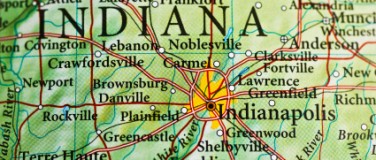 first place I was thrown, but it didn’t take because my parents moved not long after my birth back to Indiana, specifically to Alexandria, where my dad found work at the local newspaper, the Alexandria Times-Tribune. This was the place the universe threw me into.
(Alexandria is in the upper right on this map.)
Quite a specific time, too, as all times are. This was post-war America, the victorious  military spit out most of its members including my mom and dad. They settled down to populate the land. America had become a world power in the war years, so to those of us born post-war it seemed as if it had always been so.
Alexandria was a bedroom community then, a place where workers at the three shifts run by General Motors at Delco Remy and Guide Lamp could earn a middle-class income and only drive the nine miles to Anderson, Indiana on bloody Highway 9. It was in many ways the epitome of the American dream where a family could own a house, a car or two, have enough money left over for a boat and a vacation. Food on the table with regularity. Good medical care.
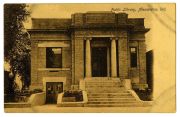
They came from the hills of Arkansas, Tennessee, Kentucky especially and settled in this small town with two dime stores, two grocery stores, a woman’s clothing store, a men’s clothing store, a daily newspaper, a newsstand and shoe repair, a furniture store, two drugstores, a bakery, two theaters, two banks, several churches, a couple of drive-ins, a bowling alley and a national class roller rink. There was, too, a Carnegie library, two or three elementary schools, a junior high and a high school. The Nickle Plate ran through town and Highway’s 28 and 9 intersected toward the north.
Physically it was flat with a small creek, the dejectedly named Pipe Creek, running on the  eastern side and through the southern end of town. Surrounded by the checkerboard pattern of mile square road systems laid down in the 19th century, Alexandria sat in the middle of fertile farmland and had a thriving farm community, too. It was mixed in that way, farm and industry.
Most folks in those early post-war years just wanted time to settle down, sink into a peaceful life. And they did. Still, my friends whose parents came from the hills in the south often talked about going home. This was a diaspora for them, a move away from home dictated by better economics, but not by a better place. Their yearning was palpable, a distinctive feature of my childhood.
Indiana in those days and Alexandria was representative of this was union country. The United Auto Workers, representing all those folks commuting to Anderson, won victory after victory against the power of GM, Ford and Chrysler. They won better wages, better medical care, better pensions, better vacations. In return Alexandria’s UAW workers turned out alternators and silvered head lamps for Chevrolets, Oldsmobiles, Pontiacs.
It was, because of the strong union, a Democratic place, a liberal voting place that put  Democrats in congress with great regularity. My dad, a newpaperman, was a Franklin Delano Roosevelt liberal which meant he supported social security and other new deal benefits, but was rabidly opposed to communism. Mom was a stay at home mom, though she had an associate teaching degree and did sometimes substitute teach at the elementary level.
There was, too, basketball. And the Indy 500. The Indiana state fair. These three were cultural institutions that defined us, creating conversation and speculation all year.
I may not be nostalgic for that time or that place, but that does not mean I don’t appreciate it, respect its place in my past and the lessons it taught me. Over time, I’ve lived here in Minnesota for 43 years now, far longer than the 21 I lived in Indiana, Minnesota has become my home, a place I threw myself into and my roots are in 10,000 lakes, the boreal forest, the cultural life of the Twin Cities, friends, family and memories here. But for all that this is not where I was raised, it is not where my high school classmates live and it is not the place where the nights and days of childhood have physical referents.