Lughnasa New (State Fair) Moon
In to St. Paul to see Ruth Hayden, a financial advisor. Then Kate’s haircut. I’ll spend the haircut time reading Rousseau at a nearby Caribou.

Lughnasa New (State Fair) Moon
In to St. Paul to see Ruth Hayden, a financial advisor. Then Kate’s haircut. I’ll spend the haircut time reading Rousseau at a nearby Caribou.
Lughnasa New (State Fair) Moon
Life seems to run from one irony to another, offering a wry twist often when you least expect it. This irony is not one of those. It’s been building for about 19 years, but it has begun to peak. The irony is this. The U.S. like the rest of the world, continues to urbanize with central cities beginning to outstrip ‘burbs. “In 2011, for the first time in nearly a hundred years, the rate of urban population growth outpaced suburban growth, reversing a trend that held steady for every decade since the invention of the automobile.”*
What’s the irony here? Now I find myself willing to defend the suburban or, in my case, exurban experience. Why is that ironic? Because I spent 24 years living in Minneapolis and St. Paul deeply involved in all manner of urban politics, working as an urban minister and eventually in charge of urban ministry for the Presbytery of the Twin Cities Area. Though raised in a small town, I made the transition to solidly urban guy. It was my profession, the city.
Cities burst with energy, offer sophisticated amusements, diverse places to live, a variety of foods to eat and the sort of jostling with others that sparks creativity. They also make obvious the divisions in our society that a drive from the Northside of Minneapolis to Kenwood, directly south of it, epitomizes. Even that last creates a juicy political scene with lots of different actors. Fun.
And I love it. Note the present tense. I love it. I enjoy being in the city and I love the kind of people who make cities their home.
Even so. I now live in an exurb of the Twin Cities. Only a couple of miles north of our home there are cornfields. Surrounding our development is a huge truck farm with tractors and warehouses and rows and rows of carefully planted vegetables. This is where the metro proper ends. The MUSA line, the Metropolitan Urban Services Area, runs less than a mile south of our home. (see map)
Over the years Kate and I have made a life here that would not have been possible in the city. We have a woods, several garden beds for flowers and vegetables, an orchard and a fire pit. Our house has about 3800 square feet with the finished basement and we could never afford that much space in the city. This combination of a large, relatively inexpensive home and land enough to create our own footprint has given us a rich and full life.
We have the suburban dream, that is, country living close enough to the city to access  museums, orchestras, restaurants and political activity. In my first days here I felt isolated and unhappy, far away from the things that had made me who I was. As time passed though, I began to find a new person emerging based on what we had here.
It is, in some important respects, a narrower life. Kate and I spend most of our time either outside or inside our home, but on our property. In this sense the community oriented life of the city does not have a domestic equivalent here, at least for us.
Here there is silence. Here we can focus on our creative activities: horticulture, writing, sewing/quilting. Here our life concentrates at our home. This is similar to the farm life of millions of Americans prior to WWII. Yes, it has its privations, but it also has unique benefits.
It remains to be seen how third phase life can be lived here, especially the waning years of that time. We may find the distances too great for us, the isolation dangerous. I hope not because I have learned to love this exurban spot as much I love the city.
*Time Magazine article, The End of the Suburbs
| — | Søren Kierkegaard |
| — | Carl Sandbur |
Have mercy Beloved,
though I am nothing but forgetfulness,
You are the essence of forgiveness.
Make me needless of all but You.”
”
| — | Abil Kheir, Shaikh Abu Saeed. |
Lughnasa New (State Fair) Moon
Nutrient drench today: Inferno. The weekly spraying of brixblaster and qualify. The  twice monthly spraying of Showtime. Inferno is a liquid fertilizer. Brixblaster encourages the plant to put its energy into reproductive growth such as flowers, fruits, vegetables like tomatoes, tomatillos, eggplant, cucumber, carrots, peppers. Qualify encourages vegetative growth: broccoli, cabbage, beets, chard, leeks, herbs. Showtime, an oil based product, helps plants repel foraging insects.
A busy early morning in the garden. The results so far have been solid, so I’ll keep it up and add the orchard this fall. I need to check the bees and put on the food safe miticide hopgard but working with bees when the sky is overcast is advised against. Without the sun bees don’t travel as much so they’re at home. More easy to rile them. Wednesday will be plenty of time
There are still limbs to move, two trunks to cut into firewood and four large branches to cut into kindling. That bee area still has to get cleared. The tasks don’t end as long as the growing season is underway.
Lughnasa New (State Fair) Moon
Mix of things today. Moving cut tree limbs and mulching harvested beds. Working on Missing. Reading. Working on Rousseau’s essay on Inequality. Watching Orange is the New Black with Kate. A Sunday.
Lughnasa Moon of the First Harvests
Some rough ideas, thrown out as thought provokers for now, on the third phase. In September I’m going to do a presentation to Groveland UU on the third phase and want to start thinking out loud here, maybe draw in some comments from those of you who read Ancientrails.
1st phase: learning [self, relationships, general skills and particular skills]
2nd phase: praxis [learning put into practice with career, family, personal growth]
3rd phase: soul work [work that only you can do. inner work. life review, summing up]
terminal phase: dying [good-byes, cleaning up, finishing up, endings]
The terminal phase is a new addition to my third phase thinking and it’s based on being with Kona as she died and on the experiences some of you have had, notably Bill Schmidt and Scott Simpson, as loved ones died, but slowly.
NB: the word associated with the phase is that phase’s primary and guiding emphasis, where the inflection of life in our culture comes down. Certainly we learn in each phase, put our learning into practice in each phase and do soul work in each phase. It’s the dominant motif that concerns me as I think about phases.
3rd phase as life’s sabbath. This idea just came to me today. It segues somewhat with the traditional view of retirement as life’s last vacation, a sort of permanent weekend, but goes well beyond it. If you agree with me that we might consider the third phase primary emphasis as soul work, then the third phase can be seen as a point when we move more and more often from ordinary time (a favorite Catholic liturgical idea) into extraordinary time, what I would call sacred time.
That means we may want to pay attention to rest, reflection, contemplation, retreats, doing work that more often integrates than fulfills needs. In my case time in the garden helps. Time not spent writing or reading, unless it’s poetry or some other reflective material. Time sitting in the chair, eyes closed, thoughts wandering. Meditating. Being with friends.
These are just the nubs of ideas. Interested in what you think.
Lughnasa Moon of the First Harvests
A slower day today. We both needed a little less activity. Nice to be able to ratchet back and not worry about it.
Did spend an hour plugging the new credit card number into those accounts that need it. Our card got stolen by someone who bought a hotel room and flowers. A romantic thief. A bit of a hassle but not too bad.
I’ve also been reading Jean Jacque Rousseau for the Modern and the Post Modern MOOC. Kant, too. Kant’s essay What is Enlightenment began the course. It contains his Dare to know idea. That is, trust your own reason and act on it.
The two Rousseau essays are very interesting, one on the arts and sciences which I plan to give more time here at some point, argues that the arts and sciences represent culture at its most decadent, at its furthest remove from the state of nature. It’s a very interesting argument.
The second, which I’m reading right now is on the origin of inequality. Here a couple of quotes from it:
Nature speaks to all animals, and beasts obey her voice. Man feels the same impression, but he at the same time perceives that he is free to resist or to acquiesce; and it is in the consciousness of this liberty, that the spirituality of his soul chiefly appears…
(Henri not Jacques)
It is by the activity of our passions, that our reason improves…and it is impossible to conceive why a man exempt from fears and desires should take the trouble to reason.
The first language of man…was the cry of nature.
…as to adjectives, great difficulties must have attended the development of the idea that represents them, since every adjective is an abstract word, and abstraction is an unnatural and very painful operation.
Lughnasa Moon of the First Harvests
Drove out near Stillwater today to Nature’s Nectar, a bee supply store. Picked up some 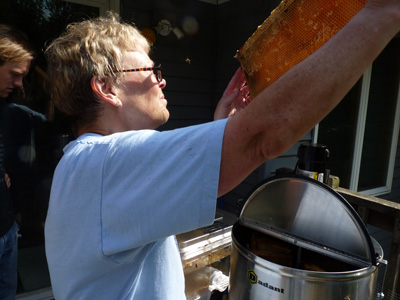 miticide and some honey robber. Also, some knowledge. Geez, hard to believe I missed in this school. “Never,” said Jim, proprietor and keeper 0f 75 colonies, “Never do extraction outside.” Oh. Well. I know why. The bees all come and want some. But doing it inside never seemed like an option. Now, all of a sudden, it does. Cardboard, plastic sheeting and everything inside where there are no bees. Would be way simpler.
(note: outside)
On the way out the clear blue sky with cirrus horse tails high and wispy kept firing memories of Canada. A magical place, in my experience, a place I could live easily. This sky, wonderful.
Lughnasa Moon of the First Harvests
We’ve settled into a rhythm that will continue until the last substantial harvest. I go out in the mornings and harvest. Kate then pickles, cans or freezes. I helped with the garlic drying, but otherwise she’s done all the work. We’ve had to clear the detritus out of the food storage room, gathered there over the winter and spring, because now trips down there for empty canning jars or to deliver full ones have become frequent.
Kate said she needed a calico dress and a gingham (Gangham?) apron. I suggested a bonnet. This work for her, right now, is primary in her life and she reports getting energy from doing it. She must because she stands long hours in the kitchen. Of course, she’s one tuckered out gal at the end, but the pantry has more stores and she feels good.
This whole garden is a dance with each of us playing different roles over the course of the season. I have overall responsibility for the gardens and their health. I do most, but not all, of the planting, all of the international ag labs supplementing and survey the various beds for plant health over the course of the growing season. If there’s corrective action to be taken, that’s my job. I bag the apples and take care of the fruit trees, also harvesting. (but not pruning.)
Kate weeds and that is one huge job. One I don’t like. She says it brings her satisfaction. I can’t get no satisfaction there so I’m glad she can. At harvest time Kate takes the lead and chooses what kind of recipes to use and what methods of preservation to employ. Near the end, when the leeks come in, I’ll make pot pies for freezing. We both do fall clean-up and I plant bulbs. Then the garden takes its long late fall and winter nap.
Lughnasa Moon of the First Harvests
Two weeks ago I began a MOOC (massive open online course) from Hong Kong University called New History for a New China*. This is a quicky, a four week dip into a data driven approach to near history in China, near history in China’s case going back to the latter Song Dynasty (1000-1100) with some sources. The work they are doing is similar to Big History and history from the longue duree (the long term) perspective most often encountered in French historiography.
Using records of students taking the national examinations for positions in the bureaucracy, a practice begun in the Sui Dynasty (605) replacing preferment from the ranks of the nobility, the practice since the origin of the bureaucracy in the Han Dynasty, the scholars at Hong Kong University look at demographic details such as age, parent’s occupation and education, place of residence, age at taking the first exam and age when the exams were passed or failed and positions achieved.
An advantage to using these records is that they are relatively consistent over a long period of time allowing a longitudinal examination of mobility in Chinese society, at least as education influenced it.
So far I find the data produced fascinating and its revelations about the workings of Chinese society often brand new though I’m not so sure about the comparative method that the scholars say lie at the heart of their work. They contend that this work can make neutral or objective comparisons between east and west, countering and sometimes correcting the Eurocentric nature of much social science research.
I’m hopeful that this work will get there though what I’ve seen so far is only a beginning and has some weaknesses that beginnings tackling a problem of this magnitude might be expected to have. Still, it’s proven an interesting ride so far.
The purpose of this course is to summarize some of the new directions in Chinese history and Chinese social science produced by the discovery and analysis of new historical data, in particular archival documents and datasets, and to organize this knowledge in a framework that encourages learning about China in comparative perspective.