
You Dip Your Honey Rod in the Molten Glass

Fall                                                                         Samhain Moon

Glory hole.  Boil.  Jacks.  Crimpers.  Gathers. Honey rods. Annealer. Diamond shears. IMAG1071Taglia. Paddles. Tweezers.  If you encounter this unusual constellation of tools and equipment, you’re about to work with glass.  Molten glass.  Molten as in 4,300 degrees molten. Molten as in droops off the end of the honey rod if you don’t keep rolling, rolling, rolling.
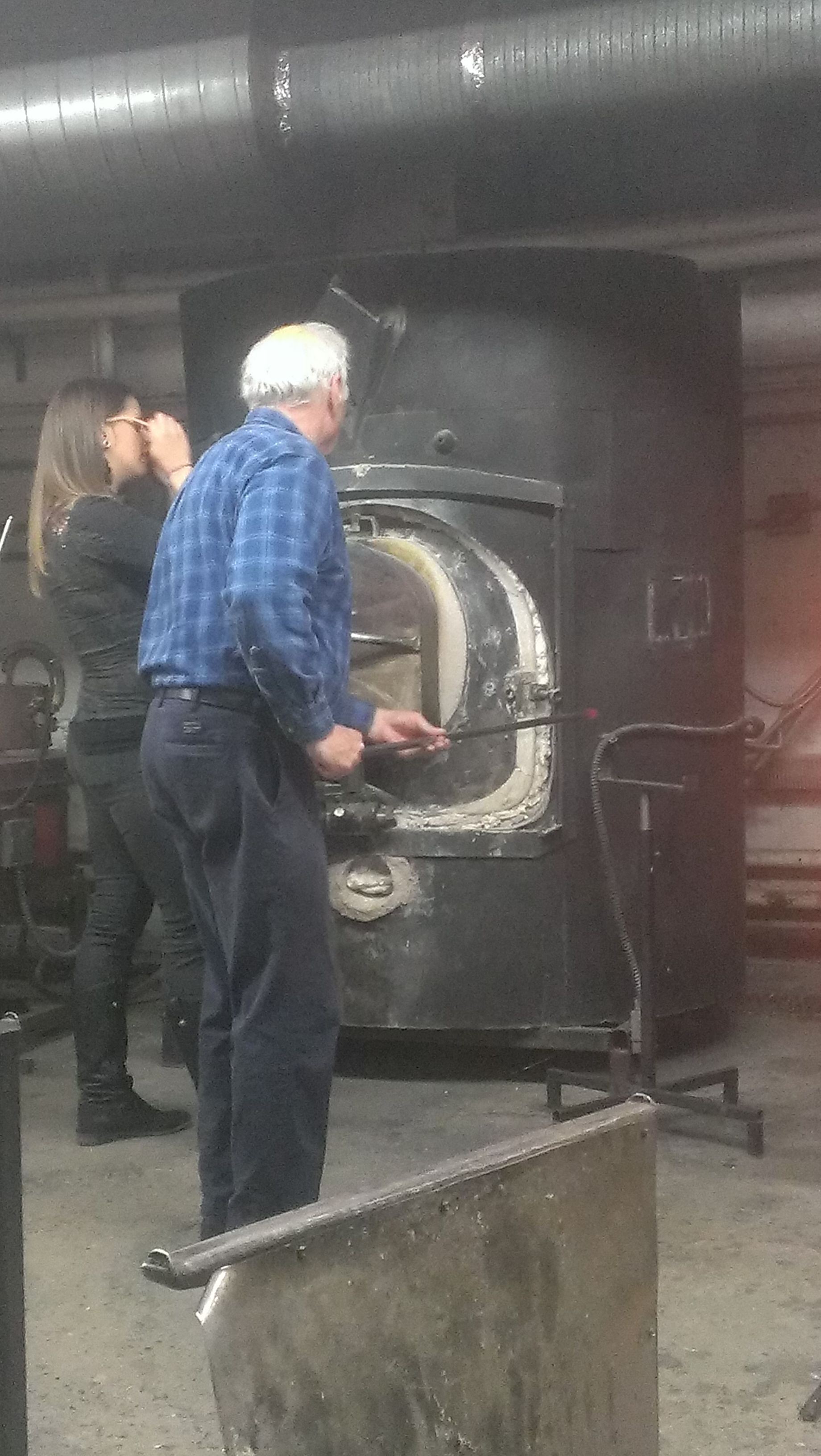
(Frank ready for his first gather.)

You dip a honey rod into an oven, a 4,300 degree oven filled with about 350 pounds of molten, transparent glass.  Twist two or three times and get a good gather on the rod.  Pull it out, orange, heat blasting back from the oven.  Roll it.  Roll it.  Over to a table that might be an Indian spice sellers tables with small mounds of wares, dip the molten glass in yellow or white or blue, move it back and forth so the color coats the gather.

To the bench.  Rolling, this time maybe pull out the tweezers and grab the end of the IMAG1070gather, pull it, twist it.  Then maybe the shears to make a few cuts. Still rolling.  Rolling. Always rolling.  Another gather, bigger this time, over the first gather, the one with color. Rolling, rolling.  Always.  This time layers of newspaper soaked in water.  Yes.  Newspaper.
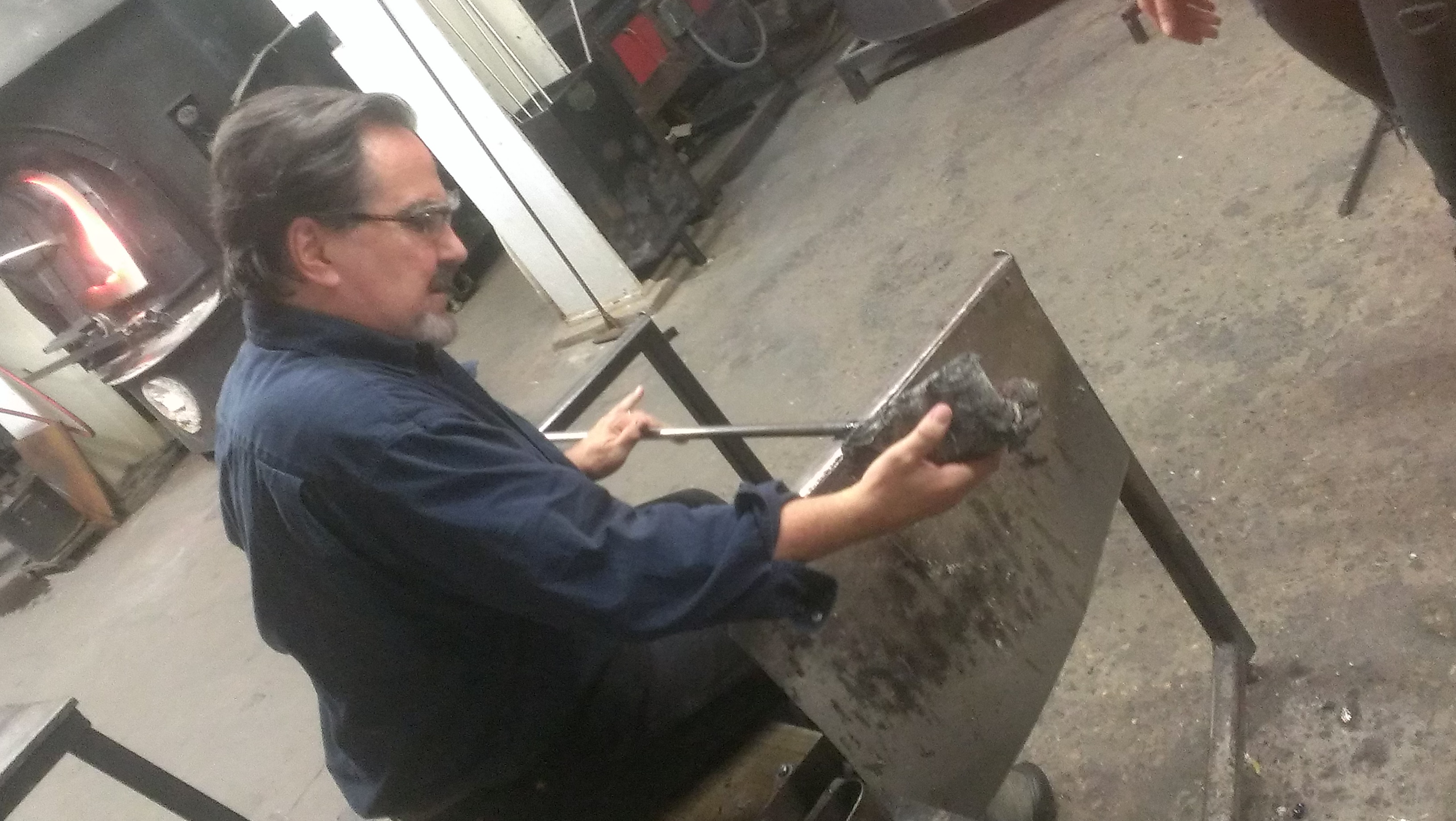
(Charlie with newspaper.)

Wet newspaper.  Thick, wet newspaper.  In your hand, against the heat of the second gather, rolling still rolling, you shape the whole, now headed toward that most mundane, but forgiving of glass shapes, a paperweight.  Back in the gloryhole for a heat blast.IMAG1058
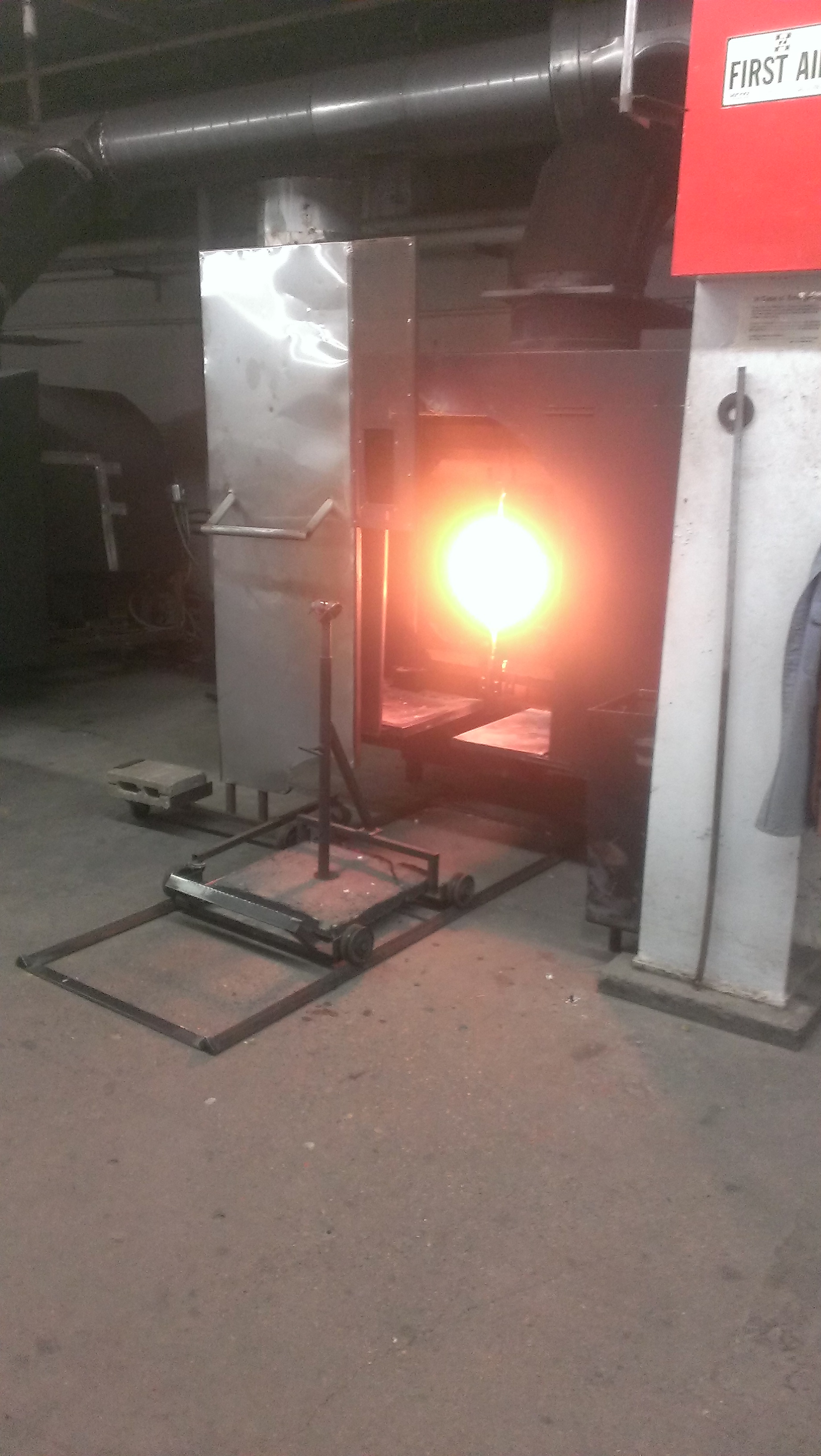
Back to the bench.  This time the jacks grip the molten glass at the rod’s end, making a line around it, a line that will make breaking the cooling glass off the honey rod possible.  “It perforates the glass.”  Oh?

(the glory hole)

Whatever it does, sure enough, after gently tapping the gather at the jacks imprinted line, the paper weight falls off.  A blow torch comes out, heats the rough edges and makes the bottom molten enough to receive initials.  Gotten know which one is yours.

Then they go into the annealer.  It gradually steps down the heat so the coefficient of IMAG1063expansion doesn’t overtake the masterpiece and shatter it.  Ready on Wednesday.
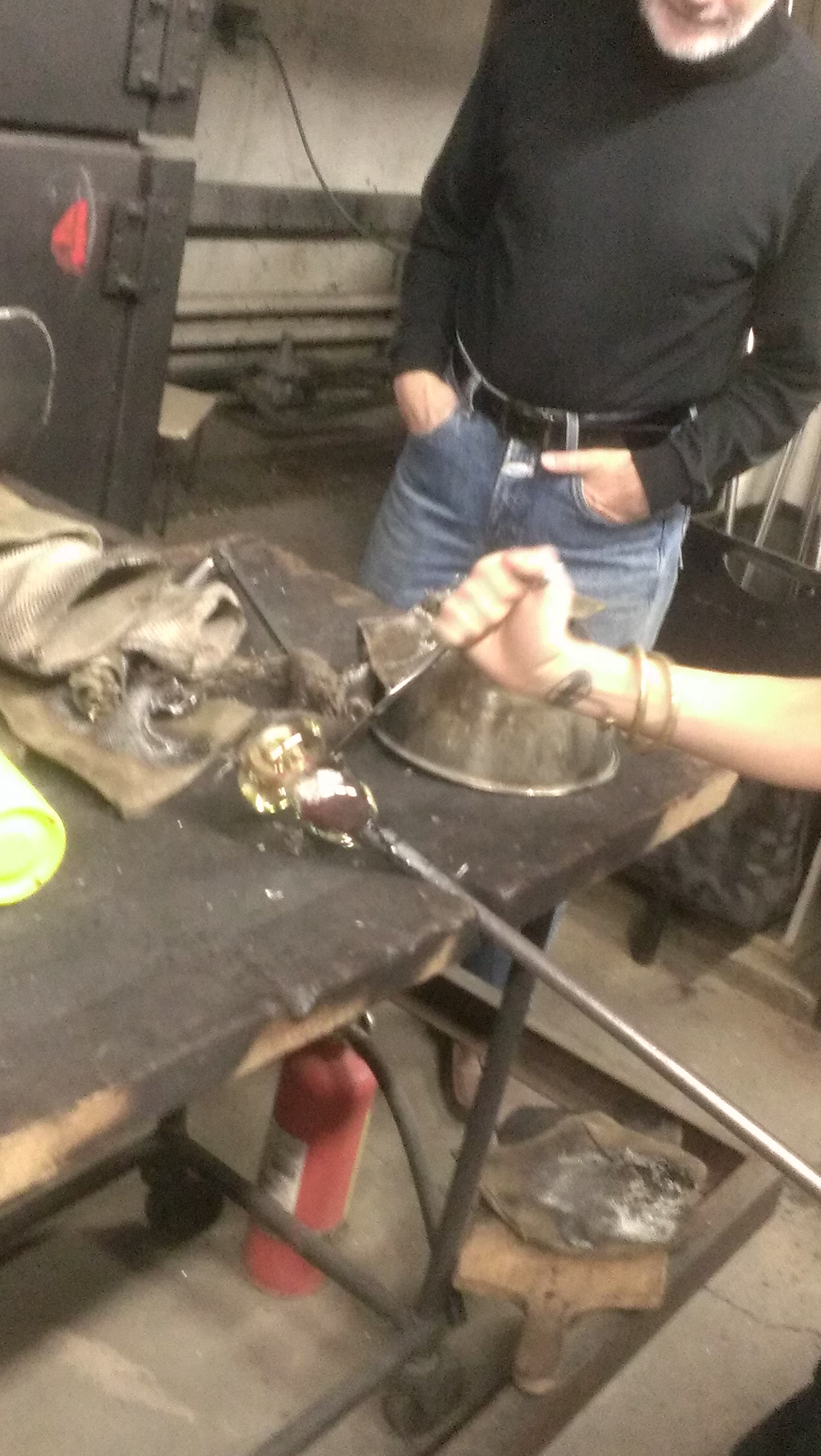
What the Woollies did this Monday night at Minnesota Glass Arts.

(Jen releases her demonstration paperweight from the honeyrod.)

A Skull Expanding Moment

Fall                                                                           Samhain Moon

Can you hear that streeetcchhhing sound?  It’s my 20th century, 2nd millennium mind trying to shoehorn in some new ideas.  Not only the New York School poets, for whom Allison gave some appreciated homework help (locating the 5 spot and some info on O’Hara and Larry Rivers), but this afternoon I’ve finished the reading on Unbending Gender and another one on reflexivity*.

We’ve entered the realm in both these courses I most looked forward to, the section on post-modernism.  I’ve never been able to get straight in my head what post-modernism is, or is supposed to be.  I had the same trouble with dew point for a long time so I think there is hope.

Reflexivity is a key aspect of modern art as I now understand it and modern poetry, too.   The poem and the art work both are works of art and commentaries (self-reflective) on the act of art-making.  This is clear when painting turned away from realism and toward cubism and abstraction, collapsing perspective into 2-d, the act of painting itself commenting on the acts involved in producing the very painting in view.

A Pollock action painting is clearly 2-d, makes no attempt at 3-d perspective and the action of dripping the paint on is clearly evident.  In commenting on this point Michael Roth, teacher of the Modern/Post Modern class, made an interesting comment, referencing someone else:  The surface in these paintings, though bold, are fragile.  I understood this immediately, though I don’t know whether I could explain it.

At some point along here I’m going to synthesize my understanding of post-modernism. To see if I can put it out there clearly.  (that may not be very post-modern though)

*wiki  Reflexivity refers to circular relationships between cause and effect. A reflexive relationship is bidirectional with both the cause and the effect affecting one another in a situation that does not render both functions causes and effects. In sociology, reflexivity therefore comes to mean an act of self-reference where examination or action “bends back on”, refers to, and affects the entity instigating the action or examination.

To this extent it commonly refers to the capacity of an agent to recognize forces of socialization and alter their place in the social structure. A low level of reflexivity would result in an individual shaped largely by their environment (or ‘society’). A high level of social reflexivity would be defined by an individual shaping their own norms, tastes, politics, desires, and so on. This is similar to the notion ofautonomy.

Changes

Fall                                                                          Samhain Moon

Buddy Mark Odegard has found a new style in poster-like art about the Northshore.  Good

We’ve had snow and we’ve had rain, who knows when I’ll be back this way again.  I do.  Next season around the same time.  Loving the change of seasons.  The transitions may be later and milder, but they’re still coming and I still love le difference.

Found out my chain saw needs a new bar as well as a new chain, so I’ll have to visit the hardware store tomorrow:  new glasses, dental visit and a chain saw bar.  These are the kind of things that take me into the really retail and away from cyber-purchase.  Hands on matters where time counts.  Otherwise, I’d rather get it in the mail.  No schlepping and it saves on gas.

What?  I heard that.  Yes, it does save on gas.  Shopping on the internet aggregates deliveries among many people allowing for a much more efficient route and far fewer trips per item.