Samhain for the Vegetable Garden

Fall                                                                                Samhain Moon

While picking raspberries this afternoon, I looked at the garden beds we cleared this week.potatopatch670 There is the suntrap where we had all those tiny tomatoes and the two plants of huge heirloom Brandywines and Cherokee Purples.  The asparagus bed, the little mound still tufted with the green of asparagus stalks, got over taken this year by the exuberant ground cherries that grew and grew and grew and would still be growing if we hadn’t decided enough and pulled them.
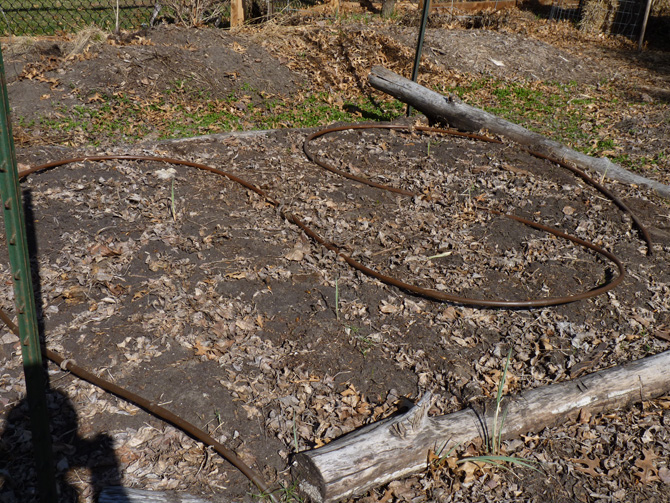
South of the suntrap is the first bed in the vegetable garden, one made of logs, made long enough ago by Jon that I’ve had to replace the logs around it already at least once.  This year it had sugar snap peas, cucumbers, egg plants, broccoli, and hot peppers.  It’s had many crops over the 16 or so years its been in place.

Next to it is a bed that we’d given over to dicentra and bugbane because of the wonderful ash tree we allowed to grow large in the garden.  They’re shade lovers.  This year, with the emerald ash borer coming and a long standing desire to open up more sun in the garden, we had the ash taken down and planted this bed with its first vegetable crop in years:  yellow tomatoes and yellow peppers.  They thrived.

When Jon originally built the raised beds, I asked him to be creative, mix up the shapes and the materials.  The first one he tried was made of tin roofing.  It worked ok, but he preferred working with 2×4’s after that.  Now it’s half daisy.  The other half this year had a productive small tomato plant and couple of so-so pepper plants.  I made one obvious mistake.  I planted a pepper to the west of the tomato plant and it never thrived.

The long bed, the extra large bed, this year had beets and carrots, a couple of crops.  It also has a persistent asian lily crop that comes from the short time I used the beds as cutting gardens.  After treating the lilies as weeds (a plant out of place), they have become confined (mostly) to the extreme south end of the bed.

To the east of the extra large bed are two similar sized beds.  The north one this year hadIMAG0955cropped1000 onions and garlic and the southern bed had beets (didn’t do well) and greens (which did).  The leeks are in the long mound west of the extra large bed, doing well, still growing.
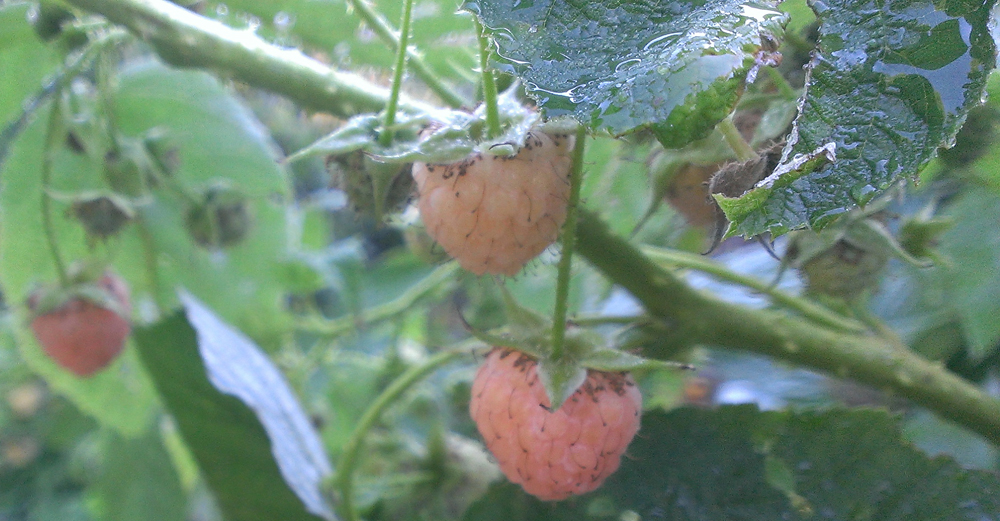
Our raspberry patch is up against the fence and behind the wisteria.  Its growth has shaded out a small bed that this year had only a crop of asian lilies.  North of it is the strawberry bed and north of that the herb spiral.

The beds we cleared are the ones on which I broadcast fertilizer last week and they’re now mulched, extra large and two similar sized ones, or awaiting mulch from this year’s leaf fall.  These beds are brown, bare of plant material for the first time since May.  They look bereft, but they’re not.  In the top six inches of soil small colonies of microbes, bacteria, fungi, worms and insects are busy, working together to create a fertile spot for next year’s garden.  It’ll be the best one ever.

Enlightenment’s Dark Side

Fall                                                                                  Samhain Moon

It was wet and chill, but the red and gold fruit warmed me as it slid off.  The raspberry canes grabbed at me as I moved among them as if wanting me to stay awhile longer, to chat or linger.  Once in a while I threw an over ripe berry over the fence to Rigel who watched my progress with head moving up and down, patient, waiting.

Before the berry picking I spent a couple of hours reading 34 pages, the introductory chapter to Adorno and Horkheimer’s, Dialectic of Enlightenment.  As this MOOC moves toward the end, we come closer to the current time and to thinkers with whom I’m familiar not through academics but through the politics of the 1960’s.  Adorno and Horkheimer are part of the Frankfurt School philosophers, most of whom emigrated to the US during WW II.  I was most familiar with the work of their colleague Herbert Marcuse, but I have come to know the work of Jurgen Habermas, too.

This is dense material and the argument is provocative, far from obvious.  In essence Adorno and Horkheimer argue that the enlightenment has become an instrument of oppression.  Some characterize the enlightenment as a movement designed to make the earth a home for humanity.  Instead of moving toward freedom and liberation the focus on repeatable natural laws and the tools of technology enabled control and domination, both of the planet and citizens of nation-states.  I’ll do better with this at another time, but this is heart of it.


God is the zocalo of Western religious life.

Fall                                                                     Samhain Moon


Last night I dreamed of a place where reality could be reconfigured only by imagining.  Though I don’t remember many specifics, I do remember that at the close of the dream I wondered if the same process could put us in different historical eras, not just different places in current time.

This led, after waking, to a continuation of the dream space to the matter of the modern and post-modern, much on my mind these days thanks to the two MOOCs I’m taking. Having read Wittgenstein on language games from his Philosophical Investigations and his attendant critique of the really real as inaccessible at best since words do not hook onto reality, only other words (a paraphrase), somehow the Zocalo came to mind.

Kate and I visited Mexico City in the 1993.  It impressed me then that at the very center of the Federal District, with the National Cathedral on one side and the National Palace on the other was a vast empty space, the zocalo.   The idea of a country with a vast open square at the very heart of its national culture appealed and appeals to me.

Mexicans fill the zocalo often.  On September 15th at 11 pm, the President comes out on a balcony of the National Palace and delivers a grito, a cry that remembers the “grito de Delores” or the cry of Mexican independence first heard in the small town of Delores.  At other times the military parades through the zocalo.  Recently it has been filled with striking teachers trying to turn back education reform.  Each spring equinox Mexico’s ethnic groups, la raza, fill the zocalo with a celebration through which they assert their critical importance to the nation as a whole.

With Wittgenstein in the background and in particular his emphasis that meaning is use, that is, we learn the meaning of our language from the contexts in which we use it, the zocalo and God suddenly merged.  God is the zocalo of Western religious life.

What do I mean?  God is the empty square at the heart of Western religious and political culture.  Over the course of two thousand years various groups from Judaism to Christianity to Muslims and many, many diverse splinters of all these groups have gathered in the square to give their grito.  At the time they fill the square they occupy the center of the culture’s awareness. (Note:  this is not at all, to the contrary in fact, a truth claim about what they say there.)

This same square also receives those who would fill it with alternative metaphysical or anti-metaphysical ideas.  Nietzsche, God is dead.  The square was empty and continues to be empty.  Nature is god.  The pantheists.  Even those who would entertain the world of many gods, contemporary polytheists like Wiccans and Astruans, have to enter the God/zocalo to make their proclamations over against this central Western idea.

This means that God is, for the group occupying the God/zocalo, what they say God is. That is, the way they use the concept of God in the square is what God is to them.  Use gives meaning.  Context gives meaning.

How is this helpful?  It helps me understand that faith, that word I’ve been trying to reimagine over the last couple of years, is not about a transcendental claim at all, but rather is a pledge to walk into the God/zocalo with a particular group and, while there, to abide by their understanding.  Faith is an initiatory passage into culture, not a passageway to the really real.  Said another way faith is agreement with claims about the really real made by a particular group when they inhabit the God/zocalo.

As long as you remain within that group, their language will be useful to you as a shared agreement about what spreads outward from the zocalo.  In Mexico City it is Mexico and Mexicanness.  In the Presbyterian occupation of the zocalo it is the presbyterian form of church government, John Calvin, local presbyteries and congregations, the Book of Order, ordination exams, elders, presbytery meetings, General Assemblies.