Next Time

Lughnasa                                                                      College Moon

As a man with Celtic blood in my veins, I’m saddened by the vote in Scotland, but not surprised. Safety is a powerful motivator, coming in second in Maslow’s hierarchy of needs. Only the Hullian needs: air, food, warmth are more basic.

It would take a strong commitment to override the concerns of bankers and businesses, though a return of Celtic pride, perhaps, with the Celtic tiger, Ireland, even a return to Celtic prominence, could have been such motivator. But it was not to be this time.

I’m proud of the 44% that put their sense of national history and cultural heritage in the forefront of their minds.  In a world gone risk averse it takes courage to try something really different. The idea of an independent Scotland had been a wee bairn, now it’s grown into young adulthood. Perhaps next time such a vote happens it will have reached maturity.

Obama a Good President

Lughnasa                                                           College Moon

Another America Votes meeting tomorrow. I can imagine gnashing of teeth since the political winds look like they’re blowing in the Republican direction. A mid-term election with light turn-out and gerrymandered districts in the House mean a continued Republican stranglehold on the House of Representatives and a possible pick-up of a majority in the Senate.

I agree with those who have analyzed Obama as a much better than average president, in spite of his low approval ratings. Why? Because he’s had fractious Republican majorities in the house since 2010 and a weakened Democratic majority in the Senate. In spite of those he’s passed the first major reform of our healthcare system, held to a principled foreign policy that tries to avoid entanglements abroad (whether this is wise or not is another question.), pulled troops out of both Iraq and Afghanistan, overseen the recovery from a banker driven financial catastrophe and finally begun to push for meaningful climate change action.

Did I mention that he’s the first black president and has had racist nutjobs on his trail the entire time?

Politics is about what’s possible, not about what’s ideal. In the arena of the possible Obama has shown remarkable ability to get things done.

Bored

Lughnasa                                                                                College Moon

A beautiful day. Odd for me since I woke up early, got some work done early as a result and have time now, since I only workout on MWF, that I really don’t know what to do with. I’m bored. Which is in unusual for me. At least to admit it.

If folks say they’re bored and act as if the world owes them something interesting to do, I lay it down to lack of imagination. So, I loop this smug comment back onto myself.

Boredom, like melancholy, has come to have a place in my life though. And for similar reasons. They are both caesuras, gaps between this action and that one, between that project and this one. Too often I can use a writing project or that gardening chore, or working on this blog, or whatever else is available to fill uncomfortable lapses in time.

When I engage tasks for tasks sake, I learn nothing, I press away whatever might come to me if I go still, become quiet, as I do sometimes at night. Accepted in this way both boredom and melancholy have a purging effect, a cleansing of the anxiety driven task completion mode so common among us Americans. And doubly so among us Americans of northern European ancestry.

You might even see boredom and melancholy as cousins to meditation, a certain stilling of the mind, letting the gears grind more slowly or even go to full stop. I hesitate to assign them a utilitarian purpose because both have their dark elements.  Boredom’s I really can’t be bothered accents and melancholy’s self-denigration are negative in themselves. But when either boredom or melancholy helps us step back from our life, examine it, see what might be missing or what’s too abundant, then they serve a real purpose in the psyche’s economy.


Vive la difference!

Lughnasa                                                                  College Moon

How different we are from Europe. Scotland has a population of 5.3 million, Ireland about 4.6 million, England 53 million. California alone has 38.3 million people. Texas 26.5. New York, 19.6 with New York City 8.3 million. Of course, we’re all tiny compared to the behemoths of India and China, but I’m interested right now in Scotland’s vote, underway right now, for its own independence as a nation.

It’s as if Minnesota were a dependency of Caltex and wanted to break away, put up its own borders and start issuing passports. My point here, heightened by our upcoming move to Colorado, is that we move between states often equivalent in size to many of the storied nations of Europe: Netherlands-16M, Greece 10.6M, Sweden 9.5M, Denmark-5.6M. Iceland-324,000.

Think of the history of Greece. Greece! The wine-dark sea. Homer. Zeus. the 300. Or, the Netherlands, home of Spinoza, holding back the sea, pot-friendly, deeply anti-semitic. Or, Denmark, Hans Christian Andersen, Copenhagen. Places redolent with backstory, filled with the architecture and the palmprints of genius.

Minnesota and Colorado sit next to each other on the population chart: Minnesota at 5.4M and Colorado at 5.2M. We could be moving from Denmark 5.6M to Norway 5M.

Imagine crossing borders, having to register as a resident alien or the equivalent, learn a different language, be aware of a different deep history. And in that imaginary case only moving 375 miles. While we will go 966 miles, almost 3 times as far to arrive in another “nation”, where the natives speak our language, share our currency and most of our habits and customs. We are a big country and our relative unity is a wonder. It might even be a miracle, albeit a very human one and no less miraculous for that. Too, we’ll have remained roughly within the center of the nation, with hundred of miles to go to an ocean from either place.

We’re so young to be so strong. And yet the world looks to us, perhaps less so now, but still…é

Scottish Independence? Yes.

Lughnasa                                                                               College Moon

The global market in television programs, which has increased its reach now that aggregators have entered the market, offers insights into other cultures. I’ve found a clue about the English/Celtic divide in one of them.

Kate and I have converted our television viewing to Netflix, Hulu and Amazon Prime as I’ve mentioned before. A knock on effect (as the Brits would say) has been an increase in watching BBC shows: Waking the Dead, Life on Mars, Ashes to Ashes, Line of Duty and others whose names I can’t recall. We’re currently watching MI-5, a long running show that features Britain’s internal security service, a combination of the CIA & the FBI.

It’s interesting as drama. They have us on edge at least once during most shows. It’s equally interesting as a reveal of stereotypical British views, especially of other countries. The Americans are loud or devious or arrogant, or, often, all three. The French. Well, they’re French and can be dismissed pretty much.

The Celts have representation on the show mainly through the IRA which MI-5 portrays as ruthless, blood-thirsty and callous. Which mirrors exactly the Irish attitude toward the English, their long time occupiers. The Welsh show up occasionally and the Scots appear mostly through the Glaswegian accent which I’ve learned to recognize.

The other night Harry Pearce, head of MI-5, made a remark about the Celts. I’m paraphrasing: Oh, you know there’s no such thing as a Celtic race. Doesn’t exist. This is an ethnocentric point of view, one which posits English culture as the norm (not really a big surprise in that attitude) and uses it to dismiss the cultural roots of the Celts.

Culture does not equal race, never has. Race, in fact, is a nonsense phrase in terms of the homo sapiens gene pool. Yes, people discriminate on their folk understanding of race as discernible by skin color, but genetically? The differences that do exist (and they are minor) have no correlation to racist typologies.

One clear marker of culture has always been language. Find a different language from your own and you’ve usually found a different culture. All the Celtic lands have some form of the Celtic language as their historical tongue: Welsh, Irish Gaelic and Scots Gaelic chief among them though there are variations on the Isle of Mann, Brittany (Briton) and Galicia (a Celtic province in Spain’s far northwest). Probably Cornwall, too, but I’m not sure about that.

Then, there is the matter of history. The Picts (Scots), Welsh, Irish, Manx and Cornish were the indigenous people of the British Isles. Yes, they were immigrants likely, too, sometime after the culture that built Stonehenge and before the Roman and Anglo/Saxon invasions, but the various tribes of the Celtae were in place long before the Anglo/Saxons, the direct ancestors of the English.

The English have a subdue, occupy and rule mentality that did not begin in the days of the British Empire writ global. No, it began, like most good empires do, close to home. The Scots held off the British (and the Romans, Hadrian’s Wall) the longest, succumbing only after a Scottish king, James Stuart, inherited the British throne, but Scotland has a long, long history of self-rule, the longest of all the Celtic lands.

Harry Pearce of the television show MI-5 had it partly right, there is no Celtic race (no black race or yellow race or white race or brown race either), but the bald attempt to dismiss the Celtic reality, its long and distinctive history and culture, is not, again as the British say, on.
Momentum Shift

Lughnasa                                                                    College Moon

We’ve decided what the second (and probably last) SortTossPack day will entail. They will move out all the red boxes and sell them at Halfprice Books. They will pack fragile and clumsy items. They will remove at least two desks, one file cabinet, three bookcases, and a small chest of drawers.

We have about a week and a half before they come. Most of our pack ahead work will be done by then, leaving only items we’ll pack just before the move. That means October will be the month to call moving companies and get bids.

Momentum has shifted. Now we’re thinking about leaving. Kate will probably start to look in earnest, as I think I said here before, sometime around Hanukkah. Whatever we do we want to move before we put the house on the market. That will make matters much easier and eliminate storage and kennel costs.

Having this large project underway since late April has had an interesting effect on me. It has given me a clear way to prioritize time and energy which has reduced my anxiety overall. Makes me wonder what I can find to take its place. Of course, there will be a year or so of settling in to the new place, so the question won’t arise until late 2015, early 2o16. Plenty of time to decide on something.

Another Layer

Lughnasa                                                                      College Moon

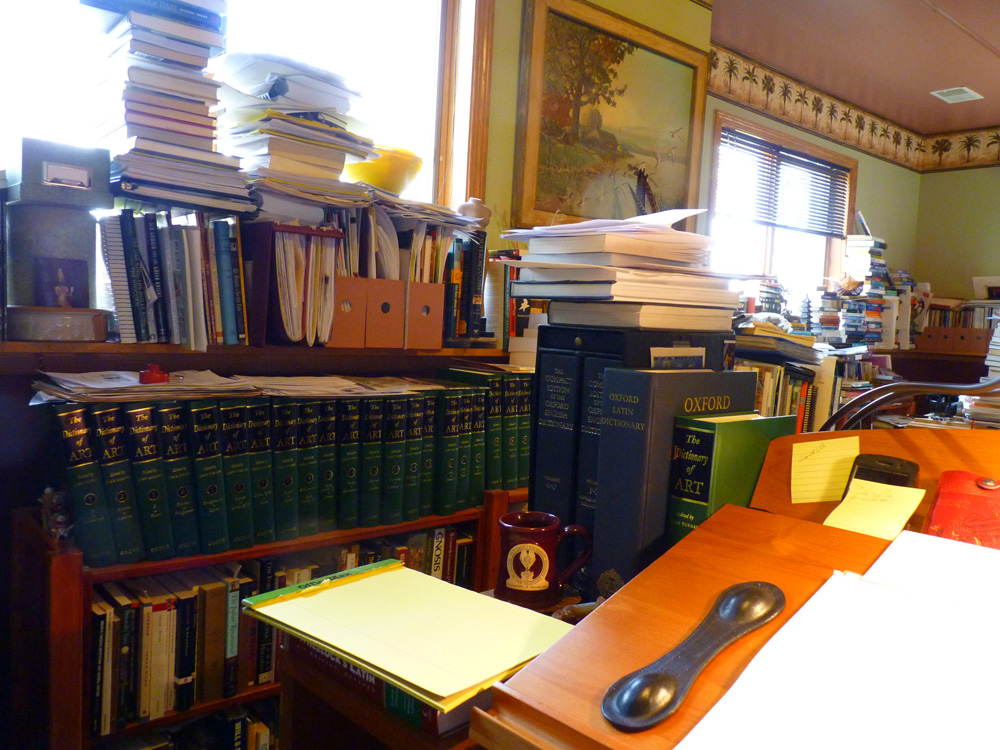
mod2011 05 06_0874Files and notebooks. Old magazines, posters, prints, objet d’arts, paintings, novel notes and manuscripts, office supplies. Perhaps more books as I admit I can let go of some of the ones I saved back and some of the books on my study bookcase. Not let go as in red tape, outta here, sayonara, but let go as in green tape box and inaccessible until the move is over.

This sorting is even more intimate and difficult than the books. Do I really need all those essays on the humanities I’ve saved over the years? Well, of course. Do I need this one on quantum mechanics? Maybe not. How about the files on the Great Wheel? Definitely. And what of the art do I love and which do I merely like? The likes go. The loves stay with me.

Those stone sculptures I bought at Artisans D’Angkor in Siem Reap? Stay. The Shiva Nataraja I bought in Boulder? Stay. The Open sign we bought at the going out of business Mod2011 05 06_0876sale at Lights on Broadway? Stay. O.K. This might be hard, too.

This is getting ready for SortTossPack who will come again on September 26th, a week from this Friday. We plan to have them pack the fragile stuff, some of the art, carry some boxes, take some furniture back to the consignment shop. It’s also, of course, getting ready for the actual move. Soon now we’ll need to contact moving companies, get bids. Wow.


Lughnasa                                                                    College Moon

The College Moon reminds me that all of those stunned freshmen I saw at the University of Minnesota over Labor Day are now deep in the throes of their first semester. The student in me-and he is strong-envies them, the newness of it all. The library for quiet study. The smell of a book, paper glue and ink. Even the confusion. Confusion is the sweat of the mind, I read recently. The adult in me does not envy their angst, the worry about career, debt, love, success, about worth.


Powerful, Scary Ideas

Lughnasa                                                                                          College Moon

Reading an important document, a Stanford Encyclopedia of Philosophy essay on authenticity. Kierkegaard, the essay says, defines the self in relational terms: “The self is a relation that relates itself to itself…” A pioneer in the concept of authenticity Kierkegaard defines the purpose of life as “becoming what one is.”

This definition of self and of life’s purpose make sense to me. Heidegger, the inventor of the term authenticity, makes a similar point with his concept of dasein:  “…human being is a “relation of being”, a relation that obtains between what one is at any moment (the immediacy of the concrete present as it has evolved) and what one can and will be as the temporally extended unfolding or happening of life into an open realm of possibilities. To say that human being is a relation is to say that, in living out our lives, we always care about who and what we are.” from the same Stanford essay.

What both of these northern European thinkers suggest is that the idea of Self is dynamic and by definition relational, somehow linking our past with our present and our hope or anticipation for the future. This means that our notion of who we are-and therefore who we can hope to become-lies in a web of feelings and thoughts connecting experiences in the external world and our internal understanding of them, with those experiences occurring only in our interior world and their relations with those stimulated by the external world.

Thus, in Heidegger’s terminology, what we are is always at stake. The choices we make and the experiences we have and the past we carry with us are always in vibrant collision, shaping and reshaping our Selves, second by second. I suppose you could see this as daunting, but for me it is exciting, meaning that my Self is not fixed, not bound to the past or to any particular future, and not only not fixed, but malleable. That is, I can make choices now, right now, that affect my Self. I can even alter the past by recalibrating the frames through which I view it.

As we discussed in the Nietzschean conversations below, once we understand this fluid, vital nature of the Self, we cannot help but live dangerously. Why? Because in every action, in every moment of contemplation, even lurking in the past are events, experiences, thoughts that change who we are. And who we can become. Powerful, scary ideas.

Nocturne

Lughnasa                                                                 College Moon

A certain softness, a wistfulness has begun to creep into the Woolly meetings for me. If we buy a house and move in January, only three more third Mondays remain.

The depth of feeling I have for these guys will last, I know that, but the relationships will grow more tenuous. That’s inevitable. They will not disappear, of that I’m sure, but without the regular gatherings things will change.

The circus tent ropes have gone slack and some of the canvas sides have begun to fold in on themselves, the tent poles are still in place: the home in Andover, the Woolly’s, the personal Twin Cities created by 40 years of memories, but each of these tent poles will eventually come down, too.

Feeling it tonight.