Lughnasa Lughnasa Moon
In times before the pagan revival this holiday had the name Lammas, even among witches. Lammas, a modern English transliteration of an Anglo-Saxon word for loaf-mass, was celebrated on August 1st. The Roman Catholic imperial strategy of subjugating, then eliminating rival religions moved forward in part by absorbing and renaming other faith’s holidays.
It is not so easy, though, to stamp out folk religions. The old ways were held tight in rural areas and those doing so were called heathens (on the heath) or pagans, from the Late Latin paganus, or country-dweller.
Here’s an example. On Lammas parishioners would grind the first of the wheat harvest, then bake loaves of bread and take them to the church for blessing. According to this wikipedia site, many would then take the bread home, break it into four pieces and put them at the four corners of the grain storage building for protection against spoilage and rodents. So Lammas remained a first-fruits harvest festival, even under the Roman Catholics, but they replaced celebration of the grain itself with incorporation of the grain into the Catholic eucharistic symbology.
(a welsh corn dolly)
As the wheel turns, so does the nature of belief and faith. In this more pagan friendly world most neo-pagans, though not all, have returned to the original Celtic, Lughnasa. While I don’t align myself with any of the contemporary pagan splinters like Wicca, neo-paganism or Asatru, I do align myself with the impetus for the Great Wheel, the changing seasons themselves, and with the value of holidays to celebrate those changes. The Celtic holidays come from within my genetic heritage, so they make sense for me.
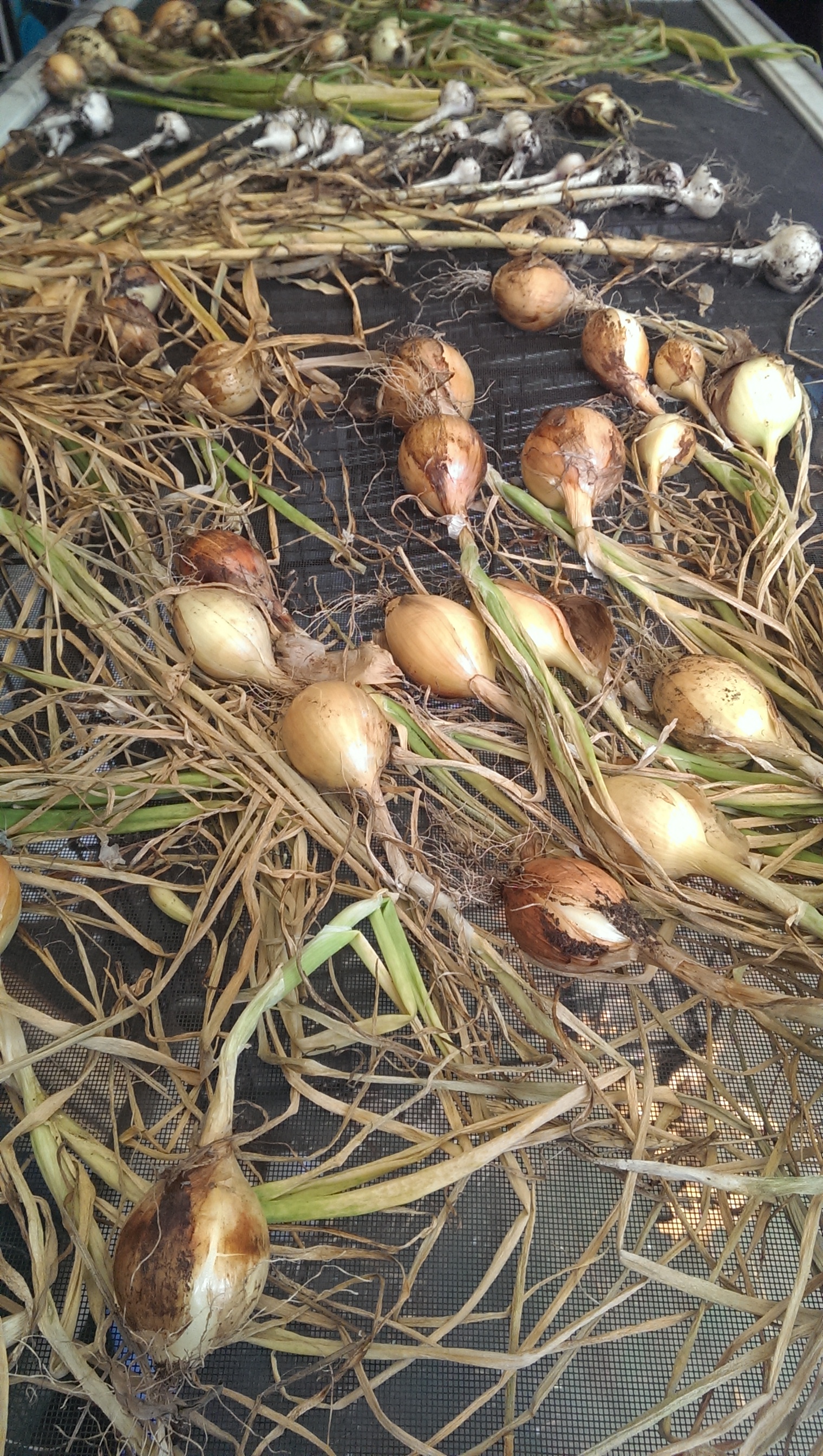
Sitting on the counter upstairs is a large laundry basket, the plastic kind that can be  carried on the hip, filled with collard greens and chard. In the shed, drying, are yellow onions and garlic of different varieties. Downstairs, in the pantry, Kate has already stored bright orange jars of carrots, blood red jars of beets and jars the solid green of green beans. We have, too, eaten onions, chard, carrots, beets, green beans and collard greens already, so this is a good time to thank the land and the weather and the plants for the food they’ve already produced.
(onions and garlic, 2014)
In Celtic lands Lughnasa would have seen a corn maiden brought in from the fields in the first grain cart holding harvested wheat. (corn, in the British use, being wheat) And corn dollies would represent this symbol of the land’s fertility throughout the long, fallow months.
These holidays were not a single day (as we tend to celebrate them now, if we celebrate them at all), but were market weeks, when produce and crafts would come into a town and villagers and farmers would shop. Games were played, dances held, and marriages, of a 3-month or a year-and-a-day length could be entered. Both were considered trial marriages, the 3-month trial up at Samhain or Summer’s End.
Since these markets enjoyed the first fruits of many harvests, they were occasions tied to the rural life. In the United States Celtic peoples continued the Lughnasa heritage with county fairs and state fairs. Though the Minnesota State Fair is a much more expansive event than the typical Lughnasa festival, the Anoka County fair held recently or the 4-H fair held annually in my hometown of Alexandria, Indiana were probably similar.
In my world Lughnasa is much as it always was in terms of intention, a moment to stop and consider the strong bond between our land and our stomachs, our land and our survival. If nothing else these holidays make us pause and reflect on what’s happening in a world, the plant and animal world, that we might otherwise ignore. It’s for this reason chiefly that I think broad awareness of the Great Wheel and celebrations of its holidays could be a balm for an overheated world.