Headline I Never Thought I’d See. Wonder if they were made by 4-H’ers?

Lughnasa                                                                    Lughnasa Moon

a headline I never thought I’d see, in the Denver Post: handmade bongs and marijuana laced brownies. Colorado here we come.

Blue-ribbon weed: Denver County Fair pot showcase kicks off

“DENVER — Marijuana joined roses and dahlias Friday in blue ribbon events at the nation’s first county fair to allow pot competitions.

Edible products did require tasting. A secret panel of judges sampled brownies and other treats earlier this month at an undisclosed location.

“At first the judges were eating them all, but by the end they were really feeling it, so they just tasted them and spit them out,” Cain said with a laugh. “We offered them cabs home.”


The winning brownie was made with walnuts and dark chocolate. Top prize was $20 and a blue ribbon…

“For the handmade bong contest, three industry insiders judged 17 entries for craftsmanship, creativity — and functionality.

“It has to be something special, something you’d want to use,” said judge Robert Folse, who works at a pot dispensary as a “budtender,” sort of a sommelier for marijuana.”

Nocturne

Lughnasa                                                          Lughnasa Moon

There is the decreasing light, the gradual slide into darkness now over a month underway, heading toward a culmination in December. There are nocturnes. There are evening prayers and compline. There is sleep, rest from the day. There is darkness now, a world which would be, without electricity, lit only by fire and the light from celestial furnaces burning bright.

(Evelyn de Morgan (1855-1919) – The Sleeping Earth and Wakening Moon)

This time comes each day, in its repetitive way soothing, not unlike the liturgy of the hours. Call this the liturgy of light and dark. In composing these nocturnes the night becomes a moment for reflection, meditation, consideration. These sorts of routines can simple our lives, give us dependable pillars that can see us through the storms on which we ride.

My wish for you tonight is the peace of sleep, the refreshment and joy of awakening to a new day tomorrow. Earth speed.

What Lies Beneath?

Lughnasa                                                                 Lughnasa Moon

Clearing out files this morning. When I came to a group of dog related files, vet records, 1000P1030765pedigrees, lure coursing material, I got stopped for a while. In Sortia’s file, our second Irish Wolfhound, a black bitch that weighed 150 pounds, I found a letter from the University of Minnesota Veterinary Hospital. Sortia was euthanized there against our wishes during an overnight stay.

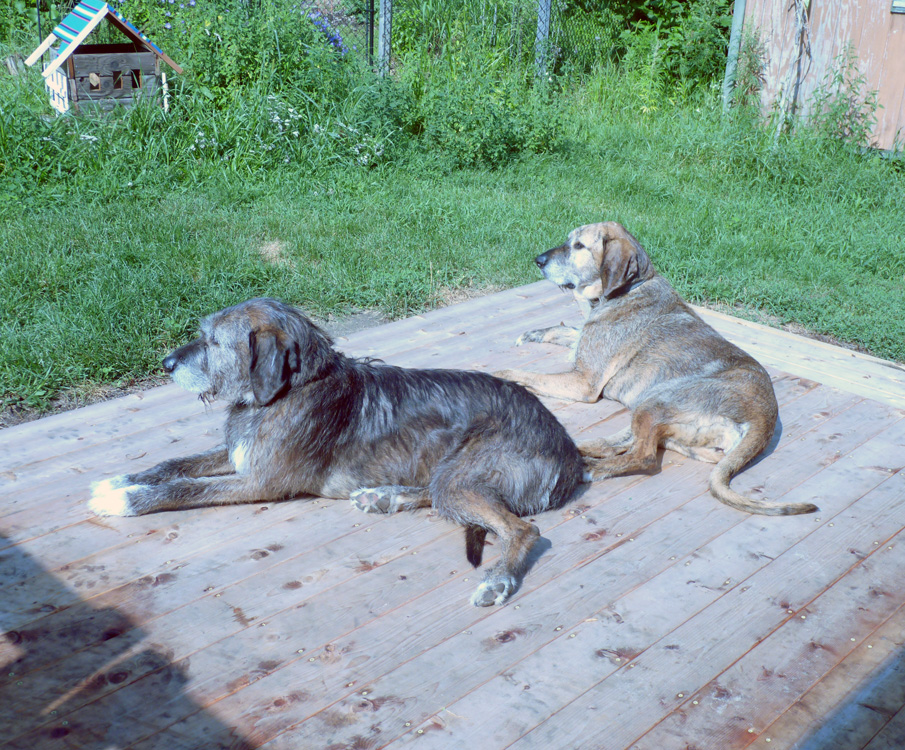
(Rigel and Vega taking the sun on our new deck)

Though the care our dogs have gotten at the U was usually exemplary, this event prevented us from saying good-bye to Sortia. Reading this letter about the incident brought it back to me in a flash. A wave of sudden sadness and deep grief gripped me for a moment, so strong that I had to put down the file and sit back while I stabilized. This feeling surprised me, came up strong from dead stop.

I also had an unexpected response a few weeks back while watching How To Train Your Dragon II.  In a reunion between the lead character, a young man, and his mother whom he thought dead, a wave of yearning swept through me. I wanted my mother to hug me. She’s been dead 50 years this year and I can not recall a feeling this strong about her in decades.

Here’s what I’m wondering. Do these strong feelings lie waiting for the right triggers, somewhat like PTSD? Or, do they swim around in the neural soup, always this strong, but engaged in another part of our psychic economy? How many of these knots of emotion exist within us, still tied to their original sources, and what significance do they have?

I may not be saying this well. As a general rule, I’m not in the grip of strong emotion unless something political is going on or I haven’t had enough sleep. Politics taps into something primal, as if a god within wakes and demands action. (I use this analogy with some reservation because I don’t believe my politics are divinely inspired, but it gives the right tone to the depth of my political feelings.) Being sleep deprived makes me irritable and far from my best self, so anger comes more easily then.

Now, maybe strong emotion could ride me more often.  Maybe I’m missing out on some part of life that flies those colors with some regularity.  But as a white middle-class guy, educated and with northern european ancestry, friends and spouse of the same, my emotional range is muted and these events, like the ones I describe, are rare.

No conclusion here. Only questions.


Among the Gooseberries

Lughnasa                                                                     Lughnasa Moon

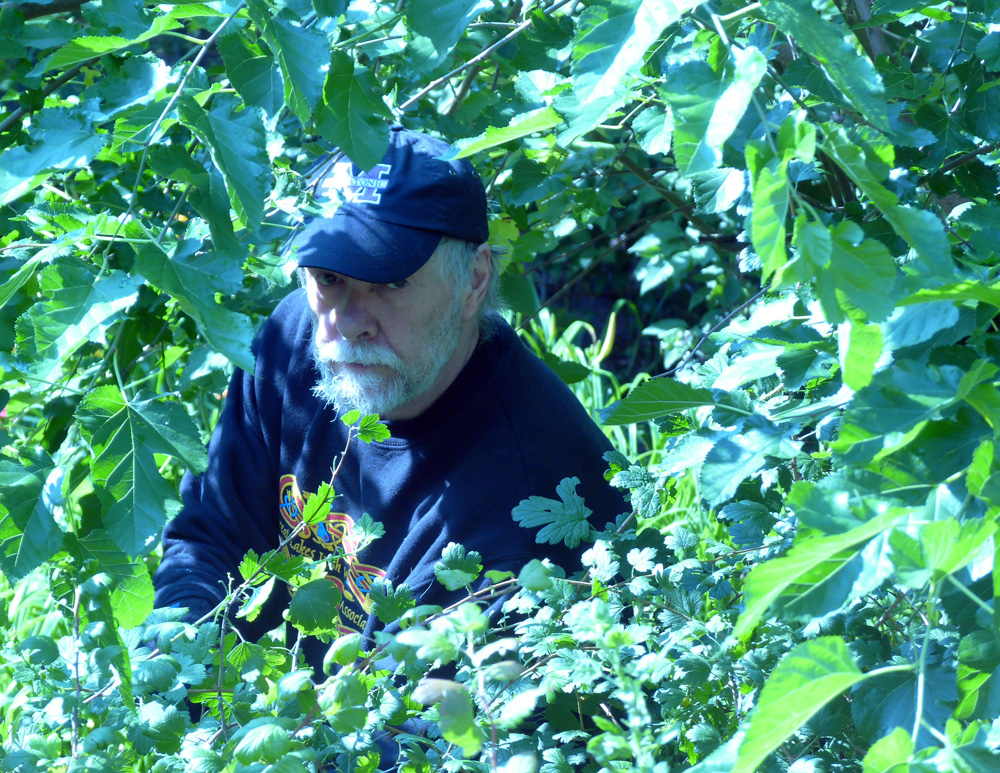
1000P1030763Gooseberries favor the small animal, especially birds, who can either land on the stem among their thorns or reach up with small paws to retrieve the prize. The larger animal like the one seen here must carefully grasp the branches where the thorns are not, wear protective clothing for vulnerable skin and have on gloves to guard the even more sensitive fingers and palms, the hand as a whole. Having done that, though, the gooseberry rewards all of them with a tart sweet berry that might make the body of a clever purple or green goblin, especially if he were fitted with an acorn head carrying its jaunty cap.

Oh, and the smart gardener (not me) would plant them with sufficient room around each bush to easily access the branches. This cramped planting requires perilous maneuvers.

On the other hand this gardener (smarter in this instance) did move all these gooseberry bushes. They languished in the shade during the day and he dug them up and replanted them in this sunny spot where they thrive. This is about learning the language of plants. They speak with leaf color, insect infestations, poor fruit production, spindly branches. The gardener must listen intently as the plant communicates its needs, then do what is necessary to meet them. If a plant can be placed in a location right for its health and provided with adequate nutrition and water, then it will produce and produce and produce without much care.

Live the Questions

Lughnasa                                                                   Lughnasa Moon

I must have had this insight at another point, or been taught it or read it somewhere, but I don’t recall any inkling of it from any source. That is, the study of religion is important not for the answers religions give, but for the questions they ask.

Buddhism, in its emphasis on enlightenment and liberation from the ensarement of the senses is asking questions I’m not asking. It sees, in other words, human dilemmas, yes, but not the ones that are important for me. This is not surprising since Buddhism arose as a response to the harsh laws of karma that bound early followers of the various Hindu faiths-Shaivite, Visnhuite, followers of Kali and Ganesh-to the priesthood and temple. Karma, in spite of its cultural adoption into English, means little to me. I do not feel bound to the karmic wheel, so I have no need of release from it.

Judaism, Christianity and Islam, on the other hand, and the various pagan faiths of the Western tradition have shaped questions in response to the urgent questions felt by those of us influenced by Greek and Roman thought. What does it mean to be alone, as an individual entity? What does death mean, since it is not followed by reincarnation? What is justice in a culture ruled by tyrants or oligarchs? What is the nature of human community in light of all of these?

This is not to say, of course, that Eastern traditions don’t ask questions relevant to us. They do. Guilt can be understood as a form of karma. Why are we guilty and what can we do about it? Is forgiveness possible? Does it cleanse the soul or unburden our conscience? Are those the same things?

Taoism, for me, asks the profoundest questions of all the religious traditions with which I’m familiar. Is it better to take action against a sea of troubles and by opposing end them, or does it make more sense to learn how to live with the energy of tides, adjusting our actions to their ebbing and flowing? Is life better served by intention or attention? Do we need to know the nature of reality or just how to accommodate ourselves to it?

And underneath the questions of both Western and Eastern traditions are the fundamental questions: does life have meaning? are there actions that are required of us? who or what can we trust? with our lives?

All of these questions are important not because some guru, imam or monk said so, but because they are the questions that occur to the conscious animal, the reflective species. And they arise because we know certain things: we are alive. we will not be. we are bunkered within bodies, walled off by flesh and inner life from all others, yet desirous of living with them.

The answers to these questions are so various and so different that a thinking person cannot credit anyone as the truth. So, it is not the answers that are finally important, but the questions themselves. Are the answers important? Sure. They can point us toward a glimmer on the horizon. They can flash in our personal heavens as bright aurora, illuminating for a time our night sky. But in the end, unless capitulation is your thing (and it is for very, very many) you will be left wondering about the answers. But never the questions.

And it is the questions that bind us together. It is the questions that define the ancientrail of pilgrimage through this chance occurrence we share, life.

Again, I’ll quote Jim Morrison of the Doors. Into this world we’re thrown…riders on the storm.