Back At It

Lughnasa                                                                      College Moon

Another week begins. And, yes, after 22 years of working on my own time, Monday is still the first day of the work week. The weekend slows hit me even now. This habituation to weekends and work week begins not when we first draw a paycheck, but that first day of first grade, maybe even kindergarten. That’s when we begin learn the distinction between the work-a-day world of Monday to Friday and the different, more relaxed Saturday and Sunday. No wonder that rhythm doesn’t disappear, even when its usual props of work place or class room have long ago receded.

Today is auto maintenance and finish the firepit repairs. Plus more De Bello Gallico. Realized the other night that I want to read Vergil’s Georgics, too. This is a four book poem on agriculture. I’m beginning to feel that writing in some way about agriculture and horticulture, apiculture would be fun and important for me.

The exterior maintenance is wrapping up over the next couple of days, then the seal coater comes on Friday. I’ll finish packing the books, tomorrow probably. We also need to finish cleaning out the sheds and do a soil test for the garden. That’s the work week so far. As to the weekend? Nothing definitive right now.

Sunday, Sunday

Lughnasa                                                                                    College Moon

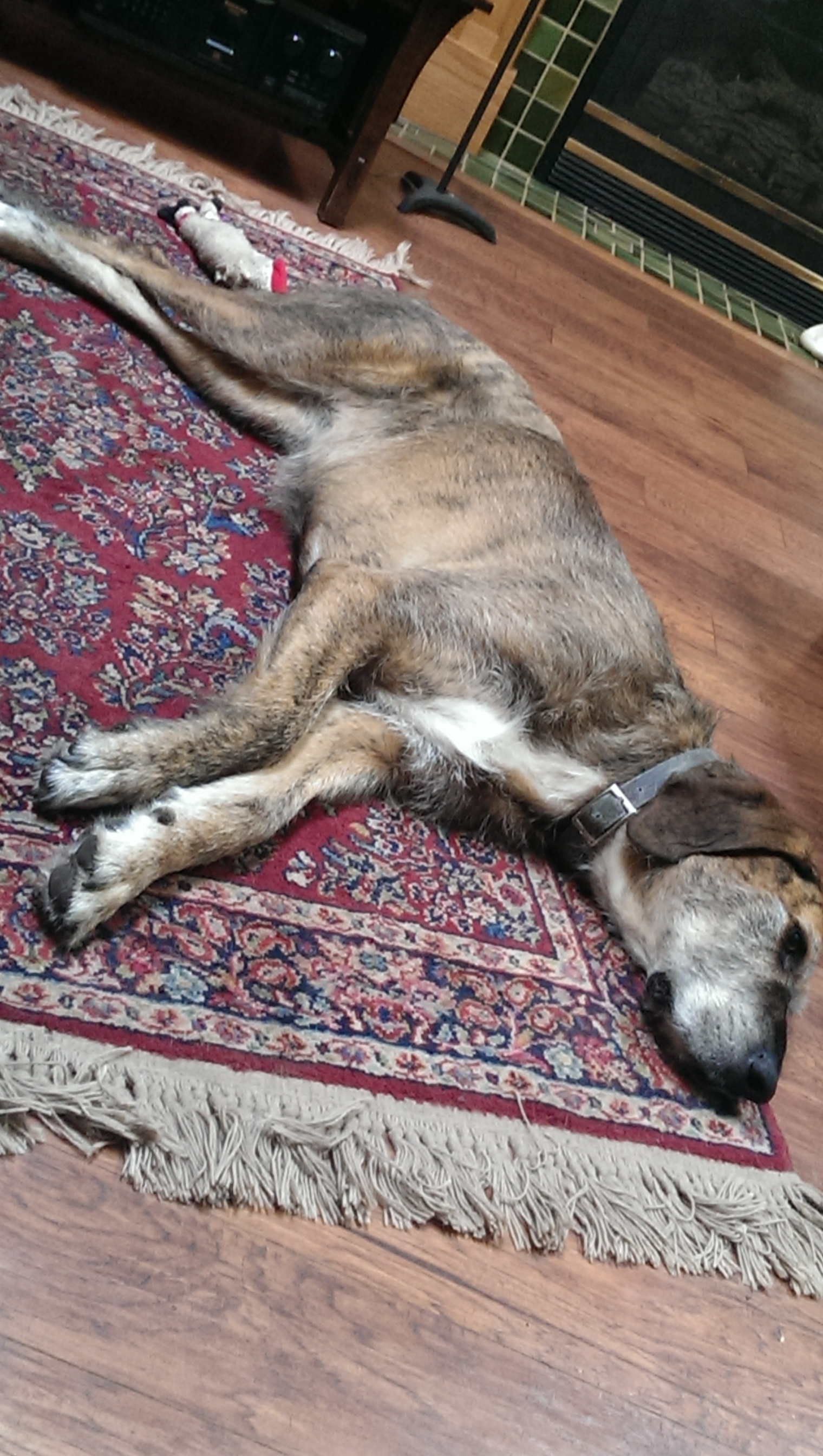
IMAG0417Vega cut her right leg near the knee. “Yeah, right there. They’re running, snag something.” The Vet at the Coon Rapids Emergency Veterinary Clinic. Always on a Sunday. Emergency vet care is, by definition, expensive. We try to avoid it, but with the number of dogs we’ve had over the years, things happen on the weekends.

(Vega in a typical position.)

The first place we took her, Blue Pearl Emergency Vet Clinic in Blaine, closed because of the number of critical care incidents they had. They could take no more patients. That’s how we ended up in Coon Rapids.

Vega is stoic. She walked in this afternoon, not limping, but a huge triangular flap of skin hanging down. The cut exposed a tendon and muscle underneath, as if it was an anatomy illustration.

When we brought her home, after the cut had been debreeded and repaired with staples, she paced for about an hour, maybe more, an after effect of a pain medication she received just before leaving the clinic. Pacing is so far from Vega’s normal lady of leisure attitude toward life that it put both Kate and me on edge. She did finally calm down.


Of Mice and Dogs

Lughnasa                                                                         College Moon

While cleaning out the garden shed, a tarp got shook out. Mice scattered from a nest in one of its corner. Amusement ensued. Vega quickly found a mouse, put it in her mouth and trotted off to slide under the shed and enjoy her prey. Gertie pounced around, finding, then losing a quick grey mouse. Ah. Finally. She has it in her mouth. Then. Oops, it’s out of her mouth on the ground. Gertie’s a retriever by instinct. When the retrieved starts squirming around? Big surprise.

Rigel came out, pounced with her powerful shoulder muscles thrusting her jaws down. She caught her mouse and ate it, all in the same sequence of actions. Kepler nosed the mouse who escaped from Gertie, but couldn’t make himself get interested. He’s a guard dog. A mouse? Not important.

This Should Stop. Now.

Lughnasa                                                                        College Moon

The Northrup King building in Northeast Minneapolis houses artists, floors and floors and floors of studios: potters, painters, metal workers, collage artists, sculptors, print makers. 5 years ago a docent group did an event there during Art-a-whirl. The room in which the event was held had remnants of the building’s original purpose. Slick concrete columns fat as oil drums flowered toward the top, supporting the weight of feed grains that would come into the top floor of the building, then get separated below through the chutes still visible in the large open area.

While the band played, memories of another time, in the late 1970’s swirled around. Back then Northrup King was still an independent seed company, selling seed to farmers. But in the mid-1970’s a specter stalked the seed industry. Large pharmaceutical companies had become aware of the great concentration of power available for those who controlled patents on seeds, on their genetic makeup. A huge buyup of seed companies was underway.

A group attempted to stop the buyout of Northrup King by Switzerland’s Sandoz corporation, but failed. Northrup King, or NK, became a subsidiary of the pharmaceutical company and was later sold to Sygenta, an agrochemical and seed company.

You may recall a post here on July 12th of this year that contained this quote: “Today, humans rely on fewer than 150 plants for nourishment, and just three cereal crops—wheat, rice, and corn—make up more than two-thirds of the world’s calories; along with barley, they own three-quarters of the global grain market.” Wired This could be the strategy statement for that buyup, which went unchallenged.

The result has been the concentration and subsequent manipulation of genetic material for many of those 150 plants and an even tighter focus on the big three: wheat, corn and rice. An article in today’s Star-Tribune mentions just one small outcome of this process, but one with big consequences for those of us who raise bees, the use of neonicotinoids. This pesticide-slathered on the seed before it is sold to the farmer for planting-has a role in colony collapse syndrome which has led to hive losses as high as 20% even for professional bee-keepers. It weakens the bee or kills them outright, geometrically increasing the effects of habitat loss (often created by the same agrochemical folks through “round-up ready” crops), mites, bee strains unprepared for the hygienic requirements these changes produce.

More than trouble for bees is exposed in the article Bees on the Brink. Here is the true problem (which is not to trivialize the problems for bees, but to see its place in a much larger and more insidious problem):

Though they represent just 2 percent of Minnesota’s population, farmers control half its land. And their embrace of the monocultures and pesticides that form the basis of modern industrial agriculture has been implicated in the decline of bees and pollinators.

But as long as farmers sit at the receiving end of an agri-chemical pipeline that fuels the nation’s rural economy, not much is likely to change…

The centralized control of seed genetics, with its beginnings in the mid-1970’s, has now become the apex of a command and control apparatus that dictates how over 1/2 of Minnesota’s land is used. And that’s just Minnesota. That control is hardly benign. Witness the Minnesota river and its agricultural runoff polluted waters.

The payoff, the ransom for which these lands are held in thrall by big pharma and big agrochem, of course, is higher yields. This however only reinforces a decades long collusion between agriculture scientists at land grant universities like Purdue, University of Minnesota Ag campus and Iowa State. Long before big pharma got involved crops have been manipulated not for better nutrition but for higher yields and crops that are easily harvested, shipped and processed.

The result? A farm sector which pollutes our waters, uses huge amounts of petroleum products in fertilizers and fuels, kills our bees, diminishes genetic diversity and worst of all produces food with less nutritional value. This is criminal and should stop. Now.

 

De Bello Gallico

Lughnasa                                                                           College Moon

I asked Greg (Latin tutor) for something new, a different arrangement. He wrote back and suggested I start reading Caesar’s De Bello Gallico. That’s not quite what I had in mind, but I decided I’d try it before our time together next Friday. I’ve already translated 20 lines. It goes quicker than Ovid, prose rather than poetry explaining part of that I imagine. Translating made me feel like I’d made real progress. Probably Greg’s point in recommending it.

The commentary I’m using for Caesar suggests reading in the Latin word order first. That’s very hard with poetry because Latin poets move words around based on rhyme scheme and meter, as well as for dramatic effect. With Caesar however it gave me, for the first time, a feel for Latin as a foreign language rather than a puzzle created by unfamiliar words. Reading in the Latin word order means thinking the way a Latin writer and reader would.

There is a subtle irony involved in reading Caesar for me, two in fact. The first is that Caesar was the first real Latin text I ever began to read, way back in Miss Mitchell’s class in high school. (Yes, speaking of ancient times, that was 1964 and 1965.) The second and more profound one for me is that it is through Caesar and through De Bello Gallico, Of the Gallic Wars, that we have a great deal of our knowledge of the ancient Celts. Gaul = Celt. And, it was Caesar who invaded Briton. Between Caesar and Tacitus, a Roman historian, we have the bulk of the written accounts about the Celts, how they lived, fought, worshiped.

I’m going to keep translating both Ovid and Caesar, though I’ll finish Caesar long before I finish the Metamorphoses.


Still

Lughnasa                                                                     College Moon


Out to Keys on University for our business meeting. Walking bleary eyed and under awake into a place with fresh coffee and breakfast is one of life’s small, but significant pleasures for me. We discussed the move, the idea of a second mortgage, the state of our finances, checked our calendars, scanned for birthdays.

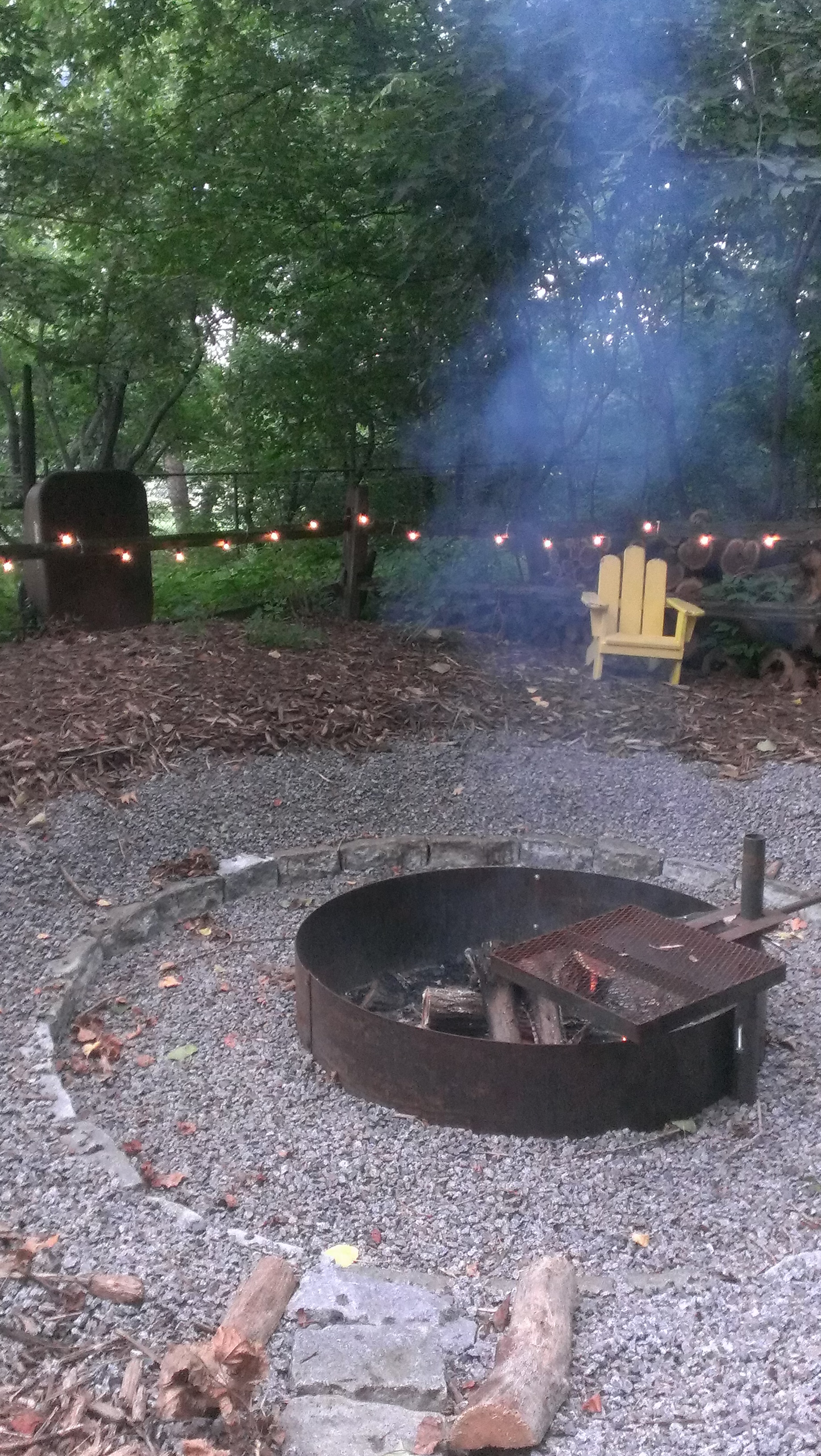
Back home we got into shed clean out mode, discarding several years worth of detritus, often saved for a time that never came. While Kate concentrated on the first shed, I worked on repairing the damage to our fire pit area by the dogs. They smelled a rodent ofIMAG0751 some kind, I imagine. This involved hauling sand sufficient to fill up the hole, replacing torn landscape fabric and will later involve hauling sand to cover the landscape fabric, then spreading mulch over it all.

Once I finish that, I’ll move onto the shed where we keep the bee woodenware, clean it up and consolidate everything we’re going to move. Then, removing the electric fence and all its accessories. Finally, a soil test for the garden. May not make all of this over the weekend, but plenty of it.

Over the last week certain aspects of the move have become clearer to me, moving from the background to the foreground. Taking a year, living in the move, is a pace I can live with and not become anxious. Still, there is the fact that it takes a year or so which is a long time. So far it feels like matters are happening at the time they need to. When the question arises, an answer appears.

The Ties That Bind

Lughnasa                                                                       College Moon

We’re gathering little clutches of cash together for moving related expenses. We cashed out some non-performing CD’s, have sold various items we didn’t want to move and just sold Kate’s silver from her first marriage plus some assorted gold pieces.

There are a lot of sunk costs in this process. The maintenance we’re having done outside, whatever inside work needs to be done, working with SortTossPack (which generates revenue, too) and then the move itself. There will be, too, various packing costs like crates for our big paintings, special boxes for the tv’s and other electronics. All come out of our pocket before we sell the house (if we buy in Colorado before we sell).

None of this is a surprise, all components of any move that involves selling and buying real property. We do these dances with material things, dances that mimic George Carlin’s famous skit. Yes, I suppose we could shrug off the house, the furniture, the books, the art, the quilting machinery, the pots and pans, the garden implements. I suppose we could.

But we will not. Because the world reels us in with the hand of a grandchild, the bark of a dog, the growth of a garlic bulb, we will not. Our life, our path, is not that of the ascetic, though the ascetic teaches us not to confuse our things with our lives. Our life, our path, is not that of the hedonist, though the hedonist teaches us to love certain things which give us pleasure. Our life is a thread, a small part of the larger tapestry being woven of our time.

We’ll add our thread, tied already to those of children and grand-children, land and plants, the lives of dogs and friends. The weft shuttles us across the warp threads laid down by the physical and larger political changes. Our presence is subtle, as is that of any particular thread in a tapestry, but consider, without each thread the tapestry will not emerge. There will be only warp threads sagging with nothing to hold them together.

We matter-and so do you-even though we are, each of us, only tiny instances in the even larger tapestry being woven now by our galaxy, our cluster, our super-cluster and that one part of another so vast we cannot comprehend it. This is what the Greeks knew when they composed their great masterpieces. Fate is not a hand from the future that plucks your thread toward a necessary spot; rather, fate is the story of stories already told, visible only after the thread is in the tapestry.


Lughnasa                                                             College Moon

All those stunned freshmen I saw at the UofM on Labor Day have begun to settle in, trying to balance free-time spent socializing with furthering their study. This mix often settles a student’s chance of academic success.  If you have a student making these choices right now, sometime in October would be a good time to sit down with them and discuss how it’s going.

More Moving

Lughnasa                                                          College Moon

The boxes are in the house for the final round of book packing for right now. Over the long weekend we plan to clean out our sheds, repair the fire pit, remove the wires from the fences put there to foil dogs and get a soil test done for the next steward of these lands.

There will be a three-ring binder with planting maps, options for caring for the fruit trees and shrubs, the perennials and utilization of the raised beds and other vegetable growing areas. A small library of Minnesota specific gardening books will be on a shelf. A well-functioning lawn tractor, bee-keeping start-up kit, a hydroponic kit for seed starting and a crystal chandelier in the kid’s playhouse will all stay behind, no longer relevant to our mountain home.

If certain decisions we’re making now prove fruitful, we could buy a new home in January, moving one, or even both of us out there that month or the next. I know, moving to Colorado in the winter, from Minnesota. Sounds like madness, but there may be some very good reasons to do it.


Movement Toward the Springtime of the Soul

Lughnasa                                                                                 College Moon

The rain and cool have come. The sun is lower in the sky. We will have lost 23 degrees of declination from June 20 to September 20. We have already lost 2 hours and 25 minutes of daylight June 25 through yesterday. The slide toward the Winter Solstice has proceeded and will accelerate on Mabon, September 20th, when the hours of night once again exceed the hours of daylight.

All of this is good news. Especially this year. Both Kate and I are ready to have a smaller property with less growing season work. Not because we don’t love it, but because we want more time now for other matters, like grandchildren and our creative work. The coming of the fallow time means the last garden here and movement toward a new year.  2015 will find us creating a new outdoors life in the Rocky Mountains.