Don’t know why it took me so long, but I know how to make America great again. It will not require red baseball hats or xenophobic bluster. No, it only requires listening to the ideas of a Passionate priest, Thomas Berry. Berry wrote a small book, The Great Work. It influenced a turn in my political activity from economic justice to environmental concerns.
This 258 page book is a quick read and it introduces The Great Work. Civilizations, according to Berry, have a quintessential role that only they can perform. The one he identifies for our civilization is this: Creating a sustainable existence for humans on this earth. That is our Great Work. It is the way to make America Great again.
The phrase, the Great Work, comes from medieval alchemy. The primary, original material of the universe, the prima materia, in the alchemist’s lab can create the philosopher’s stone. The philosopher’s stone could turn base metals into gold or silver and extend the alchemist’s life.
We can take the prima materia of the U.S., its citizens and its land, put them in the alembic created by our need for survival and our need for economic justice, and turn up the heat until we have our philosopher’s stone. When we have it, we can use it to heal the earth and create good-paying jobs for all.
Then, then America will be great. Not only again, but still and not only still but into the future as well. May it be so.
I’m weary of politics, bet you are, too. A sports columnist compared Trump’s flurry of executive orders to a strategy in basketball where one team fouls the other so much in the first five minutes that referees are less careful the rest of the game. It turns, she said, into a very physical game after that. That’s why we need to stay angry, but stay cool. This is a long game and we need to stay in it.
It’s also why we need to point our anger at its source, not its symptom. The source is the cynical manipulation of fear and despair that Trump and his team of mediocres represent. The symptoms are those who feel fear and despair. Solutions to the current crisis, and it is one, lie in a two-pronged approach: 1. resistance to the actions of Trump and his team of mediocres and 2. finding policy solutions to those matters, principally economic, that drive the fear and despair he and his team exploit.
The resistance has begun. Organizing for Action-Conifer is a local example, but there are thousands, hundreds of thousands, millions participating. Again, and probably again, I will quote Rabbi Tarfon: “It is not your responsibility to complete the perfecting of the world, but you are not free to desist from it either.”
I do not see much evidence, yet, of people proposing policy solutions for the divide that seems most troublesome of all: the economic prospects of U.S. citizens with a high school education or less. Such policies exist, many of them are well known, but the ones that will not work are those that count on the free market. Rising tides do not lift all boats, especially those not seaworthy. Counting on the ocean that sank the smaller boats in the first place is not a plan, it’s a recipe for disaster.
Make no mistake. This time is the direct result of Democrats and liberals ignoring fundamental politics, the politics of financial well-being for those not in the 1%. The shift away from these fundamentals was done in a good cause, this change in focus away from the old union, working persons emphasis of the Democratic party of my youth. Here’s an excellent article that explains how the shift happened and why it’s been so problematic, while also accomplishing a lot of good things along the way: The Peculiar Populism of Donald Trump.
I know. The drumbeat of political war drums can rattle the best of us, make us want to hide until this is all over. I get it. I feel it. Why not just stay up here on Shadow Mountain and let the flood wash up against the foothills below us? Tempting. But not who I am and, I imagine, not who you are either.
One day you finally knew
what you had to do, and began,
though the voices around you
kept shouting
their bad advice —
though the whole house
began to tremble
and you felt the old tug
at your ankles.
“Mend my life!”
each voice cried.
But you didn’t stop.
You knew what you had to do,
though the wind pried
with its stiff fingers
at the very foundations,
though their melancholy
was terrible.
It was already late
enough, and a wild night,
and the road full of fallen
branches and stones.
But little by little,
as you left their voices behind,
the stars began to burn
through the sheets of clouds,
and there was a new voice
which you slowly
recognized as your own,
that kept you company
as you strode deeper and deeper
into the world,
determined to do
the only thing you could do —
determined to save
the only life you could save.
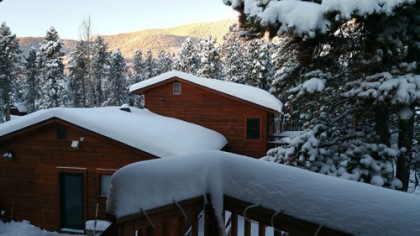
Last year we had 240 inches of snow. This year, hardly any. These are El Nino, La Nina patterns, though I don’t understand how they relate to us exactly since the mountains west of the continental divide have had an unusually heavy snow year. Summit County has had 8 feet of snow and has issued warnings to shovel roofs. Crested Butte has had snow so deep that I saw a picture of a guy on a mound of snow, with a snow shovel, shoveling snow off his roof. This is a region, especially in the mountains, of microclimates. Geography is meteorological destiny here.
A Year Ago
Of course, with the knee surgery, I’ve been glad to have less snow during my recovery period, but I told Kate the other day that the next storm, I’ll fire up the snow blower. The new knee, not exactly like the old knee, but pretty damned good is ready for some outside work. I think.
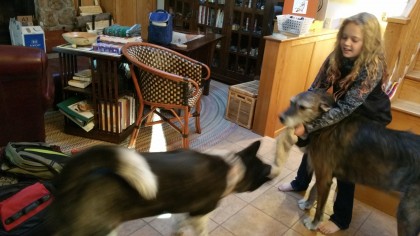
The lack of snow has meant that the persistent snow in the backyard-it faces north-has been compacted by doggy feet, melted by 50 degree days, then frozen again at night. The result is a hard, slick surface that the dogs don’t like. Rigel hurt her leg yesterday, not badly, but enough to make her cry out. Her pained yelp brought me running and I saw her with her left rear leg held up, off the ground. I went downstairs and let her in the house.
rigel and kepler and Ruth
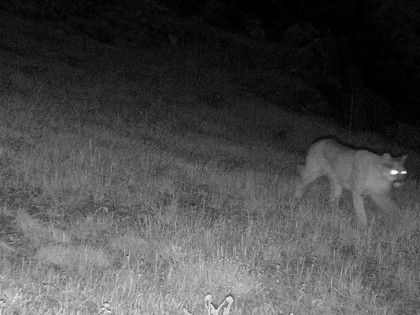
In local news there have been several reports of mountain lions killing dogs. The latest happened yesterday, well south of us, but in Conifer. A couple reported two mountain lions took their dog, a blue heeler, off their front porch, around 5:30 pm. They saw one of the mountain lions carry the dog away. Heartbreaking.
Mountain Lion, Feb 2 Jeffco sheriff photo
Mountain lions are crepuscular predators, meaning they hunt at dawn and dusk, when their usual prey, mule deer and elk, are also active. 5:30 pm is dusk right now. I admit I’m a little worried about our dogs, but having three makes things less risky. Kepler would fight back and probably be effective. Rigel and Gertie are older now, less able, though Rigel is bigger than most mountain lions and a fierce hunter in her youth.
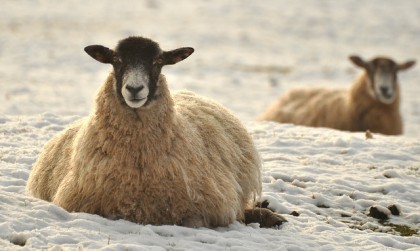
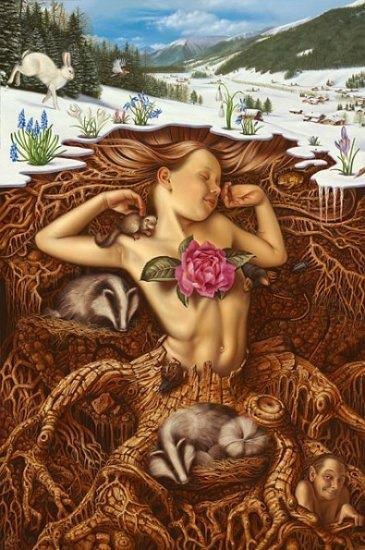
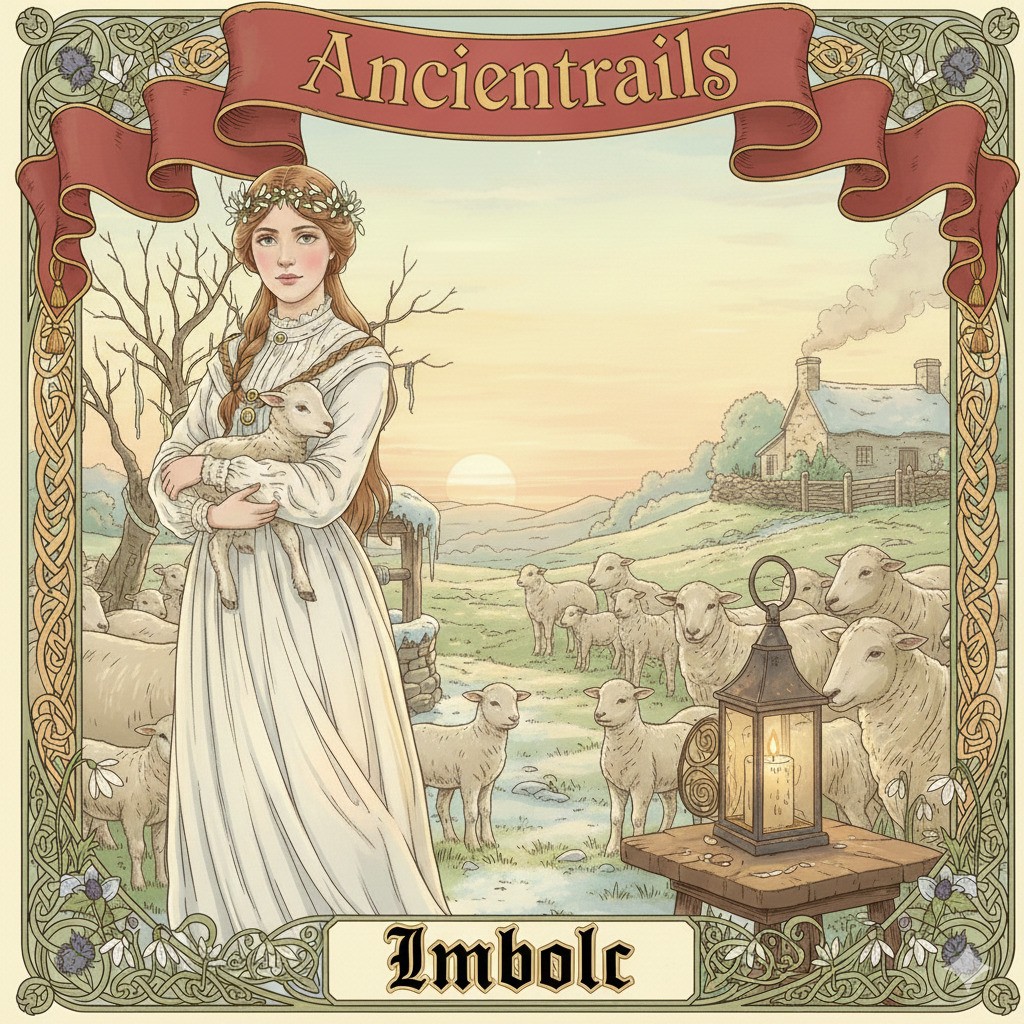
Imbolc, or in-the-belly, celebrates the time in Ireland when the ewes would freshen. Their pregnancies meant milk would be available after the long fallow season that had begun at Samain, Summer’s End.
Pregnant ewe
Imbolc lies halfway between the Winter Solstice and the Spring Equinox, what the Celt’s called a cross-quarter holiday since it falls between two quarters defined by the solar year. That milk is also a promise, like the gradual lengthening of days after the longest night of the year in late December, that spring and the growing season will come.
It’s easy for us in our refrigerated, grocery stored world to gloss over these signals of the natural world. It seems like we don’t require them anymore. After all we can buy milk, cow’s milk, at any time of the day or night, 365 days a year. And the growing season particular to our latitude and longitude also seems irrelevant since it’s always the growing season somewhere on earth. The occasional gaps that even modern transportation can’t resolve can often be filled by greenhouse or hydroponically grown produce. We’re good, right?
I’m afraid not. Celebrating Imbolc or any of the Great Wheel holidays will not resolve our alienation from the sources of our sustenance, the sun and mother earth, but this ancient tradition exists to call us back home. The Great Wheel is a reminder that the cycle of life continues, even when the fields and animals are barren. The power of the sun, working in harmony with the soil, with plants, with animals that eat the plants does not disappear. It can be trusted.
It is though, that alienation, evident in so many ways, that drives climate change, that creates produce modified for harvest and storage, not human well-being, that underwrites the paving over of cropland and wetlands. We imagine that somehow the droughts in California will stop there. We hope they’ll be confined to somewhere else, somewhere where we’re not. Global agriculture means we’ll be affected wherever the damage occurs.
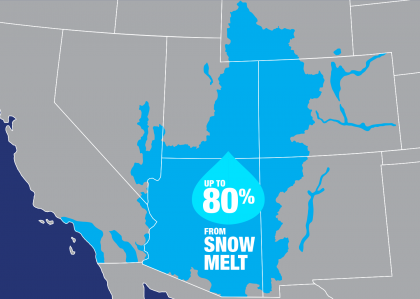
Right here in Colorado we have a key example of the interdependence for which the Great Wheel stands. Our snowpack, high in the Rockies where the Colorado River rises for its journey south toward its ancient destination in the Gulf of California, determines the amount of water available to nine states. Including California. Winter snowfall, melted by the increasing warmth of spring and summer, nourishes millions of people, cities like Las Vegas, Phoenix and Los Angeles.
In the age of Trump and rising nationalist, right wing populism, the need for the Great Wheel has never been more profound. It softens our in the moment, human conflicts by lifting up the long term, the cycles of life in which all humans, all life participate. The Great Wheel reminds us that there is no other when it comes to living on this planet. We’re all here and bound to one another, connected. My hope is that someday, perhaps someday soon, we’ll all realize that and adjust our politics accordingly.
OK. I admit it. I occasionally take the quizzes that pop up on facebook. I mention this because one set of quizzes seems, well, accurate. The same quiz website offered two recently: What kind of ancient religion would you follow? What kind of philosopher are you?
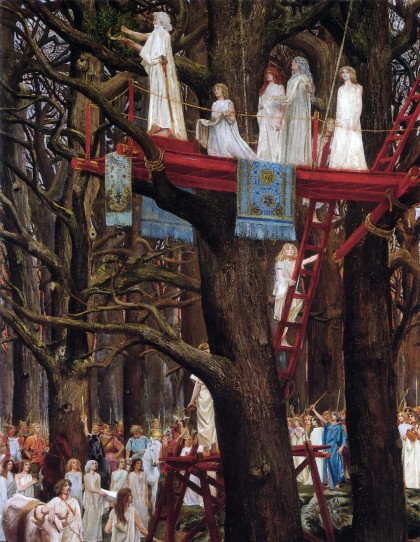
Druid Harvesting Mistletoe
Though I thought I’d saved the piece about ancient religion, I didn’t. Still. The ancient religion that matched my answers? Celtic Druidism. How ’bout that? In the year leading up to my leaving the Presbyterian ministry I was in spiritual direction with John Ackerman at Westminster Presbyterian Church. When I told him I no longer believed in Jesus/God/Holy Spirit, but was more focused now on how I fit into the natural world, he said, “Well, you might be a druid.” He meant it. Not a flippant observation. Prescient.
Since then, the Great Wheel has become my liturgical calendar. I’m much more like what I would once have critiqued as a flat-earth humanist. That is, the metaphysical realms of the world religions seem like poetry to me rather than statements about ontology. I am not a new atheist, a scorner of faith and its many, many permutations. And, yes, I recognize the role religion plays in human conflicts, but I know that most of the time religions gather people of similar demographic characteristics. When conflict emerges, it often has roots in economic and political realities that align closely with religious preferences.
I did save the note about which philosopher I’m most like.* This also seemed apposite. It surprised me, in both instances, how the 29 questions they ask managed to get somewhere close to how I see myself.
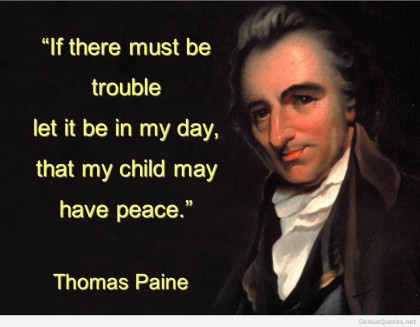
*Your mind works like the philosopher: Thomas Paine
An anarchist who championed reason and free thought, Thomas Paine was never afraid to speak his mind no matter how unpopular or revolutionary his theories were. Like Paine, you see life as full of possibilities and love to shake up the status quo by thinking outside the box. You are spontaneous and communicate confidently and fluidly. Could you write a post to inspire world-transforming events like Paine’s pamphlet ‘Common Sense’ influenced the start of the American Revolution? Who knows? (But we think it might be worth a try.)
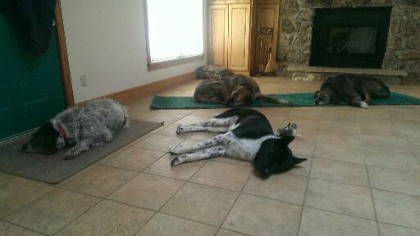
The dogs after delivery by Tom Crane and Kate, before the boxes
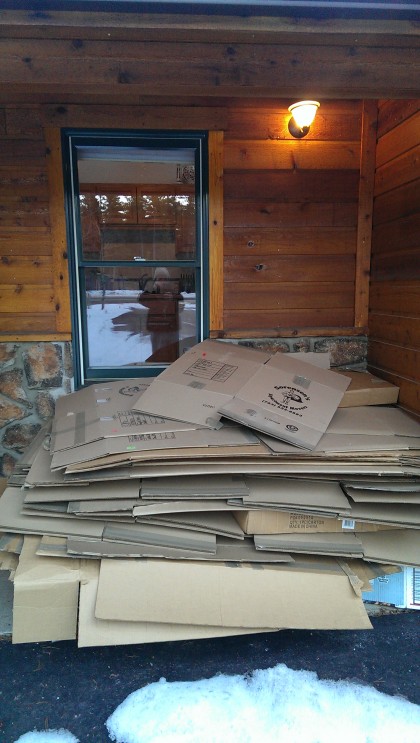
The move, two years plus later. On October 31st, Summer’s End of 2014, we closed on 9358 Black Mountain Drive. Later that same year, on December 20th, the Winter Solstice, we moved in. At the time we still owned our home in Andover, Minnesota. When the boxes piled up in all spaces of our new house, we looked at them, breathed in and out heavily and took a nap. We were to breathe in and out heavily for three months or so as our bodies adjusted to life at 8,800 feet.
The winter weather on Shadow Mountain that preceded and followed our move was snowy and cold. Even for two Minnesotans. We had to learn mountain driving on snowy, slick roads though the Jefferson County snowplows did do an excellent job of clearing and sanding our main road, Black Mountain Drive (Hwy. 78).
Progress, January 2015
Even so, living in the mountains was what we wanted and it was everything we hoped and more. Every drive took us past rocky, conifer covered mountain sides. We were on and among the Rocky Mountains.
Of course, yes, we moved out here to be closer to the grandkids and to Jon and Jen, family, 900 miles closer. Jen had expected us to move closer to them and was upset we decided to live in the mountains. We never did get her to understand that our move had two related, but distinct purposes: the first was to live in a place that we loved; the second to be with people we loved. Now that the divorce is over and the apres divorce time underway we are certainly glad we chose our home based on our dreams rather than hers.
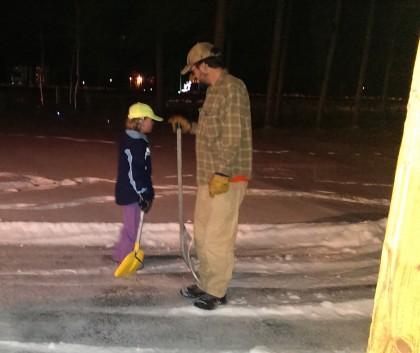
Jon and Ruth clear our drive before the moving van comes
Kate rapidly found a quilting group, the Bailey Patchworkers, and began meeting with them monthly. Out of that group came an invitation to a smaller group of needle workers who also meet monthly. I didn’t find that kind of local connection until a few months ago when we both started attending Congregation Beth Evergreen. Since then, I’ve also found Organizing for Action-Conifer. We’re both gradually becoming part of our community here in the mountains; actually, communities, because we have as much affiliation with Evergreen, perhaps more, than we do with Conifer.
It’s been a medically eventful two years for me with prostate cancer in 2015 and the total knee in 2016. Kate’s rheumatoid arthritis led to hand/wrist surgery over a year ago and she continues to have degenerative disc disease related pain. Combined with the divorce, which began in earnest in May of 2016 and continues as Jon still lives with us, it means we’ve been very inwardly and family focused the whole time so far. We both hope this year gives us a break on the medical front and that Jon finds a new home for himself, Ruth and Gabe.
fire mitigation, 2015. Just before the solar panels were installed.
Every once in awhile, we say to each other: I’m glad we moved here. And we are. The mountains teach us, every day, what it means to be mountains and what it means to live among them from snowy weather to elk and mule deer to rushing spring streams to less available oxygen. We’re very glad we’ve been here to support Jon and the grandkids. Those two reasons for the move have both manifested themselves in positive ways.
We’ve begun our third year on Shadow Mountain. Can’t wait to see what happens next.
Kate and I supplied bagels, schmear and fruit for the bagel table at Beth Evergreen yesterday. The bagel table is a casual shabbat service that includes the prayer book and the torah reading. Yesterday the parsha was va-er, Exodus 6:2-9:26, for the most part the story of the plagues sent by God on Egypt.
Rabbi Jamie said that in one instance the verb usually translated as go, as in Go to Pharaoh, is actually come. The meaning shifts a good deal with this understanding. Come to Pharaoh implies, according to Jamie, that God will be acting through Pharaoh. This falls under the difficult to understand category for me.
Kate and I talked about this idea as we drove up Brook Forest Drive. After some conversation, we decided that if you pull back, look from a historical view, then the actions of Pharaoh do work as part of God’s efforts on behalf of the Jewish slaves. His hardened heart provides the impetus, eventually, for the Exodus.
We then turned to our contemporary Pharaoh, the Trump. Could God (whatever you want to insert into this metaphysical placeholder) speak to us through the Trump? Jamie’s point was that we have to see the potential for God to speak us especially through those things or persons that we fear or despise. I suppose. Let’s try here.
Pulling back, taking the historical view, what possible liberating impulse could come from Trump’s presidency? (I take liberating impulse to equal God.) It’s true that Trump’s election highlighted the plight of the white working class, those with no more than a high school education. And, it may be, policies to address their concerns will lift all of the working class, high school educated folks. That would be an astonishing and welcome outcome, at least to me.
Too, we might consider the orders to build the wall, block Muslim refugees from certain countries, repeal the ACA, gut environmental regulations as a hardening of the heart, a so-obvious step away from justice and fairness, a big step away from a sustainable future for humanity on this planet, that the reaction to them will part the climate denying sea and create the political will for single payer health care, a return to Ellis Island immigrant welcoming that so many of us yearn for. Maybe. I suppose it could happen that way. May it be so.
As you can tell though, I’m skeptical. But, if it can be, I’ll be the first in line to admit my skepticism unwarranted.
Something’s happening here. I attended a meeting last night of Organizing for Action-Conifer. This group has gone from 20 to 180 in four weeks and that in the rural mountains of southwestern Jefferson and eastern Park County. Resist was a big word for the night. Many of the women had on their pussy hats from either the Washington March, five women, or the Denver March, most of the rest with a few men.
We broke up to form issue working groups: ACA repeal, women’s health, immigration, climate change, marginalized groups, Jefferson County issues, Park County issues and redistricting/midterm elections. Though climate change is very important to me, I sat with the Jefferson County folks. Why? Because I believe the Republicans, especially the Tea Party and the Koch brothers, stole several steps on progressives by focusing on local and state elections. This move, very successful, allowed them to control state legislatures and often governorships, which in turn gave them power over redistricting.
The whole moment gave me a boost although my days of late night political strategy sessions are past. By 8:30 p.m. I’d begun to yawn, feel heavy since I’m usually in bed by that time. (and up at 4:30 a.m. to milk the cows. well, no. to feed the dogs) These kind of meeting times are necessary though since most folks work during the day.
So I’ve found some allies who live nearby. We’re already making phone calls, writing letters, visiting legislators at the state and federal levels, marching, planning for a sustainable group and getting focused on issues. I’m still waiting to see what Beth Evergreen creates. Something, I hope; but if not, OFA-Conifer is already at work.
 Don’t know why it took me so long, but I know how to make America great again. It will not require red baseball hats or xenophobic bluster. No, it only requires listening to the ideas of a Passionate priest, Thomas Berry. Berry wrote a small book, The Great Work. It influenced a turn in my political activity from economic justice to environmental concerns.
 The phrase, the Great Work, comes from medieval alchemy. The primary, original material of the universe, the prima materia, in the alchemist’s lab can create the philosopher’s stone. The philosopher’s stone could turn base metals into gold or silver and extend the alchemist’s life.
 Make no mistake. This time is the direct result of Democrats and liberals ignoring fundamental politics, the politics of financial well-being for those not in the 1%. The shift away from these fundamentals was done in a good cause, this change in focus away from the old union, working persons emphasis of the Democratic party of my youth. Here’s an excellent article that explains how the shift happened and why it’s been so problematic, while also accomplishing a lot of good things along the way: