Spring New (Rushing Waters) Moon
A very interesting lesson in the feeding habits of the largest animal on earth.
Spring New (Rushing Waters) Moon
A very interesting lesson in the feeding habits of the largest animal on earth.
Spring New (Rushing Waters) Moon
 Today I’m making chicken noodle soup and Kate’s making Vietnamese pho. We’ll serve this at a Beth Evergreen leadership dinner for Rabbi David Jaffe, author of Changing the World from the Inside Out, a Jewish Approach to Social Change. Along with our friend Marilyn Saltzman, chair of the adult education committee, who is making a vegetarian squash soup, we’ll provide the soups for a soup and salad meal. I really like this low key involvement. It feels manageable.
Although. I am hoping that Rabbi Jaffe’s time here at Beth Evergreen, tomorrow through Saturday as a visiting scholar, will spur the creation of an activist group focused on some form of response to the Trump/oligarch era. In that instance I’m willing to move into a more upfront role, though I would prefer to remain a follower.
Then, there’s the Sierra Club. I wrote here about my excitement with Organizing for Action, Conifer. That was back in January, I think. Lots of people, lots of energy. Good analysis. I thought, wow. Here’s my group. Then, I never heard from them again, my e-mails went unanswered. Weird, but true. Weird and disqualifying for a group that’s organizing political work.
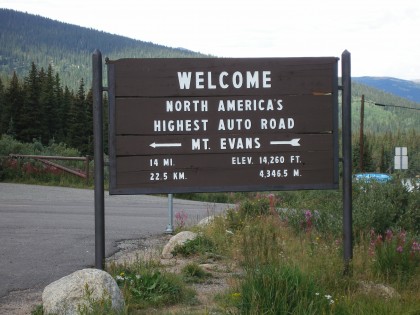 So I renewed my effort to connect with the Mt. Evans’ local group of the Rocky Mountain Chapter of the Sierra Club. Colorado seems to work more through these regional clusters than as a whole. There are nine of them, covering the entire state. The Mt. Evans’ group includes our part of Jefferson County, Clear Creek County and a northern portion of Park County. It’s titular feature, Mt. Evans, is a fourteener (over fourteen thousand feet high) which has the highest paved road in North America leading to its summit. According to locals here it’s also the weathermaker for our part of Conifer.
I finally made it to a meeting a couple of weeks ago. When I came back, Kate said, “You seem energized.” I did. And, I hadn’t noticed. Something about that small group plugged me back into my reigning political passion of the last six or seven years: climate change. Oh, yeah. With OFA I’d tried to head back toward economic justice, my long standing motivation for political work, dating back to the UAW influences I picked up as a teenager in Alexandria. Guess the universe understood me better than I understood myself. Not much of a surprise there.

My mind began ticking over, running through organizing scenarios, figuring out how we could (note the we) raise the visibility of the Mt. Evans group, gain more members, influence local policy. This is my brain on politics. I might be willing to play a more upfront role here, too, though I want to explore other ways of being helpful first.
Anyhow, between these two, I’m sure I’ll get my political mojo working in some way. And that feels good. Want some soup?
Spring New (Rushing Waters) Moon
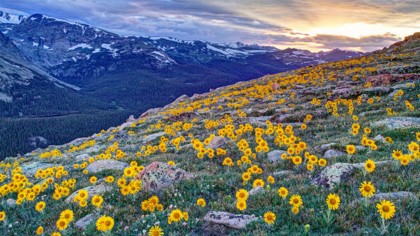
Spring, within 6 days of Beltane. Yesterday. Thunder snow. Took Gertie by surprise. Her eyes flicked from side to side, then she moved under my computer while I worked. And stayed there until we went downstairs. The solar panels have a fluffy white cover and some 16″ of new snow is predicted for the weekend. A poster on a local website said spring up here doesn’t come until Mother’s Day is past and the aspens have leafed out. Mid-to-late May. Seasonal definitions get a workout here in the mountains.
Spring New (Rushing Waters) Moon
Friend Bill Schmidt knows me well. A while back he noted I’d not yet written anything about tea while here in Colorado. He was right. Two or three years before the move out here I’d somehow gotten to making tea the Chinese way, gong fu cha. This was after years of tea from tea bags and the occasional loose tea steeped in tea infusers.
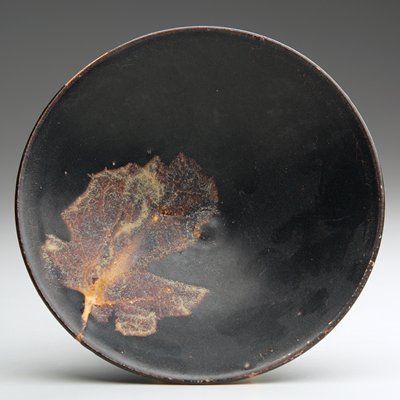 The impetus may have been my favorite object in the entire collection of the Minneapolis Institute of Art, a Song dynasty tea bowl. I don’t recall now.
Gong fu cha involves various implements and techniques that differ significantly from British/American tea preparation and drinking, but also from the Japanese chanoyu, which is a direct descendant of gong fu cha.
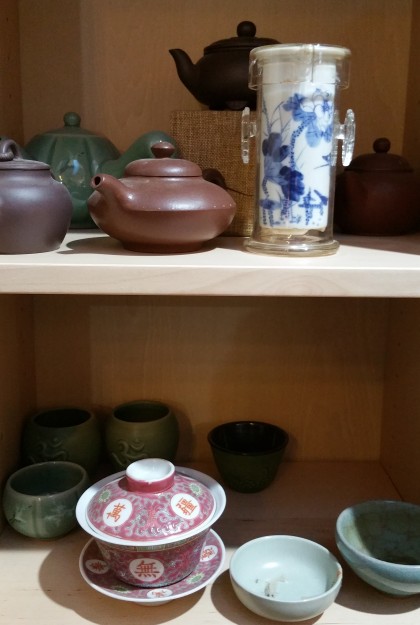 Gong fu cha inspired visiting Japanese monks to introduce tea to their Buddhist compatriots as a way of staying awake during long sessions of meditation. The Japanese tea ceremony grew out of this cultural exchange beginning in the 12th century.
Over a period of years I acquired several yixing teapots, many different teabowls (including one with a leaf embedded), tea scoops and picks for tightly compressed chunks of pu’er tea, a bamboo tea tray and, of course, several varieties of tea.
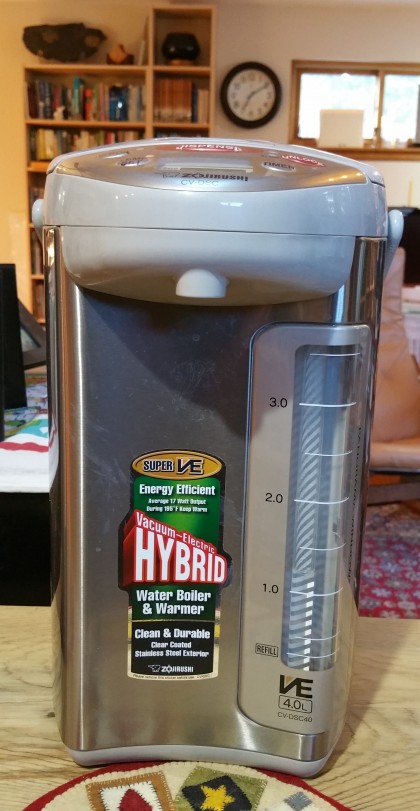
The Zojirushi is my favorite tea appliance. The Zojirushi, a Japanese model, boils water to a particular temperature and has a large reservoir so water at the right temperature is always available. Water temperature, the teapot and the quality of the tea itself are the critical variables in gong fu cha.
I considered making tea in the loft a final flourish to the work on it, so I waited until everything else was finished: book cases, art table, things put in their places. Why? I don’t know. Gong fu cha became, in my mind, a symbol that this space was ready for serious work.
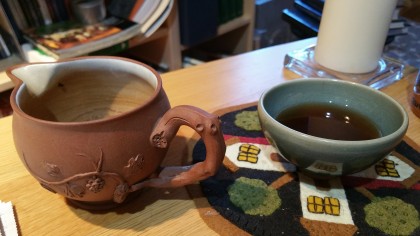 Right now I’m drinking Master Han’s loose leaf pu’er from 2000. Very smooth and smoky. I guess that means I’m getting serious about the work.
Bill knew me well. Now I’m truly here. Yixing pot in hand.
Spring New (Rushing Waters) Moon
Snow and more snow in the forecast. All moisture, good. Good sky, good sky.
The divorce, month 11. The public side of the Jon/Jen divorce started last May. Of course, they’d been getting there for some time before that. Jon is still living with us, still commuting from Shadow Mountain to Aurora, all the way across the Denver metro. The grandkids still come up three weekends a month. Jon and Jen are in the post-final orders time, a time when new norms have to be developed between them. I’d like to say it’s going well, but in fact it’s rocky. From both sides.
The whole matter will change significantly when Jon buys a new home. He’ll move out of here, his stuff will leave our garage. The custody arrangement will change to 50/50 so he will have more parental responsibilities, but also more parental influence on Ruth and Gabe.
Kate and I are ready for this new phase to begin.
Spring New (Rushing Waters) Moon
Spring Passover Moon

Spring Passover Moon

Spring Passover Moon

In a long ago TV program, the name of which I can’t remember, a character said of his Porsche, “It’s my carapace.” Yes. The vehicle we choose is a statement about us, carmakers learned this from the carriage makers. Kate and I drive a Rav4. It’s functional, unexciting, and a mostly serviceable way of moving from point A to point B. We bought it in a hurry when our Tundra had a fatal seizure not long after I’d given the Celica to charity.
But we’ve added a bit to it. First, there’s that damage to the front end, unrepaired. Long unrepaired now, maybe 2 years. That’s a statement. We also have two stickers on the back: Our House Runs On Clean Energy and Fin Del Mundo: Ushuaia. During the presidential campaign, we also had a Bernie Sanders sign. There is a small sticker on the side window for the planetarium in Boulder. Gertie and Rigel ride with us from time to time. Another statement.
 I mention the Rav4 and the Porsche first because these thoughts often occur to me while I’m driving. Vanity license plates. Fancy wheels. Political bumper stickers. Coexist. Rainbow pride. If you’re going to ride my ass, at least pull my hair. Keep honking I’m reloading. Flagpoles on the back of the pickup: the red white and blue on one side, the yellow, Live Free or Die flag on the other. Gun racks. Lowriders. Bentleys and Priuses. The occasional Maserati or Ferrari. Maybe you’re on a motorcycle wearing colors. Maybe you’re pulling a boat, or a camper, or a horse trailer.
As a culture we have chosen our vehicles as a prominent way to signal to others who we are, or who we would like to be. I read an article that said the political leanings of a particular area could be sussed out by the number of pickup trucks on the road, the more pickups the redder the politics. I’m sure you could find a similar metric by counting Cadillacs or Hummers or expensive sports cars.
I used to have a ponytail and I’ve had a beard almost all of my adult life. Look at a woman’s nails, at earrings, necklaces, bracelets. All semiotics.
 At home. Even the dogs with whom we live. Semiotics. Furniture. Art. Books. Rugs and window treatments. Semiotics. Both to others, but also, and often more importantly, to ourselves. Reminders of who we are. Or aspirational signals about who we want to become. Or, false flags, representing how we wish others to see us. The solar panels on our roof. The well maintained exterior of our home. Even the stumps of the trees cut down for fire mitigation. All messages to the world.
We are opaque. Who we are, what we mean in the world, is not evident from our bodies. We want to know, need to know, what others are like, but we’re very poor judges. That’s why stereotyping exists. It attempts to add semiotics to skin color or body shape. Because we want some advance clue as to the nature of the other. Are they are a threat? Are they a potential mate? Might we agree with them on something important? Could they be trusted?
 We all know this, at least at a subconscious level, so we offer clues. Those Grateful Dead Dancing Bears. The menorah lit in the window. The stylized fish. The stylized fish with legs and Darwin in the middle. A Bronco’s sticker. A Viking’s sticker. A lacrosse stick. Somehow we feel these things reveal a portion of who we are. Make us less opaque, perhaps a bit more transparent.
As a long ago student of anthropology, these kind of things fascinate me. I offer no conclusions, other than what they reveal about our essential opacity and our desire to be known in spite of it. The wide range of these semiotics are perhaps more necessary in a diverse nation with no tribal traditions, no single ethnic heritage, no long history as, say, Franks or Germans or Spaniards.
Spring Passover Moon
I may have found a way back into the art world, one I can sustain even from here on Shadow Mountain. A couple of weeks ago I decided to add links to several prominent museums to my bookmark bar: the MIA of course, the Chicago Art Institute, the Met, the Vatican Museum, the Uffizi, the Asian Art museum in San Francisco, the Getty Open Content site and the Google Cultural Institute. I’ll probably add more.
This started as an effort to collect places from which I could draw interesting images for Ancientrails. Many of these museums have made their collection’s images or significant portions of them available as open content. As far as I know, the Rijksmuseum in the Netherlands was the first to do this thoroughly. Every image on this museum’s website can be downloaded, used in any way. This even includes uses like those of Richard Prince, the well known appropriater of other folks’ work to create his own.
You may recall that I got myself in a bit of a twist over just this issue last year, so I’ve been eager to find image sources that won’t send me threatening letters from their lawyers. This growing movement among museums seemed like a solution. What better images could I find than great art?
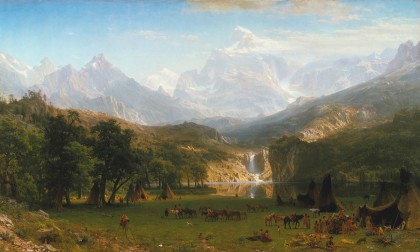
Then, while poking around on these various websites, I clicked on the Google Cultural Institute. On its home page it has various teasers to get a viewer to go deeper. One of them up at the time I visited was a collection of works on mountains, some 4,000 +. Aha. Mountains. In art. I live in the mountains. There could be something here.
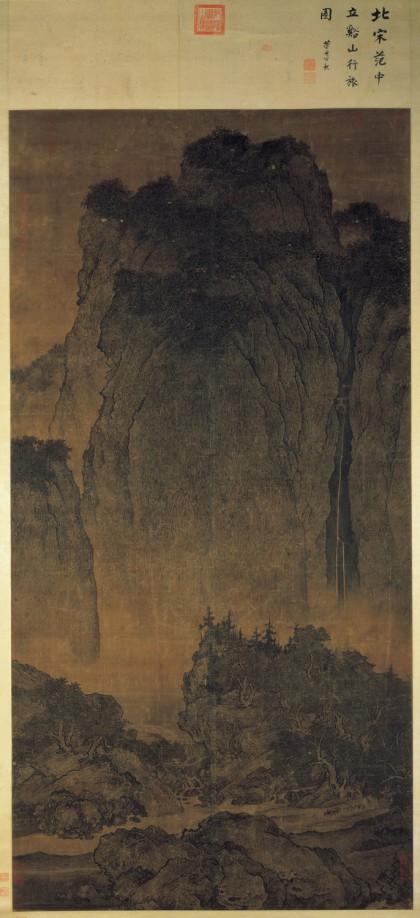
Yes, it occurred to me, I could investigate art focused on mountains. Hokusai’s “Views of Mt. Fuji.” Fan Kuan’s “Travelers Among Mountains and Streams.” Bierstadt’s views of the Rockies. And so many more. This could enrich my experience of my home terrain and provide a vein of exploration, a way to study art again with a purpose. Not to mention that I flirted briefly with the idea of becoming the Mountain Docent. This idea could add a double entendre to mountain docent.
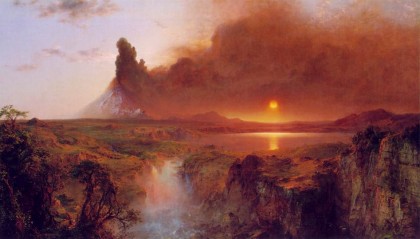
We’ll see if the idea sticks, but right now I’m excited about it. It connects well with the notion of becoming native to this place, too, and could serve as a resource for reimagining faith.
As I turned the idea around in my mind, it struck me that I have an intimate knowledge of another form of landscape, too: agriculture and horticulture. So, I may expand this project to include images of farming, of fields, of gardens, of seasonal change, the experiences of which led me to immerse myself in the idea of the Great Wheel.
Not sure where this will take me, but right now I’m pretty excited about it.