Beltane Beltane Moon
Tomorrow the biopsy. I feel fine, relaxed. Except. For those 12 tiny needles which will get their section’s worth of cells to analyze.
Just had a nice meal out, now for a quiet evening. Then…

Beltane Beltane Moon
Tomorrow the biopsy. I feel fine, relaxed. Except. For those 12 tiny needles which will get their section’s worth of cells to analyze.
Just had a nice meal out, now for a quiet evening. Then…
Beltane Beltane Moon
Beltane Beltane Moon
Kate and I love our new home on Shadow Mountain. We both find Colorado, at least for now, like being on permanent vacation. I suppose at some point that will pass, but there are so many place to explore quite close to Conifer, like Park County and South Park. Then, after them there are New Mexico, Utah and Wyoming. Each of these states I’ve seen a bit, but not in any real depth.
That family feeling, of being a real and needed part of a small human community, makes me feel good. Kate and I may offer Ruth 3 day to two week summer camps. In those we can give Jon and Jen a break from day to day parenting. It will also give us a chance to spend time with Ruth, teaching her what we each know. Kate will probably focus on sewing, cooking, other hand crafts, physics and chemistry. I’ll probably focus on native plant identification, hiking, exploring nearby spots of Western, Indian, geological or historical significance. I can also throw in literature, Latin and writing.
Gabe’s visits, due to his hemophilia, will have to be shorter. We have one idea right now, a visit to MacNation, a restaurant that serves only macaroni (his favorite food), followed a trip to the Foothills Animal Shelter. He loves animals.
Colorado’s music and theater scene has also surprised us in a positive way. The quality of the smaller theaters here is high and jazz, if not classical music, is strong.
We both love Minnesota, too, but Colorado is now our home.
Beltane Beltane Moon
Geologist Tom Zeiner from the Colorado Native Plant class calls it the “solar snowshovel.” Without spending a dime or even removing the snowblower from the garage, the weekend’s snow has melted and transpired from the driveway. This will continue to amaze me for some time. What a treat.
The forecast has rain in all of the next ten days save 2. That means more water going downhill added to the already high water levels. But, no snow.
Beltane Beltane Moon
The hits just keep on comin’. Now, in addition to the biopsy this Thursday I have lowering oxygen saturation. This is not good. It can and does destroy brain cells and my brain is my favorite organ. So, I have an appointment with Lisa Gidday sometime in the next three weeks. Geez. This all converges with long standing, but well-managed issues (right now) like high blood pressure, cholesterol levels too high or too low, stage 3 kidney disease and others like left ventricular hypertrophy.
Now, I choose to see this all in a positive light. I have some chronic conditions that are common to many people and the dietary and pharmaceutical solutions to them have been successful so far. The kidney disease and left ventricular hypertrophy (LVH) are not good, but they both seem stable.
Unless. The LVH ends up reinforcing the lowering oxygen saturation. That’s for the follow-up to my appointment with Lisa.
My sense of myself, in spite of all this, is that I’m healthy and strong. Doesn’t feel like denial. I know about each item here and its implications. My choice is to take positive and aggressive action where I can and to accept the limitations or ultimate consequences in those instance where no action can be taken.
Two different streams of thought have lead me to a calm place. The first, experienced immediately after the beginning of the prostate journey, involved facing my actual mortality. We maintain throughout most of our life a subtle innocence about the probability and even the possibility of our own death. In my opinion this attitude is the reverse of unrealistic. In fact it is protective of our need to get on with living in the face of an inevitability about which we can do nothing.
The prostate findings lifted that protective innocence from me. There was death peeking over my shoulder, the agency of its coming perhaps revealed. This shook me. Hard. Finding my way into it, not running away, took the better part of a week and a half. Then, I realized that, if not this, something. If not now, sometime. With that frame and the palliative effect of taking the actions I could take, I became peaceful again.
The second thought involves living until I die. This has always been intention, not to run away from life or problems but to embrace them. Make choices. Take action. If I see a problem that affects me deeply, my tendency is to move toward it, see if I can do something. The realization here is that no disease, no condition can stop me from living until I die. I will, in other words, continue doing those things that matter to me. As I have done. Death cannot defeat my life, just end it.
So far these two thoughts: something, sometime will kill me and death cannot defeat my life, have helped me see that I am in no different situation now that at any other time in my life. Nor will I ever be.
Beltane Beltane Moon
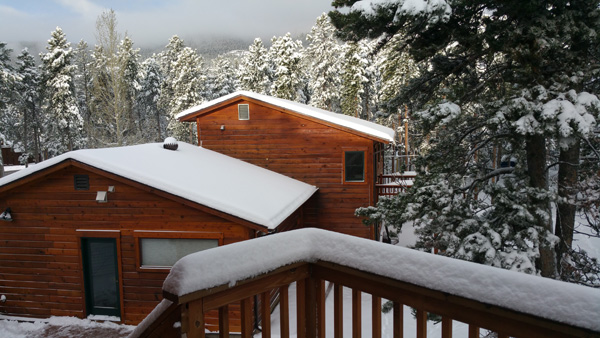 Snow began coming down in parallel streaks about 2 p.m. yesterday. It built up quickly, then slacked off. Overnight more snow fell. This is snow with a 3/1-7/1 water ratio so it’s wet, heavy. I estimate 4-6 inches which, with a different water ratio, would have been 12-18 inches.
10 days after Beltane, the beginning of summer in Celtic lands, we have snow laden ponderosa boughs, a driveway covered in a thick blanket, roofs and yard all white.
This brings us to flooding. According to weather5280, the front range has absorbed all the water it can. The rest now gallops downhill like a herd of wild mustangs. Up where we are the mountain streams are thick with fast moving water. It has spread beyond stream banks and minor flooding has occurred. But we’re the feeder system, our streams smaller, more shallow. It’s when Cub Creek hits Maxwell Creek and the two become one heading for Evergreen that the real danger happens.
Down mountain the streams collect the Cub Creeks, the Maxwell Creeks, the Shadow Brooks to create fast moving, not to be restrained small rivers. A couple of years ago this created serious flooding in Boulder, Golden, Manitou Springs, Denver all distinguished by their positions along the beginning of the high plains.
(This one from May 9th.)
All the water from the Eastern Slopes, by virtue of gravity’s strong pull, has a passionate desire to get lower, reduce the tractor beam energy created by lower altitudes. And it will see its desire met. No matter what lies in its way.
This is nature at its wildest. Floods are a force like hurricanes, tornadoes, avalanches, wildfire. We humans build our houses, pave roads, throw up restaurants, grocery stores and filling stations and often wild nature lets us have them for a time. But. Ask the residents of New Orleans after Katrina, of New York City after Sandy, the nearby residents of Waldo Canyon who saw the 2012 Waldo Canyon fire ravage their homes, the merchants in Manitou Springs who had two feet of mud in their basements, folks living in Moore, Oklahoma after the F-5 tornado did a Dorothy on their homes. Ask them whether human artifice seems so permanent.
Now there is significantly more water up here in the mountains. It came over the last week in the form of rain and today, for those of us above 8,000 feet, as snow. The rain is already on its way to the Denver metroplex. The snow may, thankfully, delay some of the water by plugging up streams and releasing its own moisture gradually over the next days.
Beltane Beltane Moon
A few photographs from my Colorado Native Plants class yesterday.


Beltane Beltane Moon
Up early today. Too early. 3:00 am. Sigh. Still, got blogging done, e-mails sent and my high intensity workout in before leaving for my first Native Plant Master class in Morrison’s Mt. Falcon Park.
On the way I got gas at Conoco rather than the Loaf and Jug (Rumi, Omar?). I did that because I wanted a breakfast burrito from the best breakfast place in town according to reviews. But when I pulled up, the best breakfast place in town was gone. Not there. Vanished. Disoriented me for a bit, even though it was a food wagon. Not sure where it went, but I found it disconcerting to have an entire business, one I’d seen frequently since we moved here, disappear. Not to mention that I wanted breakfast and now no longer had time to stop elsewhere.
The dewpoint/temperature convergence coupled with lots of moisture in the air gave the mountains long tendrils of fog slipping through the pines and white crowns like so many of my friends. Atypical. The effect is very schwarzwald. This could be Bavaria.
In Morrison I turned off 285 North, which heads into Denver, and onto Colorado 8. It goes into Morrison, passing by the Fort, the adobe restaurant I mentioned some time back. Just a mile or two past the turnoff for Mt. Falcon Park where I was headed is the well known Red Rocks Amphitheater.
These Coloradans are a hearty group. Every one came with a backpack, obviously used before, rain gear, hiking boots and some had water repellent, zippered pants over their regular pants. One young woman, recently moved here from North Carolina, had bananas, clementines and granola bars stuck in several mesh pockets.
I say hearty because we each dutifully consulted our Colorado Flora field guide, our plant identification list and the Native Plant Master guide for Mt. Falcon Park (these last two distributed this morning as course material) in the constant and, at times hard, rain. It rained as we investigated a pretty five-petaled plant whose flowers change color after pollination. It rained while we investigated the shrub with trumpet shaped flowers that stood next to it. It poured down rain as we used Colorado Flora to narrow down the two species of cypress that stood next to each other.
Further along the trail, yes, it rained, we found a vetch, one of two species of the pea family we looked at. Vetch takes up selenium from the soil and concentrates the mineral in its stalk and leaves. Horses and cows get the blind staggers from the selenium so, though a native, it’s an unwelcome plant in pastures. Plants that take up soil minerals and concentrate them in their stalk and leaves have created a new discipline, geo-botany. Geo-botany uses plant analysis to find places where toxic minerals are present in the soil.
Did I mention it rained? All the time, from moderately hard to pelting. Not a usual Colorado problem. This is an anomalous May, though May is usually wet. So I’m told.
We had a recently retired geologist in our class. We stopped among shrubs and short trees for a snack. He noted that was a geologically important spot. The Fountain formation, red sandstone and crumbly red shale, the same formation that makes up the Red Rock amphitheater, gave way to the granitic rock of the true Rocky Mountains only 5 or 6 feet away. “This means we go,” Tom said, “from 250 million year old sandstone to billion year old rock.” To the east the sandstone, remnant of a much earlier mountain range, covers the same billion year old rock exposed during the Laramide orogeny, the mountain building episode that formed the Rockies.
Since Kate had a pacemaker appointment, I had to leave early. I was not unhappy though I look forward to the next class. May it be dry. Of course, then it might be hot.
Beltane Beltane Moon
Hmmm.
“Snow for the northern and central mountains is looking like a sure-bet, and with that the National Weather Service has issued a Winter Storm Watch which goes into effect Saturday afternoon and continues through Saturday night. Heavy snow at elevations >8,500 feet for the northern and central mountains will add up to 10 to 20″ by Sunday morning. If your plans take you into the mountains Saturday afternoon, please plan for winter driving conditions.” weather5280
Beltane Beltane Moon
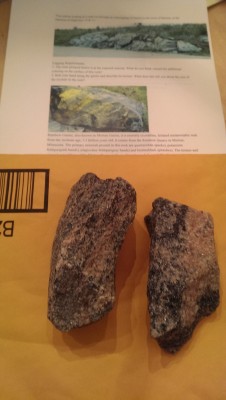 There’s history, pre-history, then there’s a really, really long time ago. Friend Tom Crane sent these two chunks of Morton gneiss.* I think he wanted me to have a marker stone for the oldest rock in the U.S. Thanks, Tom. They’ve gone on the rock wall before the Ely greenstone** we collected last week.
We visited the Ely greenstone outflow in Ely together last Sunday after the Woolly retreat.
The ability to touch this hardened time is a remarkable opportunity. The past is always with us.
Our body is the Morton gneiss of our deep past. It carries in itself memories of formative events we have long forgotten. There is a debate about the continuity of the self, one side seeing it as a narrative stitched together to explain our existence, but non-essential. The other side, my side, sees the self as a current manifestation of all the moments that have shaped us, plus an ineffable emergent quality that makes us more than the sum of our parts.
The dense, hard bones of mother earth support the efflorescence that is the biosphere. This living, breathing outer layer is, likewise, an emergent property. It is not, said another way, predictable from the original constituent elements of planet formation. Thus, the entirety of earth’s vital children evidence the earth’s own selfhood.
This is not the gaia hypothesis which sees the earth as an interdependent system of systems. It is, rather, an attempt to position the evolution of our planet from Hadean times, the earliest period of earth’s formation, as a mystery, yet one with known parts.
The mystery is that these parts formed at all from the detritus of the big bang. The mystery only deepens as evolution proceeds and creates a wanderer that follows a repetitive path. As geologic changes shaped the early continents and reshaped them, another, profoundly deeper mystery occurred. Somehow, life. From inert gneiss and greenstone and all the other truly ancient bones, came a quickening in the vast waters that covered most of the surface.
In my opinion the revealed self of this particular cosmic location manifests in this most peculiar change, one in which the earth begins to move, root, swim, run, think. I am not trying to anthropomorphize the earth. It doesn’t need it. It is as it has become, a thing sui generis, unique in our solar system, maybe in our galaxy. Who knows?
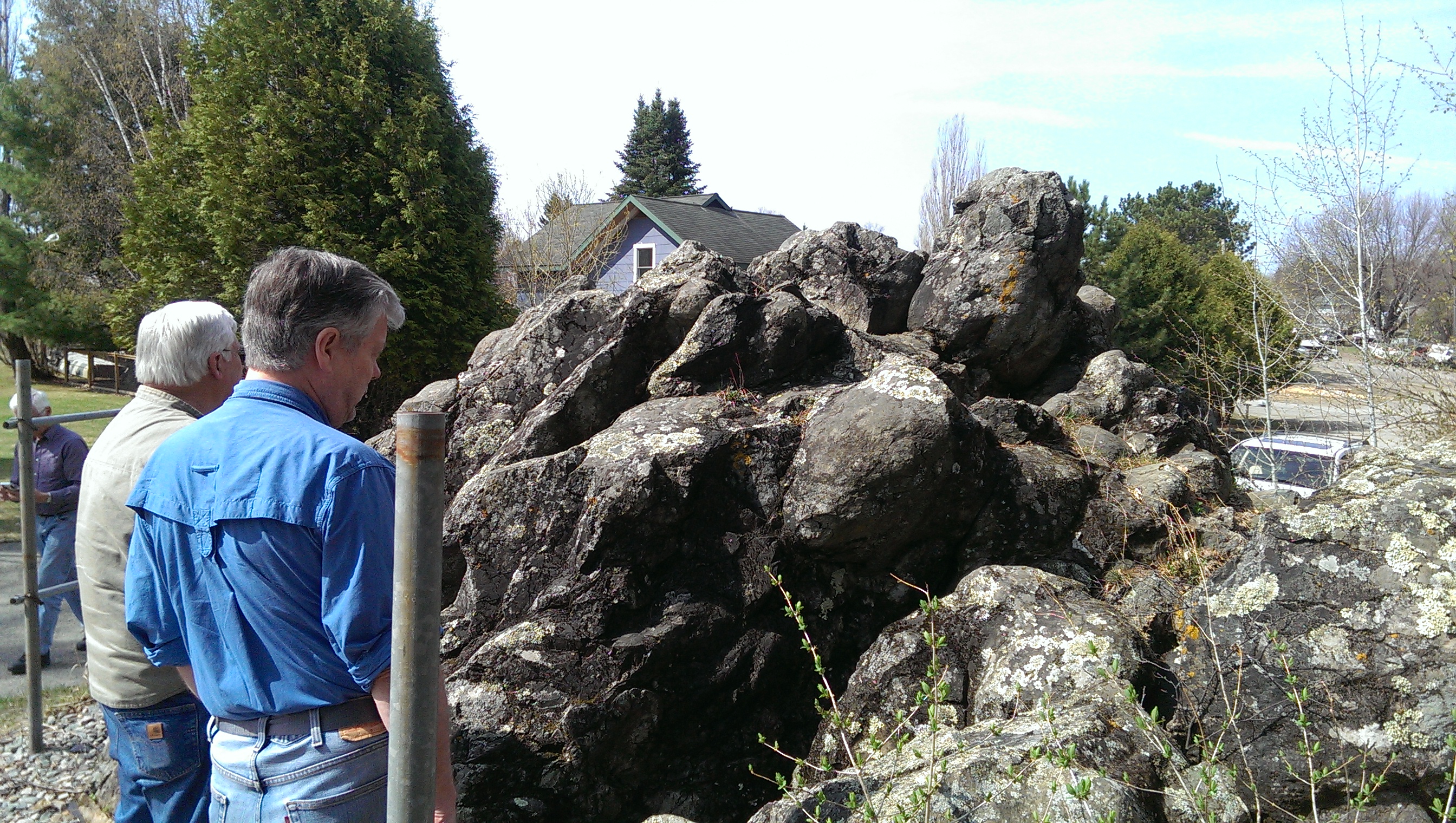
*”Archean crystalline basement rocks are exposed at several places along the Minnesota River valley in south-central Minnesota. These rocks are mostly gneisses of various compositions along with other igneous and metamorphic rocks.
 |
Left: exposure of mafic gneiss at Granite Falls beside the Minnesota River. Right: closeup view of pegmatite vein within the gneiss at Granite Falls. |  |
Among these ancient rocks, the Morton and Montevideo gneisses are the oldest whole-rock continental crust in the United States. Many attempts to date these rocks using various radiometric techniques have yielded an age ~3.5 billion years old (Goldich, Hedge and Stern 1970; Bickford Wooden and Bauer 2009).” Morton gneiss
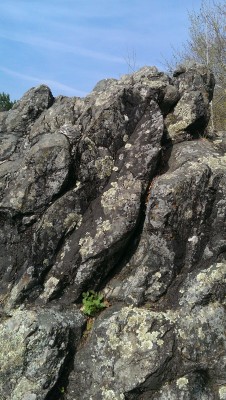
**”The lakes of the BWCA were carved from Precambrian bedrock of the Canadian Shield by advances of ice sheets during a succession of ice ages during the past two million years. Many varieties of this ancient bedrock are exposed, including granite, basalt, greenstone, gneiss, as well as metamorphic rocks derived from Precambrian volcanic and sedimentary rocks. Greenstone located near Ely, Minnesota is up to 2.7 billion years old. The size and shape of most lakes in the BWCA are dictated by the bedrock, due to the ability of glacial ice to erode softer and weaker rocks more easily, creating depressions later filled with water.” canoetrip.com