
Fall Harvest Moon
 The country I used to know. It wasn’t perfect. Take MLK and the civil rights movement. Vietnam. Crushing, unnecessary poverty and the dismal, shameful access to health care. Coal and gas poisoning the atmosphere. The lives of women and girls. And, yes, so much else.
It wasn’t perfect, but it wasn’t sit at the stoplight, look at the car next to you and wonder if this asshole voted for Trump bad. It wasn’t mock the disabled, give aid and comfort to white supremacists bad. It wasn’t lock up democracy in a Republican’s only cabinet, then turn the Republicans into mean spirited and cruel operatives. It wasn’t grow the 1% at the expense of everyone else, grow the 1% at the expense of mother earth, grow the 1% at the expense of our allies. It wasn’t give aid and comfort to our enemies, to dictators and shun our friends.
No, this, this whatever we have now is worse, so much worse. I feel as if I woke up one morning, uncertain when, and found I’d moved to 1930’s Italy or Germany or Japan. As if the cultural fabric in which I lived and moved and had my being for 71 years had torn. In this case it revealed not an inept but kindly wizard, but a disturbing cabal of old white men, each one worse than Gollum, rubbing their own versions of the one ring and saying, my Precious, my Precious, my Precious.
 As I drive down the hill, then climb back up, I wonder if this is the way it was. Lives going on, wives in hospitals, trying to make sense of the unexpected, sudden calamities that visit us all but finding those calamities embedded in a greater one like Russian nesting dolls. Kate’s struggle a small instance of the larger one, a people beset by unforeseen tragedy. But, where do you take a country in extremis? Where are the emt’s for a sick nation?
This will sound strange, but I find Kate’s troubles, significant and important as they are to our family and friends, pale in comparison to the rot, yes, the evil, the poison in the veins of our body politic. These are not times of political disagreement, of debates over national debt or military preparedness or immigration policy, these are times with the flavor of a cold civil war.
I cannot describe to you how sad all this makes me. How disorienting I find these times. I don’t know what happens next, where we go from here. I hope the November elections shake the foundations of the Republic.
Too much. Kavanagh’s cowardly confirmation now seats two known sex offenders, criminals, on the highest court in our land, both with lifetime appointments. How can we trust our country? What does it mean to be an American now?


 Like Charlie H. in the Woollies, this person threatened to leave the group. It struck me that both used their own intransigence and subsequent reaction to it as a means of manipulating the group into reinforcing their willingness to include them. I feel extorted in those situations, like I have to simply roll over and say, oh, please stay. In Charlie’s case I would not have done it, had I been in the Twin Cities and able to face the daily consequences of defying him. In the mussar group instance I only held my hand up half way when asked if we wanted this person to remain in the group. I felt similarly manipulated, but did not feel my cohesion with the group quite strong enough to withstand outright defiance.
 OK. NYT article from an anonymous Trump administration official. Saying what we know about Trump, increasing logarithmically the force of Bob Woodward’s Fear, also making the news right now.
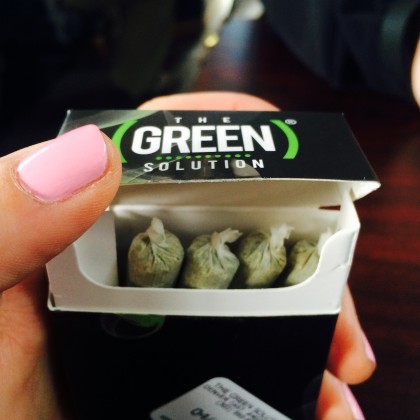 We tried a Colorado cure for Kate’s nausea symptoms. She toked up yesterday morning, lighting one of the pre-rolled Jilly Belly spliffs. She took four hits. Result: nausea subsided, heartburn began. And, she said, I feel spacy. Which she didn’t like. So she went back to bed anyhow. A work in progress. Next time she’ll try two tokes. If it does reduce the nausea, we will get her a bong and use ice in the water to cool down the smoke. I told her she was one toke over the line sweet Jesus; then added, well, maybe better, one toke over the line sweet Moses.
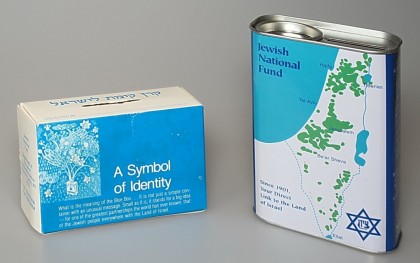 In the packet that he offered, Ariel quoted Rabbi Abraham Heschel, a great friend to Martin Luther King: “There is immense silent agony in the world, and the task of man is to be a voice for the plundered poor, to prevent the desecration of the soul and the violation of our dream of honesty.” And, “Morally speaking there is no limit to the concern one must feel for the sufferings of human beings, that indifference to evil is worse than evil itself, that in a free society, some are guilty while all are responsible.”
 After mussar Kate and I went with many members of the group to a place called Go, Paint in downtown Evergreen. It was the start of an interesting local expression of an international movement called
  Listening to some music on youtube while cleaning/rearranging. One clip leads to another. I’d started out on the Band’s “Long Black Veil” and youtube ratcheted me along to a guy named Blake Shelton. He’s a country guy, well known in areas where he’s well known, I gather. The song was, “Kiss My Country Ass.”
 Then it hit me. Much of country music is protest music. It’s the protest music of the blue collar worker, the southern working class, and the white supremacist (these are not conflatable categories though they may cross over.) You may have noticed this a long time ago, but I hadn’t.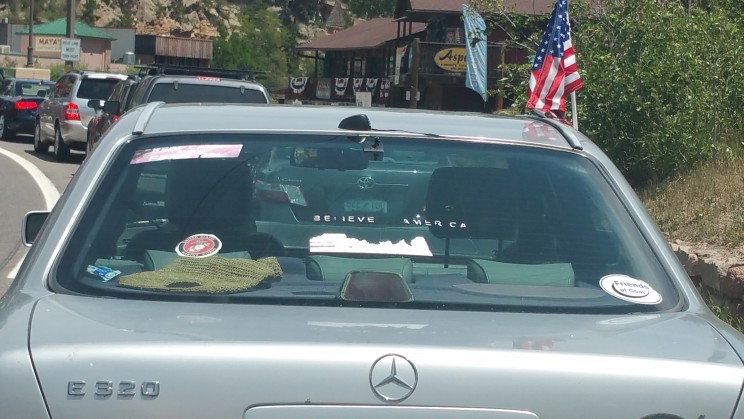


 Sad. Mad. Incredulous. Shocked. Mystified. Hurt.
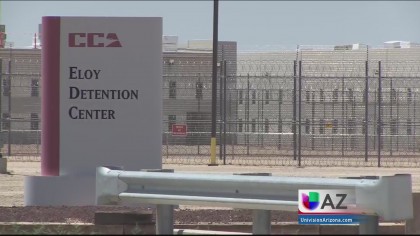
  Ms. Montoya became too emotional to talk. Several times. She answered question after question from this audience of maybe 75 people, all outraged, most wanting to do something. Kate stood up and asked what kind of medical care did these children receive? Ms. Montoya said no particular medical care was available. That means diabetes goes untreated. Other chronic conditions, too. Another asked what kind of education the kids were getting? Ms. Montoya said, “The kids speak Spanish; all the guards and caretakers speak English.”
 Part of the problem for legal projects like Florence and
  *Valentina Restrepo Montoya was born in Boston to Colombian-immigrant parents. She earned her J.D. from Berkeley Law, where she advocated on behalf of asylum seekers, latinx workers, latinx tenants, and indigent defendants in criminal cases. Valentina clerked for The Southern Center for Human Rights, where she investigated language access to adult and juvenile courts. After law school, she joined The Southern Poverty Law Center, dedicating herself to litigation against The Alabama Department of Corrections for providing constitutionally inadequate medical and mental health care to prisoners, and not complying with The Americans with Disabilities Act. Prior to joining The Florence Project, Valentina was an assistant public defender in Birmingham, Alabama. She enjoys playing soccer, reading The New Yorker, practicing intersectional feminism, and rooting for The New England Patriots.