Category Archives: Bees

Bee Diary: April 16, 2011

Spring                                                          Waxing Bee Hiving Moon

All day today at the Bell Museum on the UofM campus.  Advanced beekeeping.  I learned a number of new things that I’ll take to heart this year.  One is an experiment I plan to do with two colonies which will involve one hive box, then all honey supers after that.  The third colony I plan to treat in the usual way with building up the colony to three hive boxes with plenty of honey and then trying, again, to overwinter.

Other new wrinkles here and there, too.  Marla Spivak and Gary Reuter do a funny and informative dance, switching between hive management (Gary) and bee diseases and research (Marla).

I just got back and have had no nap, so I’m off to bed.  Later.

Week’s End

Spring                                                          Waxing Bee Hiving Moon

Kate and Annie (her sister) are off to Omaha, Kansas City and various quilt shops in between.  When asked what they do on the bus (she’s done this before), she said, “Talk.”  Me, “No quilt-road-tripsinging, no poker, no beer?”  Nope.

Brother Mark is here, decompressing from a tough six months, and inhaling American culture, “Something there, but being brought forward from far back in the mind.”  He’s not been back to the US in over 20 years.

Today is the first day I’ve had any lengthy time to myself this whole week.  Gonna spend it doing Latin.

The kale and chard starts have germinated; the tomatoes have yet to break the surface.  All this is under the lights.  I’ve not checked the beets, spinach and lettuce planted outside earlier in the week, but they should get started in the not too distant future.

Next weekend the bees should arrive, so there are bee related chores this week:  cleaning frames and hive boxes, moving everything to the orchard, checking the honey supers.  The smoker needs cleaning out, too, a lot of soot collects over the course of a season.  Tomorrow I have advanced bee keeping, open only to those who have kept bees at least a full season or two.

But, since this is Minnesota, first we may have to have some snow.

Bee Diary: April 12, 2011

Spring                                                   Waxing Bee Hiving Moon

Hobby Bee Keepers tonight.  Kate and I heard a presentation on Minnesota Grown, a very interesting initiative by the Minnesota Department of Agriculture that supports local food 400_garden_0084based businesses with marketing assistance.  A woman gave a presentation on cooking with honey.  How to make truffles.  Uh-oh.  They were really good.  Not a healthful food, but my were they tasty.

The hobby beekeepers have a farmer look, a rural feel, even though there are many urban and suburban beekeepers.  Guys with hat line tans, checked shirts and blue jeans; woman with sensible cloths and no make up.  Tonight I learned what to do with all the honey I have left over from the demise of my two colonies; use it four frames at a time to feed my new package bees.

The night was clear and warmish.  Today was busy, as was yesterday and as tomorrow and Thursday will be.  My energy is up and I’m having fun.  I’m glad we’ve had the warm weather and a chance to get into the garden.

About that land my sister, brother and I own in West Texas.  Probably not gonna be used for a housing development.  Forty acres of mesquite and sand, plus, natives assured me, quite a few rattlesnakes.  Taste like chicken I’m told.  A certain, lonely hermit part of me finds West Texas desirable because of its emptiness, its vast spaces and little civilization.  I loved Marfa and could imagine a winter retreat down there in Imperial that could serve as a base for outings to Great Bend, Marfa, Guadaleupe Mountains, Carlsbad Caverns.  Maybe.

Think I’ll send Mark down there to scout it out, maybe hire a surveyor.

West Texas

The 2010 Census confirmed what anyone passing through the scrublands of West Texas already knew: People are leaving, and no one is taking their place, even with oil at more than $100 a barrel. The people who remain often drive an hour or more to visit a doctor, buy a pair of jeans or see a movie.

So you might wonder why anyone is still there, in this place where natural beauty is defined by dry creek beds and scraggly mesquite, where public transit is a school bus and Starbucks is a punch line.

“The greatest sunsets. The stars are just right there. You hear the coyotes howling,” says Billy Burt Hopper, sheriff of Loving County, home to 82 people and the least-populated county in the United States.

Bee Diaries: April 9, 2011

Spring                                                                             Waxing Beehiving Moon

This morning:  an auto da fe, an act of faith, but as you history buff’s know, also a burning.  Acting on the word of Mcarthur Grant Genius, Marla Spivak, I burned my old hives and frames since I believe they had an infestation of American Foulbrood.  They were old and came from my first bee mentor, Mark, so it was time to cycle them out of our bee yard hive-burninganyhow.

It took me a while to get them going, I felt a little bit like Crankshaft, pouring on the starter fluid, but finally the heat got high enough to melt the wax and then the fire burned, smoky and jumping high, all that work melting into flames.  While they burned, I cleared plant matter out of the raised beds, detritus from last fall, readying them for planting tomorrow, I hope.

(not mine, but a bee keepers fire)

Purification by fire, burning out a disease organism that can stay in the brood cells for up to 50 years, a small flake filled with the virus, only waiting for a moment when it can awaken.  This stuff can spread from hive to hive so scorched earth is the best answer.  In addition, Marla recommends burning five year old frames and hive boxes just to be safe.

The comb melted and spurred the fire higher, small bee bodies dropping from the brood chambers and the sides of the frames to the bottom board.  It’s been awhile since I burned anything, but it did remind me of the old days in Alexandria, Indiana where we used to burn our trash in 50 gallon oil barrels.  We had to poke it and move the the stuff around to insure everything got consumed.

I’ll use the dead bees and the ash as a fertilizer for the raised beds, a whole cycle.

If you go down further in my postings, you’ll discover the posting I removed earlier are back.  My brother is now here in Andover, away from Thailand.  Apparently an angry employer can retain foreign nationals for unfinished work contracts and Mark had a bit over three weeks left on his.  Nothing happened, so he arrived safely around 12:45 today after the grueling 17 hours in the air from Bangkok.  We’ve talked, he’s sleeping off his jet lag now.  Both Kate and I are glad he’s here.

We Inch, Slowly, Toward Spring

Spring                                                                 Waxing Bee Hiving Moon

Kate comes home tonight.  Yeah!  I miss her when she’s gone. I’ll follow our usual procedure and pick her up at the Loon Cafe, conveniently located at the end of the light rail service 650-herb-spiralfrom the airport.  Makes the drive much shorter and I get a good meal in the bargain.
After the biting and the barking and the adrenaline I figured out a somewhat complicated solution to the Rigel/Sollie problem.  It involves making sure that one set of dogs is in their crate before admitting the others to the house.  This way nobody trespasses on anybody else’s territory.

It demands a careful watching of when Rigel and Vega are away hunting so I can let Sollie, Gertie and Kona inside.  Or, alternatively, when Rigel and Vega are on the deck and the others are out hunting.  A bit baroque I know but I have no more indentations in the leg.

(pics from April of last year)

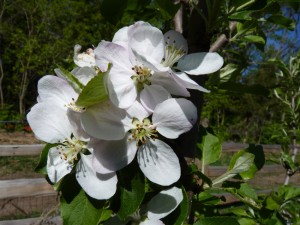
As the Bee Hiving moon goes from New to Full, our yard will lose its snow and we will have several species of flowers in bloom, a few vegetables in the ground and as it begins to wane we should have our new bees hived and happy in their new homes.  There are things that need to happen before this last, not the least moving the hives to the orchard, cleaning all the frames of propolis and burning the old hive boxes and frames I got from Mark, the bee mentor.650-apple-blossoms

Seeing the bulbs planted in the fall begin to emerge always heartens me because it reminds me of hours of labor spent in the cool air of late October or early November.  We won’t be here for that time next year, so probably no new bulbs this year.

In fact, I’m declaring finished to our orchard, garden, vegetable, bee expansions.  We’ll stick with no more than three hives, the raised beds and other beds we have in the vegetable garden, the trees and bushes we have in the orchard and the flower beds we have in place now.

We’ll always have to replace dead plants and put in new ones in their place.  We have to care for the fruit trees and bushes, plant vegetables and maintain the bee colonies so we’ll have to plenty to keep us occupied.  I just want to get good at the stuff we have and begin to slowly limit the work we do over the course of the year.

Breakthrough!

Spring Waxing Bee Hiving Moon

I have made several entries private and will explain that decision on Sunday. Stay tuned.

The snow has only a few strongholds left in our front yard though the back and the woods still has plenty. The garden behind our patio has daffodil stems through the 06-27-10_marigoldeyeviewearth, a bit yellow at the top, then light green, then a darker green. Soon there should be other bulbs breaking through including some I’d forgotten I planted in the orchard.
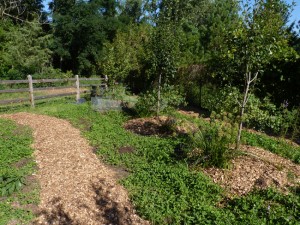
This is the transition week for our place, when the snow disappears and the greening begins. I’m excited to see the garden come to life. When the bees come, some time after April 23rd, it will feel like the whole gangs back together. I’m hopeful that the orchard will start producing this growing season. We’ll see.

I want to get some more woodchips down right away in the orchard, perhaps in the vegetable garden, too. 670_0300

It’s also time for serious clean up work in the back. I got distracted last fall and didn’t keep up with the maintenance as well as I could. Then, there’s all those tree branches split by the heavy first snowfall last November. So, plenty of outside work.

We ate the last of our potatoes just two weeks ago and still have garlic, yellow onions, honey, and canned vegetables from several years.  We couldn’t make it as pioneers but we’re doing well at supplementing our diet.  More.  We tune our lives to natural rhythms, especially in the growing season.

That original revelation to us that Emerson talks about is coming along out here in Andover.

Changing Seasons

Spring                                               New (Bee Hiving) Moon

We are now over three months away from the Winter Solstice.  The spring equinox has come and gone, yet our yard still has snow, maybe 5 0r six inches, more in spots where the snow plow moved our many snow falls to the side of the driveway.  In the orchard the snow has begun to melt around the apple, pear, cherry and plum trees.  The currants have no snow around them at all and the huchera is free of snow, too.  Those gooseberry plants I didn’t move last fall are still in the orchard, but their destination is the sunny slope of our 650-orchard-late-summer-2010_0175third garden tier.

I have a sizable number of trees with broken branches, many large ones.  They will have to be cut down and moved.  The chain saw!

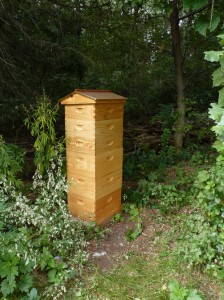
As soon as the soil becomes workable, I’ll get the cold weather crops in the ground, something I’ve not done so well in the last three years.  The bees will move into their new homes in the orchard where I hope the protection of the garage on their north/northwest side and the sunny aspect of the southern exposure will help them in the winter.  They will be closer to the house, which may prove to be a problem.  If so, they’ll have to go elsewhere next year.

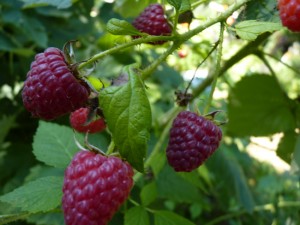
In the spring this man’s heart turns to the garden, the bees, the trees.  I’ve been preparing my body for spring, but I’m a bit 650-raspberries-late-summer-2010_0199further behind than I thought I’d be.  The resistance work has taken a while to work its way into my exercise cycle, but it’s there now.
Learning the language of plants, flowers and vegetables, is a life-long pursuit.  Another school year begins in just a few weeks.

Bee Diary March 26, 2011

Spring                                               Waning Bloodroot Moon

All three colonies are dead.  I rechecked them last weekend.  I have ordered three packages of bees, the larger 3 pounds boxes, that will arrive in early April, perhaps April 9th.  Hiving 500honey-extraction_0231the new packages takes place as soon as possible after I pick up the bees from Nature’s Nectary outside Stillwater.  They may wait a day, but not more.
I’m weighing whether to take the route of several beekeepers I know who buy new packages each season and harvest all the honey that’s made, rather than trying to overwinter the colonies.  If I do decide to go that route, we’ll have to sell the honey to recoup the costs, perhaps show a little profit.

There are arguments for and against this method.  Obviously it gives the bees only a season of a life, that’s a definite mark against it.  On the other hand, if colonies die anyhow, then there’s really no change except the certainty of their death.

This does allow harvesting the maximum from a colony’s first year, which would have added about 100 pounds of honey last year, or maybe 12 gallons to the five we collected.  On the other hand, it doesn’t allow for maximum production because an over-wintered colony produces more, since it already has its stores and will proceed to fill honey supers right away.

Another positive would be holding diseases down since they would have not have the overwintered, weakened condition that allows some diseases to take hold.

As I write this, I can see the argument for only one season of the bees.  Still not sure which say I’ll swing.

This will be the third season at Artemis Hives and I have a few new management ideas in addition to the one I’m considering above.  Instead  of a third hive box, I will use two honey supers instead.  This gives the same volume as a hive box, but in lighter by half units.  This will also make retrieving all the the honey easier if I decide to go with one season only for all 400_honey-extraction_0225the colonies.  I’m also going to check out better ways to have a bee proof environment in which to extract honey.  It was pretty bad last year.

In spite of the cold weather projected now through June according to Paul Douglas, we will hive the bees in early April and begin to plant cold weather crops as soon as the soil becomes friable.  Early April through early October is a major season here at Artemis Gardens and Hives.

At the end of it Kate and I will pack our bags and sail away to South America.  We’ll greet October 28th, 2011 somewhere in Ecuador.  That’s the time the world changes according to one understanding of the Mayan calendar.

Carpe diem

Imbolc                                 Full Bloodroot Moon

Got my novel a boost by going out to Blue Cloud, got back and dove into the legcom, MIA, Latin sequence plus finishing my presentation,  Redefining the Sacred, and have gotten little novel work done.  The times.  Now the air has begun to warm up and the snow to melt.  That means more time outside, which I’m eager to get started, but that, of course, means less time inside and all of the winter work is desk bound or at the museum.

When I talked to Kate about my despair for human life on this planet (see yesterday’s post), I also commented on my zest for life.  It’s never been higher, I told her.  OK, yes, the sun shone, the sky was blue and it looked warmer, all boosts to the life zestometer, but it’s more than that.  Kate’s retired and that’s removed a lot of stress from my life as well as hers.  I know this for sure because I have a mild case of psoriasis and its gotten much, much better since her retirement in January.

I’ve also got two challenging volunteer roles, docent at the MIA and the legcom at the Sierra Club, each of them test different skill sets every week.  The Latin work has given renewed confidence in my learning capacity, plus it’s fun in ways I hadn’t anticipated.  We have two grandkids with birthdays coming up.  The dogs are healthy.  Our orchard should begin producing this year.  I know what seeds I’m going to start and what I’m going to plant outside, early.  There’s a novel underway.  I’ve made new friends at Bluecloud and through the MIA and Sierra Club work. This will be my third year as a beekeeper. The Woolly’s are in our 25th year.  Finally, Kate and I have started new physical routines.

Said another way I get to be around art, practice politics, create, grow, love, laugh, visit with friends and family.  Life is full of matters that can keep us excited and eager to get up in the morning.

No matter what the world may be like tomorrow today is a day filled with promise.  So, like my friend, Bill W., I’ll take my life one day at a time.

Home Is Where the Garlic Is

Imbolc                                       Waxing Bloodroot Moon

This journey has begun to bend toward home.  I”m more eager know to go home than I was to come here when I left.  That seems good to me.  Home is the place you know you’re away from when you’re gone.  No place else on earth has that lodestone attraction for me.

Home is where the heart is, yes, and my heart is with Kate, with Vega, Rigel and Kona, with the raised bed and the garlic, the asparagus, the strawberries, with the bees and the grandkids play house, with the flower beds and the woods, with our house which, in exactly the same way a church is sanctified, has become sacred.  The life and the love,, our history there, has made it a sacred realm, a realm of the heart and a sanctuary for our life.

I have two yellow pads, one full, the other on its way, scribbled with this story of another world and these people I’ve come to know over the course of writing it.  Brag, Constance, John, Aeric, Gullen, Arton, Isaac, Cern.  Well, maybe a couple of these are speaking animals and one is a god, but they’ve come alive for me over the months I’ve spent on Missing.  Their journey, I see now, has only just begun, will only finish its first phase as this novel draws to a close in another 30,000 words or so.

This writing is and has been such a strange act for me, virtually solitary save for Kate, who has stuck with me in my up and down moments, my more confident moments and, most important, in my melancholy.  Otherwise, I’ve written these novels, these short stories and they go in a  file or in a box and sit, George Plimpton once called an unpublished work of his, A Monster In A Box.  This will be my sixth or seventh monster.

Not complaining just observing that’s been strange.