Category Archives: Our Land and Home

Under the Garden Planning Moon

Winter                                   New (Garden Planning) Moon

In the next couple of weeks I’ll order two packages of bees, 2#, to install in mid-April. Two hives produce plenty of honey for us and some to sell.  I have no desire to create a bigger operation, but working with bees has its soothing aspects and its downright fascinating aspects.

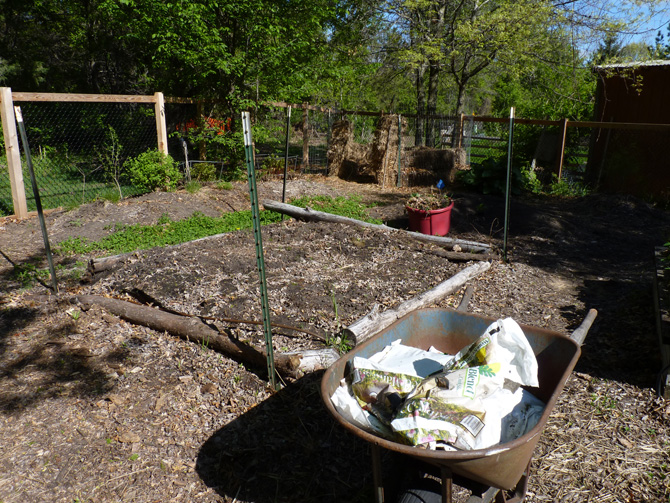
Also, over the next couple of weeks Kate and I will sit down and plan our 2012 garden.  We now have all the beds installed, the orchard has begun to produce, albeit still at modest levels and our perennial beds have taken more or less to running themselves with the occasional weeding foray and bulb planting episodes.

My short burst workouts, which include four sets of resistance work in between the all out sessions of 30 seconds and one minute, have begun to show results, so this summer I plan to have more muscle which makes gardening both easier and more fun.

We have a fire pit, dug out fully by Mark last summer with a large metal fire ring and cooking grates ready to be installed come spring.  Once it’s in place we’ll have a nice area near the grandkids playhouse for twilight and nighttime fires, roasting marshmallows and wienies.

With Kate at home much more now, we’ll be able to take even better care of the yard.  Wisely, Kate let the grass cutting go a couple of summers ago, enabling her to concentrate on weeding and pruning, tasks, for some inexplicable and yet joyous reason (from my perspective), she enjoys.

Reimagine

Samain                          Moon of the Winter Solstice

Jon sent these two links.  Wish I’d had’em when I owned that farm up near Nevis, Minnesota.  I might still be up there, motoring around on some of these very clever inventions.  They show what an ingenious mind can do when rethinking what appear to be over and done with ideas.

http://opensourceecology.org/
http://www.ted.com/talks/lang/en/marcin_jakubowski.html

Makes me wonder what other ideas need a complete rethink.  Computers have followed a pretty standard architecture up to now, one based on a central processing unit.  I read an article in Scientific American last week about a neural computer which, in essence, gives each unit of a computer a cpu, allowing for massively parallel processing as an integral part of the design. It’s modeled on, but not attempting to replicate, the human brain.

How about housing?  Cars?  Or, my personal quest and long time obsession, religion?  The family?  Electrical generation?  I’m interested in distributed generation where a cul de sac or an apartment building or a couple of blocks city residential units might get their electricity from, say, a combination of wind, solar and geo-thermal units sited in their immediate vicinity.

Here’s another one that could use a complete overhaul, reimagining:  nations.  The nation state is a relatively new phenomenon, most experts date its rise somewhere around 1800, perhaps a hundred years earlier in the instance of Portugal and the Netherlands.  In the wake of the globalization of economic life national boundaries have much different meanings that they did, say, 50 years ago.

Let’s go back to religion for a second.  Over the last several years, 23 to be exact, I’ve wrestled with the hole left by Christianity in my life and sought to fill it through what I call a tactile spirituality, one wedded to the rhythms of the seasons, of flowers and vegetables, of bees.  This direction took its initial impetus from an immersion in Celtic lore while I sifted for writing topics.

Then, I began to follow the Great Wheel of the seasons, a Celtic sacred calendar focused on 8 seasons, rather than four.  That led me to integrate gardening with my sacred calendar.  In the wake of these two changes in my life, I began to see the vegetative and wild natural world as more than tools for food or leisure, rather I began to see that they were my home, that I lived with them and in them, rather than having them as adjuncts to my anthropocentric life.

This whole change, this rethink of what sacred and holy mean, what the locus of my spirituality is and where it is, has had a long maturation, much thought and experimentation.  My hope is that my reimagining might provide a common religious base, a sort of ur-religion, which all humans everywhere can embrace.

As in times past this base religion could certainly have others layered on top of it, its essence after all is to be non-exclusive.  What I hope further is that reasserting, inviting, even luring others to see the sacred and the holy in our planet and its other living beings, they will be more likely to join in to see it healthy and vital.
Mi Casa

Samain                                     Moon of the Winter Solstice

Much as I enjoyed the travel, the close time with Kate, the ocean, new cultures and places, I find this computer and my own keyboard, my reference shelf and my library, mementos from past trips, family, collected art like slipping into a pair of comfortable bedroom slippers.  At its best travel allows for renewal, challenge, broadening, but an unexpected and forgotten pleasure, perhaps never noticed before, is this lifting up of home.

Home as reality and as metaphor carries a special valence for all of us, one way or the other.  I moved so often for the first 40+ years of my life I never had the time, the digging into a place where I could really feel home.  Here in Andover, although the burb itself is nada as place, the home Kate and I have created nourishes both of us.  We have space for our mutual creative work, space for mutual work outside and in, leisure space and fitness space.

Over the years, as is the case with most family homes, our sons have developed memories here, now grandchildren and in-laws, too.  Animals, both present and past, inhabit the hallways and the woods.  Storms past, challenges met and overcome, Thanksgiving, Hanukah, Christmas, birthdays, honey harvests.  All here.

Home.  This trip made me appreciate it more than I ever have.

Acts of Omission

Fall                                                                      Waning Autumn Moon

Went out in a cool fall afternoon, cut open bags of composted manure, spread them with a cultivator, working it into the soil.  Poured leaves from our trees over the top.  An investment in next year’s garden, the last act of the gardening year.

The ash tree in the garden has no leaves.  I wonder about its future with the ash borer; it may die, leaving a large part of our garden open to the sun again.  In that sense its death would be a good thing, but it’s one of several trees I decided to let grow, early when we moved here.

I cut down a whole grove of black locust, a fine wood for posts and other uses, but bearers of large thorns.  In that grove was a young ash, a young elm and three young oaks.  Instead of removing them, I left them and now 17 years later they are all young adults, grown tall and filled with leaves.  All over the property I have practiced this let it alone arborism and there are now mature trees in several spots.

They’ve grown up here as we have grown older here.  I feel a special bond with them and this ash in particular because it’s in the center of our garden.

Over the years I’ve wondered how often our acts of omission, not cutting down these young trees for example, influence the future in positive ways.  What about those acts I chose not to commit?  The grudges I let go.  The times when we leave well enough alone not out of avoidance, but out of love.  It’s hard to tell in human lives, but in the instance of trees, it’s very clear.

Making Pot Pies

Fall                                                       Waxing Autumn Moon

We had our final straight from the garden meal last night.  Roasted potatoes, onions, fennel, carrots and a lone beet.  Raspberries for dessert.  Marinated chicken for protein, not from here.

Today I cut up the leeks, cooked some chicken breasts, carrots, celery, peas and corn (none of these ours), and cooked the leeks in salt water for five minutes.  After shredding the chicken, a roux thickened the broth with the vegetables.  The shredded chicken went in the pie crust, then the leeks (our own), and after that the thickened broth and vegetables.

A rolled out pie crust for a top to the pies and they went in the oven.  4 chicken/leek pot pies, frozen now, treats we can have when we get back from South America along with raspberry pie.

Had an aha about our garden while cutting up the leeks.  We’re not feeding ourselves in any significant way with our garden, though we do eat several meals a year with our own produce and fruit.  What we can grow, and the leeks, garlic, heirloom tomatoes and heirloom potatoes are good examples, are specialty vegetables that, even if we wanted them, probably wouldn’t be available and would certainly not be available fresh from the garden.

We preserve tomatoes, store potatoes and onions, garlic and honey.  Kate makes currant jam and wild grape jelly.  We have raspberry pies frozen and now the chicken/leek pot pies.  We also freeze chard and spinach.  Our garden supplements our diet in ways that would not be possible without it.

It also gives us a joint project, a place we can work together, while keeping us in touch with the Great Wheel and the ways of the vegetative world.  We get a lot from our garden.

Saudi Arabia, Here He Comes

Fall                                        New Autumn Moon

Go, now.  The visa process is ended.  Yes, it’s true.  Mark’s visa cleared the Saudi Embassy at 3pm today.  Hopefully his passport will get here tomorrow via Fedex.  If that happens, Dr. Ahmed will send Mark an electronic ticket and he could be on his way as soon as tomorrow night.

Kate and Mark just came in and said we had wild turkeys in the perennial bed.  Sure enough, 7 turkeys are up on the third tier, eating something, maple seeds perhaps.

Into the museum today for an hour long presentation on Dine blankets by a collector.  He said the Dine always made mistakes in their weaving so as not to upset the gods.  Greeks did the same.  Hubris is a terrible thing.

Partners and Co-Creators

Fall                                                       Waning Harvest Moon

Went out and picked raspberries for pancakes this morning.  With a definite chill in the air the garden felt different, a bit sleepy, ready to bed down for the cold season.  After a month or so of feeling burdened by it, wanting it to disappear, my spring affection reappeared.  This patch of earth, these beds, work together with the plant world and Kate and me.  We share a joint stewardship of this property, each in our way committed to making it healthy, beautiful and bountiful.

The soil has given of its nutrients, its water holding capacity, its sturdiness as a base for roots and stems.  The plants have combined the chemicals of the soil with that water and pushed themselves up and out of the earth, then blossomed and in many cases fruited.  Kate and I weed, tend the soil, watch the plants, picking bugs off of them, pruning, replanting.  We also harvest and, when the harvest ends, we replenish the soil with composted manure and mulch.

When we use the plants and their produce, we take the leaves and stems and other unwanted parts and put them in a compost bin to return to the soil.

This complicated working partnership among many different parties here is, in microcosm, the partnership we humans have with the natural world and the world of soils, air, water and sunshine.  It’s significant to note that the one unnecessary party to this the work is the human race.

Plants will grow.  Rain will fall.  The sun will shine.  Soils will improve.  Fruits and vegetables will be made and distributed, all whether humans enter in or not.  We exist only as part of a richly integrated chain of being and we exist as its wards, not benefactors.

We do have the capacity to intervene, but too often, far too often, when we do intervene, we disrupt what nature does willingly and foul the process, in the end harming ourselves.

I wish our gardens and our orchard were more than supplements to our diet, but that is all they are, to be otherwise would require a commitment to the work I no longer feel able or willing to give.  Even so, as a supplement, this growing of flowers, potatoes, tomatoes, beets, carrots, leeks, beans, onions, lettuce, chard, spinach and peas, this caring for bees and harvesting honey, does keep us intimately engaged as partners with the natural world, a partnership so often hidden from view in this, the most capitalistic of all possible worlds.

The Normal Extraordinary

Lughnasa                                       Waning Harvest Moon

Just back from the grocery store.  Kate went along, a nice treat.

On so many levels the grocery store speaks to privilege.  We have food, fresh food, all year round.  Kate and I can buy food all year round.  The U.S. has fields of grain, feeder lots with cattle and pigs, chickens and turkeys, fruit grows in many places, nuts, too.  Vegetables grow within miles of every major metro area and within them, too.

As citizens of a powerful country, albeit one in economic struggles, we have so many things available to us, things we consider normal, that are extraordinary in most of the world.

It’s not to early to start thanks giving.

The Chain Saw

Beltane                                                                   Full Last Frost Moon

Instead of opening Ovid this morning, I opened the garage doors and took out the chain saw.  Checked the chain oil, thick almost like grease.  Added some.  Filled a measured quantity of oil in a squeeze bottle, poured into the one gallon gas can, added a gallon of fresh gas, shook the can and put the gas oil mixture in the chain saw.  With the choke out full, I put my toe through the handle, pressing the saw firmly onto the driveway, grabbed the pull and yanked up.  Sputter.  Pulled again.  Nothing.  Pushed the choke half way in, yanked again and that ear-splitting racket that pierces homes and exurban silence whined to life.

With the exception of one cedar trunk I’ve now downed, limbed and cut into smaller sections all of the damage from last November’s early, heavy snow.  The large cedar tree just off our deck is the only tree I’ll miss.  We nurtured it from a small shrub into a magnificent tree.  Though I’ll miss its 17 year journey with us, it does open up a lot of sun for the vegetable garden.  It would have been strategic to cut it down years ago, but it was a friend.

When I finished limbing the first cedar trunk, my arms grew tired.  I quit.  No using chain saws when tired.  Flesh and bone pose no obstacle to these tree fellers.

Bee Diary: April 12, 2011

Spring                                                   Waxing Bee Hiving Moon

Hobby Bee Keepers tonight.  Kate and I heard a presentation on Minnesota Grown, a very interesting initiative by the Minnesota Department of Agriculture that supports local food 400_garden_0084based businesses with marketing assistance.  A woman gave a presentation on cooking with honey.  How to make truffles.  Uh-oh.  They were really good.  Not a healthful food, but my were they tasty.

The hobby beekeepers have a farmer look, a rural feel, even though there are many urban and suburban beekeepers.  Guys with hat line tans, checked shirts and blue jeans; woman with sensible cloths and no make up.  Tonight I learned what to do with all the honey I have left over from the demise of my two colonies; use it four frames at a time to feed my new package bees.

The night was clear and warmish.  Today was busy, as was yesterday and as tomorrow and Thursday will be.  My energy is up and I’m having fun.  I’m glad we’ve had the warm weather and a chance to get into the garden.

About that land my sister, brother and I own in West Texas.  Probably not gonna be used for a housing development.  Forty acres of mesquite and sand, plus, natives assured me, quite a few rattlesnakes.  Taste like chicken I’m told.  A certain, lonely hermit part of me finds West Texas desirable because of its emptiness, its vast spaces and little civilization.  I loved Marfa and could imagine a winter retreat down there in Imperial that could serve as a base for outings to Great Bend, Marfa, Guadaleupe Mountains, Carlsbad Caverns.  Maybe.

Think I’ll send Mark down there to scout it out, maybe hire a surveyor.

West Texas

The 2010 Census confirmed what anyone passing through the scrublands of West Texas already knew: People are leaving, and no one is taking their place, even with oil at more than $100 a barrel. The people who remain often drive an hour or more to visit a doctor, buy a pair of jeans or see a movie.

So you might wonder why anyone is still there, in this place where natural beauty is defined by dry creek beds and scraggly mesquite, where public transit is a school bus and Starbucks is a punch line.

“The greatest sunsets. The stars are just right there. You hear the coyotes howling,” says Billy Burt Hopper, sheriff of Loving County, home to 82 people and the least-populated county in the United States.