Lugnasa Garlic Planting Moon
|
My Heart Leaps Up My heart leaps up when I behold |
Lugnasa Garlic Planting Moon
|
My Heart Leaps Up My heart leaps up when I behold |
Lugnasa Hiroshima Moon
The Spring Dumbledor
An August Midnight
by Thomas Hardy
I
A shaded lamp and a waving blind,
And the beat of a clock from a distant floor:
On this scene enter—winged, horned, and spined—
A longlegs, a moth, and a dumbledore;
While ‘mid my page there idly stands
A sleepy fly, that rubs its hands…
II
Thus meet we five, in this still place,
At this point of time, at this point in space.
—My guests besmear my new-penned line,
Or bang at the lamp and fall supine.
“God’s humblest, they!” I muse. Yet why?
They know Earth-secrets that know not I.
Spring Bee Hiving Moon
Boy, have you caught the sliver moon with Venus above it and Jupiter below? Soon there will be tulips and crocus and snow drops. The magnolia already lights up our patio. A soft torch of white burning quietly. Round Lake just a quarter mile from our house looks great right at sunset and in the dark with stars and the moon reflecting in it.
The climate may be playing havoc with the seasons but the inescapable beauty of the natural world remains.
Keats may have stretched it a bit, but not too far. Truth is beauty.
The good news here is that no .5%’er will ever corner the market on sliver moons or magnolia blossoms or reflections in that pond near your house. These, the original art works, the masterpieces of our everyday world, belong to the commons. All we have to do is step outside.
Beltane Waning Last Frost Moon
On a pile of essays, yet unread, sits one at the top, “The Great River of the Classics”, by Camille Paglia. She is my heroine, an outspoken advocate for the content of the humanities, the deposit of art, music, literature and theater that flows from Western civilization’s beginnings in the fertile crescent, a river with a delta now rich with islands and streams, a fan of human experience at its most intense and intimate that nourishes the ocean that is Western humanity’s collective conscious and unconscious.
Egypt’s splendor, the profundity and innovation of the Greeks, the ordered ambition of the Romans, the spirituality of the Celts, the deep feeling of the Russians and the Germans, the list is long and has depth. Gilgamesh. The Egyptian Book of the Dead. The fragments of the Pre-Socratic. Jewish texts. Christian and Muslim texts. The pyramids. The parthenon. Rome. The pantheon. Fra Lippa. Giorgio. Botticelli. Michelangelo. Da Vinci. Petrarch. Erasmus. Francis Bacon. Titian. Brueghel. Boccaccio. Chaucer. Beowulf. The poetic eddas. Ovid. Turner. Poussin. Rembrandt. Barye. Tolstoy. Dostoevsky. Singer. the Baal Shem Tov. Racine. Shakespeare. Marlowe. Haydn. Mozart. Beethoven. Brahms.
And the many, the very many left out of this brief evocation.
Perhaps the humanities do not pass the test of occupational preparedness, a test now applied to departments in higher education. Just yesterday an academic group released a study the dollar value of varying university degrees based on earnings over time and starting salaries. In many colleges and universities humanities departments look like low hanging fruit when it comes to the budget ax.
So. If humanities degrees result in less earned income over a student’s life, does this make them, ipso facto, less valuable? Obviously. If, that is, the only yardstick is dollars. No, I’m not going to make the argument that dollars are a grubby, undistinguished measure; each of us has to eat, reside somewhere, raise our children and nourish our dreams.
Even the fact that the humanities stood at the very center of the project of higher learning at its inception does not privilege them now. The needs and values of the middle ages were different from ours today. No, the humanities must stand valuable by today’s standards more than they must reflect the values of past centuries.
It may be that the university is no longer the place for the humanities. It may be that higher education’s mission in contemporary life involves primarily occupational learning, a sort of advanced vocational training. Institutions focuses change over time. Their work must meet the needs of those whom they serve or they have no reason to exist.
It does not bother me if higher education strips out the humanities. Let the music department perish. Banish the philosophers, the artists, the literati, the linguists and language crowd, let history go, too. Leave the ivy covered walls with only economics, business, pre-law, pre-med, engineering, architecture, agriculture, veterinary science, family and child psychology. Keep those subjects that inform the workers of today and tomorrow and let the fluff go. Keep the hard stuff, abandon the soft disciplines.
Why don’t these changes bother me? Because an artist does not need an art department, she needs fellow artists and places to display and sell her goods, but art departments, no matter how good, no matter how well intentioned, are not necessary to artists. Work is. Literature, too. Writers write because they must, because words and ideas matter to them. No writer writes because there are good writing programs. Of course, they can learn things in those programs, but writing does not depend on English departments. Music, too, is part of the beating heart of culture. Musicians, whether trained in universities or not, will make music. Musicians will and do get trained in many other places than higher education. Philosophers are stuck with the sort of minds that go to the root of things and they will dig deep without philosophy departments. They need other philosophers, yes, but there are books and airplanes.
The humanities are of, by and for humans. Because they are of our essence, they will survive diminished or even eliminated university and college support. Will they be poorer? Probably. For a while. But not for long. We need music to fill our souls. We need literature to grasp the many ways there are to be human. We need painting and sculpture and print making because beauty satisfies an essential yearning of the human spirit and because we need to experience the interior world of others as much as we can. We need those among us who will ask the difficult, the unpopular questions and pursue them where they lead.
We need all of these things; they do not need higher education. It will be poorer without them, less reflective, more insular, more satisfied with apparently easy answers.
What might happen is this. After the humanities have been ejected from higher education, humanities practitioners and scholars will meet, find they still need each other. An idea will occur to them. Why not have a place where the humanities can be taught? An institute, maybe. A gymnasium. An academy. Or, maybe something new. A virtual gathering space for artists and scholars, for writers and teachers.
Out of these experiment might grow, what? I don’t know. Perhaps an educational institution with its primary mission immersing its students in the Great River of the Humanities, a baptism by art. Could happen.

Imbolc Waxing Bridgit Moon
Jacob and Esau and Rebekah and Isaac came to life tonight as we felt our way into this peculiar, even troubling story of deception, betrayal, theophany and a redemptive moment followed by a warm hearted, unexpected ending. These stories still resonate, still have the power to grab the attention, hold the heart and propose new perspectives. These are stories by and for men, archetypal moments held close to the heart for thousands of years.
After the reading of these stories and a conversation that followed many paths, a few left for bed: Mark, Scott and Tom while Paul, Stefan, Charlie H., Jimmy, Warren and I sat up reading poems or, in Paul and Jimmy’s case, reciting poems from memory. Poetry comes alive when one poem sparks another and books come out, dogeared and ragged from much use. Rilke, Frost, Oliver, Pauly, Sarton, Rumi all visited us, speaking across the centuries or the decades, speaking directly into the heart.
A magic, spontaneous moment, the stuff of which retreat memories are made.
Fall Waxing Harvest Moon
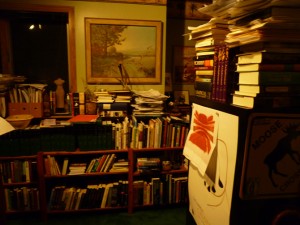
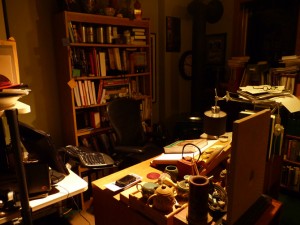
I have begun to accept that I will never read everything I want to read. Books sit stacked up on the floor in my study; they lie on top of rows of other books on bookshelves; all my
bookshelves are full and many have books piled on top of them. Each one I want to read. Some I want to use only as reference, but most I want to read cover to cover. The books range in topic from fairy tales and folklore to basic scientific texts on biology and geology, from philosophy to theology, art history to renaissance life, china, japan, india and cambodia to single dictionaries and the multiple volumes of the OED and the Dictionary of Art. Of course there is fiction, too, and poetry, works on historiography and works on the enlightenment. This doesn’t count the 90 books I now have on my kindle, many fiction, but many non-fiction, too.
When it comes to books and learning, I seem to not have an off button. Maybe it’s a pathology, an escape from the world, from day to day responsibility, could be, but I don’t think so. Reading and learning feel hardwired, expressions of genes as much as personal choice. So it’s tough for me to admit that I have books here, in my own house, that I may never read. A man has only so many hours in a day and I find spending any significant amount of them reading difficult.
That always surprises me. I love to read, yet it often feels like a turn away from the world of politics, the garden, connecting with family and friends, so it takes discipline for me to sit and read for any length of time. Instead, I read in snippets, chunks here and there. Even so, I get a lot read, finishing the Romance of the Three Kingdoms took a lot of dedication, for example. One year, I put the books I finished in one spot after I finished them. I don’t recall the number or the number of pages, but it caused me to sit back and wonder how I’d done it.
Sometimes I fantasize about stopping all other pursuits, sitting down in my chair and begin reading through the most important books, the ones on the top of my list. Right now that would
include the histories of Herodotus and substantial commentary. The Mahabharata. Several works on Asia art. A cabinet full of books on the enlightenment and liberalism. Another cabinet full on calendars and holidays. I will never do it. Why? Because I do have interests, obsessions maybe, that take me out into the garden or over to the State Capitol and the Minnesota Institute of Arts, the homes of the Woolly Mammoths and our children. Kate and I will, I imagine, resume at least some of our SPCO attending when she retires and there will be travel, too.
This relates to an odd self-reflection occasioned by Lou Benders story of my first day on the Ball State Campus. According to him, there was a picture of the Student Body President, I reached out and touched it and told him, “I’m going to do that.” Three years later I ran and lost for Student Body President. The year was 1969. Recalling this, I wondered if my intention, my ability to clarify my direction had waned. Had I defocused, living my life with no clear intentions, drifting along, letting life happen?
Then I recalled the moment I told Kate I wanted to write, the moment four years ago when I realized I had to put my shoulder behind the Great Work, creating a benign human presence on the planet, the moment I began to pester Deb Hegstrom for a spot in the junior docent class of 2005, the time when Kate and I decided to push our property toward permaculture-the harmonious integration of people, plants and animals in a specific spot in a sustainable way. No, I’ve not lost my ability to focus. Not at all.
This life, the one I’m living now, is the one I’ve chosen to live, a life Kate and I have made together. And that feels good.
Who knows, maybe I will finish these books? Who knows?
Beltane Waxing Planting Moon
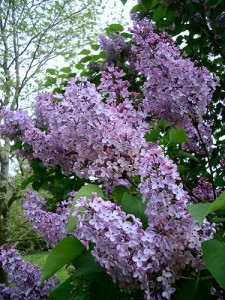
My poem The World Still Smells of Lilacs will be printed in the upcoming Muse, the newsletter for MIA docents. They (Bill and Grace) wanted an image to go with it, but one from the MIA collection. It took a while to find one that worked well with it, at least for me. This Study in Shadows is the one I chose.
I”m honored they asked me. Grace wanted to know how many poems I’ve written, “Oh, I don’t know. Hundreds, I imagine.” I’ve written poetry since high school, but lost all of my work through my senior year of college when my 1950 Chevy panel truck got stolen. My poetry became an unwilling hostage, unceremoniously dumped I suppose.
Since then, I’ve written poetry off and on, in this journal or that and I’ve never bothered to collect them. I have one small booklet I printed on the computer as a holiday gift several years ago, but that’s it. Pretty uneven work I’d say. A few good ones here and there, a lot of therapeutic pieces, some just plain rambling.
Another bee and garden weekend, plus chapter 16 of Wheelock, then, later on in the week, another 5 or so verses of Ovid.
Beltane Waxing Planting Moon
from a difficult time in my life:
A star rises from my heart
Into the dark, dark sky.
You and I.
As other celestial objects
Wheel and slowly turn
The star shines. An urn
Reflects the star light,
It contains the dust
what remains of us.
The star o’er sheep once played
A hope that grew
From a babe into
A savior, a christ,
A man who loved and died.
It watches as we are tried
In the crucible of time
And found wanton.
Left for abandon.
Oh, well. I loved you once.
The star traverses the sky
Watching, as we die
The death of personal crucifixion
A penalty which seems too harsh.
Yet, a bird sings on the marsh.
The sun rises rosy-fingered,
Eggs are hatching.
Gates are latching.
The world still smells of lilacs
Spring Awakening Moon
Had our Latin session with Greg at noon today. I asked him if he thought my trying to translate Ovid now would hurt my learning. He said, no, go for it. But. Get a latin text with a commentary and work out your translation to your satisfaction before you compare it to someone else’s. So, I went on Amazon and found a 2-volume latin text with commentary. They are on their way. I’m excited. I know I’ve got a long way to go before I’m a competent translator, if I ever make it to that level, but I can punt away at it. He said to expect frustration. Oh, I do.
(from the Metamorphosis, Ulysses men turned into swine. 1591)
After that into the Art Institute for the first of two lectures on the upcoming spring show, Until Now. The lecture was excellent. Docent training leaves out huge chunks of the world’s artistic tradition with a necessary focus on the art history of objects in the museum’s collection, but the biggest lacuna was contemporary art. I found the guest curator’s lecture very informative, a good background for an aspect of art history in which I feel very weak.
Until Now is contemporary art in a large show and it combines with Art Remix which features museum contemporary works placed at provocative or evocative locations. David Ryan, curator of modern design, said years ago the museum would only purchase works of an artist who was dead. This was to ensure that whatever work we purchased represented an important and/or mature example. That policy ended a few years ago and the museum has begun collecting living artists.
We have a new contemporary art curator and her initial job was to figure out how contemporary art fits into the MIA’s mission as an encyclopedic collection. At the MIA we can place contemporary work in context, the art historical context which informed and informs artists working especially since WWII. The Art Remix is an attempt to draw on the museum’s historical examples and use them as conversation starters about contemporary art as it has evolved out of the older works and how the older works can be illuminated, seen in a different way when viewed through the lens of later artist’s work.
(a work by Kara Walker, African/American, 1998)
The last hour of the day was a conversation about the Art Remix. I found Liz Armstrong’s rationale for the Remix strong though I felt this first effort was uneven. Some of it is very provocative, like the photographic panels in the Korean collection and the TV Buddha, which features a bronze buddha watching television, a television screen filled with a video camera turned on the Buddha statue and especially the Chinese Ming dynasty chair carved from a single block of marble and placed in the Wu family reception hall. The works put in the Egyptian and African galleries (not the Shonibare, which I love) are not as effective for me.
A day with a lot of learning.
Imbolc Waxing Awakening Moon
St. Patrick’s Day. I’ve always felt that the Irish celebrating St. Patrick’s day is much like the Dodgers celebrating a Yankee World Series win or maybe more like Native Americans celebrating the coming of Christianity to the New World.
Why? The snakes St. Patrick drove out of Ireland represented the takeover of the ancient Celtic faith by the invading dogma of Roman Catholicism. Not only did the R.C.s finish off the auld faith, but they did in a native Celtic version of Christianity that had a close relationship to Mother Earth and who offered to the church, Pelagius, a theologian who believed we were born good. Augustine, yes, that Augustine, set out to crush Pelagianism and he succeeded. In fact, Augustine was so successful that Pelagius rarely comes in church history at all.
What I know of Celtic Christian spirituality would salute this poem by e.e. cummings that Scott Simpson quoted at our last Woolly meeting: