Drove the fifteen or so minutes to Staunton State Park yesterday. Since we moved here I’ve wanted to include regular hiking as part of my fitness routine, but I let first one thing and then another get in the way. No longer. Bought an annual state park pass. “Sir, could I ask you if you are over 65?” Saved me ten bucks. Sure. Ask away.
Debbie, the personal trainer who put together my new workout plan has suggested I alternate cardio days with resistance work. Since I’m paying her for her expertise, I’m going to go follow her suggestion. She also said hiking would be good for abductor/adductor strengthening, uneven terrain. “The Davis Pond trail at Staunton would be a place to start.”
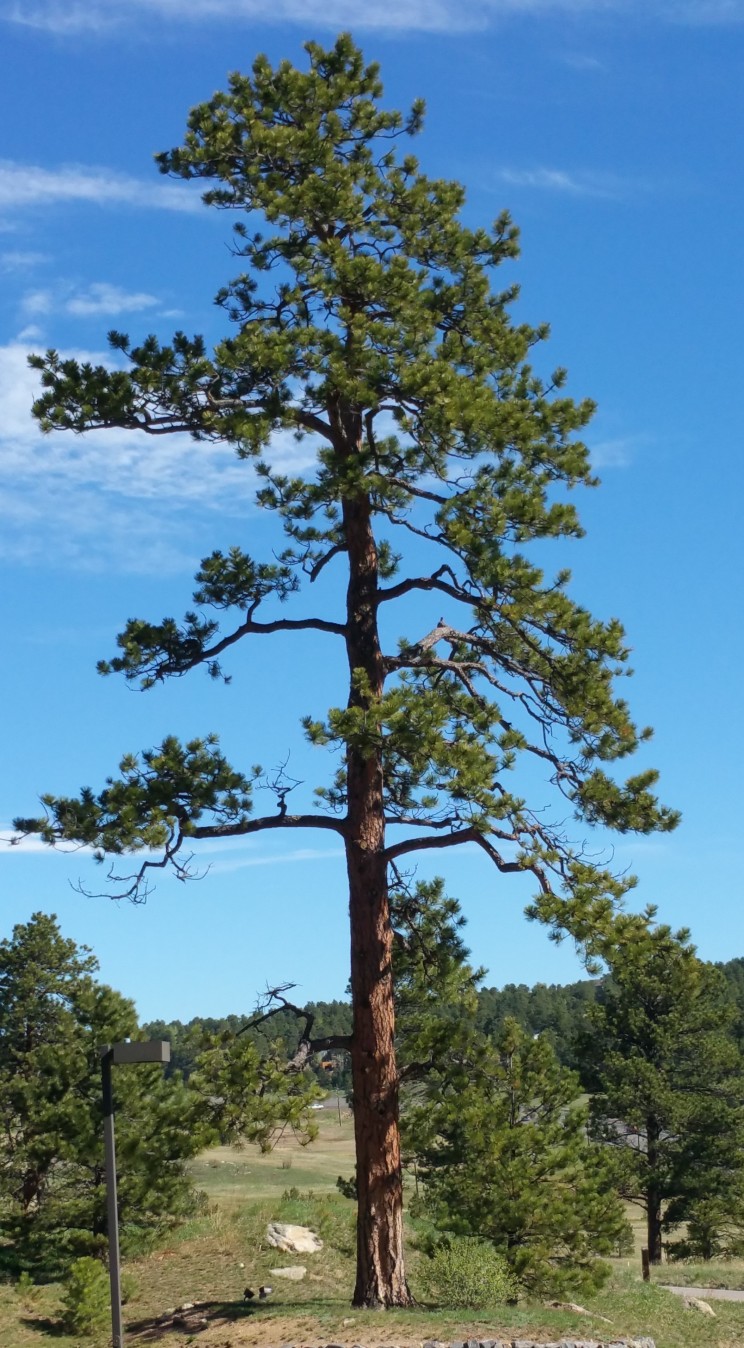
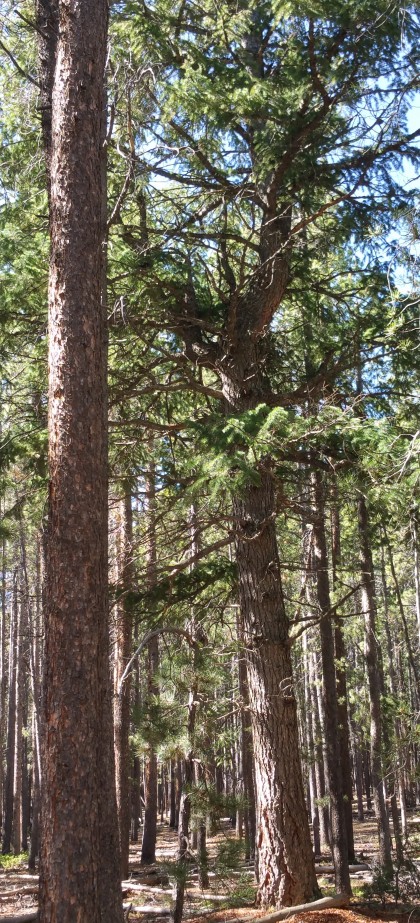
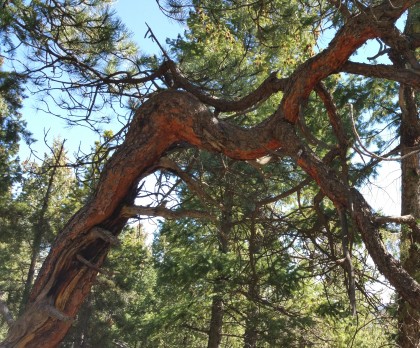
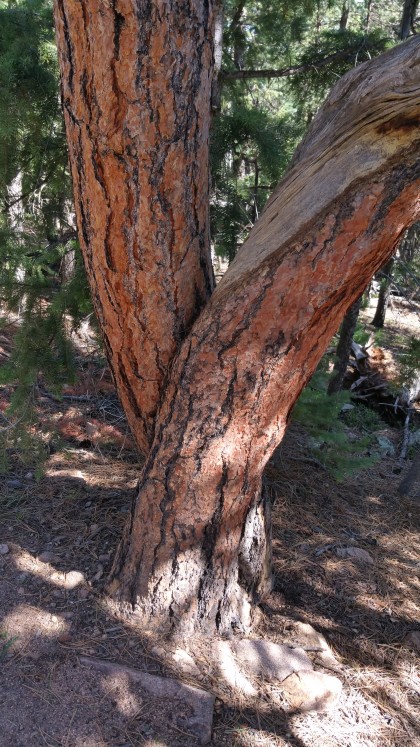
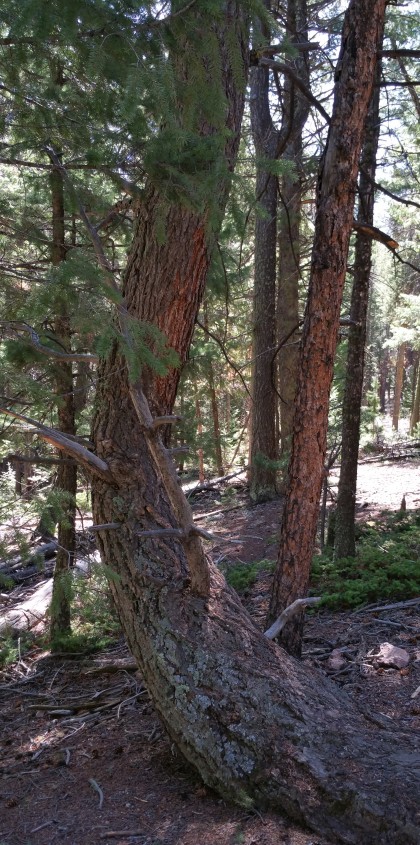
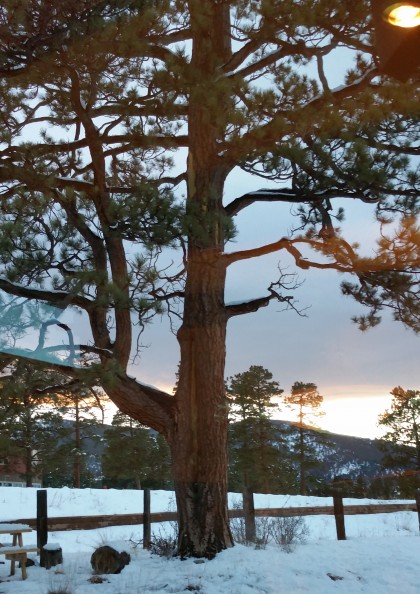
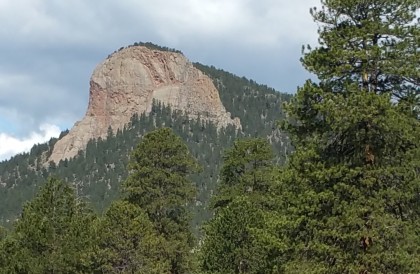
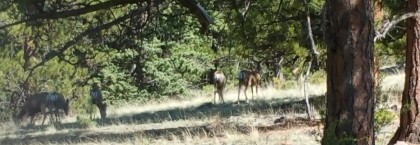
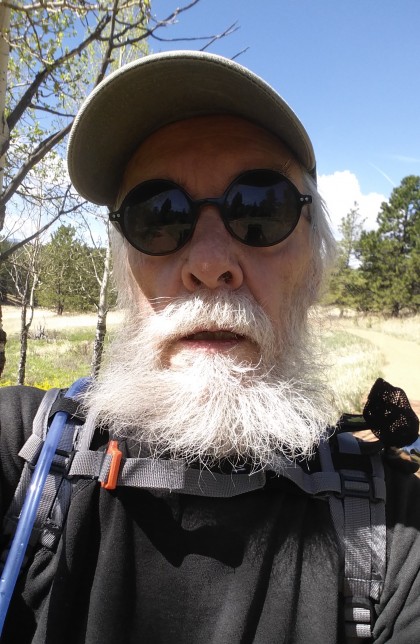
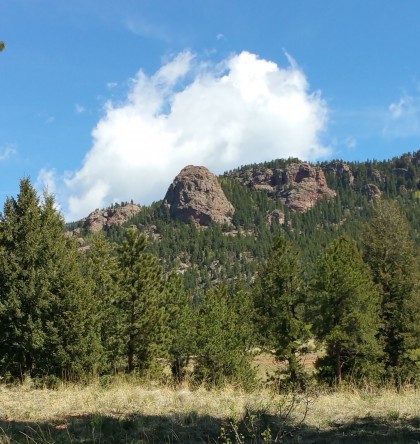
Here are a few pictures from that very trail. I used to exercise outside a lot: Crosby Park in St. Paul, Lake George Regional Park and Rum River Regional Park in Anoka County, but the ease of the treadmill and inertia moved me away from it. Glad to be getting back. And the scenery here is amazing.
Yesterday was my first religious work since moving to Colorado. I felt a bit awkward, mildly anxious. The awkwardness and the anxiety came largely from the Jewish portion of the session since I don’t read Hebrew and have a very limited feel for the deep background. This primarily involved understanding words like hasidut, which I had mistakenly translated as loving deeds when it actually refers to a person engaging in them. Chesed, which is familiar to me from seminary as loving-kindness, was less problematic. Ma’asim, which I took as deeds of daily life, seemed to mean close to that.
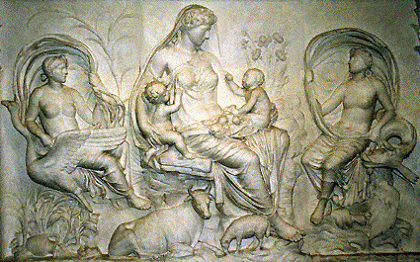
This was important because the material I had prepared focused on deeds of loving kindness toward grandmother earth. Bonnie and Tara, both fluent in biblical Hebrew, gently put me back on course when I made a mistake. Their helpfulness made me realize, just now as I’m writing this, that there is a different way of being a presenter, one that relies on others as well as on preparation. I know, obvious right? Not to me because in the Christian religious culture and even in the UU culture the clergy presents and others react. The process can be dialogical, yes, but usually involves only reactions to the ideas of the presenter.
We did have a wonderful discussion about anthropocentrism and various religions’ implication in its effect on the environment. Mostly though we discussed ideas generated by several quotes I gathered. They ranged from a segment of Emerson’s introduction to his essay, Nature, to Henry Beston from the Outermost House, and also included several thoughts on the nature of holiness by Jewish theologians.
Here are a few of the latter that I found especially moving:
Martin Buber: Holiness is not found in rising above one’s neighbors but in relationships, in human beings recognizing the latent divinity of other people, even as God recognizes the divinity in each of us. The commentary adds, “As human beings we can be Godlike by exercising our powers to sanctify moments and objects in our lives.”*
“The modern distinction between “religious” and “secular” is unknown to the Torah. Everything we do has the potential of being holy.”*
Again, from Buber, “Judaism does not divide life into the holy and the profane, but into the holy and the not-yet holy.” Another scholar, a man named Finklestein, adds, “Judaism is a way of life that endeavors to transform virtually every human action into a means of communion with God.”*
This, too, is in the commentary: “…(find) ways of sanctifying every moment of your life. We can be as holy as we allow ourselves to be.”*
Lunch with Bonnie at the Everbean, a coffee shop overlooking Lake Evergreen. Bonnie is in a mentored adult education style path to becoming a rabbi in the Renewal Movement. I wanted to discuss my material for today’s mussar session. She was the mussar point person as Beth Evergreen managed a two-year grant awarded to them. The program focused on how to integrate mussar into synagogue institutional life. 22 congregations received a grant and coordinated their work with each other. (If you don’t recall what mussar is, here’s a reminder website.)
Bonnie encouraged me that my approach, focusing on the application of the ideas of hasidut (a person of loving deeds) and chesed (loving-kindness) toward grandmother earth was in bounds for a mussar dialogue. We’ll see how that works out later today. I’m excited.
In the evening Kate and I went to a havurah, a fellowship gathered for a specific purpose. This havurah is a once a month mussar session that features food and wine before exploration of a middot of the month. The Thursday afternoon mussar group studies a text and meets weekly.
Bonnie led a session on tikvah, hope. She took us into the idea by using the Israeli national anthem, Hatikvah.
I found the melody haunting and the poem, written in 1877 or 1878, used for the lyrics, a profound expression of the yearning for a place to call home. Bonnie led us in a close reading of the poem’s stanzas used in the anthem, only two.
The lines that struck me most were these: “Our hope is not yet lost,
The hope of two thousand years…” The two thousand years here references the destruction of the second temple in 70 a.d. It still amazes me to be in the midst of this group of Jews, members of the tribe, whose time horizon extends far back. This two-thousand year old hope marks a rebellion by the Jews against the Roman empire, a failed rebellion since it ended in the destruction of the temple built to replace the first constructed by King Solomon.
Rabbi Edgar F. Magnin, 1929-1930: “The Jews march captive out of Jerusalem bearing a golden Menorah or candlestick of the Temple.”
What amazes me is the historical reach while genetic and genealogical descendants of that same history sit around the table as we discuss these things. My viewpoint toward religious matters is radical and skeptical, but I also have a conservative side that relishes history and personal connections to history. Judaism, like the Chinese civilization of the Han and Japanese civilization, all cultivated over several thousand years, appeals to me in part for this reason. These older, truly ancient trails offer a correction to the almost ahistorical sensibilities of American culture.
These are the last two days of the Rushing Waters Moon but its namesake creeks will continue rushing for another week or two. Last week’s substantial snow has been followed by some rain and last night another inch or so of snow. More precipitation to come, too.
The Moon of the Summer Solstice is new on the 25th. If I had the cash, I’d go to Sweden.
Still working on how I will lead our mussar class next week. It’s been hard for me, mildly anxiety producing. First, I don’t have the depth, any really, in Jewish thought. The Mesillat Yesharim, Path of the Upright, is a complex, subtle and often difficult to parse text. With a guide like Rabbi Jamie Arnold its complexity and subtlety becomes an advantage, encouraging a range of views, sparking discussion. But with me, lacking sufficient knowledge, it could become a bramble thicket instead.
Secondly, I do have some depth in other fields, especially those related to the environment, and I find myself drawn to them with the content of chapters 18 and 19 in this central mussar text. Those two chapters recount movement toward hasidut or piety and chesed or loving kindness. Since these are action outward categories-hasidut can also be translated as loving deeds-ecological thinking fits well with them. But. I realize if I go in this direction I risk making my own agenda the centerpiece rather than learning about these middah.
Thirdly, the whole Jewish immersion experience I’m having at Beth Evergreen is like learning a new language. I have some words and a very limited amount of grammar. I don’t want my naivete getting in the way of other’s learning.
Last. As is usual for me, I have way more information than can possibly fit. At this stage, roughly a week away, that’s not a problem. Except it is. I don’t know how to edit the material because I’m not really sure what my focus is. Is it hasidut, chesed, kedusha (holiness) or is it the manifestation of those ideas in the world? In this case it’s a question of am I moving too quickly beyond the new concepts to their application?
I’ve enlisted the help of a rabbi in training, Bonnie Houghton, to help me sort out what will be useful and what won’t. Mussar and Torah study both emphasize the value of a study partner. A sound idea.
Kate and I sponsored the oneg last night at Beth Evergreen. Oneg means delight and in this use it’s a modest event after the sabbath service. It involves the kiddush prayer over wine, the passing of challah (a ceremony not coincidentally similar to the Christian eucharist) and having some sweets or other snacks. It’s similar to coffee after a Christian or U.U. service, but different in one significant regard. The Jewish sabbath, as a day of rest and renewal has a focus on good food and general delight, so the oneg both is that ideal and reinforces the larger sabbath ethos.
Kate did her usual excellent job of providing a variety of tasty food and adult beverages, in this case white wine. We bought the challah at a small bakery, Alpine Bakery, in Evergreen. I picked out cookies: bunnies, unicorns and trains. The oneg was in honor of Ruth and Gabe so they seemed apropos.
In the service, sparsely attended, due I imagine to the snowfall over the last three days, the Beth Evergreen choir sang. The Reconstructionist book for the sabbath service is an impressive piece of liturgical accompaniment. It contains both Hebrew and English versions of the various portions as well as commentary that suggests the reconstructionist take on traditional elements of Jewish worship.
Charlton Heston at work
In a section focused on the Exodus, the parting of the Reed (Red) Sea the commentary says an early Reconstructionist prayer book did not include the parting of the sea because of its supernatural element. This version of the prayer book has it because “As myth, however, the ancient tale of wonder underscores the sense of daily miracle in our lives.” This gives you a good feel for the Reconstructionist approach to both theology and the Torah. It’s one I find myself nodding to a lot.
Though I retain my empiricist, flat-earth metaphysics I’m finding it under spiritual and intellectual siege. This ancient tradition, radically reconsidered from within, pushes me to open myself to a deeper, more mystical place. The mystical has always been a significant part of my spiritual journey, but I’ve let it lie fallow for the most part in recent years. Not sure where this is headed, stirrings of old feelings mixed with reimagining faith. An interesting moment.
Working on a presentation for our mussar class at Beth Evergreen. Want to include Berry’s idea of the great work for our generation: creating a sustainable human presence on earth.
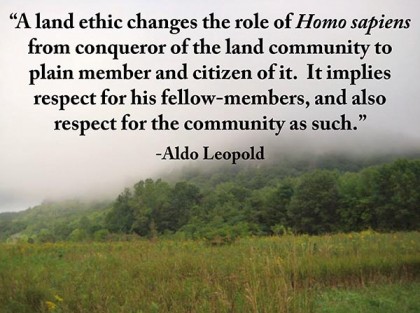
Also want to include Aldo Leopold’s land ethic:
“All ethics so far evolved rest upon a single premise: that the individual is a member of a community of interdependent parts.The land ethic simply enlarges the boundaries of the community to include soils, waters, plants and animals, or collectively the land.” The Land Ethic, A Sand County Almanac.
The date of the presentation happens to be Emerson’s birthday. So, from Nature: “The foregoing generations beheld God and nature face to face; we, through their eyes. Why should not we also enjoy an original relation to the universe? Why should not we have a poetry and philosophy of insight and not of tradition, and a religion by revelation to us, and not the history of theirs? Embosomed for a season in nature, whose floods of life stream around and through us, and invite us by the powers they supply, to action proportioned to nature, why should we grope among the dry bones of the past, or put the living generation into masquerade out of its faded wardrobe? The sun shines to-day also. There is more wool and flax in the fields. There are new lands, new men, new thoughts. Let us demand our own works and laws and worship.” introduction to his essay, Nature.
Linking up with the parsha* (Torah portion read in Shabbat services) I found Leviticus 25 filled with interesting ideas about the land. Here are a couple that fit well with these ideas.
Lev. 25:18 “…you shall live on the land securely.”
Lev. 25:23 “…the land shall not be sold permanently for the land belongs to Me, for you are all strangers and temporary residents with me.”
Of course, this is a mussar class so all of this has to connect with the Mesillat Yesharim, Path of the Upright, that we’re reading. To do that I think kedusha, holiness, hasidut, piety, and chesed, loving-kindness are key. These last two come from the same root.
Here are some ideas about holiness from the parsha of a couple of weeks ago, Kedoshim. Leviticus 19:2b: “You shall be holy, for I, the Lord your God, am holy.” In commentary on Kedoshim the Conservative text* that I have quotes many famous Jewish scholars.
Martin Buber: Holiness is not found in rising above one’s neighbors but in relationships, in human beings recognizing the latent divinity of other people, even as God recognizes the divinity in each of us. The commentary adds, “As human beings we can be Godlike by exercising our powers to sanctify moments and objects in our lives.” Namaste.
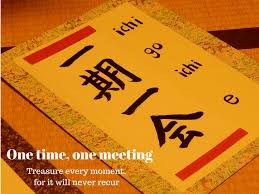
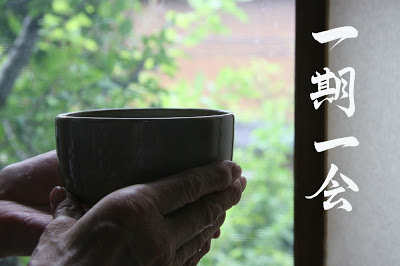
I can also link this idea to the Japanese ichi-go ichi-e, once in a lifetime, attitude gleaned from the work of Japanese tea masters, especially the renowned Sen no Rikyū. He learned ichi-go ichi-e from his master, Takeno Jōō. “Jōō believed that each meeting should be treasured because it can never be reproduced.” wikipedia
ichigo ichie
Another of my favorite Japanese ideas is shinrin-yoku or forest-bathing. Here’s a one-line summary from the website linked to here. “The idea is simple: if a person simply visits a natural area and walks in a relaxed way there are calming, rejuvenating and restorative benefits to be achieved.”
More from the commentary on Kedoshim: “The modern distinction between “religious” and “secular” is unknown to the Torah. Everything we do has the potential of being holy.”
Again, from Buber, “Judaism does not divide life into the holy and the profane, but into the holy and the not-yet holy.” Another scholar, a man named Finklestein, adds, “Judaism is a way of life that endeavors to transform virtually every human action into a means of communion with God.” or, perhaps with a pagan sensibility, ichi-go ichi-e.
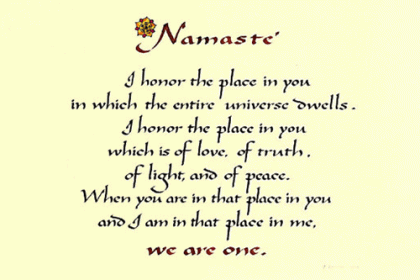
I say perhaps intentionally because my reimagined faith could intersect with these ideas in a positive way, especially so if the locus of the divine is the individual soul, that part of us that connects with collective unconscious, Brahma, the three Sephirot: kether, the crown, chochmah, wisdom and binah, understanding, that part of the other to which we bow when we say Namaste. Or, as I quoted Buber earlier, “Holiness is not found in rising above one’s neighbors but in relationships, in human beings recognizing the latent divinity of other people…”
This, too, is in the commentary: “…(find) ways of sanctifying every moment of your life. We can be as holy as we allow ourselves to be.” again, the Japanese ichi-go ichi-e and shinrin-yoku.
I’m also trying to pick up some ideas about Hebrew roots but that, so far, has eluded me.
Somewhere in this stew is enough material for a session. Just gotta sort it out.
*Etz Hayim, Torah and Commentary, The Rabbinical Assembly, The United Synagogue of Conservative Judaism. 2001. New York, N.Y. 10027
Our next Sierra Club meeting will be on June 19th, one day before the summer solstice. Sierra Club work is paganism stripped bare of its mythic content. There is passion for sure, but not the poetry, no ritual, no inner work. It’s all outer work: hike, lobby, analyze, network, persuade. We may, for example, show the next Al Gore movie, Inconvenient Sequel: Truth to Power. See trailer below.*
The work is good, necessary. It is even, as Thomas Berry said, the great work of our generation, but it often feels mechanical to me. Pull this lever. Have this meeting. Create this sign. Monitor Polymet. Call the governor. Write your Senator. Hike this trail. In its mechanistic form this does not feel like my love for our home, this earth, this planet, third rock from the sun.
Somehow I need to find a way for my inner work to imbue my outer work. Todd, a long-time member of the Mt. Evan’s local group to which I belong, talked about a hike he took yesterday in Reynold’s Park. He named a particular orchid that he found and his face lit up. “A bullsnake, too.” It may be that these folks, tied to the very local region encompassed by our borders, find their inner work in being on the trail, hiking Mt. Bierstadt, taking the Mt. Evan’s road, helping clear trail.
The hike I took at Flying J Ranch (see posts below) was shinrin-yoku, forest bathing. Perhaps that’s a way to combine the inner work with the outer work. Or, perhaps I could follow the mussar notion of outer work affecting the inner work. Not sure. But, there is a need for me to more closely match my spiritual journey with this work. Maybe the mountain art notion will fit here, too. More to come.

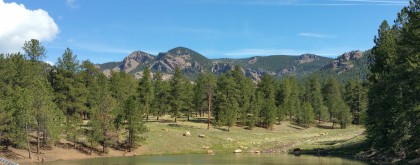 Beltane Moon of the Summer Solstice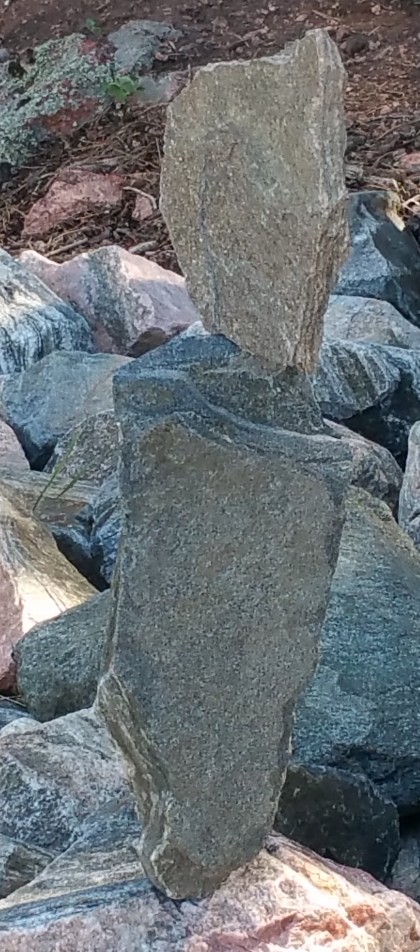

 This was important because the material I had prepared focused on deeds of loving kindness toward grandmother earth. Bonnie and Tara, both fluent in biblical Hebrew, gently put me back on course when I made a mistake. Their helpfulness made me realize, just now as I’m writing this, that there is a different way of being a presenter, one that relies on others as well as on preparation. I know, obvious right? Not to me because in the Christian religious culture and even in the UU culture the clergy presents and others react. The process can be dialogical, yes, but usually involves only reactions to the ideas of the presenter.
 Here are a few of the latter that I found especially moving:
 Again, from Buber, “Judaism does not divide life into the holy and the profane, but into the holy and the not-yet holy.” Another scholar, a man named Finklestein, adds, “Judaism is a way of life that endeavors to transform virtually every human action into a means of communion with God.”*

 Still working on how I will lead our mussar class next week. It’s been hard for me, mildly anxiety producing. First, I don’t have the depth, any really, in Jewish thought. The
  Thirdly, the whole Jewish immersion experience I’m having at Beth Evergreen is like learning a new language. I have some words and a very limited amount of grammar. I don’t want my naivete getting in the way of other’s learning.
 Kate and I sponsored the oneg last night at Beth Evergreen. Oneg means delight and in this use it’s a modest event after the sabbath service. It involves the kiddush prayer over wine, the passing of challah (a ceremony not coincidentally similar to the Christian eucharist) and having some sweets or other snacks. It’s similar to coffee after a Christian or U.U. service, but different in one significant regard. The Jewish sabbath, as a day of rest and renewal has a focus on good food and general delight, so the oneg both is that ideal and reinforces the larger sabbath ethos.
 Also want to include Aldo Leopold’s land ethic:
 The date of the presentation happens to be Emerson’s birthday. So, from Nature: “The foregoing generations beheld God and nature face to face; we, through their eyes. Why should not we also enjoy an original relation to the universe? Why should not we have a poetry and philosophy of insight and not of tradition, and a religion by revelation to us, and not the history of theirs? Embosomed for a season in nature, whose floods of life stream around and through us, and invite us by the powers they supply, to action proportioned to nature, why should we grope among the dry bones of the past, or put the living generation into masquerade out of its faded wardrobe? The sun shines to-day also. There is more wool and flax in the fields. There are new lands, new men, new thoughts. Let us demand our own works and laws and worship.” introduction to his essay,
  Here are some ideas about holiness from the parsha of a couple of weeks ago, Kedoshim. Leviticus 19:2b: “You shall be holy, for I, the Lord your God, am holy.” In commentary on Kedoshim the Conservative text* that I have quotes many famous Jewish scholars.
 I say perhaps intentionally because my reimagined faith could intersect with these ideas in a positive way, especially so if the locus of the divine is the individual soul, that part of us that connects with collective unconscious, Brahma, the three Sephirot: kether, the crown, chochmah, wisdom and binah, understanding, that part of the other to which we bow when we say Namaste. Or, as I quoted Buber earlier, “Holiness is not found in rising above one’s neighbors but in relationships, in human beings recognizing the latent divinity of other people…”
 Our next Sierra Club meeting will be on June 19th, one day before the summer solstice. Sierra Club work is paganism stripped bare of its mythic content. There is passion for sure, but not the poetry, no ritual, no inner work. It’s all outer work: hike, lobby, analyze, network, persuade. We may, for example, show the next Al Gore movie, Inconvenient Sequel: Truth to Power. See trailer below.*
 Somehow I need to find a way for my inner work to imbue my outer work. Todd, a long-time member of the Mt. Evan’s local group to which I belong, talked about a hike he took yesterday in Reynold’s Park. He named a particular orchid that he found and his face lit up. “A bullsnake, too.” It may be that these folks, tied to the very local region encompassed by our borders, find their inner work in being on the trail, hiking Mt. Bierstadt, taking the Mt. Evan’s road, helping clear trail.