Interesting intersection of past and present yesterday. In my Christian days, I explored many different forms of spiritual practice, including a Benedictine form called lectio divina. Turns out a Rabbi is teaching a version of lectio to other rabbis for use, in particular, with Torah study. Bonnie, a rabbi in training who attends Beth Evergreen, modified it to use in our Mussar study.
She read short passages three times, emphasizing different words each time and we all listened silently. She then gave us a brief time and introduced two questions about the passage. The idea was to react to the feelings generated, not the intellectual content. This is congruent with what I know of lectio in which language, often as little as one word, functions as a mantra rather than a message.
I found myself slipping into a comfortable place, going inside, considering my inner journey. It felt good. I hope we use the process more.
Kate has had her second Hebrew lesson. We plan to attend at least some of the high holy day services, beginning with Erev Rosh Hashanah, the first service of the Jewish new year.
Black Mountain, which is covered in lodgepole pine and actually green as a result, has small gold flecks this morning. Those few aspen groves on its slopes have begun to turn, as have more and more aspens between here and Evergreen, but not those on our property. Too, Orion appeared in the southern sky a week or so ago, the early morning southern sky. On Shadow Mountain Orion and the changing of the aspens are true harbingers of autumn.
The splashy colors of a Minnesota fall, when the remnants of the Big Woods flash their deciduous glory, are absent here, but Denverites flock to the mountains anyhow, going on “color” tours. The transformations of the Great Wheel, in all temperate latitudes, stimulate celebrations, holidays, ad hoc personal adventures.
Autumn, with its temperature changes, plant senescence, calm blue skies, the ongoing harvest and the beginning of school is one of my favorite seasonal transitions. Cooler weather increases my intellectual and spiritual energy, underscoring for me the upcoming holiday of St. Michael the Archangel on September 29th. I think it was Rudolf Steiner who referred to Michaelmas as the springtime of the soul. I know it was Tom Crane who introduced me to the idea.
I will be lucky enough to be in Minnesota in a week and a half. I’ll get a chance to visit that Midwestern fall, get pictures for the folks here in Colorado.
Two great quotes yesterday. One from our mussar group: I never saw a U-Haul trailer behind a hearse. The second from a comment on a NYT article on the meaning of life: You say No Matter, I say Never Mind.
Mussar. It’s September, the days are cooling down and years of Septembers have me getting ready to accelerate my study. This year a focus will be mussar.
Mussar is defined here by Rabbi Ira Stone, of the Mussar Leadership Program: “The most accurate translation of the word mussar into English is “discipline,” defined in all three ways we use the word in English. Mussar defines a discrete area of study, like the discipline of physics. It describes a practice, as in “it takes discipline to practice piano every day.” It also describes the act of correcting behavior, as in “you must discipline the child.””
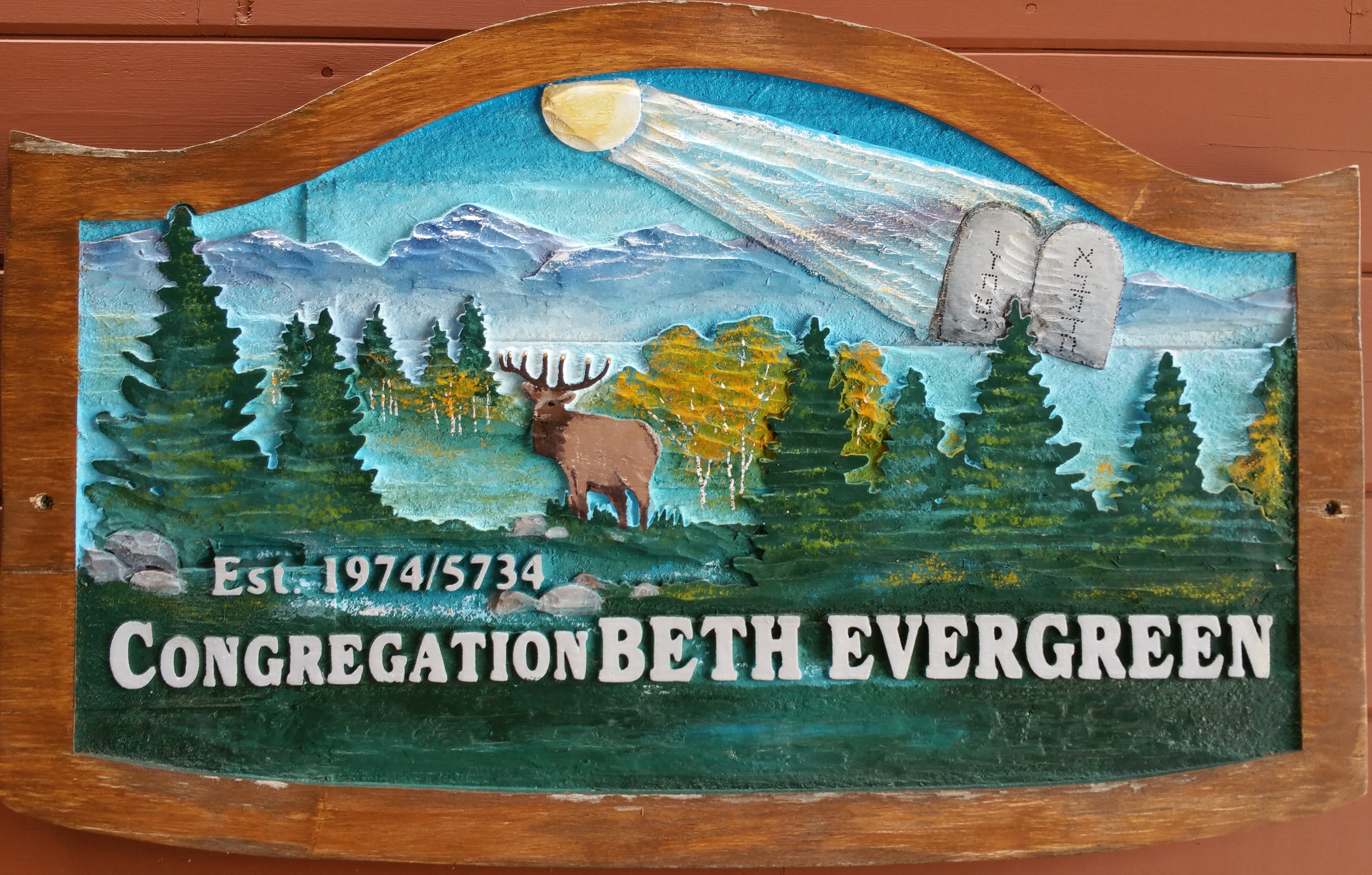
In our study of the Way of the Just, begun yesterday at Congregation Beth Evergreen (CBE) and led by Rabbi Jamie Arnold, we talked about the purpose of life. Rabbi Jamie offered what he said was a traditional Jewish perspective: Experience happiness fully. Experience sadness fully. And in the times between be content. Works for me.
It feels good to have some anchors in Evergreen now. Our work with Bear Creek Design will introduce us to the contractors who do work for them. Kate’s study of Hebrew and our mutual study of mussar has begun to open up relationships at CBE for CBE. This means Evergreen is no longer a destination only for restaurants and shopping, but also for community.
Caspar David Friedrich Wanderer Above the Sea of Fog (1818)
Fellow traveler. Back when America was great, like the 1950’s or sometime, fellow traveler was an epithet that indicated a person with sympathies for the communists. To be a fellow traveler meant shared understandings if not complete agreement. The aim of communism, an egalitarian society with the basic needs of all met, is still my dream. But, how to achieve it is as muddy to me now as it has been all my political life. True: I voted for Gus Hall for President in several elections.
There is, though, another sense to this term. A fellow traveler can also be one who is with, but not of, a particular group or thought-world. It occurred to me this morning that being a fellow traveler is an important part of my life.
This may be a deep flaw, but it is and has been an ancientrail on which I have walked often in my life. Let me explain. The most salient example right now is my involvement with Congregation Beth Evergreen, or CBE as they often shorten it. Being a fellow traveler with Jews and Judaism has been a consistent thread in my life since early college. That is, I admire Judaism as a culture and have found many friends among observant and non-observant Jews-not to mention a wife. Jews tend to approach the world as curious, skeptical, engaged people, people embedded in history and tradition. That worldview has appealed to me since my first anthropology assignment took to me a synagogue in Muncie, Indiana.
Maurice Denis Jacob Wrestling with the Angel
Kate’s a converted Jew and feels herself part of this ancient tribe. I do not. But Judaism continues to speak to me in its ethics, its ability to withstand constant suffering and abuse, its tribalism and in its ritual and spiritual practices. I am gradually becoming in, but not of, Beth Evergreen.
Even in seminary, I felt more like a fellow traveler with Christianity. Though I did immerse myself in the Christian tradition and its beliefs, its intellectual and cultural practices, its political message was more important to me than its metaphysics. Let justice roll down like an everflowing stream. Do unto others as you would have them do unto you. Suffer the children to come unto me. What you do to the least of these, you do to me.
I tried to merge my political passion with a religious sensibility, but in the end it became clear that I had got the stick wrong end round. Political purpose preceded religious conviction. Within any religious way that’s backwards. As a result, over time I became more of a fellow traveler with my colleagues and friends in the Presbyterian Church than a true believer. Throughout my ministry after ordination in 1976 I felt in, but not of, the church. Eventually, the tension between my purpose and the church’s purpose became too strained and the link between the two broke.
Politically I feel and have felt in, but not of, mainstream American politics. That is, political action has been another key ancientrail in my life, but I’ve had to engage it from a stance left of even the further edges of liberalism.
There are other examples, but you see the point. It is my habit to be with groups, but not of them. This is the deep flaw I referred to above. That same curious, skeptical, engaged, embedded in history (but not tradition) fellow feeling I have with Judaism keeps me just to the side of certainty, a seeker with little probability of arriving at his goal. By this point in my life I find this outsider role familiar and, for the most part, comfortable. But I wonder what it would be like to enter the world of the convinced, the believer? Am I missing out on an important element of life? I don’t know.
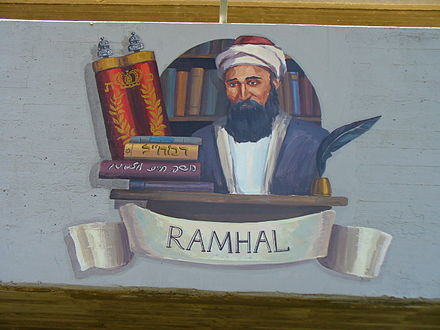
Moshe Chaim Luzzatto (ramhal) Wall painting in Acre, Israel
Yesterday in our Midday Mussar gathering we chose a book for study during the next year, The Path of the Just, “the Mesillat Yesharim an ethical (musar) text composed by the influential Rabbi Moshe Chaim Luzzatto (1707-1746).” Amazon tagline for the book.
I was in favor of using this text because Mordecai Kaplan, an early 20th century rabbi who founded the Reconstructionist Movement in Judaism, translated it in 1936. Studying his translation of this key mussar volume will help me understand the Reconstructionists as well as the spiritual practice of mussar. A twofer.
Though I have little use anymore for God (and, yes, if he/she exists, he/she may not have use for me anymore), spirituality and the search for a good and compassionate life are still critically important to me.
This mussar class is, too, something Kate and I attend together. It’s good to have a spiritual discipline, an ethical path to discuss and practice. The class itself provides us with some exposure to more mountain folk, increasing the possibility that I will eventually find a friend or two up here.
Bear Creek Designs has finalized our bathroom remodel plans. They start next week and estimate 4-5 weeks total. A zero entry shower may not be strictly necessary right now, but when it is necessary, I don’t want to have figure out if we have the money to make the change. We do now.
We went over to Bear Creek in Evergreen yesterday and discussed possible shower door options, an unexpectedly complicated chore due to the small size of the bathroom. The solution, move the shower valve to the opposite wall from the shower head, seemed counter intuitive until we explored all the other options. It allows us to maintain the zero entry which was the point of the remodel. So, we chose to do it.
Afterward we ate at Beau Thai. Get it? The food is better than the pun. It’s sister restaurant is a Himalayan spot only four doors away. Tom yum and green papaya salad. Since we still had a little time, we went to our favorite small shop in Evergreen, the Village Gourmet. Among many kitchen and home related items, the Village Gourmet also has a very nice truffle shop. We got four truffles plus some dishtowels and a plate to replace one broken over the weekend.
Then to Beth Evergreen for Midday Mussar. This was the fourth of four weeks in which we looked at classic texts in this long established Jewish spiritual tradition. Once we choose a text, next week, I’ll probably write more about mussar. It’s a very pragmatic discipline and worth knowing.
A woman we met recently was at the end of a four year saga waiting for a new kidney. She had diabetic neuropathy and finally found a kidney for transplant a few weeks ago. Her explanation of the transplant’s effect on her was eloquent. “I thought I knew about gratitude, but now I know I didn’t. This gift to me from a man who checked his organ donor box is beyond explaining. I now have to consider what I will do with the rest of my life. Which I will have. I’m going to live it to be worthy of the gift I’ve received.”
A taste of fall here. 42 degrees right now and cool weather tomorrow, too. A soaking rain yesterday.
Step-son Jon took Kate and me out to Carra Viejta, a Mexican spot just off 285 at Windy Point. Kate’s birthday. Good food and good company. Jon’s in much better spirits these days as the divorce moves closer to resolution.
Kate and I drove over to Congregation Beth Evergreen yesterday for another session of mussar, led by Rabbi Jamie Arnold. Over the last three weeks we’ve been discussing possible texts to use as the basis for study over the next year. One more this next Thursday. The three texts so far are: The Palm Tree of Deborah, the Way of the Tzaddikim and the Way of the Just. These are completely unfamiliar to me, which makes them interesting.
I get surprised occasionally. Jamie said yesterday, “We’ll have to see what our ancestors saw in these texts.” Not my ancestors. It’s interesting to be in but not of the conversation, I like it. Also, when the conversation turns toward G-d, I stop internally. I have to engage in a reconfiguration of the idea. What does G-d mean to the author here? Does the idea bring anything unique to the conversation or does it serve as a placeholder for something like: This is really important; or, take this seriously, dude; or, this is the best we could do in figuring out why should we believe this; or, this idea links us to all those in our 5,000 + year history who have believed this.
My impatience with religions of revelation has not waned. Revelation, word and practices with the imprimatur of divinity, has created so much bloodshed, so much cocksure wrongheadedness, so much diminution of the other that it seems like the opposite of what it claims to be. If there were a devil, it would be a clever ploy to create texts reputedly authored by God and spiked with so much absolutism that adherents to the texts would consider themselves an exclusively correct clan.
Outside dogmatic adherence to the idea of revelation most religious traditions have also devoted a lot of thought and practice to the question of the good life. How might we live? What are behaviors that respect all of G-d’s universe? How can we navigate the often muddy waters of our inner life? This is mussar. And kabbalah. And lectio divina. And the Way of the Pilgrim. And meditation. And the four noble truths. And the Tao Te Ching. These approaches to life as we live it here and now are among the great gifts of the world religions. They distill the wisdom of generations of sophisticated and nuanced thinkers, practitioners. It feels good to be learning another one.
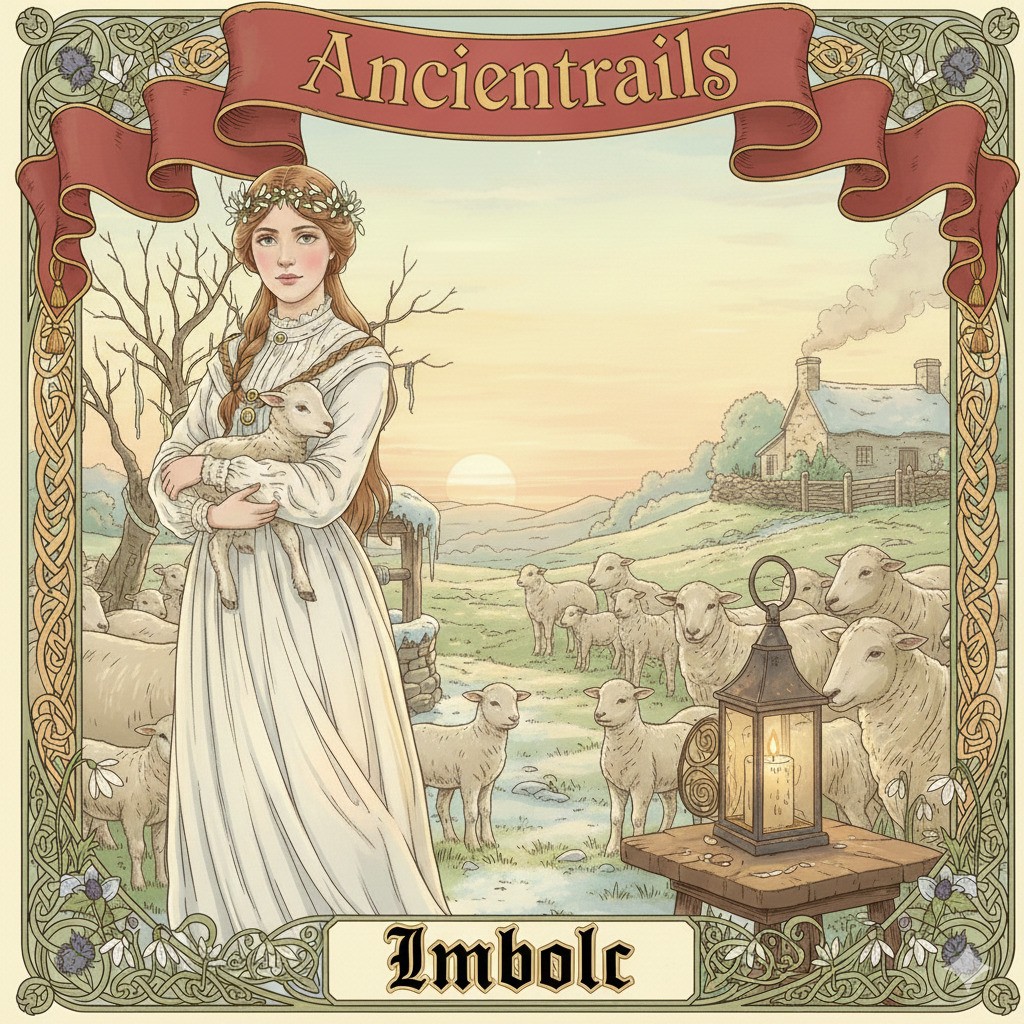
Lughnasa opens the harvest season, celebrating the Celtic God of arts and sciences, bright Lugh. Its emphasis on the harvest, however, comes in honor, not of Lugh himself, but of his foster mother, Tailtiu. (most of the information here comes from Myth*ing Links Lammas page.)
Tailtiu was, in a mythic rendering of Ireland’s ancient history, one of the Fir Bolg, the fourth of six peoples to invade and settle Ireland. The first three groups left the island or were eliminated, each one leaving an empty country for the next invasion. Tailtiu was a royal lady, a ruler among the Fir Bolg, captured when the Fir Bolg fell to the Tuatha de Danann, the fifth of the invaders. The Tuatha de Danann are a supernatural race who became the primary gods and goddesses of pre-Christian Ireland.
The conquering Tuatha de Danann forced Tailtiu to take on a decidedly unroyal task, the clearing of a great forest to create fields for agriculture. She succeeded, but in the process exhausted herself and died. Her body, buried beneath a hillock, the mound of Tailte, gave fertility to the newly made grain fields.
As the first year’s grain crops began to ripen, Tailtiu’s foster son, Lugh, decreed funeral games be held in her honor. They were held, in the beginning of August, at the mound of Tailte. Over time these games at the start of the harvest season became common throughout Ireland. Market days and ceremonies that honored not only the grain harvest, but the work of those who farmed the earth, became part of Lugh’s original celebration of his foster mother.
Tailtiu might have been an earlier goddess of the earth. In this understanding, which makes mythic sense, Lughnasa gives prominence to the sacrifice of the soil, necessary for a crop to grow. Myth*ing links quotes an article by Mara Freeman on an earlier name for the festival, Brón Trogain, which refers to the painful labor of childbirth.
The funeral games for Tailtiu, and the subsequent extended festival known as Lughnasa, have continued life in the U.S. as county and state fairs. The early Irish and Scots immigrants to this country brought their harvest celebrations with them. The last of the three harvest celebrations, Samhain, the end of the harvest and summer’s end, we celebrate as Halloween.
Mussar. I mentioned it a while back. It’s an old spiritual discipline in the Jewish tradition. Rabbi Jamie teaches a class each Thursday at 1 pm and Kate, the new member of Congregation Beth Evergreen, and I went today.
The big takeaway from today’s session for me was about stimulus and response. Mussar, the Rabbi said, is about lengthening the time between stimulus and response. The longer we can wait between an external or internal event and our response to it, the more options we can choose. Each month mussar practice encourages the practitioner to take a different middot, or virtue, and concentrate on it. This is an emphasis on character as a religious matter. The longer time between striking the match and lighting the fuse, the better chance we have of living out a virtuous character.
This was familiar ground for me and it felt good. I’ve learned from many spiritual practices over the course of my life and mussar will be beneficial, too.
Kate’s meeting with Rabbi Jamie of Congregation Beth Evergreen today. A joining up meeting. This is an ancientrail she began to walk a long time ago, converting at Temple Israel under Rabbi Max Shapiro. She felt at home within the Jewish tradition. The power of feeling at home, that this place is my place, these people are my people, may be the most significant feeling we ever have. Why? Because it locates us, puts us in context, gives us a base.
Last night we attended a learning session for the chevra kadisha, a burial society that guards a person’s body from the minute they die to the point of burial. They also wash the corpse, may wrap it in a traditional shroud. They do all this anonymously.
We watched the movie, Taking Chance, about the process and journey of caring for the body of pfc. James Phelps from his death in Iraq to his burial in Wyoming. Though focused on military ritual, it apparently conveyed much of the Jewish attitude toward honoring the dead and caring for the corpse in a respectful and dignified way.
Jewish tradition and the Jewish faith cannot be separated. This is a thousands year old culture that has survived many dislocations, much persecution and yet retained its link to the very distant past. Rabbi Jamie said the origin of the guarding of the body was quite literal, coming from a time when wild animals might approach a corpse as scavengers. Obviously a long time ago. But the respect and care that began in this practical way has been transmuted in the alchemy of time into a spiritual practice.
This is not my way; but it is a way, one with depth. I look forward to learning more about this ancient faith and walking with Kate along her path.
 Interesting intersection of past and present yesterday. In my Christian days, I explored many different forms of spiritual practice, including a Benedictine form called lectio divina. Turns out a Rabbi is teaching a version of lectio to other rabbis for use, in particular, with Torah study. Bonnie, a rabbi in training who attends Beth Evergreen, modified it to use in our Mussar study.
 I found myself slipping into a comfortable place, going inside, considering my inner journey. It felt good. I hope we use the process more.
 Black Mountain, which is covered in lodgepole pine and actually green as a result, has small gold flecks this morning. Those few aspen groves on its slopes have begun to turn, as have more and more aspens between here and Evergreen, but not those on our property. Too, Orion appeared in the southern sky a week or so ago, the early morning southern sky. On Shadow Mountain Orion and the changing of the aspens are true harbingers of autumn.
 Mussar is defined here by Rabbi Ira Stone, of the

 Politically I feel and have felt in, but not of, mainstream American politics. That is, political action has been another key ancientrail in my life, but I’ve had to engage it from a stance left of even the further edges of liberalism.