Category Archives: Commentary on Religion

Old Stories, Old Poems, Old Men

Imbolc                                             Waxing Bridgit Moon

Jacob and Esau and Rebekah and Isaac came to life tonight as we felt our way into this peculiar, even troubling story of deception, betrayal, theophany and a redemptive moment followed by a warm hearted, unexpected ending.  These stories still resonate, still have the power to grab the attention, hold the heart and propose new perspectives.  These are stories by and for men, archetypal moments held close to the heart for thousands of years.

After the reading of these stories and a conversation that followed many paths, a few left for bed:  Mark, Scott and Tom while Paul, Stefan, Charlie H., Jimmy, Warren and I sat up reading poems or, in Paul and Jimmy’s case, reciting poems from memory.  Poetry comes alive when one poem sparks another and books come out, dogeared and ragged from much use.  Rilke, Frost, Oliver, Pauly, Sarton, Rumi all visited us, speaking across the centuries or the decades, speaking directly into the heart.

A magic, spontaneous moment, the stuff of which retreat memories are made.

When the Bell Tolls, It Tolls For Me

Imbolc                                      Waxing Bridgit Moon

Here I am, a heretic beneath the bell tower of Blue Cloud Abbey, sitting at this mobile scriptorium, pecking away at the keys.  The bell tower rises outside the window, a jet passing by, contrail at an acute angle toward the north, a metal angel streaking like Icarus toward the sun; a sun, obscured early by the western wing of the retreat center, that this morning draped a bloody red-orange mantel over the far horizon, visible for miles from this point, 900 feet above the floor of the otherwise flat prairie.

When the bell rings, which it does every quarter hour once, every half hour twice and the  number of the hour on the hour, I fly on the time machine of sound back to the middle ages when the sound of the bell determined the compass of a parish, all within the sound part of the same community, an aural community, knitting itself together every half hour.  These days, these latter days, these 21st century days the bell could not be heard over the rumbling engines of trucks bearing cookware, basketballs and note-book paper, cars scurrying here and there with people, like small loud beetles set loose on the hardened surface of mother earth.

How do we know what community we belong too, now, now the bell’s sound has become muffled?  Could it be that this very medium (there goes the bell, ringing 3:00 pm), these bits and bytes that travel from this prairie monastery, constitute our new bell tower?  A quiet sound heard world-wide, making us one people, one community, one pale blue marble in a vast ocean of airless space?

We ate lunch today with the monks in their lunchroom, a wide, long room with the animals symbolizing the gospels painted on a mural, done in a style reminiscent of Northwest Coast Native American design styles:  an ox, an eagle, a lion, a winged human.  Some of the monks wear the black robe, others blue jeans and sweaters.  Some of the monks have become stooped by age, while others, younger, would not be distinguishable from any one at the counter of a Marvin, South Dakota coffee-shop.  I had spinach, a vegetable medley, two peaches and a bit of tuna salad.  Fare fit for a simple life and just fine with me.

I find myself wanting to come here by myself, perhaps for two weeks or so, to concentrate on my Latin, on finishing the novel I’ve already well begun.  Perhaps I will, one of these days, if Kate’s ok with it.

Externally, We Swim In the Same Ocean, but…

Winter                                              Waning Moon of the Cold Month

“Man must cease attributing his problems to his environment and learn again to exercise his will — his personal responsibility.” – Albert Schweitzer

Schweitzer was a favorite of both my mother and my father, his “reverence for life” must have rung loudly in the ear of the WWII generation.  I find his Christianity, though unorthodox, still too orthodox for me these days.  This quote seems to lean against the interrelatedness voiced by MLK and quoted here recently and put that inflection point back on the individual.  In most ways I agree with it from  a personal perspective, a focus on the existential predicament decided by emphasizing personal choice rather than the web of influences from genes and nurture.

As I’ve reflected on the notion of interrelatedness over the last month or so, and commented on it by using the idea of inflection, that is a mental tick by the perspective most important at the moment, this dialectical, tension of opposites approach, seems more and more sound to me.  What I mean is that, yes, we are in this together and that, yes, the fate of even the most vulnerable and neglected bears on our own, while at the same, yes, we live alone and will die alone, never really bridging the gap between our interior and that of the Other.  Externally we swim in the same waters as one larger organism, a sort of super-0rganism, while internally, we paddle alone in our single kayak traversing the vast expanse of the inner world.

On a less abstruse note, well, a bit less abstruse anyhow, I did very well on my Latin session today.  I’ve decided it takes me 4-6 hours to get through a Wheelock chapter and the particular grammatical points presented there, along with exercises.  Greg said that was about right.  So, I might as well lean into it and learn it right the first time.  Then, he says I have to read, read, read.  I’m thinking about picking up some Caesar and maybe some Tacitus since they write in prose and that’s easier than the convoluted word order of poets like Ovid and Virgil.  I’m sticking with Ovid as my Northstar in all this, but reading some stuff where I’m not stumbling over words and phrases lines apart that belong together might be fun.

Free Speech and Fast Saints

Winter                                                 Waxing Moon of the Cold Month

Cameras and inks and papers, oh, my!  Then, new glasses and seven bags of groceries.  We’ve been gone and the larder was bare of important items like milk, turkey slices for the dogs, veggies and fruit, bread and bagels.  Now it’s not bare.

JPII is on a fast-track for sainthood.  Just like today.  Fast foods and fast saints.  Just can’t wait, can we?

JPII’s successor, the German Shepherd, has taken on major moral issues recently, like, the right name for your kid.  No weird ones.  He’s also cranked up the heat, already at record highs set by JPII, on theologians teaching at Catholic schools, gays at mass and those pesky liberation theologians.  Whoever said the divine right of kings is dead?  It lives on in its last bastion, Vatican City.  (pic.  Yikes!)

The whole Gifford/Tucson shooting controversy.  We have rule of law and one of those rules is no prior restraint.  This means that we cannot stop someone from committing a crime until they’ve actually committed it.  This gives us big trouble with at least two categories of persons:  pedophiles and psychotics, especially paranoid psychotics.  We know the probability of their offending is high, but until they act out there’s nothing we can do.  Anyone who has dealt with the seriously mentally ill knows the difficult line walked in their care and treatment, a line between limiting freedoms and giving the individual a realistic chance at living in community.

Does this mean that the gaseous explosions protected as free speech had no affect on Loughner?  I doubt it.  Some peoples minds are more porous than others, more open to outside influence.  It’s not hard to imagine a scenario in which a paranoid psychotic decides that Rush Limbaugh actually knows what he’s talking about, that Sarah Palin is a respectable political figure.  O.K.  Maybe only a paranoid psychotic would think either of those things, but it only confirms my point.  His actions did not exist in a vacuum.  Neither did lynchings in the rural south nor do gay hate crimes in many (most?) parts of our country.

Can we or should we stop Limbaugh, George Beck, Sarah Palin, the tea party gas bags from using inflammatory rhetoric?  Regrettably, no.  Part of the idea of free speech is that discerning citizens will tell the demagogue from the statesman, the propagandist from a public servant.  It does appear that discernment may well be at an all time low in the current US, but it’s not the first time.  Those of us with other views must speak, too.  And act.

Gut Check

Winter                                                                    New Moon of the Cold Month

Last Monday night I ate dinner with my friends, six of them, at a restaurant, the Bukhara, which carries on the Mughal influenced culinary tradition of Northern India.  On the way home I got a gut check on my world view.  There was a light snow, the temperature hung at zero and the lights of other cars and trucks reflected off melted water on the highway as I headed toward Coon Rapids.

Near the intersection of 494 and Rockford Road some part of me, a deep part, reached up and said, your friend’s wife may die.  That part went on, speaking in images and feelings as the deepest parts of us do.  The reflected highway, a skidding truck, my death.  What then, Charlie, it asked?  What then?  Another aspect of my Self, perhaps even the same part asking the question, raised up an image from an old movie about Rome, The Fall of The Roman Empire.  Why?  What?  Oh.  Alec Guiness.  Marcus Aurelius.  A principled man, a Caesar, a Stoic.  The author of the Meditations.

How did this relate?  The epitaph.  Reported as the most popular of ancient Rome:  I was not.  I was.  I am not.  I don’t care.  Stoicism and a principled approach to this life.  Cast aside the final, eternal question.  Unanswerable.  Unknown.  Most likely unknowable.  Still act.  Still live.  Still care.

The windshield washers snicked, dirty water thrown up by vehicles in front of me cleared and I was back on the highway, headed toward 694.  And I knew.  Yes.  The deepest part of me knew, too.  Yes.  This life.  For all I’ve got.  This one.

Listen, This New Year’s Night

Winter                                                                       Waning Moon of the Winter Solstice

Have you ever been touched, brushed by a faint wing as it passes?  Perhaps a brief hesitation in an other wise confident progress, or a stutter in your step as you return home?  Some of us feel the passing of these birds of pray more than others.  We’ve not yet perfected the thickness, a protection against stooping falcons of unrest, leaving our Selves out there, unprotected, waiting for the faintest grazing, perhaps seeking it, knowing the tentativeness is real, life fleeing either before us or behind us, who can tell which?  Until it fails us altogether.

I’ve always been this way, though it got a burnishing after I entered college and studied philosophy, then anthropology.  Doubt, skepticism, questions come so naturally to me I have trouble noticing when they take me too far, leave me out there, dangling by myself, a victim of my own questing beast.  In my life there is no such thing as certainty.  Perhaps I was born post-modern, always aware of the interpreter, always aware of the Self as interpreted, subject to oceans of ideas, rivers of feeling, no life guards on this beach, the tide out, vanishing out to sea.

It sounds, I don’t know, dark, or at least gray, but I don’t experience it that way.  Instead, I take in things anew, fresh, not as expected, but as inspected, weighed, considered, felt.  This gives life a newness, a just been seen character that, no matter how exasperating to the other, gives me a world born again with every breath, every step, every sight.

It also means you can’t count on me to agree with you, can’t trust my perception of things since it’s so idiosyncratic, in fact, I don’t trust the things I perceived a day ago.  Perhaps this is true of everyone though I doubt it.  It is the fruit, whether rotten or delicious, of trying to know myself.

When I set foot in Delphi, walked the sacred way up to the temple of Apollo and put myself on the ancientrail of others seeking wisdom from the oracle, I was at my holy of holies.  Here you either learned to know yourself as the sign on the door way commanded or risked losing a kingdom.  Just ask the shade of Croesus.

Listen, this new years, for the sound of flight, air moved aside by feathers, softly.  It might be a raven who owns the sun, or an albatross who has ceased to follow the Ancient Mariner.  If you hear her, go still, watch.  Perhaps you can follow toward those caverns measureless to man.
Banned Art

Winter                                                             Waning Moon of the Winter Solstice

I have now seen “A Fire in My Belly.”

What did I think of it?  Much of the movie disturbed me:  scenes of lucha masked wrestlers throwing each other to the mat, a grainy clip of bull fighting, occasional interpositions of an Aztec priest lifting the heart out of a sacrificial victim, gamecocks fighting to the death, legless beggars walking a city street and panhandling in traffic, a man’s mouth being sewn closed, young boys breathing fire on Mexican city streets to make a few coins.  Frankly, the ants crawling across the crucifix, I didn’t see them biting the ivory figure but maybe the Catholic League paid closer attention, didn’t have near the shock value I anticipated from the news releases and very little compared to the much more violent or voyeuristic images I’ve already mentioned.

I’ve added some material below from the Catholic League and the Walker.  The Catholic League’s argument is a farce from a logical perspective.  It suggests, for example, that because the first amendment prohibits the state’s establishment of religion that it should not be able to fund things that “bash” another.   Whether or not this is bashing may lie in the eye of the beholder, but the argument that prohibiting establishment somehow contains a negative constraint against critiquing religion just doesn’t follow.  At all.

As a work, I found “A Fire In My  Belly” obscure as to meaning and intent, though with some powerful images that display the underlying violence of Mexican culture.  Just why he chose the savagery of Mexican cockfighting, wrestling, bull-fighting and human sacrifice, I don’t know, but linking it to the kind of brutality that could crucify a god on earth seems like a powerful pro-religious statement.

Images of Coatlicue, She of the Serpent Skirt, show up frequently in the film and may provide an interpretive key.  Among other things, she is the birth giver from whom all life comes and to whom all life must return in the eternal cycle of death and rebirth. An art historian familiar with this sculpture from the Mueso de Antropologica in Mexico city, says:  “In effect she symbolizes the earth, but also the sun, moon, spring, rain, light, life , death, the necessity of human sacrifice, humanity, the gods, the heavens, and the supreme creator:  the dual principle.”  (material quoted from The Flayed God, pp 220-223)

Thus, her presence signals the deeper mythic significance of the individual images from Mexican culture and places the crucifix, certainly bound up in the eternal cycle of death and rebirth, in an artistic context.

This is not an easy piece, either viscerally or art historically, and may be as much a cry of pain as anything else.  The more I think about it, the more powerful it becomes.  So there, Catholic League.

Continue reading Banned Art

Good-Bye, Ike

Winter                                                      Waning Moon of the Winter Solstice

The oldest cousin on my mother’s side died on Christmas Eve.  Isaac, Ike, Jones always had a special place in the family as the first child of my mom’s five siblings.   The last of mom’s siblings, my Aunt Roberta, died several years ago and we cousins became the older generation.  Now, for the first time, death has invaded our numbers.

Ike’s death was, in many ways, a blessing.  A victim of a nasty spinal condition that left his head permanently inclined forward, Ike suffered a bad fall in March and never really recovered.  In the end his lungs gave out.  We weren’t close, perhaps he was the most distant of all the cousins, but he’s still family, part of us and now part of our memories.

No one really knows what death, the most shrouded ancientrail is like.  Does life just wink out with the last breath, the last heartbeat, the last brainwave?  Jews believe the spirit stays around the body for a few days, thus the careful and personal treatment a corpse receives in traditional Jewish practice.  My friend, Gyatsho, believed that after 49 days his soul got a new incarnation based on karma and the attitude near death.  Many people in the obituaries believe the dead meet Jesus, or go to heaven, or greet family and friends who died before them.

You never see it in the obituaries but some believe in a place of eternal punishment, the last fork on the ancientrail leading to hell.

I have no idea what happens after death though the most likely thing to me is extinction.  We simply become no more as a Self, eventually dispersing our elements back to the universe from which they came.

The Greeks, it seems to me, had the most cogent idea; that is, we live in our deeds, our family, our legacy.  Even so, for most of us, the legacy will not amount to much, perhaps a generation’s remembrance at Thanksgiving meals, family reunions.  Then, we’ll become one of those sepia photos  a later generation will pick up and say, “Who was this?”

Or, perhaps not.  It’s possible that the internet has become an engine of immortality, allowing our words, pictures, even our consumer habits to live on, perhaps in the cloud?  In this case perhaps my great-grandchild will access Ancientrails much as you do, reading of one life, at least the bits and pieces that end up on a page or in photographs.  What might we call this?  ByteLife.  CyberMemory.  Life in the Cloud.  SiliconeForever. (no, wait, that’s those breast implants.)  Life According to Electricity.

Missing Spirit

Winter                                                            Waning Moon of the Winter Solstice

Wondered if I was missing something.  Turned on the radio to 99.5 and listened to Christmas music, classical variety.  As I just to wrote to my brother and sister, there is some residual Methodist wandering around in my head, recalling those nights in the church on John Street, candles winking out as congregants extinguished them, leaving the sanctuary in darkness, a voice, in this particular instance, a voice from the Metropolitan Opera, a hometown gal who’d made it big in the big city, singing out of that darkness, O Holy Night.  Still sends shivers up my spine.

There is, too, a small boy waiting for Santa Claus and the luster of mid-day on objects below.  He misses the Christmas tree and the presents and the music.  And family.  Perhaps most of all family.

These both are, however, voices from my past, valued and warmly received when they emerge, but no longer vital in my present, just as the music of the 60’s or the cars of the 50’s still recall a good time, an important time, but a time now gone by.

I pressed the cd button and returned to the lectures on Big History, this time a review of the paleolithic, a historical era critical for our species, but often overlooked.  In this time we migrated first to the southern rim of Asia, then across the waters to Australia, and through Asia, across the land bridge to North America.  Each one of these migrations a test for our new specie’s capacity for collective learning, each one requiring a new set of skills, new tricks to wring energy and resources out of a new environment.  These were tests we passed and in that passing set the stage for our current dominance of the earth’s biosphere.

Christmastime and the Christmas spirit no longer enfolds me as it once did, sweeping down after thanksgiving and placing me in the confusing mix of retail extravaganza and high religious celebration.  Now the Solstice carries some of that numinosity for me, but none of the commercial buzz.  I don’t miss the maw of gifts and money and credit, false gods if ever there were ones.  Quiet, calm, still.  Dark, meditative, inward.  That’s the reason for the season for me now.

So, I’m glad for a place of peace as the Christmas machine churns anxiously all around me.  Still into the incarnation though.

The Longest Night of The Year

Samhain                                                            Waxing Moon of the Winter Solstice

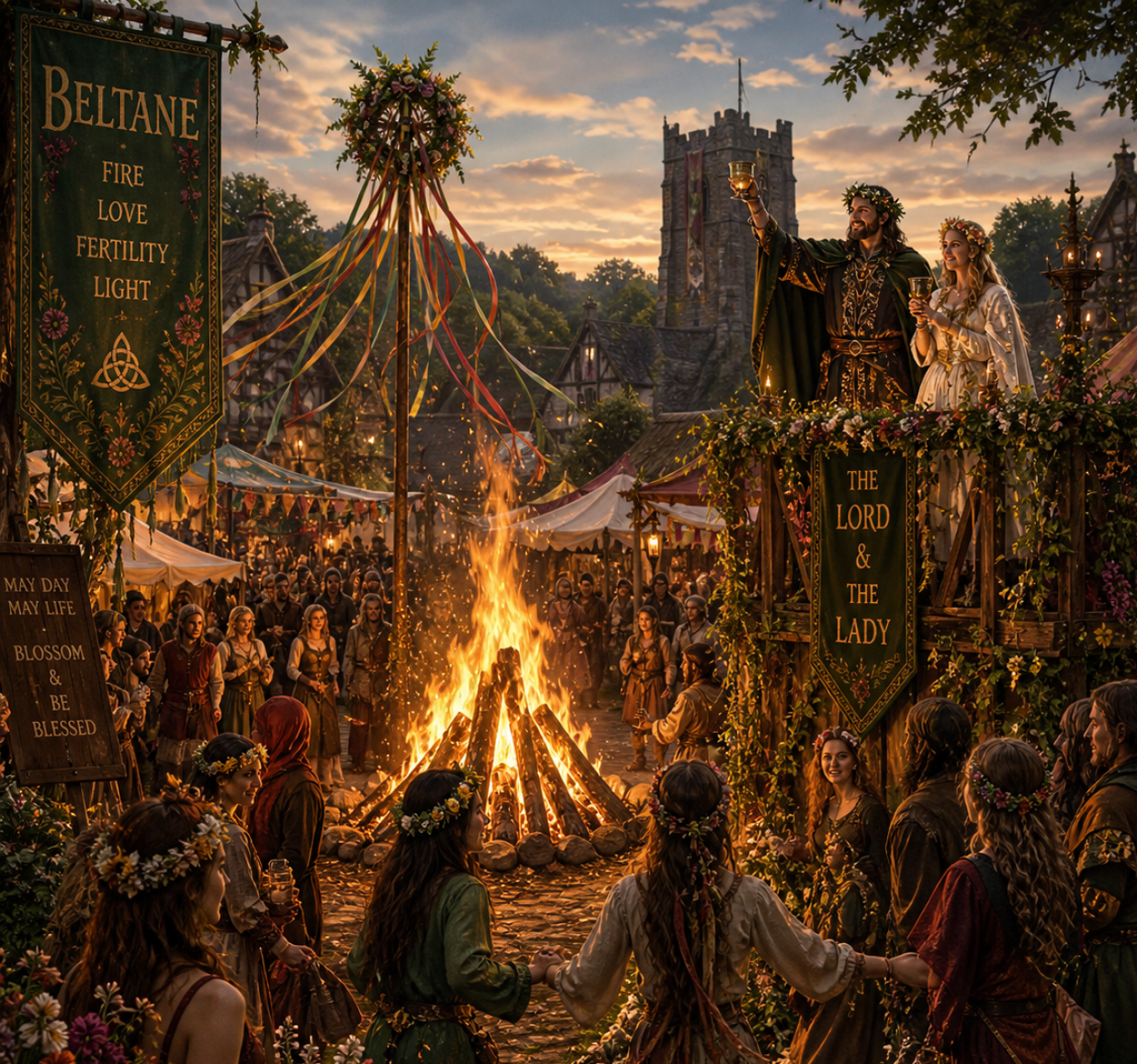
In my sacred world the holiday season has begun to climb toward its crescendo, or, rather, descend.  Would that be a descendo?  As I gradually shifted my view of sacred time from the Christian liturgical calendar to the ancient Celtic calendar, at first I celebrated Samhain, Summer’s End, as my foremost holiday.  It is the Celtic New Year, representing the end of the old year, too, Janus like, like our January 1st.   The growing season ceases and the long fallow season begins as Beltane ends, the season of growth and harvest.  I liked this simple, incisive division of the year, growth and rest.  Samhain also sees the thinning of the veil between the living and the dead, between this world and the other world, between our reality and the reality of faery.  Life takes on a numinous quality around the end of October and the beginning of November.

In the years when I celebrated Samhain as my chief holiday I began novels then, ended projects begun in the earlier part of the year and thought a lot about ancestors and the delicate, egg shell nature of life.

Samhain still represents a key moment in my sacred year; but over time, as I worked with the Great Wheel, an expanded Celtic calendar that added Imbolc and Lughnasa to the solar holidays, equinoxes and solstices, my soul begin to lean more and more toward the Winter Solstice.  At some point, I don’t even know when, I began to look forward to the Winter Solstice as I once had to Christmas and after it, Samhain.  This was a quiet change, driven by inner movements mostly below consciousness.

Now the longest night has that numinous quality, angel wings brushing by, contemplation and meditation pulsing in the dark, taking me in and down, down to what Ira Progroff calls the inner cathedral, though for me it is more the inner holy well, that deep connection drawing on the waters flowing through the collective unconscious.  I’ve been to a few solstice celebrations, but none of them grabbed me, made me want to return.

I’ve become what the Wiccans call a solitary, practicing my faith at home, according to my own rhythms and my own calendar.  At times I’ve shared my journey through preaching at UU congregations or writing seasonal e-mails and sending them out, but now I write something on this blog and post it on the Great Wheel page.  Otherwise, on the Winter Solstice, my high holy day, it’s a candle and some reading, long hours of quiet.  This Tuesday.  The longest night of the year.