Category Archives: Great Wheel

The Solstice of Summer: 2011

Mid-Summer                                                                    Waning Garlic Moon

A favorite website of mine, Pip Wilson’s Almanac, comes out of Australia and reminded me of this illustration with his cheery, Happy Winter Solstice.  Yes, indeed, cross the equator and the seasons switch, while we have the Summer Solstice, they have Winter.  I’m excited about our cruise for many reasons, but a particular one is that we will cross the equator and enter the realm of season’s opposite to ours here in the Northern Hemisphere.  Thus, we will cruise through Chile and Argentina in their spring time heading toward summer, while our home here in Andover experiences fall heading toward winter.

Here at 45 degrees north we celebrate now the middle of summer, the moment when, usually, our temperatures have begun to heat up.  Not this year.  As Pip Wilson points out, today is not mid-summer, that comes on June 24th, St. John’s Day, which is the traditional sabbat.  That is the day celebrated in Shakespeare’s “A Mid-Summer Night’s Dream.”

The Solstice, on the other hand, is an astronomical holiday, that moment when sun stands as high in the sky as it will all year.  Now we celebrate the longest day, the longest proportion of light to dark.  In Australia they celebrate the reverse, the shortest day and the longest night.

You may celebrate this on the 21st, the 22nd, or the 23rd since they all have the same long day.  Only on the 24th do days begin their long, slow descent toward the longest night of the year.

This is the midst of the growing season though the year has been chilly and generally wet so far.

I always take time around now to celebrate what grows well for me right now and what needs attention to move toward harvest.  There is, still, that novel out there, which needs lots of attention.  My work with Ovid has grown a good deal in the last few months and will benefit from yet more time.  The Sierra Club demands more and more of my time and my hope is that over the next few months we can push our legislative efforts into greater and greater strength.  I’ve been concerned for a while that we’ve been punching below our weight and it’s my feeling that the environment and the state need us at our best.  This is a slow time for tours at the MIA, but it is a time when those of who give tours can concentrate on getting the best resources made available to us.

What is it that grows in your life right now?  What needs more attention?  What has a good start toward the harvest?  Take the time to sit with a plant or two in your immediate surrounding and watch how they grow.  Become patient with yourself as a plant is patient in its growth over a season.
Horticulture

Beltane                                                              Waxing Last Frost Moon

Gardening commends itself in several ways, but two are most important to me.   Having life tuned to the seasonal and daily rhythms of heat, light, rain, snow, even frost like we have predicted for tonight, grounds me.  If the frost comes and I have nothing outside to protect, it is a passing phenomenon of little interest.  With delicate plants to protect I know what it means, cold enough to cause ice crystals inside plant cells to burst.  Likewise drought is of no notice to me if I live in a condominium or on a city lot where my grass and a tree or two are my only contact with the plant world.  With a vegetable garden, though, the plants dry up, don’t produce.  I have to consider the drought, see that my plants get adequate water.

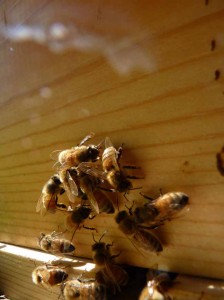
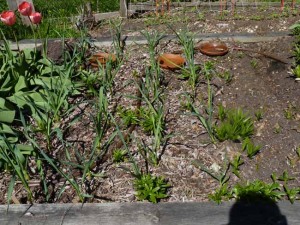
When the rains come, followed by warming days and the seeds leap up through the soil, when the potato eyes push a stalk and early leaves through to the surface, when those leeks nurtured since early April stand up and begin to fatten, it matters to me.  Their work, much like the bees, comes from their essence, not from anything I do, but, also like the bees, I have a role, to protect them, to see they have what they need.  We work together, the vegetables, the fruit trees, the currant and gooseberries bushes and the bee colonies.

The food that comes from our garden does not see us through the winter, though some of our crops, like potatoes and garlic for example last that long, but eating close to the land, lower down the food chain, happens more naturally when some substantial part of the diet comes from home.  So, the food alone serves as a final link to the growing process, but as a present symbol of the food available in the vegetable world, it paints into our world color that needs to be at our table all year round.

This, then, has come to pass as my new faith, a link with the earth and its fruits, a role in caring for them and the constant reminder of our dependency, our interdependency on it all.  When I began to work with the Sierra Club three plus years ago, I did it to put my political experience to work on behalf of the living world, in part at least as a thank offering for the sustenance I have received from it all these many years.

A Northern Spring

Beltane                                                              Waxing Last Frost Moon

This northern spring, a season all its own, as is the northern summer, has turned cold and wet.  Again.  The cold weather vegetables have had a near perfect early growing season.  This combination of occasional heat followed by cold and rainy days marks the uncertainty, the ambiguity of our spring, often a time when the weather is neither this nor that, a variety.

Later,  in another three to four weeks at most, we will trend hot and hotter, finding ourselves by mid-summer in heat rivaling our southern states.  As the days heat up, the vegetables and the fruits will flower, become pregnant, then fruit, giving us the food we love:  tomatoes, beans, potatoes, apples, pears, cherries and currant.  Perhaps this year, with the transplanting even the gooseberries will yield.

Then, by mid-to-late August, the evenings will begin to cool, though the days remain warm.  The sky will become an impossible blue, a color found only in the heart and the mind’s eye.  This sky absorbs all earthbound thought and transforms it into the higher concepts of heaven.  This signals the onrush of the harvest season.

Blessed be.

Real Religion

Beltane                                                     Waxing Last Frost Moon

“The real religion of the world comes from women much more than from men – from mothers most of all, who carry the key of our souls in their bosoms.” – Oliver Wendell Holmes

Especially true if you insert mother earth for mothers and nature for women, viz.  The real religion of the world comes from nature much more than from men-from mother earth most of all, who carries the key to our souls in her bosom.

I am just back from seeing Leslie give her final presentation at Groveland.  Ran into Bill Mate.  He’s been doing work for the Methodist Church in New Orleans.  Sounded fun.

Wow.  No nap yesterday plus 5 hours driving, then up early for going into St. Paul to see Leslie.  Got hit by a sudden need to lie down and sleep.  Did so.  Better now, less foggy.

When I got back, Kate was in the front, raking and planting, earth mother to mother earth.  I made pizza, then crashed.  Still waking up.

Light rain, warm.  80’s in the forecast.  Spring, it seems, may have finally arrived, well after it has come and gone as a Celtic season.

Beltane 2011

Beltane (May 1)                                                        Waning Bee Hiving Moon

A bit about how I got interested in the auld religion, the ancient Celtic faery faith and from it, the Great Wheel.

23 years ago I left the Presbyterian ministry and wandered off into a life I could never have anticipated.  The writing turn I took then led me to investigate my Celtic past, the heritage of my Welsh and Irish ancestors.  I learned about Richard Ellis, son of a Welsh captain in William of Orange’s army who was stationed in Dublin.  After his father’s death, his mother paid Richard’s fare to America, to Virginia, where he was to become heir to a relative’s land, a common practice at the turn of the century since children died so often.  This was 1707.

Also a common practice at the turn of the century was a ship captain’s larceny, stealing Richard’s fare and selling him into indentured servitude in Massachusetts.   Richard went on to found the town of Asheville, Massachusetts and become a captain in the American Revolution.

My own other Celtic ancestors, the Correls, were famine Irish, part of the boat loads forced out of Ireland by the failed potato crop, or an Gorta Mór it is known in Gaelic, the great hunger. (Incidentally, this was due to planting potatoes as a mono-culture, much like we plant corn, soybeans and wheat today.)  They came to this country in the mid 19th century.

I did not go into the history of Wales at the turn of the 18th century, nor did I investigate the an gorta mor and its aftermath.  Instead, I went further back, into ancient Ireland and Wales; in fact I looked at all the Celtic lands, Isle of Mann, Scotland, Brittany and Galicia as well.  What fascinated me then, and still does now, was the auld religion, the Faery Faith, as represented in The Fairy Faith by W. Y. Evans-Wentz, more famous as the translator of the Tibetan Book of the Dead.

Not long after leaving the Presbyterian ministry I packed my bags for a week + at St. Denioll’s, a residential library in Hawarden, Wales.  While there I wandered northern Wales, visiting holy wells, castles and Welsh villages.  There was also an extensive collection of Celtic material at St. Denioll’s. Continue reading Beltane 2011

Rainfall as Destiny

Spring                                                       Waxing Bee Hiving Moon

Let the rainy season begin.  Thunder in the forecast for tomorrow.  That means Rigel slinking around, barking at the sky, and, with Sollie and Gertie here, amping up the possible opportunities for red in tooth and claw encounters.  Temperate climates change the game every three months or so, just to see if we’re still alert.

There is an argument in the Star-Tribune today that correlates 50-100 mm of rain a year with democracy.  This is a new version of an old staple, geographical determinism, now sometimes called environmental determinism.  In essence geographical determinists equate a particular land form or climate with political destiny. An explanation from about.com is below.

“The main argument of environmental determinism states that an area’s physical characteristics like climate have a strong impact on the psychological outlook of its inhabitants. These varied outlooks then spread throughout a population and help define the overall behavior and culture of a society. For instance it was said that areas in the tropics were less developed than higher latitudes because the continuously warm weather there made it easier to survive and thus, people living there did not work as hard to ensure their survival…

By the 1950s, (my emphasis, note that this perspective held sway in geography until recently, and, in fact re-emerges now and then.  See today’s star-trib.) environmental determinism was almost entirely replaced in geography by environmental possibilism, effectively ending its prominence as the central theory in the discipline. Regardless of its decline however, environmental determinism was an important component of geographic history as it initially represented an attempt by early geographers to explain the patterns they saw developing across the globe.”

The main problem with this line of thought is that it confuses correlation with causation.  In other words it is deductive rather than inductive.  In its earliest and grossest form it posited, for example, that equatorial regions produced lazy, shiftless people because food was so readily available.  A later version of the same argument claims to correlate 70% of a nations or regions economic production by its distance from the equator.  The reasoning though is backward.

Take the article claiming the causal link between rainfall and democracy in the paper this morning.  It looks at democracies, notes that most fall in temperate regions and asks the question, why is that?  In answering this question they come to a conclusion that moderate rainfall has a goldilocks effect producing an ideal agricultural environment with an environment conducive to food storage (cold winters).  This leads to individual property and strength of individuals who can then join together in democratic government.

Well.  Here’s the way it would have to go if the theory were to actually work.  First, you would have to take a geographic or climactic feature, let’s say rainfall, then look at what rainfall produces and then predict what cultural and political configurations were likely.  At that point you could take your theory out into the wide world and see if it matched up.  If it did, then you might, note might, have a law.  The might, even in this method, is that even with prediction, correlation is not always causation.  That’s why scientific theories have to be tested and verified by others, others who don’t have your assumptions.

Both culture and political configurations are far too many variables removed from climate and geography to demonstrate causation rather than correlation.  That is, the human mind and the creativity of the group, can overcome, in fact, has a long track record of overcoming geographic and climactic variations.  Overcoming, not being overcome by.  We may argue whether that’s good or not, but it is a fact.

And, oh, by the way, this article doesn’t account for China, the world’s largest autocratic state with quite a bit of temperate climate.

We Inch, Slowly, Toward Spring

Spring                                                                 Waxing Bee Hiving Moon

Kate comes home tonight.  Yeah!  I miss her when she’s gone. I’ll follow our usual procedure and pick her up at the Loon Cafe, conveniently located at the end of the light rail service 650-herb-spiralfrom the airport.  Makes the drive much shorter and I get a good meal in the bargain.
After the biting and the barking and the adrenaline I figured out a somewhat complicated solution to the Rigel/Sollie problem.  It involves making sure that one set of dogs is in their crate before admitting the others to the house.  This way nobody trespasses on anybody else’s territory.

It demands a careful watching of when Rigel and Vega are away hunting so I can let Sollie, Gertie and Kona inside.  Or, alternatively, when Rigel and Vega are on the deck and the others are out hunting.  A bit baroque I know but I have no more indentations in the leg.

(pics from April of last year)

As the Bee Hiving moon goes from New to Full, our yard will lose its snow and we will have several species of flowers in bloom, a few vegetables in the ground and as it begins to wane we should have our new bees hived and happy in their new homes.  There are things that need to happen before this last, not the least moving the hives to the orchard, cleaning all the frames of propolis and burning the old hive boxes and frames I got from Mark, the bee mentor.650-apple-blossoms

Seeing the bulbs planted in the fall begin to emerge always heartens me because it reminds me of hours of labor spent in the cool air of late October or early November.  We won’t be here for that time next year, so probably no new bulbs this year.

In fact, I’m declaring finished to our orchard, garden, vegetable, bee expansions.  We’ll stick with no more than three hives, the raised beds and other beds we have in the vegetable garden, the trees and bushes we have in the orchard and the flower beds we have in place now.

We’ll always have to replace dead plants and put in new ones in their place.  We have to care for the fruit trees and bushes, plant vegetables and maintain the bee colonies so we’ll have to plenty to keep us occupied.  I just want to get good at the stuff we have and begin to slowly limit the work we do over the course of the year.

Spring, 2011. The Great Wheel

Spring                                                       Full Bloodroot Moon

The winter solstice came under a full moon and now, so the does the spring equinox.  Last night the full Bloodroot moon was a super moon, both full and at its perigee; though here the system bringing rain most of the night, also blocked our view.

In most old religions the equinoxes and the solstices had special meaning, but not for the early Celts.  They divided the year between summer and winter, summer beginning on May 1st on Beltane and the new year beginning at summer’s end, Samhain, on October 31st.  The Celts did later add Imbolc that celebrated the triple Goddess Brigit and the freshening of the ewes and Lughnasa, on August 1st, which is a first fruits of the harvest festival.  At some point they added the equinoxes and solstices, in effect making them cross-quarter holidays to their already established four divisions of the year.  This was all before the advent of recorded history so the actual sequence and motivations behind these changes are matters of speculation.

Here in Minnesota the spring season, officially beginning at 6:21 pm today, can go by in a blink as the weather downshifts into a sharp curve from the cold of winter to the heat of summer.  Today I’ll get the leeks started in anticipation of getting them in the ground as soon as the soil can be worked.  The hydroponics are well underway and we’ll have our first greens from it in the next couple of weeks.  We’re using technology to smooth out the curve, make it a bit less violent for our garden.

The rain that beat against our bedroom last night won’t make the river folks happy since it speeds the snow melt, adds more moisture and puts both into motion over still frozen ground.  The river may be 10 feet high and risin’ in a couple of weeks, maybe sooner.

Carpe diem

Imbolc                                 Full Bloodroot Moon

Got my novel a boost by going out to Blue Cloud, got back and dove into the legcom, MIA, Latin sequence plus finishing my presentation,  Redefining the Sacred, and have gotten little novel work done.  The times.  Now the air has begun to warm up and the snow to melt.  That means more time outside, which I’m eager to get started, but that, of course, means less time inside and all of the winter work is desk bound or at the museum.

When I talked to Kate about my despair for human life on this planet (see yesterday’s post), I also commented on my zest for life.  It’s never been higher, I told her.  OK, yes, the sun shone, the sky was blue and it looked warmer, all boosts to the life zestometer, but it’s more than that.  Kate’s retired and that’s removed a lot of stress from my life as well as hers.  I know this for sure because I have a mild case of psoriasis and its gotten much, much better since her retirement in January.

I’ve also got two challenging volunteer roles, docent at the MIA and the legcom at the Sierra Club, each of them test different skill sets every week.  The Latin work has given renewed confidence in my learning capacity, plus it’s fun in ways I hadn’t anticipated.  We have two grandkids with birthdays coming up.  The dogs are healthy.  Our orchard should begin producing this year.  I know what seeds I’m going to start and what I’m going to plant outside, early.  There’s a novel underway.  I’ve made new friends at Bluecloud and through the MIA and Sierra Club work. This will be my third year as a beekeeper. The Woolly’s are in our 25th year.  Finally, Kate and I have started new physical routines.

Said another way I get to be around art, practice politics, create, grow, love, laugh, visit with friends and family.  Life is full of matters that can keep us excited and eager to get up in the morning.

No matter what the world may be like tomorrow today is a day filled with promise.  So, like my friend, Bill W., I’ll take my life one day at a time.