Beltane Mountain Moon

Beltane Mountain Moon
Beltane Mountain Moon
 Rabbi Rami Shapiro is here from middle Tennessee. He’s a prolific author, 36 books, and funny. Kate and I heard him at mussar on Thursday. He offered a paradigm from somebody whose name I didn’t catch, but it represents the human as living on five levels simultaneously. If you imagine a spiral spun out at least five whorls, he puts the body at the center, then the heart, the mind, the soul and spirit.
The first two operate below the level of consciousness. He referred mostly to the autonomic functions of the body: breathing, heart beating, all those things the body does on its own, that we couldn’t control even if we decided we wanted to. The heart in this model is two emotions love and fear, both of which arise unbidden and with which we then have to contend at the level of mind.
The mind, the ego, focuses on survival, on navigating the body and the heart through the visible world. The mind, in this paradigm, wears masks (but not in a pejorative sense) as it expresses itself to the world. Soul and spirit are, like body and heart, operating out of the realm of usual consciousness, but they can be accessed. In meditation we can reach soul as we are living it right now.
 As soul we become aware of our direct links to other people, to the world we live in and we understand them as part of us and ourselves as part of them. Shapiro says that such dictums as love thy neighbor as thyself become axiomatic at the soul level. When we know the true face of the other, which we can do at soul level, then we have to treat them with loving kindness. This includes the earth.
Spirit is inaccessible through our actions, but in meditation we can come right up to it. Grace has to pull us over the boundary. Once in the realm of spirit our sense of connection becomes total. We know, without effort, the interconnection and interdependence of all things, from the tiniest fly to the furthest galaxy and beyond.
It’s an interesting paradigm in its insistence that we live on all five of these levels all the time. We are always, then, in the realm of the spirit, accessing universal bonds, and the level of soul where we know the true faces of all around us.
Something about it seems a little hinky to me though and I can’t quite identify it. As a heuristic, I believe it has a great deal of value since I do believe we live on several levels all the time. At a minimum it reminds us of that.
 He refers to himself as a perennialist. Here’s what that means:
“I am a Jewish practitioner of Perennial Wisdom, the fourfold teaching at the mystic heart of the world’s religions:
1. all life is a manifesting of a single Reality called by many names: God, Tao. Mother, Allah, Nature, YHVH, Dharmakaya, Brahman, and Great Spirit among others;
2. human beings have an innate capacity to know the One in, with, and as all life;
3. knowing the One carries a universal ethic of compassion and justice toward all beings; and
4. knowing the one and living this ethic is the highest human calling.”
Beltane Mountain Moon

Time last night. Qabbalah. Does the past exist? Oh? How do you know? Key learning, something I have to learn and relearn, the past exists, yes, but only in the present. Just like, oddly, the future. Why? We never have any time other than the present. Never. We can pull ourselves away from awareness of the present by being focused on the past regrets, anger, guilt, yet we can only experience the past in the present. So, whether it has any ontological reality or not, we cannot know it except as a ghost that we carry forward with us.
Likewise, the future never arrives. Free beer tomorrow. Our dreams or fears or hopes or anguish about a future event can affect us, but, again, only in the present. Now is all there is, and, again oddly, the moment we think of the now, it is past.

Moment to moment the Reconstructionist prayer book says, the process of creation is renewed. Creation continues. Revelation continues. Tradition changes. This seems right to me and offers us substantial hope. We are not bound by past. This moment is new and we can choose in it to experience the past differently, to change the narrative, to reframe. In the same way we can choose-this is very existential-to reframe our future hopes and fears.
 In the present, which has never existed before and will recede as if it were never there, all things can be made new. This is a subtle idea, at once obvious and at the same time almost impossible to grasp. Yet it is true that the 71 years of my life have passed in moments, always in the now. Even in 1947 my life passed moment to moment in increments, the very same as the increments I experience today in 2018.
Reb Zalman, founder of the Jewish Renewal movement, and a resident of Boulder until his death, talks about sin as a remnant of the past that is no longer useful, a story whose narrative obscures our ability to be in the present and, therefore, to make choices in the present. I really like this idea since it removes sin from morality and certainly removes it from any stain on the essence of a person. When we discussed this last night, I offered a metaphor from gardening, “A weed is a plant out of place.”
Beltane Mountain Moon
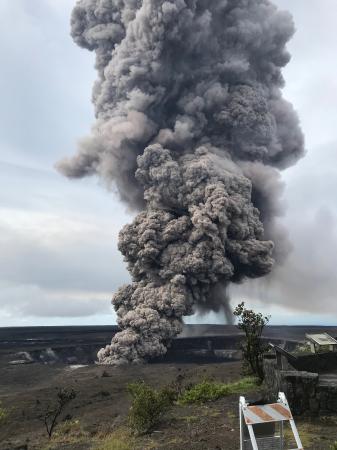
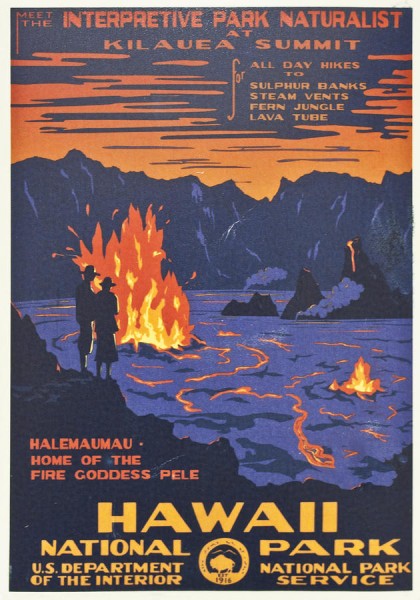
The home of goddess Pele
Beltane Mountain Moon

On Sunday I reached some sort of odd apotheosis, presenting a series of video lectures on the Dead Sea Scrolls at Beth Evergreen. In the audience of 20, larger than I had expected, were 4 people from Idaho Springs and Georgetown, Christians invited by a biblical scholar who is a member of Beth Evergreen. That meant that in answering some of their questions, even haltingly because I don’t know the field very well, I, still an ordained Presbyterian clergy, represented a Jewish perspective to Christians on subject matter that altered both faith traditions. Weird.
It could have been better. Two weeks ago I checked out the A/V setup I would use. Though I had a DVD, my laptop, a Lenovo has no DVD player. Not a problem because I could stream the lectures off the Great Courses’ website. The link to the synagogue’s wifi was fine, as was the hdmi link to the projector set in the ceiling. Rabbi Jamie and I fussed around with the sound board, unfamiliar to me, linking the computer to it. We did get the sound to work and I thought I had it down. Turns out I missed a key move on powering up the sound board.
Kate and I got to Beth Evergreen at 1:15 since she had agreed to handle the food (which she did in typical splendid fashion) and I wanted to have time for tables and for making sure my setup would deliver. With some satisfaction I soon had the lecture displayed on the screen. But. No sound. Hmmm. I have plenty of time, that’s why I came early.
After looking carefully at the soundboard, being sure it connected to the hdmi feed, a few people began to show up. Uh oh. I really had to get this to work. Finding the power buttons, I got the sound board to light up, but still no sound at the screen. It’s been a long time since I got sweaty palms, but I did on Sunday. Folks kept coming. I kept having no sound. It was ten till 2, the start time, and being an unreconstructed Northern European the thought of starting late literally made me sweat.
 I had to call Alan Rubin, a new Beth Evergreen friend, who is the A/V sage. He said he was sitting by his pool enjoying the weather. It was a blue sky, white cloud, warm but not hot, Colorado day. After some false starts, Alan isolated the problem, I poked a button and, right at 2, the sound. Whew.
 However. All this meant I had not had time to arrange the tables for folks to take notes, so they sat in chairs looking up at the screen. I also had not given sufficient thought to the pedagogy of the afternoon. How would we interact? What questions might prompt discussion? The fact that everyone faced front rather than seeing each other across a table made getting a conversation started difficult. Though I don’t think the audience cared, I’d hoped for a more interactive event and I didn’t facilitate that.
This was the first of what we hope to be many more online type offerings by the adult education committee, so I’ll get a chance to get better at it.
Sunday’s session anticipated a May 20th trip to the Denver Museum of Nature and Science for a tour of the Dead Sea Scroll exhibit currently there. Russ Arnold, Rabbi Jamie’s brother and professor of religion at Regis University, Denver, will lead the tour.
Beltane Mountain Moon

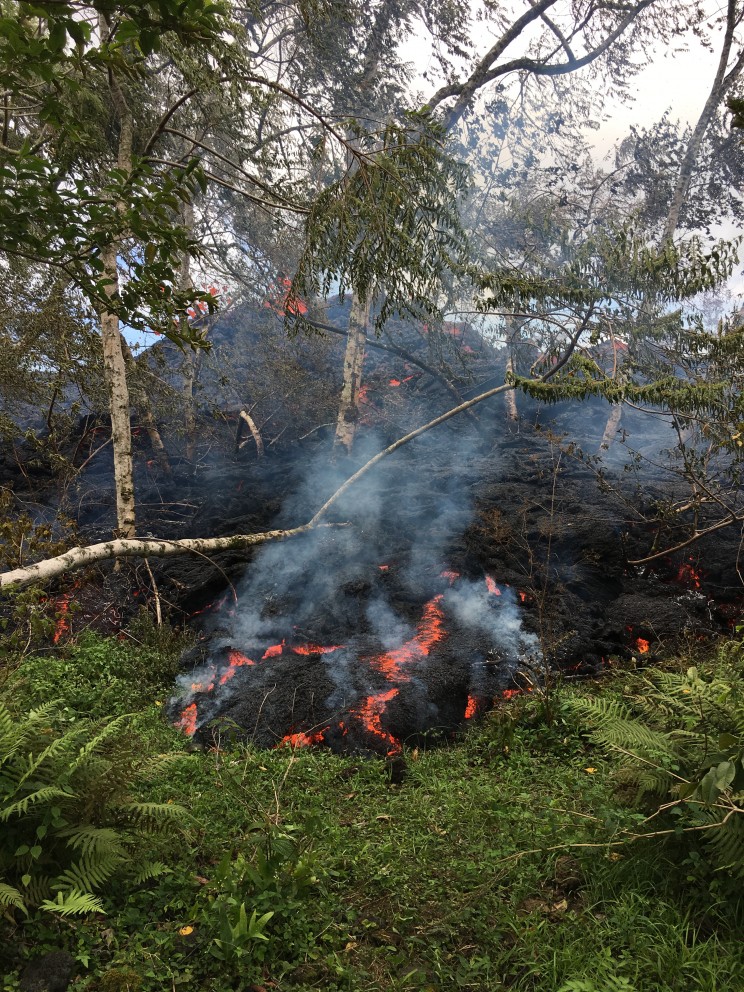
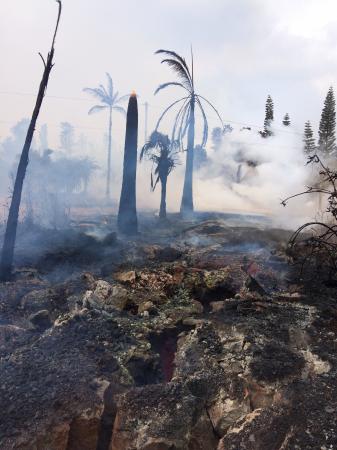
Still fascinated by the eruption of Kilauea. The Leilani Estates, houses bursting into flame, residents standing dazed by their vehicles after evacuating, monster movie scenes like the one below, show humans as do many Song dynasty paintings, small and insignificant next to mountains and rivers.
Listening to residents of the Leilani estates describe the shock is a lesson in reenchantment of the world. There were expressions of grief, of course, and bewilderment. All knew this possibility existed, but, like residents of flood plains and the wildlife-urban interface (us here on Shadow Mountain), hoped they would be spared. The lure is beauty. Always beauty. We take risks to live in beautiful places.

Some said things like, “Well, if madame Pele wants the land…” “Pele goes where she wants.” There was, in these remarks, no irony that I could detect. No wink, wink, you know what I really mean. The native Hawai’ian’s faith in Pele, given witness by the offerings at Halemaʻumaʻu Crater and numerous legends and dances, has, at least partially, reenchanted the Big Island for haoles (non natives). Whether they believe in a real, physical goddess or not, probably not, I sense the feelings of awe and the mysterium tremendum et fascinans that Rudolf Otto associates with the numinous, the essential components of the holy.
What’s happening at Leilani Estates is similar, perhaps the same, as my experience here on Shadow Mountain when I came for the closing on our home. The three mule deer bucks in our backyard, curious and welcoming, were mountain spirits blessing our move. I knew it while standing there with them, present with them in this new, strange place. It is not, in other words, that the numinous has disappeared from our encounters, only that we have unlearned how to know it. The reductive nature of scientism, that attempt to totalize our understanding with numbers and equations and laws, and the restrictive arrogant nature of religions certain that they know truth, has blinded us to the numinous.
 Reenchantment has a precursor experience, a moment when we embrace the awe and the mystery, a feeling that we each experience, perhaps even experience often (childbirth, death, sunrise, the greening and flowering of spring, a snowstorm, bitter cold, blazing heat, the vastness of the ocean, love), but a feeling we have allowed others to reframe for us. The laws and beauty of scientific understanding do not explain away, as many assume. They are descriptive, a language of their own about the world in which we live. But they have not stripped out awe and mystery though men like Richard Dawkins, Sam Harris, and Christopher Hitchens insist on it. Empiricists, fed by scientism, want to suggest only through data and analysis can we know the truth.
 Or, the experience of the Celts and the Roman Catholic church is instructive here, one faith’s certainty can leave no room for the numinous anywhere but in their dogma, their rituals. Catholics built churches over Celtic holy wells. They deployed words like heretics and blasphemers and pagans to undercut the authority of the old faith. They appropriated Celtic holidays by turning Lugnasa into Lammas, Samain into All Saints. Mordecai Kaplan, the founder of Reconstructionist Judaism says it well, “It is not the seeking of God that is the problem, it is the certainty of those who believe they have found God that is the problem.”
We can learn from the residents of Leilani Estates. We live in a wild universe, one well beyond our capacity to either control or understand. When we can set aside the certainty of others, the narrow thinking, and open ourselves to awefull and wonder of wilderness home, then we can know the ordinary holy, the secular sacred, the profane faith of those whose revelations no longer come from books or laboratories, but from that wilderness itself. That is reenchantment, that is reconstruction, that is a reimagined faith.
Beltane Mountain Moon

Black Mountain sits, stoic and massive. No Pele here on Shadow Mountain either though not far away, less than 600 miles, is the supervolcano at Yellowstone. Does Pele feel these others, all these others? Stromboli? Mt. Etna? Montserrat’s Soufrière Hills volcano? Mt. Pinatubo? All those seamounts like Lo’ihi? Are there other Pele’s around the world or is She the one goddess of fire beneath the earth’s surface?

And what of the Rocky Mountains? Is there a Vishnu-like deity here, noted for His calm, stolid presence, a stable and stabilizing force? To be on and among these mountains does not call out terror, does not reveal the raw fierce power of an erupting volcano. The wildfires that can scour their flanks are not of them, but of the soil, of the world of plants and lightning, of drought and human folly. Their orogeny was, of course, violent, a brutal tearing of the earth itself, forcing rock up, up, up, a tectonic plate pushing hard against another. But that was long ago, ended long ago.

The tao here is quiet, steady whereas the tao of Kilauea creates in ropy pahoehoe and ragged aa, in blasts from the magma chambers meeting underground water, by rips in her surface. Yet they are both the tao. No less generative, no less powerful for their difference. The tao here relies on cohesion, aggregation, altitude, the flow of the atmosphere. The tao on the Big Island relies on explosion, heat, creative destruction, movement.
Both are outward expressions of absence, the unceasing, unrelenting power of pure creation. The tao comes into this reality from the ein sof, making the ten thousand things. The same source that births you or me or the ocean or the sun or the Sombrero Galaxy.

(Emperor Ningzong’s poem inscribed in the upper right corner reads, “The wild flowers dance when brushed by my sleeves. Reclusive birds make no sound as they shun the presence of people.”)
Yes, I am one with the calm of Black Mountain, with the hottest lava erupting now on Kilauea’s eastern rift zone, with the gathered strength of the Yellowstone magma, with the flow of the Colorado, the Rio Grande, the Platte with the globe straddling fluidity of the world ocean. So are you. We bring our own uniqueness, self-consciousness, to the tao. We know ourselves as part of the tao. I am stolid, explosive, fluid, distant, near. We are of the tao now, as we were before being thrown into this time, these places, and we will be of the tao after this life we have dissipates, falls away.
Beltane Mountain Moon
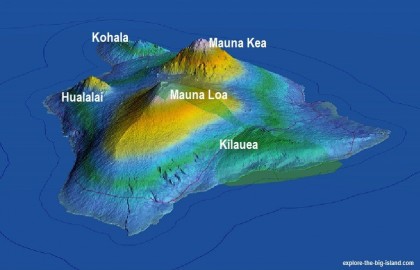
Volcanoes of the Big Island
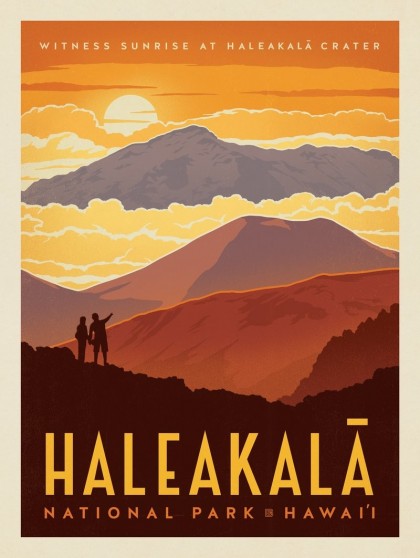 In the month of the Mountain Moon Kilauea has reminded me that my interest in mountains precedes the Rockies. My first mountain driving experience was Haleakala on Maui. I learned there that you don’t have to brake going up, take your foot off the accelerator and the mountain takes care of you.
Haleakala means house of the sun and on one of our trips to Maui I did the tourist thing of seeing the sunrise on Haleakala. As we rode in the small van around 4 a.m., the skies were cloudy, rushing across the island, allowing the full moon to become visible, then blocking it out. Even though we were on Maui, a tropical paradise, the early morning temperatures on Haleakala’s summit, 10,023 feet, were cold and windy. Black Mountain, visible from my window here in the loft, is 10,731 feet.
 Hawai’i put vulcanology on my oh this fascinates me list. On a visit to the big island, Hawai’i, we drove the Highway east out of Kona, traversing first Hualalai, which sits just above Kona, then Mauna Loa, the long volcano, and finally, climbing up the eastern flank of Mauna Loa we went past Kilauea. We did not go in that day, driving on to Hilo town. On our way back, later that evening, we drove along the southern flank of Mauna Loa again, the air scented by gardenias and jasmine.
In 1999 we visited the Big Island again, this time staying in Volcanoes National Park at Volcano House. We were there for two weeks. Learning the language of volcanoes was easy there: fumaroles, vents, calderas, pahoehoe, ropy undulating lava, and aa, fragmented sharp blocky lava, lava tubes, magma, magma chambers, and the home of Pele, Halemaʻumaʻu Crater. (see poster above)
Hiking a long path around the summit, walking on lava flows where the Pu’u O’o vent added to the land mass of the Big Island, exploring inside now drained lava tubs with ferns growing from the ceilings and reading about volcanoes gave me both an experiential and intellectual immersion. I’ve followed Kilauea off and on since then and the news coming out of the Big Island has me riveted.
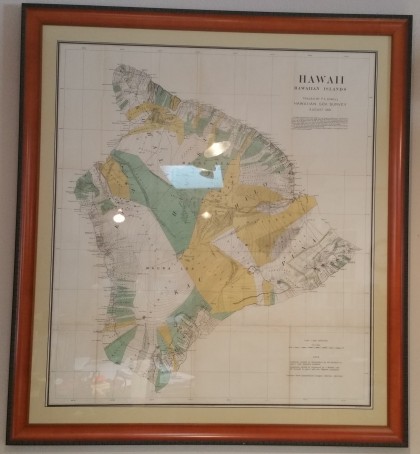 Maps. Kate bought me this wonderful vintage map of the Big Island. It now hangs in a prominent position here in the loft, reminding me of many adventures including our stay at Volcano House. Kilauea is in the yellow portion of the map that extends south to the Pacific and butts up against the large swath of green in the middle. The new eruptions are in the eastern, white segment that extends to the north from the point where Kilauea meets the Pacific. This is Kilauea’s eastern rift zone*. People building there knew about the rift zone, but hoped it wouldn’t affect them, much like we hope our location in the Wildlife Urban Interface, WUI, won’t result in our home burning down. Mother Nature gives no passes for human hopes however. She decides when and where things happen, according to her own laws.
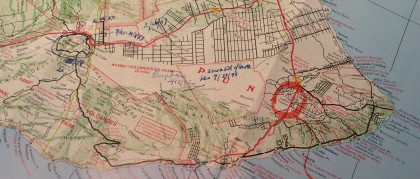 Over years of travel I have purchased maps and annotated them. I did this especially in Hawai’i where we visited often while Kate practiced. It is a popular location for continuing medical education. Each time we visited I would mark where we had gone, the date, sometimes a brief note though the longer explanations were in my notebooks. We spent time on Maui, Hawai’i, and Kaua’i, enjoying all of them in turn. Each has their particular charms.
The section of my Big Island map above shows the eastern rift zone area with our 1999 visit marked by the black circle in the upper left and the current eruptions in the Leilani estates circled in orange. The Lo’ihi seamount, the latest island of the Hawai’ian archipelago forming beneath the sea, is just south of the shoreline shown here. It’s the volcano that is most directly over the hotspot** which has formed the whole archipelago.
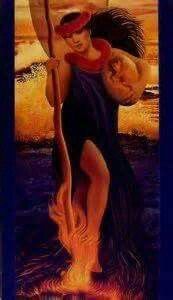 In 1999 I stood on the rim of Halemaʻumaʻu Crater. Next to me were empty bottles of gin and rum, sprays of flowers, especially red ginger and bird of paradise, a lei of gardenias. These were left by native Hawai’ians who came here to worship Pele, the goddess of fire, of volcanoes, of creativity. This is, according to Hawai’ian theology, Pele’s current home though I imagine she will be moving in the next few thousand years to Lo’ihi.
Rudolf Otto, the German religious philosopher who wrote about the nature of the holy, said it combines two elements: awe and the mysterium tremendum et fascinans***. Gazing down over the rim, looking 150 to 200 feet to the crater’s floor, awe came bubbling up at me. In 1999 Pele’s home had no active, visible lava, but just knowing that the magma existed below a thin crust of cooled lava was enough. There is a large lava lake in the crater now.
Otto could have written these words to describe my feeling: “overpoweringness, majesty, might, sense of one’s own nothingness in contrast to its power.”
Wordsworth, too, in the World Is Too Much With Us:
“I’d rather be
A Pagan suckled in a creed outworn;
So might I, standing on this pleasant lea,
Have glimpses that would make me less forlorn;
Have sight of Proteus rising from the sea;
Or hear old Triton blow his wreathèd horn.”
The lava on Kilauea is about 2,200 degrees Fahrenheit. Various magma chambers up to six miles below the surface feed the lava flows into Halemaʻumaʻu Crater, formerly fed (up until this last week) Pu’u O’o and now feed the fissures breaking through the eastern rift zone 21 miles from the Kilauea caldera. Here is the raw power of our wild universe visible in its most primal form, kin to the winds of a hurricane, the awful speed of a tornado, the waters of a tsunami, flooding rivers, avalanches, wildfire, orogeny. Nothing subtle at all in these forces; we ignore them at risk to ourselves and those we love.
I need no book, no prayer, no revelation of another. Here is the great wild, the generative power of the tao laid out for all to see. Stand in a sanctuary and feel no more divinity than in their presence. Visit St. Peter’s or the Temple Mount or the Wailing Wall or Angkor or the Great Medicine Wheel and know no more of the sacred, the holy than when the heat of the lava brushes your delicate skin. Pele’s touch.
*Rift zones are areas where the volcano is rifting or splitting apart. The rock in a rift zone has many cracks and is relatively weak, and thus it is easiest for magma to make its way to the surface through these rift zones.
**Hot spots are places within the mantle where rocks melt to generate magma. The presence of a hot spot is inferred by anomalous volcanism (i.e. not at a plate boundary), such as the Hawaiian volcanoes within the Pacific Plate. The Hawaiian hot spot has been active at least 70 million years, producing a volcanic chain that extends 3,750 miles (6,000 km) across the northwest Pacific Ocean. Hot spots also develop beneath continents. The Yellowstone hot spot has been active at least 15 million years, producing a chain of calderas and volcanic features along the Snake River Plain that extends 400 miles (650 km) westward from northwest Wyoming to the Idaho-Oregon border.
*** Rudolf Otto and the numinous
“Mysterium tremendum et fascinans” (fearful and fascinating mystery):
Beltane Mountain Moon
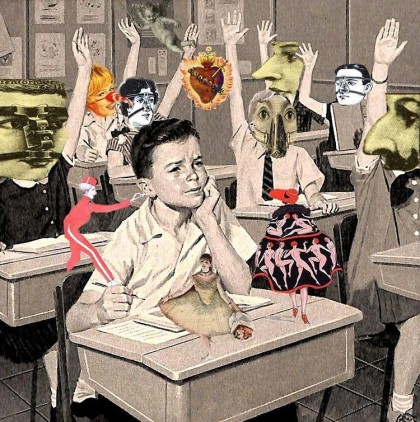 Back in the day, the now further and further away day, I always went to class. I might have missed a few, but it was rare. I enjoyed learning from lectures, getting in the mix of dialogue, thinking out loud. Last night I was the only student in the qabbalah class on Time.
Rabbi Jamie and I had a solid hour together talking about the nature of the sabbath, the notion of sacred time, and, hidden space-time. L’Olam va’ed, translated most often as forever and ever, has another translation, hidden time witnessed. The second translation, a qabbalist’s, points to the intersection of the three dimensions: space, time, and soul. Soul is consciousness in this frame. It is a nexus that is crucial to understanding existence per se. Without all three, space, time and consciousness, the fabric of the universe cannot exist, or, perhaps better, in my opinion, couldn’t be known as we humans know it.
The tao. The tao feels like the central idea that I have learned, even though it’s pretty damned slippery. Putting it into this qabbalistic paradigm, being one with tao is awareness of L’Olam va’ed. When our soul sees hidden time, we see reality as it is, a moving generative force and we can align ourselves with its flow, not impede it.
 Being human is a daunting task, steeped in misdirection, existential isolation, perception clouded by tradition, by language, even by our body. Qabbalists and taoists and ch’an buddhists have worked, hard, to peel the onion of our awareness. They are subtle, in their own way as subtle as particle physics or genetics or neuroscience, attempts to understand this task, the one none of us can jettison, save through suicide. They differentiate from the narrowing tendency of science by insisting on a full, a comprehensive positioning of this strange creature that we are in the wild.
Make no mistake, the universe is the true wilderness and we wander in it as innocents, thrown into it for what reason we do not know, headed toward a destination we do not understand and cursed or blessed with awareness, consciousness, soul as we travel.
 Thought experiments like taoism, qabbala, ch’an or zen buddhism try to shock us out of our stupor, the life lived without seeing the wilderness for what it is, the life lived within the conventions of a particular time, a particular language, a particular place, a life lived without knowing what life is. Most people find little reason to peak behind the curtain of this emerald city that we think is what is. The apparent life, the one with family and money and the NFL and food and houses and sunlight and night, seems to be all that could be. We do not question, we try to paddle the little barque of our body on this river (life) often using only our hands over the edge of the boat.
 And yet there is more, not more in the sense of more layers or more depth, for those layers and depths, the wilderness, always surround us, are the water to which we are the fish, but more in terms of what we can know, what we can access, what we can use to help us become awake. Woke, in the current vernacular, not woke to racism and sexism and oppression in this instance, but woke to the true majesty and wonder of life itself, of this wilderness journey, this most ancient of ancientrails.
Do you want to wake up? Shake off the slumber of convention? Head out into the wilderness knowing it for what it is? If you do, there are paths to take, fellow pilgrims with whom to travel. I honestly don’t know whether it’s important or not to peel the onion, only that in doing so, I’ve become alive, able to see. And I prefer that consciousness, awareness to life as a long sleep.