Beltane Rushing Waters Moon
“Everyone sees the unseen in proportion to the clarity of his heart, and that depends on how much he has polished it. Whoever has polished more, sees more, unseen forms become manifest to him.” -Jalal ad-Din Rumi
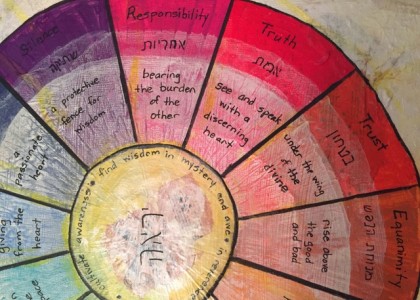
Bonnie, a rabbi in training and a former high level bureaucrat for the U.S. National Forest Service based in D.C., led our mussar class yesterday. Mussar is an odd (to me) blend of ethics and spirituality, a way of living the 613 mitzvot, or laws, found in the Torah. Since the laws themselves have the unified purpose of leading the faithful on a sacred journey that carries them closer and closer to God, mussar (ethics in Hebrew) is technically an ethical system with a spiritual aim, one embedded in the unique cultural experience of Jewish history.
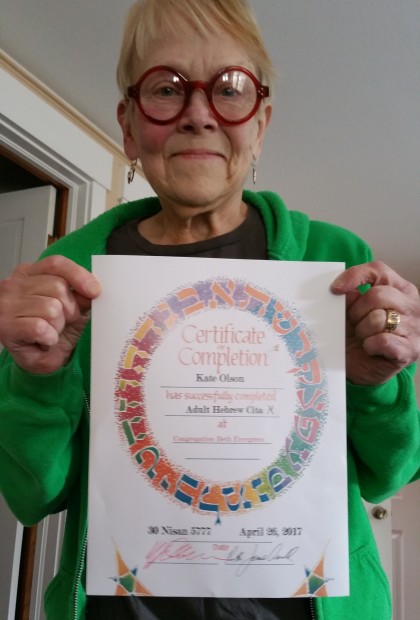
Mussar intends to guide this sacred journey through measurable development of character traits, or middah. The measurability comes in as mussar students, like Kate and me, learn a particular middah, then decide on incremental steps we can take to increase its presence in our lives. We record our progress in a journal and reinforce it through the use of focus phrases. Well, that’s the theory anyhow. It’s taken me nearly a year to get my intellectual footing, so I’ve focused on learning about learning mussar rather than using those tools. I do see their value.
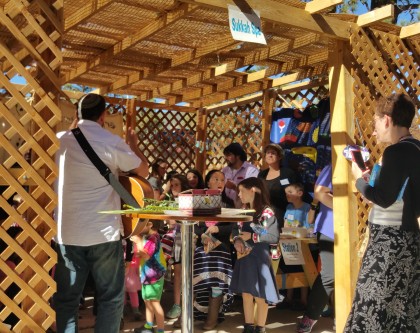 An intriguing pagan element runs throughout the Judaism I’ve been exposed to at Beth Evergreen. The Jewish liturgical year is on a lunar calendar. Shabbat begins at sundown on Friday and Friday shabbat services are held at night. Sukkot is a harvest festival, held outdoors in a sukkot booth. Tu BiShvat is new year for the trees. Judaism is also very body positive, actively opposing ascetic practices that exist in some forms of Christian monasticism, and encouraging the enjoyment of sex.
Bonnie highlighted that element yesterday in her mussar lesson on the middah of clarity, clarity of self and soul. Tahara is the Hebrew word for clarity. Her examples for achieving and practicing clarity focused on the medieval four elements: earth, air, wind and fire.
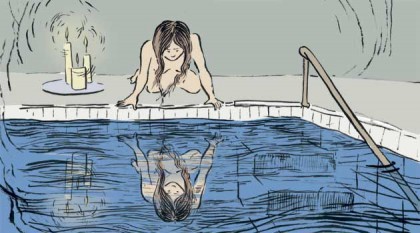 Water – Bonnie offered a quote from the novelist Julian Barnes: “Mystification is easy; clarity is the hardest thing of all.”
She then described still water, with the sediment settled out, as an instance of crystal clarity. Bonnie suggested three examples of how water facilitates clarity in Jewish ritual life: the mikveh, tevilah and netilat yadayim. The mikveh and the tevilah are ritual immersion in water, the first in a bath, the second in running water. Netilat yadayim is handwashing after contact with a corpse, burial or visiting a cemetery. The water carries away any tumah, spiritual impurity.
Finally, she gave ways of embodying this mussar practice:
Swim, float, dangle your bare feet in water. Take a dip in a bubble bath or a hot spring. Stay out in the rain, don’t run for cover, splash. Get out/in/near open water.
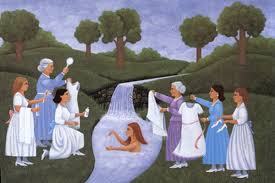
Interestingly, in Judaism the soul is pure. As the Psalmist says: The soul that you, my God, has given me, is pure. You created it, you formed it, you breathed it into me. No original sin here. The water rituals wash away shmutz, a film or a build up, spiritual impurity, that clouds the pure soul. Result: clarity.
Thinking of clarity, a clearly seen pure soul, in this way helps any encounter with water, air, earth or fire act as a spiritual practice, reminding us of the need for clarity while helping us scrape off the shmutz.
This marriage of the elemental and the spiritual resonates for me. I once referred to gardening as a tactile spirituality. These ideas expand that notion in a helpful way. The reimagining faith project intersects with this approach to mussar.
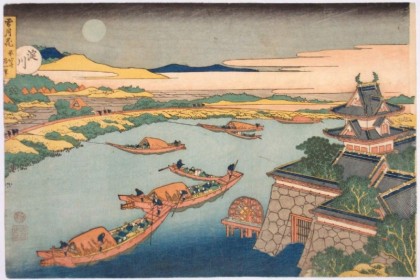

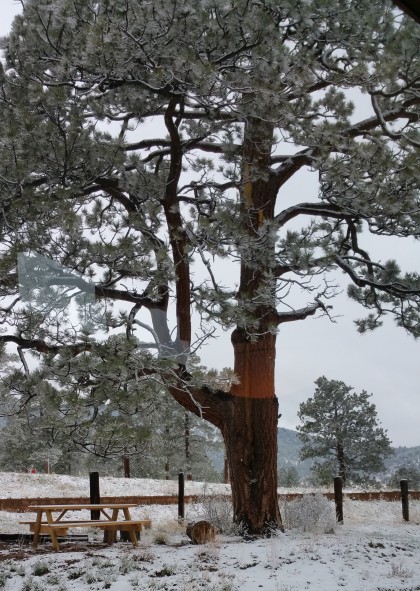
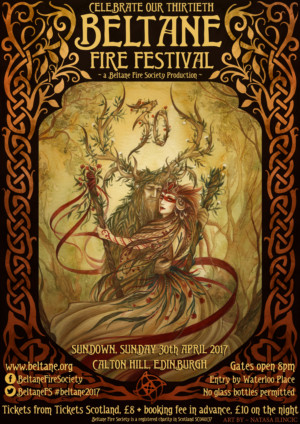 Cue the couples out in the fields doing their sympathetic magic for the fertility of the crops. Light the bonfires for leaping over and the bonfires for driving the cattle between. Gather the naked Scots outside of Edinburgh for the great fire festival. Dance in the streets because the growing season has finally come round again, the Great Wheel has turned and food will begin to appear from mother earth.
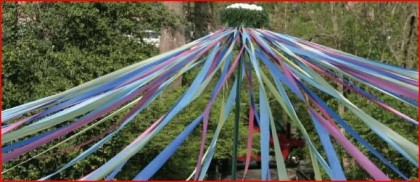 This is Beltane. Mayday. Collect women and men, girls and boys, give them streamers and ribbons, connect them to the tall pole and have everyone swirl, under and in and out and back again. Pick flowers for the table, for a basket, for your lover.
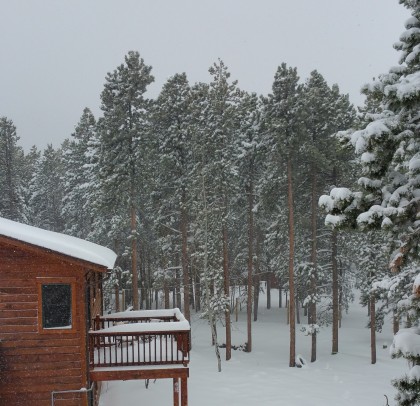 The last day of spring. Solar panels covered. Roof covered. Driveway plowed. 16-24 inches of new snow Friday night through yesterday. Delightful, but hardly springlike. In our spring fantasies, that is. The ones that have tulips and iris and crocus and lilacs and wisteria in them. For a mountain spring though, welcome and not unexpected.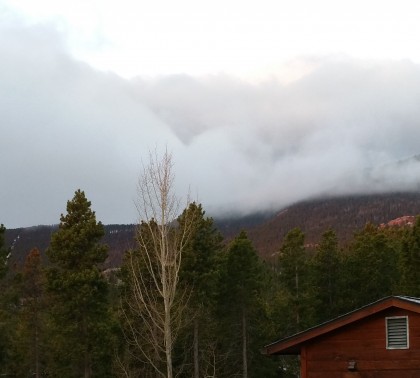
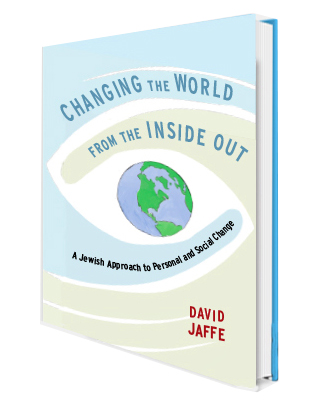
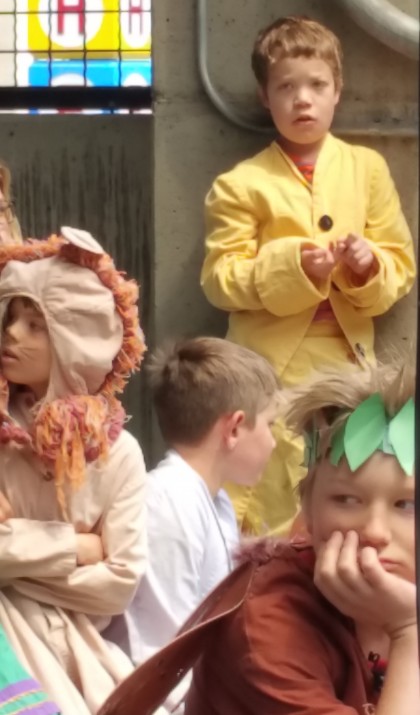 After getting home around 9:30 (our bedtime is 8pm) we got up the next morning and drove into the Denver Performing Arts Center to see grandson Gabe perform in the Denver Public Schools Shakespeare Festival. This ended up taking longer than intended, but we got home in time for a nap before returning to Beth Evergreen yesterday at 4:30. This time we helped set up for Rabbi Jaffe’s lecture, preceded by a congregational meal.
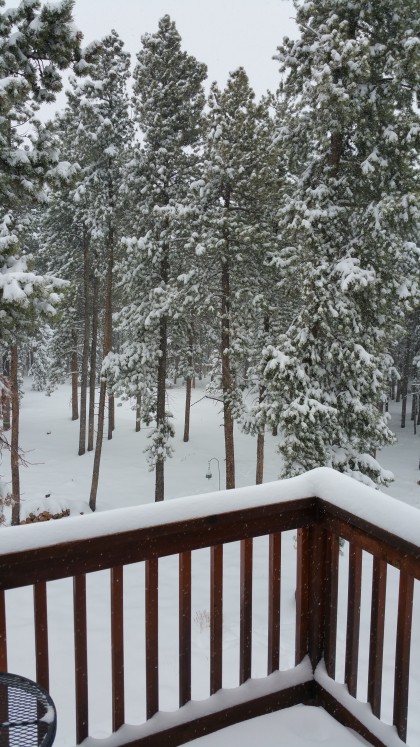 Today was the People’s Climate March in Denver, which I intended to attend, but the roads going down the hill are icy and snow covered. Climate change is, as I said in an earlier post, once again the focus of my political energy so I’ll only miss the gathering, not the action.
 Today I’m making chicken noodle soup and Kate’s making Vietnamese pho. We’ll serve this at a Beth Evergreen leadership dinner for
 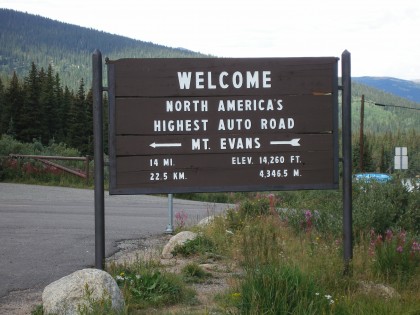 So I renewed my effort to connect with the Mt. Evans’ local group of the Rocky Mountain Chapter of the Sierra Club. Colorado seems to work more through these regional clusters than as a whole. There are nine of them, covering the entire state. The Mt. Evans’ group includes our part of Jefferson County, Clear Creek County and a northern portion of Park County. It’s titular feature, Mt. Evans, is a fourteener (over fourteen thousand feet high) which has the highest paved road in North America leading to its summit. According to locals here it’s also the weathermaker for our part of Conifer.
 The waning passover moon is behind a faint scrim of clouds giving it a moonlit halo. Each moon cycle repeats the past, yet is unique to itself. The slow orbit (relatively slow) of the moon around the earth produces the same phases each month and in that sense repeats. But the lunar month and the sidereal year do not quite match up*, as all cultures that depend on lunar months for their calendars have long known. Judaism is such a culture.
 When you consider the irregularities in the lunar position occasioned by the sidereal/synodic difference and the speed of our solar system both moving on its own toward Lambda Herculis and around the Milky Way and then throw in the speed of the Milky Way itself, it becomes clear that no one phase of the moon every occurs in even remotely the same location.
 Finally, the point. We are, each of us, unique and precious instances of over 2 billion years of evolution of life on Earth. We represent a moment in time, yet even our moment is not static. It finds us moving incredible distances.
 Think about it. Out of all the billions of years since the Big Bang, moving in all the various ways discussed above and at speeds that make Formula One look slothful in the extreme, you and I exist in this special time together. How remarkable! We are in fact made as the conscious image of this whole universe, with all its reckless momentum and we have been given the chance to know each other and through knowing each other to know the universe that gave birth to us.
 Easter morning. Sunrise services somewhere. The celebration of the resurrection and, by implication, the incarnation. As Passover defines Jews, Easter defines Christians. Whether you find the idea of resurrection absurd or inspiring, it heralds, as does Passover, the coming of spring. It’s not difficult, at least for me, to see the power of resurrection in the emergence of spring ephemerals: daffodils, crocus, grape hyacinth, early tulips, snowdrops, pasque flowers, bloodroot.
 Moses reminds the slaves, and God, of the covenant made with Abraham long ago. That covenant is the bulb planted in the hiddenness and darkness of bondage. When God finally forces Pharaoh to let the slaves go free, the bulb begins to push its stalk toward the surface. Though it takes forty years of wandering for the stalk to break the surface in the Promised Land, the beauty of freedom’s flower has dazzled those struggling with their own personal or political bondage ever since.
 So on this great wakin’ up morn, I’m greeting the sun, the greening lodgepole pines, the daffodils, the pasque flowers and bloodroot with a religious fervor.
 Yesterday in mussar Jamie gave us a writing prompt: write about a want that occupies a lot of inner time and attention, then to try to find the root of that want. This was a lead in to talking about avarice.
 I’ve looked up the idea of the hungry ghost and I don’t think it really applies to me, but the caution evident in the bookstore example certainly does. Buying books represents a deep seated want, too. But what is it?
 So, the books represent my own struggle with the nature of mortality, my way of structuring my inner world. And, yes, it can be a problem if I refuse to recognize it for what it is. But, and here’s the liberating possibility for me in both books and writing, if I acknowledge what they are for me, if I embrace the underlying motivation, yet not its anticipated result, then I can continue writing and reading, using them not as shields against disappearing, but as ways of being in the world, not as ways of protecting myself.