Category Archives: Mountains

Oh, Yeah. Fox!

Imbolc                              Black Mountain Moon

We have fox here and some use Black Mountain Drive as a route from here to there. Late this afternoon Rigel was at the window, looking out toward the road when a fox ran by. Rigel, who is feral herself, gave a prey bark and the others responded. Soon the house filled with barking and yipping, running for the front door, the back door, anyway to get at the fox.

Rigel and Vega have coyote hound and wolf hound blood. This animal was in the prey category. Smack in it. And they felt the need. You could see it activating their attention, their ruffs, their dogness. This was the moment they were made for.

Much as I would have liked to let them run the fox down, or give it a try, the danger to them would have been too great. (cars, angry neighbors, getting lost) So they had to forgo the hunt.

Even a half an hour later though they were still smiling, prancing, looking 100% dog qua dog. Not pet. Not domesticated, just animals cued for what their life purpose is.


Learning Colorado

Imbolc                                         Black Mountain Moon

Signed up for 4 Colorado Native Plant Master programs: one in the foothills, one in the montane eco-system (ours) and one in the high plains. 3 of these are 3 session 8:30-12:30 classes. The fourth is a two session, 9-3, course on plant sketching. Don’t really want to qualify for the Native Plant Master program since it has requirements for volunteering that I don’t want to fulfill, but I want the content and the chance to meet some people involved in botany here.

All part of becoming native to this place. Starting this week I plan to keep a nature journal, hand-written, a record of our yard, hikes, these courses, geology lectures and field trips, meteorology notes. I’m not much of an artist, but I think with some practice I can draw plants and animals, maybe sketch geological features, at least well enough to call them to mind when I review the entries.

We drove into Evergreen for our business meeting at the Wildflower Cafe. It was good to see those folks again. Afterward we drove around Evergreen a bit, going out to the I-70 entrances and seeing in the distance snow covered peaks. Our mountains around here have snow, but are not snow covered.


Happy Purim!

Imbolc                                         Black Mountain Moon

A sunny, 55 degree Friday here on Shadow Mountain. It has knocked on that door behind which hides spring longing. One thing I look forward to is a mountain spring, but I know it will come when it comes. Still, these day make me imagine what our neighborhood, our drive, our mountain will look like without snow cover, with the aspens leafed out.

Today I went back into Ovid for the time in several months, delighted to see that my skill level has picked up considerably. I’m still far from facile, but I can see the plateau before it from where I stand now.

Then this afternoon I wrote another 1,500 words on Superior Wolf. This version, this is my fourth or fifth restart, going back to 2002, seems to have the push necessary to get to the end.

Kate’s gone into Denver to celebrate Purim* at Temple Micah. She made hamentashen, the triangular goodies associated with this holiday.


*The festival of Purim is celebrated every year on the 14th of the Hebrew month of Adar (late winter/early spring). It commemorates the salvation of the Jewish people in ancient Persia from Haman’s plot “to destroy, kill and annihilate all the Jews, young and old, infants and women, in a single day.”


The Rio Grande Rift

Imbolc                                                Black Mountain Moon

Into the Colorado School of Mines last night, its Museum of Colorado Geology, for a second lecture to the Friends of the Museum. This one: Whither the Rio Grande Rift?

The significance of the title escaped me until Vince Matthews, former Colorado State Geologist, explained that the rift was a spreading of the earth’s crust, a spreading that thins the mantle and increases volcanism and creates faults. Then it hit me. Oh, a rift. Like the Olduvai Gorge in the horn of Africa.

There are three faults within the Colorado portion of the Rio Grande Rift that made it onto the USGS hazards map, one believed capable of producing a 7.5 magnitude quake and another of producing a 7.0 quake. Logarithmic scale. Those would be powerful and they would come in the middle of Colorado, toward the New Mexico border.

He used two terms in this dense, finely argued lecture that were completely new to me: graben and lineament.

Graben: In geology, a graben is a depressed block of land bordered by parallel faults. Graben is German for ditch or trench.


Lineament: A lineament is a linear feature in a landscape which is an expression of an underlying geological structure such as a fault. Typically a lineament will comprise a fault-aligned valley, a series of fault or fold-aligned hills, a straight coastline or indeed a combination of these features.

The focus of his presentation was the true northern extent of the Rio Grande Rift. Here’s a map that shows its extension in the consensus view (more or less). In this map you can see the Rio Grande rising in southwestern Colorado, then flowing through the San Luis basin into New Mexico and then onto its more familiar location as a major boundary feature between the US and Mexico.

Vince said that current thinking took the Rio Grande Rift as far as Leadville.


Leadville in this map is the first black lettered city above the C in Colorado. I use this map to show you the San Luis Basin (the light tan opening to the left of Highway 25 and starting at the New Mexico border. The San Luis Basin is a major feature of the Rio Grande Rift as it comes north out of New Mexico.

Matthew’s argument extended the Rio Grande Rift considerably further north and then hypothesized a turn from its primarily north/south axis to an east/west one. This map of the Colorado Plateau can be used to illustrate his argument:


Matthews extended the boundary of the Colorado Plateau east to include the Rio Grande Rift, then proposed that the rift extended east/west toward the area here marked as the White River Plateau. He based his argument on indicators of a rift zone (which I won’t go into here) and on an experiment on a clay model of the Colorado Plateau.

In essence he argues that the Colorado Plateau is a tectonic feature that has been rotated clockwise. When asked how that could have happened, he said, “I don’t know.” But, if you imagine the Plateau as a piece of the earth’s crust that has physical integrity, then a motion pushing up on its southwestern edge would turn it clockwise. One of the other geologists in the room proposed the San Andreas Fault as it developed. (I got lost right here, but I followed the argument up to this point.)

Very interesting. These lectures are helping me orient myself to the unusual topography of Colorado and some of forces that shaped it.

BTW: I loved Matthew’s description of two cinder cones as “very young.” They were only 640,000 years old. Puts 68 in a very satisfying context.
Aurora

Imbolc                                                          Black Mountain Moon

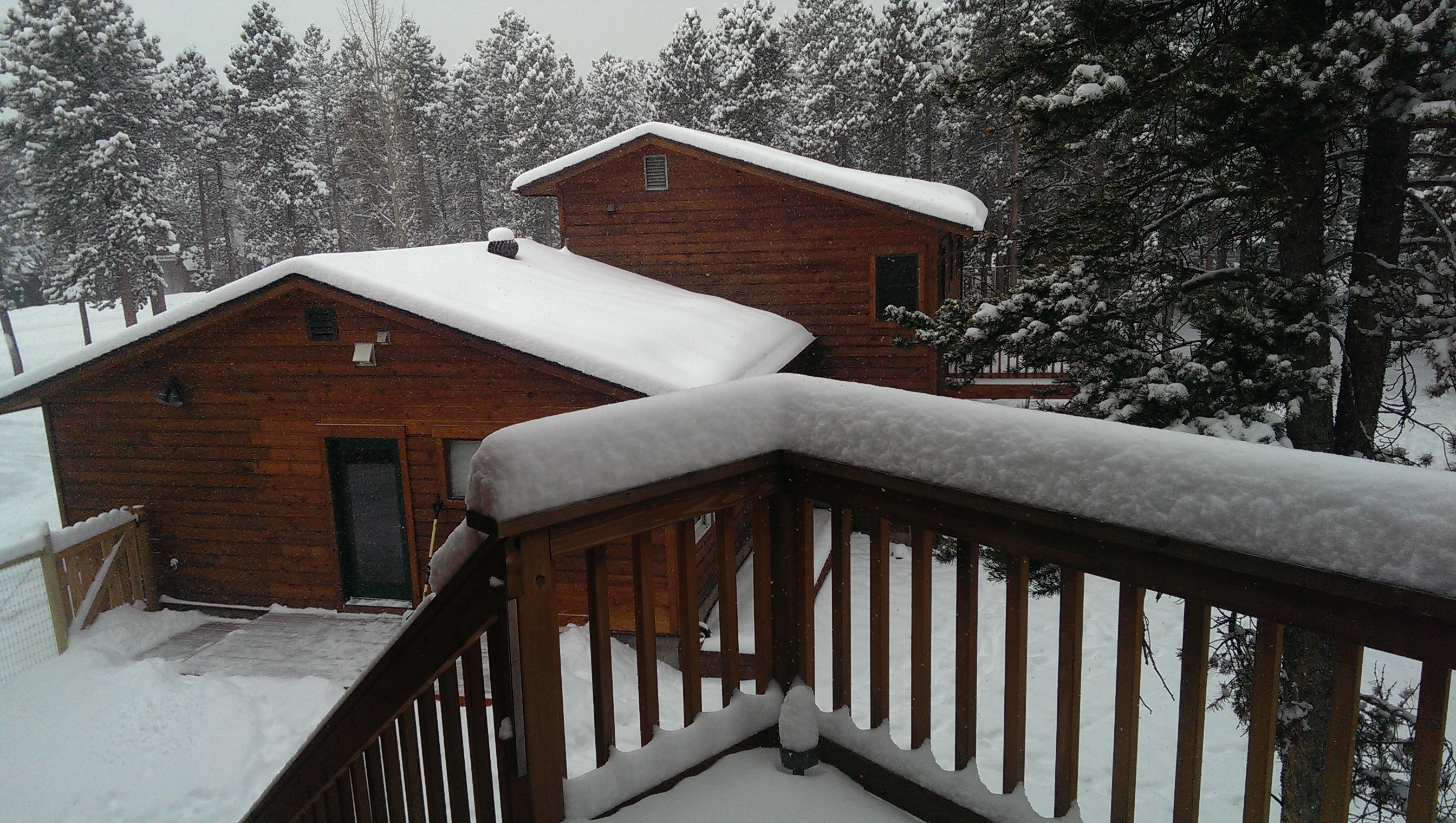
At 6:00 a.m. now the sky has gone from black to a whitish blue, a few stars still visible. When I go to bed, usually around 9:00-9:30 p.m. these days, night has fallen sometime ago, but on the nights around the full moon, the land in our back is a wonder. The moon shine comes in from the south-south east and lights up the snow with its silver glow. It also creates dark, soft shadows around the lodgepole pines. If I follow the pines to the sky toward which they point, I see stars: Cassiopeia and others in her vicinity.

Now, in the morning, Black Mountain slowly emerges from indistinct mass to large, pine-covered height, 10,000+. Sometimes, like today, it has a streak of cloud behind it. Not often, but sometimes, too, it has a lenticular cloud giving it an atmospheric halo.

Shadow Mountain, where we live, only reaches 9,600 feet and we’re about 800 feet below that, so we look up to our taller neighbors. Beyond Black Mountain, but not too far, is Mt. Evans, a fourteener.

Mt. Bierstadt is another fourteener. Those of you interested in art may recognize it since it was named after the Hudson River School painter, Albert Bierstadt. He painted this of another Colorado fourteener, Long’s Peak.

Spring

Imbolc                                      Black Mountain Moon

“Come, fill the Cup, and in the Fire of Spring
The Winter Garment of Repentance fling:
The Bird of Time has but a little way
To fly–and Lo! the Bird is on the Wing.”
–  Omar Khayyám

March 1st is the beginning of meteorological spring. The three coldest months of the year are over and the next three are a transition between the cold of winter and the heat of the growing season, the three warmest months of June, July, August. Meteorological spring, though, is a creature of averages, a soulless thing with no music. I prefer the emergence of the bloodroot (in Minnesota) as the true first sign of spring.

On March 20th Imbolc will give way to Ostara, the Great Wheel’s spring season, on the day of the vernal equinox.

I do not yet know the traditional first signs of spring for the montane ecosystem, but I will. Nor do I know the tenor, the rhythms of the seasonal change here in the mountains. I look forward to learning them.

I’m reading the Thousand and One Nights again, a new translation, so right now Arabic and Persian stories, poetry fill my head. Khayyam’s Rubaiyat was my earliest introduction to Persian culture and one I found magical from the beginning.

There is, today, the slightest touch of spring longing in me. And so I wrote this.

Here. And Not.

Imbolc                                   Black Mountain Moon

IMAG0948

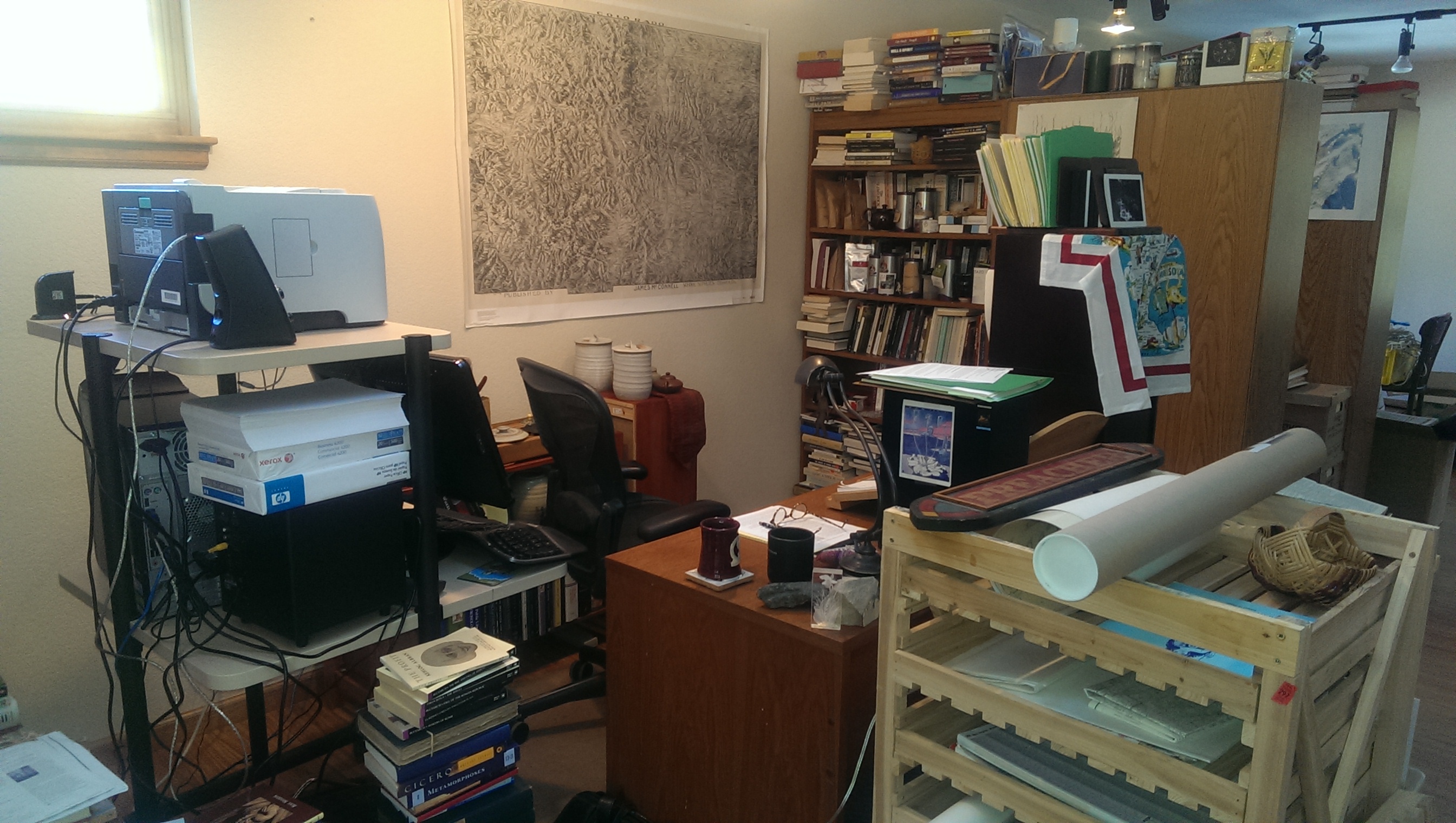
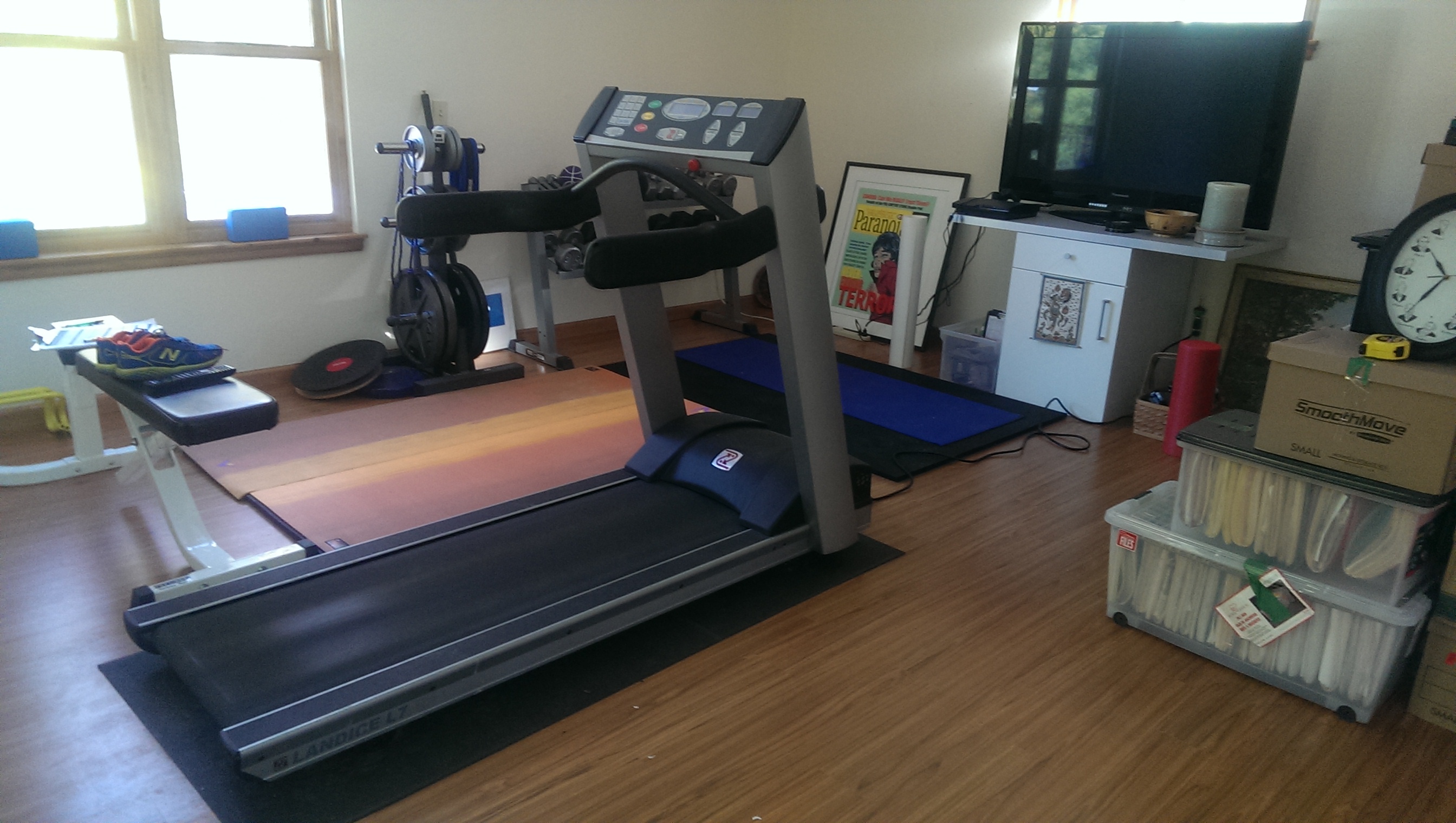
With the books in organized clumps, art still in boxes, files in the horizontal file, journals, dvds and novel notes stacked together in banker’s boxes, and the exercise area functional I’ve reached a stasis in terms of organizing the loft. Kate got back to sewing yesterday, making a table runner from a pattern both she and Annie bought this last week. Her sewing area has also begun to take shape with her table, cutting surfaces, stash, sewing machine and Matilda (the dress mannequin) in usable, if not permanent places.

We await now the new Stickley table we purchased for downstairs, which will make that space more flexible when entertaining or during family game nights. The reading room, the bedroom, the living room and the kitchen all have usable, if not permanent configurations. The garage and the homeoffice remain hangouts for the cardboard set, art in the latter and mostly gardening/beekeeping/tools in the former.

Over the next few weeks Jon will install built-in bookshelves up here, attach my pull-up bar and help us IMAG0950hang art in the house. He’ll also develop plans for linking the house and the garage, a current problem spot for us. Why? There’s no straight line into the house from the garage and no path that can be cleared. We have to move through the snow to get to the truck or upstairs to the loft. Not a big deal, but one that could be better.

Kate went in yesterday and had a day as grandma, doubled with Barb’s presence. They were at Barb’s apartment with Gabe and Ruth who were out of school for teacher’s conferences. In one of those mysterious moments we humans have from time to time, Kate went from Minnesota grandma to Conifer grandma, a change that began at the birthday cum house warming celebration on Saturday. She’s now fully here (as I sense it) and in the life she dreamed about as we prepared for and executed the move.

There’s a bit further for me to go. I got a very sweet book from Ruth as a birthday present, a compilation of IMAG0942poems and images about Grandpop plus comments from her. I feel completely here as Grandpop and did perhaps sooner than Kate, but the Self that has begun to grow here, a Colorado, Western Self has barely emerged. In part I need to get my old rhythms back, the ones I mentioned yesterday: Latin, writing, art history, exercise, sheepshead, perhaps some political work. But, too, I need new rhythms: exploring Colorado and the near West with Kate, hiking and snow-shoeing in the mountains, learning the history and the geology and the biology of the land we now call home. It will be the dialectic between the old, stable patterns and ones possible only because we live here that will finally get me all the way here. For now, I’m neither fully here nor fully gone from Minnesota. Liminal. Again, still.


Mountains

Imbolc                                                                            Settling Moon II

Phillip Levine died yesterday. Here’s a stanza from his poem: Our Valley. Seemed apt to me.

“You probably think I’m nuts saying the mountains
have no word for ocean, but if you live here
you begin to believe they know everything.
They maintain that huge silence we think of as divine,
a silence that grows in autumn when snow falls
slowly between the pines and the wind dies
to less than a whisper and you can barely catch
your breath because you’re thrilled and terrified.”

Who?

Imbolc                                                                      Settling Moon II

As the dominant ethos of Minnesota lies in its wild lands to the north, the Boundary Waters Wilderness and Voyageurs National Park emblematic of it, so the dominant ethos of Colorado lies in its wrinkled skin, mountains thrusting up from north to south and from the Front Range to the west. Where Minnesota’s map is essentially flat, marked with depressions filled with either water or wetlands or peat bogs, Colorado’s map is tortured, angular chunks of rock shoved up this way and that, lonely roads tailing off into gulches and canyons and valleys.

These two states share a common theme, wild nature at their core. You may live in these states and never trek in the mountains or visit the lake country; it is possible, but if that is you, then you shun the basic wealth of the land which you call home. In these two states, as in several other western states like Idaho, Washington, Montana, Oregon the political borders that mark them out matter much less than the physical features that define them.

In these places the heart can listen to the world as it once was and could be again. This is a priceless and necessary gift. It may be found in its purest form in the areas designated as wilderness, but these lands participate in wild nature in their totality. Those of us lucky enough to live within them have a privilege known only by occasional journeys to city dwellers. With that privilege comes, as with all privilege, responsibility.

These places which speak so eloquently, so forcefully when seen are silent out of view. On the streets of Manhattan, inside the beltway of Washington, in the glitter of Las Vegas and the sprawl of Los Angeles these places shimmer only in photographs, movie and television representation, books and their power is not in them.

Who will speak for the mountains? Who will speak for the North Woods and its waters? Who will speak for the trees?

Mr. Atom and Back to the Treadmill

Imbolc                                                                             Settling Moon II

62 here yesterday. A record warm spell for Denver, not sure about up here on Shadow Mountain. Kate and I went out in shirtsleeves, looking at plants in the front, trying to decide what they were. Bearberry, I think, or kinnikinnick, which it turns out is used as a tobacco by Native Americans. A small, evergreen shrub that lies low to the ground, kinnikinnick is a ground cover I tried to grow in Minnesota but could never make last. It grows on the edge of Montane forests where it’s sunny. Just where this is.

Had the Geowater folks here yesterday testing our water from various spots in the house.Looking mostly at corrosivity and radionuclides. We have a radon mitigation system in place so the latter is not out of the realm of possibility. Corrosivity will test the ph of the water, specifically to see if our well is the source of the acidic water in the boiler.

Started my exercise regime yesterday evening. Painful. I have detrained aerobically and in terms of resistance, plus there’s the effect (complicated) of altitude. I started over after a 7-week layoff during our cruise and this is about the same length of time away, so the difficulty getting back to it is familiar, if not welcome.