Category Archives: Jefferson County

Long ago native to this place

Beltane                                                                               Beltane Moon

Up early today. Too early. 3:00 am. Sigh. Still, got blogging done, e-mails sent and my high intensity workout in before leaving for my first Native Plant Master class in Morrison’s Mt. Falcon Park.

On the way I got gas at Conoco rather than the Loaf and Jug (Rumi, Omar?). I did that because I wanted a breakfast burrito from the best breakfast place in town according to reviews. But when I pulled up, the best breakfast place in town was gone. Not there. Vanished. Disoriented me for a bit, even though it was a food wagon. Not sure where it went, but I found it disconcerting to have an entire business, one I’d seen frequently since we moved here, disappear. Not to mention that I wanted breakfast and now no longer had time to stop elsewhere.

The dewpoint/temperature convergence coupled with lots of moisture in the air gave the mountains long tendrils of fog slipping through the pines and white crowns like so many of my friends. Atypical. The effect is very schwarzwald. This could be Bavaria.

In Morrison I turned off 285 North, which heads into Denver, and onto Colorado 8. It goes into Morrison, passing by the Fort, the adobe restaurant I mentioned some time back. Just a mile or two past the turnoff for Mt. Falcon Park where I was headed is the well known Red Rocks Amphitheater.

These Coloradans are a hearty group. Every one came with a backpack, obviously used before, rain gear, hiking boots and some had water repellent, zippered pants over their regular pants. One young woman, recently moved here from North Carolina, had bananas, clementines and granola bars stuck in several mesh pockets.

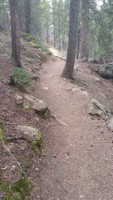
I say hearty because we each dutifully consulted our Colorado Flora field guide, our plant identification list and the Native Plant Master guide for Mt. Falcon Park (these last two distributed this morning as course material) in the constant and, at times hard, rain. It rained as we investigated a pretty five-petaled plant whose flowers change color after pollination. It rained while we investigated the shrub with trumpet shaped flowers that stood next to it. It poured down rain as we used Colorado Flora to narrow down the two species of cypress that stood next to each other.

Further along the trail, yes, it rained, we found a vetch, one of two species of the pea family we looked at. Vetch takes up selenium from the soil and concentrates the mineral in its stalk and leaves. Horses and cows get the blind staggers from the selenium so, though a native, it’s an unwelcome plant in pastures. Plants that take up soil minerals and concentrate them in their stalk and leaves have created a new discipline, geo-botany. Geo-botany uses plant analysis to find places where toxic minerals are present in the soil.

Did I mention it rained? All the time, from moderately hard to pelting. Not a usual Colorado problem. This is an anomalous May, though May is usually wet. So I’m told.

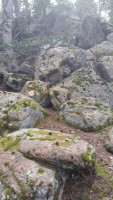
We had a recently retired geologist in our class. We stopped among shrubs and short trees for a snack. He noted that was a geologically important spot. The Fountain formation, red sandstone and crumbly red shale, the same formation that makes up the Red Rock amphitheater,  gave way to the granitic rock of the true Rocky Mountains only 5 or 6 feet away. “This means we go,” Tom said, “from 250 million year old sandstone to billion year old rock.” To the east the sandstone, remnant of a much earlier mountain range, covers the same billion year old rock exposed during the Laramide orogeny, the mountain building episode that formed the Rockies.

Since Kate had a pacemaker appointment, I had to leave early. I was not unhappy though I look forward to the next class. May it be dry. Of course, then it might be hot.



Places are strange

Beltane                                                                            Beltane Moon

The plane performed its wonder, lifting a couple of hundred people into the air. The full Beltane moon lit up the clouds passing by underneath. I stared out the window, a bit confused, leaving Minnesota to return home. This required an adjustment in my thinking.

Then, when I arrived at my home airport, it was strange, another place on the road with unfamiliar paths and habits. Mostly I enjoy learning new things, but it was 10 pm, almost my bedtime and I stumbled a bit, as I would in an airport unknown to me. This experience conflicted with Kate waiting in the cell-phone lot, ready to pick me up and take me back to the mountains. Odd.

Coming home to Colorado, the first time from away. The Woolly retreat for 2015 now over.

It’s a cliche. Felt like I never left. But true. Slipping back into the physical presence of my friends, my Woolly brothers, was like putting on a comfortable shirt. It just fit. Coming as it did a couple of weeks after the start of the prostate path, it was especially welcome. One friend has had prostate surgery. Another knew many who had. Most of the news was positive. Cures, few side effects. Offers to talk further as the path winds on. So welcome.

I suspect the level of my comfort at Camp du Nord, about a half-hour north and west of Ely, figured inversely to the level of strangeness I felt when returning to Colorado. But. I had no desire to remain in Minnesota, to reconsider our decision. I wanted to get home.

More on the retreat later.

Lucky We Live the Mountains

Spring                                                        Mountain Spring Moon

Lucky we live the mountains. Yes, Minnesota is a beautiful state, but the exurban chunk of it in which we lived and the areas in which I usually traveled, south toward Minneapolis, only occasionally reflected the wonder of the northern part of the state. There was the Mississippi, the lakes in the city, the green belt of parks. There was little Round Lake on Round Lake Blvd. That was about it. The rest of it, the beautiful part, including northern Anoka County with its high water table, marshy and wooded terrain, had to be sought out by driving.

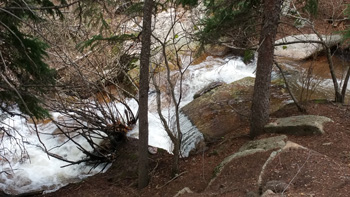
Here the 3 mile drive home from highway 73 up Black Mountain Drive winds past a valley filled with grass and pine on the south side of which rises Conifer Mountain. To the north Shadow Mountain gradually pulls the road higher and higher, rocks jutting out, ponderosa and aspen dot the slopes and mule deer sometimes browse. Each morning when I go to the mailbox to retrieve the Denver Post Black Mountain is on my right, guarding the west and the eventual sunset.

Anytime we leave home, whether to go into Evergreen for our business meeting or into Denver to see the grandkids or south toward Littleton for medical care mountains and valleys, canyons and gulches grace the roadways. Small mountain streams run next to the roadways, swift and right now, often violent. Walls of sheer rock alternate with wooded mountainsides. Always the journey is up or down until we get past the foothills onto the beginning of the great plains where the Denver metroplex takes over.

This was my thought while driving home from the doctor yesterday. How short is a human life span. Not even a tick of the second hand to this rock. These mountains have been here for millions of years longer than the human species itself has existed. They will probably be here millions of years after we’re gone. What is one lifetime? What is a few years here or there? Compared to these. This was a comforting thought.

Pulses

Spring                                               Mountain Spring Moon

Under the mountain spring moon various shades of green have slowly, slowly begun to appear. The ponderosa pines have been green all winter but they’ve greened up some. The first ground cover green to appear was the bearberry when the snow melted back. This evergreen ground cover was green all along, just hidden. A shaded patch of moss has gone from a muted pale green to emerald over the last couple of weeks. There are, too, even here at 8,800 feet, dandelions. Some grass, too. Crab grass for sure, another hardy perennial. Tufts of grass that look like prairie drop seed, but are not, I’m sure, remain their winter tan.

Too, the dogs have begun to sniff through the deck, smelling, I suppose, new rodents of some kind. Along with that has come Rigel digging. With the advent of warmer soil Rigel and Vega may begin creating holes in the rest of the yard as well. Another harbinger of spring.

Birds chirp happily around 5:30-5:45 am as the sun begins to rise.

Driving along Highway 78 (Shadow Mountain Drive, Black Mountain Drive (our segment) and Brook Forest Road) the only snow that remains is on the north side of the road or in shaded spots. A pond not far from our house still has ice, but the ice has a shallow layer of water over it. The mountain streams run, burble, ice now long melted and turned into stream. Willows along the streams look fire tipped as their branches turn a green gold. “Like dusted with gold,” Kate said.

The mountain spring is a slow arriver, coming in pulses, alternated with sometimes heavy snows. We have the potential, for example, for a huge snow storm Wednesday through Friday.

While on a drive Sunday, not far from our home, on top of a large outcropping of rock where the sun penetrated the trees, lay a fox, curled up and enjoying a quiet Sunday nap. The fox was a tan spot against the gray of the rock. Mule deer have begun to return as well, we see them at various places along the slopes and valleys. Kate just called and said, for example, that we have four deer in our front yard and “the dogs are levitating.” Sure enough, there they are, finding the green just as I have been.

Getting There

Spring                                             Mountain Spring Moon

To get to the seder we left Conifer at about 3:30 and drove into Denver, ignoring I-70 traffic, “that I-70 mess” as our mortgage banker called, we stayed on Hwy 285 to Monaco and drove up through the city from south to north. This has the additional advantage–to my sensibilities–of seeing the city as it changes from southern suburbs to its northern most neighborhoods, passing on the way through an area with streets named Harvard, Yale, Bates, Vassar, then Wesley and Iliff. This last is also the name of a Methodist seminary located on the campus of Denver University.

Going further north Monaco bisects the Cherry Hill neighborhood, a 1% enclave. Further on housing changes from low rise apartment complexes and condominiums to ranch style, one story smaller homes, but with big yards. Then Monaco becomes a four-lane boulevard with a park-like central strip and brick homes, some resembling small castles, others futuristic. Here the flowers bloom. Finally, we get to Martin Luther King, which extends to the eastern edge of Denver through the Stapleton new urbanism development. But we’ll turn on Pontiac, well before that.

On Pontiac we enter a predominantly African-American neighborhood, a couple of blocks west of Quebec, formerly a boundary street for the old Stapleton Airport and along which hotels were built to accommodate air travelers. Behind the hotels grew up a community filled with one story homes with little square feet and often desperate looking lawns, sometimes littered. It includes, too, the same homes with neatly groomed topiary, lush grass and, on Jon and Jen’s block, some older two-story homes, residue of an era before the airport was built, probably of an era before Denver reached this far toward Kansas and Nebraska.

Jon and Jen’s home was, according to house lore, originally a residence for a local farmer. Could be. They’ve done a lot of rehabilitation, adding on a new kitchen and dining area, plus a bedroom for themselves above. Jon’s done the bulk of the finishing work including tiling and plumbing two bathrooms. Outside Jon has several garden beds, fruit trees, a grape arbor, a tree house and a work shed where he produces hand-built skis.


In Flight

Spring, Mountain Spring Moon.

The Latin work has begun to change, moving toward more careful, yet faster translation, a new novel is underway and my exercise program has altered. So, too, is this blog undergoing change. I don’t anticipate much difference in the work I do here, but the form needs to reflect a new reality, Colorado home.

The mountains, the plants, the animals of this Western state press increasingly into our minds: scissor-tailed flycatchers, the fat fox, mule deer, mountain lions, Ponderosa and Lodgepole pine, Shadow Mountain, Black Mountain, Mt. Evans, Conifer Mountain. The drives into Denver, to Evergreen, to Aspen Park, toward the Kenosha Pass.

When the travelers have settled, the way will appear.

Up Early

Imbolc                                                  Black Mountain Moon

One of those nights. In spite of the warmth of my electric blanket I was awake at 3 a.m. For good. So I got up, let the dogs out, fed them, but didn’t go get the paper. (too early) It’s now 5:45 and I’m planning on working on Latin as soon as I finish this. Why waste the time?

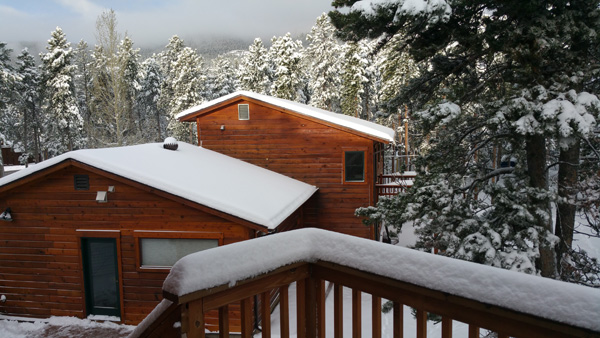
There was more snow on the deck this morning. Not so much, maybe an inch. I’d say we got 10 inches over the weekend. Snow here is both more present-it snows more often-and less. It melts soon after coming. This week the weather will be cool enough to retain the snow on the grounds, but it should be sunny enough to melt the driveway.

I’m trying to increase my work. The long preparation for, then the execution of the move, distracted me at points, especially over the last couple of months. We needed our focus on the move and that’s where it was. Now though I want to write a new book, continue the work in Ovid and Caesar, dig into art scholarship, especially in aesthetics and Song Dynasty China, and get more deeply into my Reimagining Faith project by focusing on the concept of emergence.

We have a plan for a modest garden using raised beds designed around horse watering troughs. They have a root-centric bottom up watering system and come ready to use. All we’ll have to do is site them and fill them with soil. I purchased material for a Flow Hive set-up like the one posted below, but it won’t come until November, so I’ll give the bees a pass this year. In April I take the first of several classes in a Native Plant Master program.

Exercise is two-thirds of the way back to pre-move intensity and I’ve added three days.

All this happens wrapped in regular visitation with grandchildren, Jon and Jen, going to movies, reconnoitering Denver and our immediate area around home: Jefferson County, Park County, Evergreen.

Settling in. Becoming native to this place. A process.


Dialectic: Reason or Soul

Imbolc                                     Black Mountain Moon

When Kate and I went out last night, we went to a Regal cinema and afterward across the street to the Macaroni Grill for dinner. We could have been in any upper middle class retail enclave in the country. While there is a soothing, predictable quality to these often brick or stone centers, virtues not insignificant in a huge and varied nation like our own, we both commented that we could have been on France Avenue in Edina. In fact, we couldn’t tell the difference while inside the theater and eating at the Macaroni Grill. That’s ok once in a while, but visited frequently these standardized spaces can, like the electric light bulb, begin to blur, then obfuscate the true nature of a place.

Becoming Native to This Place, the book by Wes Jackson of the Land Institute which I quote from time to time, is the antithesis of this form of shallow standardization. He insists, like Aldo Leopold in his land ethic and Wendell Berry in his work on his family’s farm in Kentucky, that we root ourselves, both literally and figuratively in the place where we live. Particularity, not universality is key to their thought.

The core goal of Die Brücke, a movement among young Dresden based artists at the turn of the last century, was to embrace the German/Nordic soul, one based in the particular physicality of the soil and geography of Germany and the people’s nurtured by it, and give expression to that particularity, not the universality presumed by the application of reason.  Die Brücke rejected the Enlightenment’s emphasis on reason, distanced themselves from art’s classical tradition, favoring the Fauves, other key French artists like Cezanne and Gaugin and the Dutch Van Gogh.

This dialectic of reason and soul is a main theme of this new millennium, one with its trailhead deep in the ancientrail of Western philosophy. It may be the main theme of my life, a driving energy behind most of what I do.

Snow Falls Twice Here

Imbolc                                                         Black Mountain Moon (New)

With each snow here there are two separate snowfalls. The first happens when the snow begins, floating down to blanket the earth and the trees. The second snowfall may happen soon after, or be delayed by a day or two. When the weather pattern shifts, the winds come. They dislodge the snow gathered on the sloping branches of the lodgepole pine, a white mist of snow fans out from the branch, following the wind and a large clot of snow falls to the ground.

This second snowfall is more gradual and more idiosyncratic than the first. It depends on how much snow stuck to the lodgepole’s branches, which direction the wind comes from, the sun’s melting the snow and obstructions that divert the wind through the trees. It happens in bursts of white, sometimes many in sequence, as if dominoes had toppled over. Sometimes only one branch dislodges its snow.


The Acid Test

Imbolc                                                                                       Settling Moon II

The full settling moon has been beautiful these last couple of nights. We’re also in our shorts and t-shirts with non-alcoholic umbrella drinks. 66 degrees an hour ago, trending a bit down right now. Weird.


Boiler inspection yesterday. Not such great news, apparently. Low ph in the boiler water. Acidic water no good for its copper pipes and internal workings. Not clear how it got there, so I’m having the water tested for a corrosive ph. Should I have discovered this before? Maybe. But I didn’t. Caveat emptor.

GeoWater services will send a tech out to do a site visit and investigate the quality of our water. Could have been done before hand, but wasn’t. Sigh. You just can’t think of everything.

I focused on water availability in this arid region. Did the well have supply? Yes. Did the production of the well, measured by flow rate, meet the needs of the typical home? Yes. Is the water acidic? Didn’t occur to me.

The joys of home ownership. They never end, except after a sale. We’re ready right now to pass those joys over to some nice couple in Minnesota. Step up and lay your money on the table.