Imbolc Imbolc Moon
Whimsy. Dreams. Finally, a flying car.
First, a before the launch video, then, live streaming of Starman.
And, then. Buck Rogers!
Imbolc Imbolc Moon
Whimsy. Dreams. Finally, a flying car.
First, a before the launch video, then, live streaming of Starman.
And, then. Buck Rogers!
Winter Moon of the Long Nights

Last night, third night in a row at Beth Evergreen, was the MVP, the mussar vaad practice group. Tuesday was the unveiling of the third stained glass window. Wednesday was the first class of the third in the first year kabbalah curriculum, the Mystical Hebrew Letters. On a personal, physical level this many evening sessions, which extend well beyond my usual 8 p.m. bedtime and then require a half hour ride home afterward, exhaust me. But on a psycho-spiritual level the nourishment I receive more than compensates.
As I wrote this last sentence, I looked up at Black Mountain and noticed a pink glow, a penumbra at its peak. A good symbol for the new understanding that is beginning to dawn on me.
In the mid-day mussar class, where we are near the end of the Messilat Yesharim, the path of the upright, by the 18th century kabbalist, Rabbi Moshe Luzzato, Jamie commented, “Remember, these are kabbalists. They include proof texts as an invitation to rethink them as metaphor, not to accept their literal meaning.” Jamie has said this before, in the kabbalist classes especially. “The Torah is a metaphor, not history.”

A bit later, he asked, “What is Torah study?” This was a topic we covered over a year ago when beginning Luzzato’s work. Torah study is not about content. It is not, in other words, limited to scholarship about Genesis, Exodus, Leviticus, Numbers, and Deuteronomy. Torah study is a method and it involves paying close attention to the person next to you, to the sunrise over Black Mountain, to the cry of a sparrow, to the way a lodgepole pine sloughs off snow, to the needs of the dog sleeping beside your chair. to the nature of fire crackling in the fireplace. Torah study is about loving attentiveness. It is a way of engaging the sacred world which we can know first from within our own person and which permeates that which we encounter throughout our lives.
And, again, aha! The sun, the sacred sun with its life-giving light, just lit up Black Mountain and showed me a sign, a way of illustrating a literally dawning awareness. The wind, the finger of the sacred blows as the ruach, the breath of spirit, the breath of life and moves the lodgepole pines in our front yard. The pines themselves erupt out of the stony Shadow Mountain ground, able to express life in a soil mostly barren of the rich nutrients available in the farmlands of the American Midwest.

I find this means I can read the word God in a new way. Shortly after Jamie commented on Torah study, we read a sentence in Messilat Yesharim that included the English word omnipresence, as in God’s omnipresence. I asked Jamie what Hebrew lay behind this translation. He looked it up, “Hmm. Something like, permeated knowledge.”
God lit up for me. Ah, if I do Torah study, if I engage in loving attentiveness to my Self, my own Soul, and those of others and of the broader natural world, then I can find the knowledge which permeates all things, that very same shards of the sacred that shattered just after the tzimtzum to create our universe. That is God being available everywhere. This is far different from the Latinate imponderable of omnipresence, sort of an elf on the shelf deity lurking in every spot, finding you everywhere. And judging.
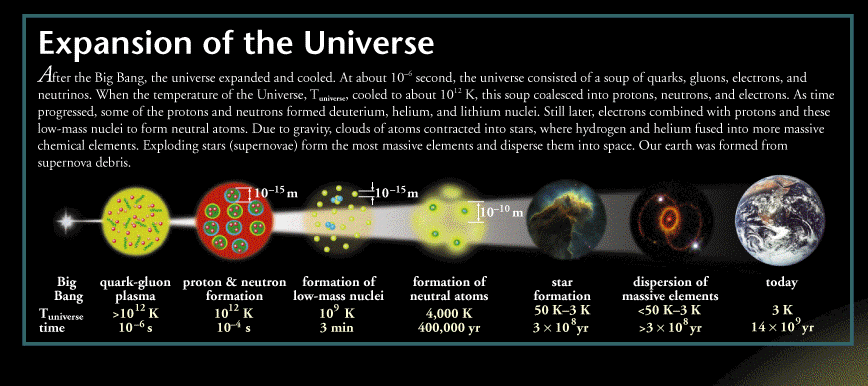 No. God is another word for the intimate linkage between and among all things, from the smallest gluon to the largest star. God is neither a superparent nor a cosmic Santa Claus writing down your behaviors in the book of deeds; God is a metaphor for the sacred knowledge which permeates the perceivable, and the unperceivable, world.
Our deeds are, of course, written in the very real book of our life, so they have consequences, not only on our life as whole, but as they impact others and that same world which we all inhabit. You could also see God’s judgment as the manifestation of those consequences, in their positive and negative natures, not as a divine finger shaking or outright punishing, but as ripples from one instance of the sacred to the another.
Winter Moon of the Long Nights
 The solstices mark swings to and from extremes, from the longest day to the longest night, there, and as with Bilbo, back again. Darkness and light are never steady in their presence. The earth always shifts in relation to the sun, gradually lengthening the days, then the nights.
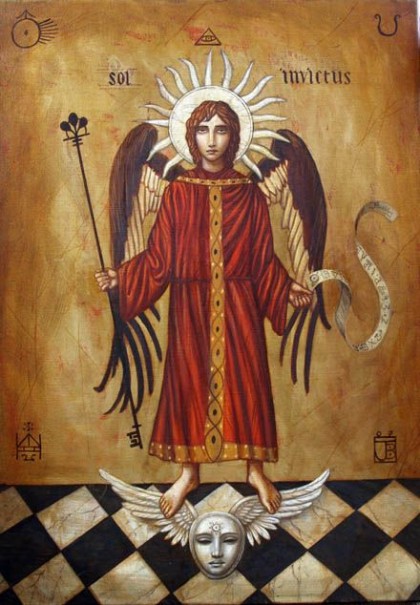
Most folks celebrate the Winter Solstice for its moment of change toward increasing light. Sol Invictus, the Roman sun god, added a martial spirit. The ancients feared that the nights would continue to grow in length, and act as a shroud thrown over the earth marking an end to growing seasons, to warmth, to life. It’s no wonder that relief at the return of the sun, revealed by small increases in the length of the day, caused holidays to be born around this subtle astronomical change.
There are also bonfires and songs and drinking and sex on the Summer Solstice. The sun manifests itself as light giver, light bringer, with the longest days. The growing season is well underway then, the miracle of life that the sun’s increasing light creates is the very relief anticipated on the Winter Solstice. Fear and the vanquishing of fear. Sol Invictus, the conquering sun.
Yet even in ancient times there had to be a few outliers like myself. We don’t begrudge the return of the sun, nor deny all the miracles that its return makes possible, that would be silly; but, for some psychic reason, perhaps not clear even to us, we reverse the common sensibility and find succor in the gradual lengthening of the nights that begins at the Summer Solstice and reaches its maximum on the night of the Winter Solstice.
We know that the cold and the darkness, the fallow time whose genesis each year happens on the longest day, is also necessary, also worthy of honor. It is earth’s sabbath, a time for all the generative powers to rest, to regather themselves, to ready themselves for the next florescence. I suspect somehow in our psyches we honor slight dips into depression or melancholy, knowing that in those times we regroup, rest the eager forward creative parts of our souls and the gradual lengthening of the darkness outside mirrors that.
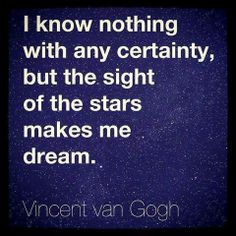 In these long nights the cold often brings clear, cloudless skies. The wonderful Van Gogh quote that I posted a few days ago underscores a virtue of darkness, one we can experience waking or asleep. Dreaming takes us out of the rigors of day to day life and puts us in the realm where ideas and hopes gather. So, the lengthening of the nights increases our opportunity to experience dream time. Whether you believe in Jung’s collective unconscious or not-I do, the rich resources of dreaming are available to us with greater ease when the nights are long and the cold makes sleeping a joy.
It was, too, many years ago when I pushed the notion of transcendence out of my spirituality in favor of immanence, incarnation over a god in the sky. My focus moved to down and in, not up and out. Our inner world is a mystery, a place of fecundity, but also a place often occulted by the demands of the day. When we shift our focus to the night, to the half of the year when darkness grows, we can use that external change as a trigger to lean inside, to find the divine within. If we can make this discovery, the god that we are, we can stiff arm the notion that revelation stopped thousands of years ago.
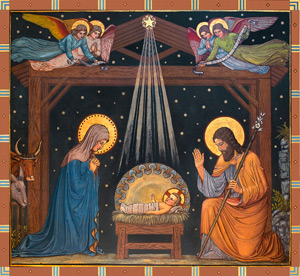
Every moment of our existence is a revelation, the path of a god, the most fundamental ancientrail of all. No, we are not omnipotent, that’s an illusion created by the idea of transcendence, the need to find validation outside of our own soul. This is the true polytheism, the one that folds its hands, says namaste, bows to that of god in everyone, in every animal, in every plant and stone and star.
When you reach out in love to another person, to a dog, to a crocus blooming in the snow, you bring the finger held out by the white haired floating god in Michelangelo’s Sistine Chapel ceiling. That moment of creation is always, ongoing, a joint effort between and among us all, human and inhuman, animate and inanimate, the cosmic dance of Shiva brought into this mundane world. He or She is not out there, waiting to be called by prayer, but in here, waiting to be called by the quiet, by the joy, by the persistence held in the soul container that is you.
Winter Moon of the Long Nights

The Winter Solstice. Today and tonight. 23.4 degrees of tilt. Explanation for the tilt is not settled science though at least part of the answer seems to lie in the accretion of matter and the occasional outright collisions that occurred during our planets formation early in the history of the solar system. Another interesting theory, perhaps part of the answer too, is that any large imbalance, say a supervolcano with a huge mass, could have caused the earth to tilt so that mass ended up near the equator.
Whatever the exact reason, the current tilt, which remains constant as the earth revolves around the sun, creates our seasons. As the earth orbits, the tilt causes a reduction and increase of the energy of the sun’s light by either concentrating it during the summer solstice (leaning toward the sun) or by spreading the light over a wider area (leaning away from the sun) during the winter solstice. Today at 9:28 MST the northern hemisphere will be at its maximum tilt away from the sun while, of course, the southern hemisphere is thrust toward the sun and celebrating its summer solstice.

All of this is a continuing evolution caused by forces set in motion by the big bang over 13 billion years ago. The fact that I’m sitting at 8,800 feet on a chunk of rock thrust up by the Laramide orogeny, watching snow drift down as the air up here cools toward below zero temperatures, waiting for the longest night of the year, 14 hours and 39 minutes here in Conifer, showcases the violent origins and their ongoing impacts on earth and her sister planets. When we settle into the chair tonight, or hike outside with a headlamp, or listen to some quiet jazz or Holst’s The Planets, the darkness enveloping us is an in the moment result.
As the earth leans away from the sun, we can lean into the darkness, the long night when the woods are lovely, dark and deep. As we do, we have the opportunity to sink into the fecund darkness within us, a soul link with the darkness all around us and our tiny solar system. In it we can recall sleeping animals in their dens, beneath chilled lake waters, in their lodges made of sticks and branches. In the darkness we can rest a moment beneath the surface of the snow and cold covered soil where roots and microbes work feverishly transmitting nutrients and available water into plants slowed, but not killed by the seasonal temperatures.
 In the darkness we can attend to the dark things within us, the places in our souls where our own origins and their ongoing impacts create a climate for our growth, down below the conscious considerations of our day-to-day lives. We can embrace this darkness, not as a thing to fear, but as a part of life, a necessary and fruitful part of life.
I’ll sit in my chair this evening as the night unfolds (I love that imagery.) and consider death, my death, my return to the woods, lovely dark and deep. And, I’ll hug close to my heart the life I’ve been given and this opportunity, granted by the stars, to meditate on it.
Samain Bare Aspen Moon
 Think I’ve figured out my kabbalah presentation. Still a bit rough around the edges but that’s going to be part of it. It’ll be a how to think with the tree of the life as a touchstone example, using the Great Wheel as an instance.
It’s been a difficult couple of weeks trying to figure out whether or not I’m trying to put the cliched square peg in a round hole. That is, can the Great Wheel be interpreted from within the tree of life’s basic framework? Or, vice versa.
My tentative conclusion right now? Yes, they both speak to the same essence, to a fundamental truth about the nature of reality as we humans experience it. Both abstractions focus us on the dynamic of life arising from the inanimate and returning the borrowed elements to the inanimate at the end of a cycle. We could call it entropy, but entropy does not have the revivifying element of both the tree of life and the Great Wheel.
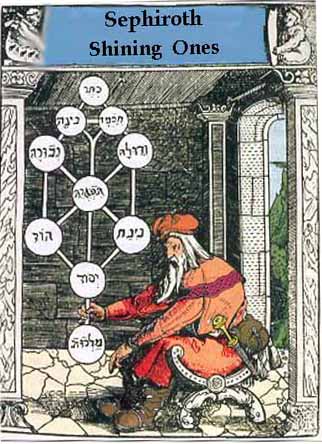 This a crucial difference between a secular, scientific world view and a mystical one. Entropy posits, as I mentioned in a post not long ago, that all things die, including death, I suppose. The Great Wheel and the tree of life challenge that grim metaphysics with an alternative.
In the tree of life emanations from the keter, or crown, flow down through the ten sephirot, emerging after a journey through possibilities and limitations, into malchut, the realm of the Shekinah or the feminine aspect of the divine. This is the daily reality you and I experience. Rabbi Jamie uses the illustration of a fountain with metal leaves (the sephirot) that catch the emanations, then direct the flow downward toward malchut. This could be entropic. Divine emanations could flow down to malchut, exist there for awhile, then simply disintegrate, disappear. Or, they could all flow down to malchut until it was filled, then the flow would stop. The heat death of the universe could be seen as such a result for the big bang.
But this fountain flows both ways. Malchut, as Rabbi Jamie explains it, is also a pump and the fountain sends water (divine energy) back up the tree of the life, returning it to the ein sof, the infinite oneness. Repeat until God is repaired.
 God became fractionated during the tzimtzum, the contraction of divine energy that made the finite possible. This idea is still difficult for me, but I’m just accepting it for the purposes of this presentation. During the tzimtzum the infinite light, ohr, tried to manifest in the finite, filling the space created by the contraction, but the vessel, things, (ein sof = no-things, infinity) could not hold it and shattered. That shattering created all the elements that now make up our universe. (and other universes, too) Trapped inside all of these elements is the ohr. The ascent and descent of divine energy, from the keter to malchut and backup through the sephirot to the keter from malchut, is the way the ohr will once again join with the infinite. How? No clue.
OK. So how does this correlate, if at all, with the Great Wheel? The Great Wheel divides into two halves, a fallow half beginning at Samain and ending at Beltane when the growing season begins. That’s roughly from October 31st to May 1st on the Gregorian calendar, but of course the reality varies by latitude and altitude. The key thing to consider here is a growing time, a time of vitality and, not only vitality, but vitality created from the inanimate materials of soil, air and sun followed by a fallow time when plants die back, when the animate returns to the inanimate.
 This is a malchutian manifestation, I think, of the ascent and descent and ascent again of divine energy represented by the tree of life. Why? Well, until the divine energy passes through yesod and becomes real in malchut, it is hidden, invisible, just like the vivifying function of the soil and the air and the sun is hidden during the fallow time. Both represent the cyclical nature of things coming into existence from apparent no-thing, then returning themselves to the invisible, the hidden.
Whereas the summer solstice could be seen as a major holiday for malchut, so the winter solstice could be seen as a major holiday for the keter and the ein sof. The summer solstice is a celebration of growth and fertility, the winter solstice a celebration of darkness and hiddenness, the depth (or height) of the nine sephirot and their crown.
Now it could be said, and I have said, that the Great Wheel represents cyclical time and that the notion of time itself is a matter of mental organization for the human mind. It could also be said that the very nature of the Great Wheel limits it to malchut since it expresses the seasonal changes of our particular planet. I believe, at least right now, though, that the Great Wheel instead reveals the universal nature of life on our planet, in malchut, as a simulacrum of the energy paths of the tree of life.
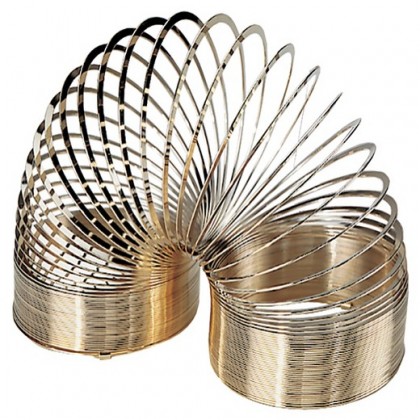
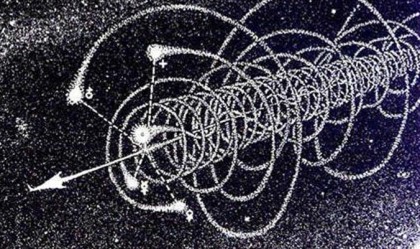 The slinkys I will hand out, tiny one-inch ones, illustrate what I mean. The Great Wheel turns through one year, one orbit around the sun, then repeats and is, in that, cyclical and not chronological. But, if you link this orbit to that one we get a spiral as our rapidly moving planet follows our solar system around the galaxy at unimaginable rates of speed. The Great Wheel then extends in space, in a spiral, this year’s revolution becoming another while the whole planet and its sun captive neighbors push further and further around the Milky Way. And, just to add complexity, as the whole galaxy moves, too.
Fall Harvest Moon
 The tree of life, the tree of immortality guarded by the angel with the flaming sword; the tree itself still growing in paradise, concealed by language, by our senses, by the everydayness of our lives; the path back to the garden often forgotten, the exile from paradise a separation so profound that we no longer know the location of the trail head and even harder, we no longer have a desire to search for it.
Metaphor? Of course. But in these three words lie a trap for the unwary, a trap in which I allowed myself to get caught and held, a mindhold trap. My life seems like a sine wave of grasping, then losing the significance of metaphors.
When young, I felt the mystery behind the communion wafers and the grape juice at Alexandria First Methodist. At the tenebrae service, when we extinguished the little candles with their paper drip guards and the sanctuary went dark, I thrilled to the change from ordinary experience, sensed the power rolling over us as the memory of crucifixion and death came hurtling through the centuries to land in our small Indiana town, in the very spot where I sat.
The sunrise services held on Easter morning lit up my whole inside. The power of the tenebrae had been defeated and life did go on forever, death only a mistake, an illusion, misunderstood as a cruelty when in fact it was a gateway. I suppose on those days, repeated over many years, I had a glimpse of the path back to the garden.
My mother’s death, I think, shattered this instinctive faith. Those feelings occasioned by grape juice soaked squares of bread, darkness and the rising of the sun, were a true path and one I lost when the brutal reality of grief smeared the way.
But the memory of that way remained. So I moved up from the instinctive triad of netzach-hod-yesod, forced by fear and loss to skip the next triad chesed-gevurah-tiferet and go to the one easiest for me to access, hochmah-binah-daat. I know these hebrew words may mean nothing at all to you, I’m still at the base of a steep learning curve with them myself, but they do appear on the illustration above so you can see where they are on the tree of life.
In simple, but not simplistic terms, the triads are netzach-hod-yesod, the realm of instinctual behavior, chesed-gevurah-tiferet, the realm of emotions and hochmah-binah-daat, the realm of the intellect. Movement in the tree of life goes from the keter to malchut and back from malchut up to keter, so there is no real top or bottom, only different spots in an ongoing process of creation.
 But here’s the trap. Metaphor, of course! I studied philosophy, religion, anthropology in college. Then, after a few years stuck in unenlightened instinctual behavior-the storied sex, drugs and rock and roll of the sixties and seventies-I moved to seminary. The trap tightened. I learned about the church, scripture old and new, ethics, church history. It was exhilarating, all this knowledge. I soaked it up. I remained though stuck in the intellectual triad, pushing back and forth between the polarity of intuitive wisdom, hochmah, and analytical thought, binah, often not going on to daat, or understanding. I learned, but did not integrate into my soul.
There was a time, after seminary, after ordination, as I groped my way around in the work of ministry, that I found the path again. It was in mystical traditions like the Jesus Prayer, or the use of lectio divina, contemplative prayer. I had spiritual directors who guided my prayer life and I meditated often, daily for years, went on private retreats for days at a time. In those years I found my way back to the netzach-hod-yesod triad, traveling again on the instinctual path formed so long ago.
The trap sprung another time, though, as I got better at my ministry, more able to apply organizational development paradigms to congregational life, more able to pull the levers of political power for the good of various purposes: affordable housing, unemployment policy, economic development for poor neighborhoods, fighting off corporate takeovers of those same poor neighborhoods, more able to navigate the internal politics of Presbytery life. I became stuck in malchut, the material world which we experience everyday. So stuck that eventually I could see nothing else and the path disappeared again.
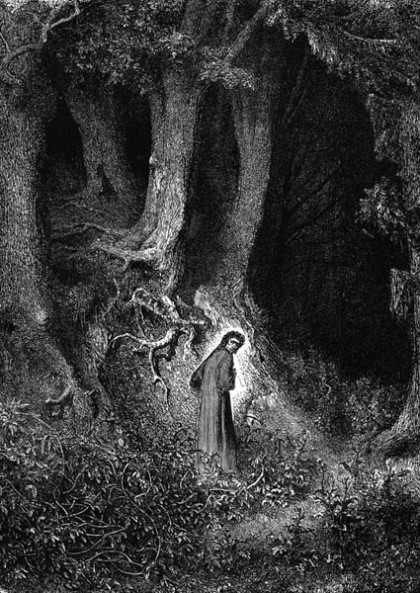 My heart knew I had gotten lost, in exile once again. In Dante’s words in Canto 1 of the Divine Comedy:
“In the middle of the journey of our life, I came to myself, in a dark wood, where the direct way was lost.
It is a hard thing to speak of, how wild, harsh and impenetrable that wood was, so that thinking of it recreates the fear. It is scarcely less bitter than death…
I cannot rightly say how I entered it. I was so full of sleep, at that point where I abandoned the true way.”
This time I knew I had to extricate myself from the subtle trap, get out of the thought world that had me lost in the dark wood, the direct way lost. It was a wild, harsh, seemingly impenetrable forest.
It was clear that for me the Christian faith had gotten muddled up with ambition, immersion in the world of power. And, most problematic of all, it had become part of the metaphor trap. The metaphor had gone stale, had become a barrier instead of a koan. Not the fault of the faith itself, but of my journey within it.
 At the time of its crumbling another path had begun to open for me. Fiction writing emerged when, ironically, I began writing my Doctor of Ministry thesis. Instead of working on it I ended up with 30,000 plus words of what would become my first novel, Even The Gods Must Die. Irony in the title, too, I suppose.
In the train of that shift came a decision to look into my Celtic heritage as a source for my fiction. While researching Celtic religion for the fantasy novels I wanted to write, I discovered the Great Wheel.
It grounded me. So to speak. My spiritual life became tactile, bound up in soil amendments, bulbs, corms, seeds, spades and hoes, fruit trees, raspberries and bees. And, of course, dogs. Always dogs.
Meeting Kate enabled me to move gracefully out of the ministry and into a pagan worldview. I was back in the netzach-hod-yesod triad, but now firmly attached to malchut, the queendom of this world.
Writing fiction found me exploring the chesed-gevurah-tiferet triad, having to reach into my heart for believable characters, story lines. Over the course of those years, the years since leaving the Christian ministry and now, I began to gradually integrate the triads, at least the three: intellectual, emotional and instinctual. The combination of family life, the Andover years, writing, and working as a docent at the MIA began to slowly weave them into my soul.
 Even so, I sat behind the barrier, the flaming sword, the metaphor trap. Beth Evergreen and Rabbi Jamie Arnold have started me on a journey back to where I began, immersed in the dark. Seeking for the light, yes, but happy now in the darkness, too. The Winter Solstice long ago became my favorite holiday of the year.
When I left Christianity and took up my earth-bound spirit, I shut off access to the fourth triad, the one subsumed under keter: faith-joy/pleasure-will, and its source of energy, the ein sof, the infinite One, perhaps god in small letters. Today, as I write this, I’m more pagan than I’ve ever been, more embracing of the body, the mountains, the stars, the elk and the mountain lion, than any words from any source.
 But. At Beth Evergreen I have begun to feel my way back into the fourth triad, the mystery I first encountered on the hard wooden pews in Alexandria, the one pulsing behind the metaphors of tenebrae, of crucifixion, of resurrection, and now of Torah, of language, of a “religious” life. I knew it once, in the depth of my naive young boy’s soul. Now, I may find it again, rooted in the old man he’s become.
Fall Harvest Moon

Been thinking about a new analogy for reimagining/reconstructing faith: the transition from representational to abstract art. I like the analogy because it reaches deep into prehistory to the cave art of Lascaux and Chauvet of 40,000 years ago. This tradition developed so powerfully that its underlying assumptions were simply not questioned. What would art be about but the reproduction of the human world in two-dimensions? Then, in 3, but still a man, or a god, or an animal. The introduction of perspective reinforced the representational, but did, I imagine, to the sensitive eye, give an inkling of the manipulation of space and color that really underlay art making.
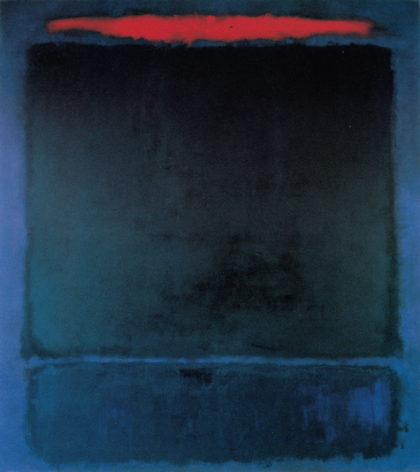
So called modern art was a radical break with this tradition. It happened as artists in many places looked at painting and sculpture with fresh eyes. They asked about the purpose of art, the purpose of paint on canvas, the purpose of reshaping wood and stone. What are the primary elements of the work? Color. Paint. Form. Space. Negative space. And perspective, did it have to be mathematical? Was there a perspective that developed simply through the use of color? (Cezanne) Did perspective have to be singular? (Picasso) Could a painting be nothing but color? (Morris Louis, Rothko, Kandinsky) What about painting or sculpting things that could not exist? (Man Ray, Dali, DuChamp)
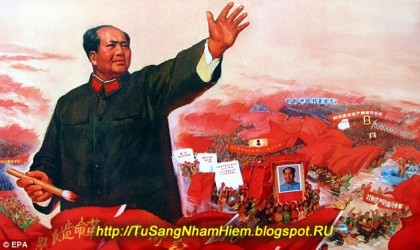
As artists began to consider the fundamentals, the unexamined assumptions of making art that had shaped its global expression since humans began making marks, though, that other tradition, the old representational one, did not die out. There were still portraits, still landscapes, still still lifes, sculpted men and women and animals and mythical beings of all sorts. This reimagining, reconstructing of art itself seemed to displace the older way, but only because museums became so dominant. There were modern art museums like the Walker and the Guggenheim and the Modern and the Tate which seemed to position the older, encyclopedic museums like the MIA, the Metropolitan, the Kunsthistorisches, the Louvre as showplaces of what used to be. Even the development of ateliers, who imagine themselves as the heirs to the older tradition, seemed to be an admission that the reimaginers had swept the field.
 So what I’m proposing is not another religion with a different origin story, a different set of scriptures, different roots from, say, Hinduism, Zoroastrianism, Christianity, Islam. And what I’m definitely not proposing is a reductionistic attempt to find out what all religions have in common, nor am I proposing a sort of tolerance for all faiths, an attempt to learn from each of them (though this is a good thing to do) and out of that shape a new faith.
No, I want to play with the fundamentals of religion, those things that underlay the tradition of religious thought and practice. I say play advisedly because I think it was the playful aspect of the artists who questioned their tradition that made their work bearable. And, in making it bearable, made it accessible enough to thrive.
 So, what are some of those fundamentals? Prayer, worship, gods, ritual, art, revelation, congregations, sacred space, the notion of sacred, divinity, after life, morality and ethics. How might a radical approach take the long history of prayer, for example, and reshape it, reconfigure it, reuse it for the person who chooses to stand outside particular traditions, but still wants to paint? Or, what about gods? How does the notion of powerful, unseen entities with various agendas fit into the life of persons no longer monotheists, no longer willing or able to see many gods?
I don’t even want to do what Emerson proposed. That is, have a religion of revelation to us rather than the dry bones of theirs. I want to examine revelation itself. What is revealed? Why is hiddenness so important to religion? What is revelation in a quantum mechanical world? Where is revelation? How are things revealed? How have things been revealed all along, but we didn’t notice? And why do we care about a world beyond the one we experience effortlessly?
Lughnasa Eclipse Moon
Say awe. My focus phrase for this month’s middot: yirah, or awe. (middot=character trait)
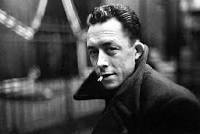 Albert Camus. One of my favorite theologians. It occurred to me that the abyss Camus mentions may be what gets crossed when we experience awe. Somehow we let the absurd in, or the mute world gives us a shout.
“For Camus … [our] astonishment [at life] results from our confrontation with a world that refuses to surrender meaning. It occurs when our need for meaning shatters against the indifference, immovable and absolute, of the world. As a result, absurdity is not an autonomous state; it does not exist in the world, but is instead exhaled from the abyss that divides us from a mute world. ‘This world in itself is not reasonable, that is all that can be said. But what is absurd is the confrontation of this irrational and wild longing for clarity whose call echoes in the human heart. The absurd depends as much on man as on the world. For the moment it is all that links them together.’ …”
Here’s another way of thinking about awe from Alan Morinis, a mussar guru:
“Awe is the feeling of being overwhelmed by a reality greater than yourself and greater than what you encounter in ordinary life. A curtain is drawn back and the little human is overtaken by a trembling awareness that life is astounding in its reality, vastness, complexity, order, surprise. Experiences of awe awaken a spiritual awareness.”
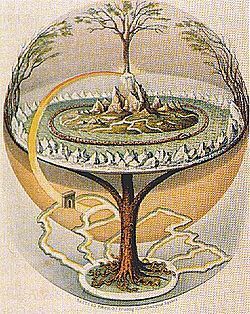
Immanuel Kant used the phrase ding an sich, the thing-in-itself, to name that from which our senses separate us. We experience the ding an sich, the mute world of Camus, only through our senses, through our sensory experience of certain qualities, qualia, that the thing-in-itself presents. We do not, in other words, experience that which has the qualities, but only its qualia and then only those within the very limited range of qualia accessible to our senses.
The ding an sich, the abyss, a reality greater than yourself all name a something beyond ordinary experience. There are many ways of articulating the gap between us and the ding an sich, the things in themselves.
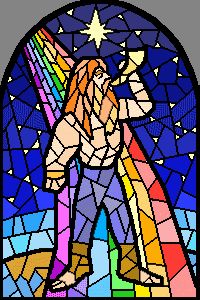
Here’s one I like. Bifrost is the rainbow bridge of Norse mythology. As in this illustration, bifrost connects Asgard, the realm of the Aesir (Odin, Thor, Freya), and midgard, or middle earth, the realm of humans. Awe could be a brief moment when we stand not on midgard but on the rainbow bridge, able to catch a glimpse of the realm beyond us.
Or, we might consider the Hindu concept of maya. Among other meanings maya is a “magic show, an illusion where things appear to be present but are not what they seem”” wikipedia
 What all of these ideas suggest, I think, is that a gap exists between an individual and the really real. An important religious question is what is beyond that gap, or what constitutes the gap, or what is the significance of the hidden for our spiritual lives.
I don’t know how to answer that question. Camus’ notion of the absurd makes sense to me. If that’s not an oxymoron. What I do know, for sure, is that the only tool we have for answering it is our experience. Awe may help us. It may allow us a momentary peek into the abyss, or place us on bifrost, or pierce the veil of maya.
What has awed you this day? This week? This year? In this life?
Lughnasa Eclipse Moon
 Totality in Tetonia, Idaho

Mountain Spirit at home

Bristlecone pine cones, Mt. Pennsylvania, outside Fairplay, Colorado
Lughnasa Eclipse Moon
Want to know how far we are into the Buck Roger’s world? Read below.

Our Mission, Vision, and Expertise
MISSION
The Center for Space Resources (CSR) is a research and technology development center dedicated to the human and robotic exploration of space and the utilization of its resources for the benefit of our society through the joint efforts of academia, government, and the private sector.
VISION
The Center for Space Resources (CSR) pursues the study and utilization of space and planetary resources by developing technologies for prospecting, drilling, excavation and extraction, materials processing and manufacturing, and spacecraft and habitat life-support systems. In addition to the many practical uses of space exploration on Earth, the greatest achievement bringing benefits to humankind would be to develop in-space commercial applications of space technology and planetary resources. These applications will one day form the basis for new space industries that will include:
EXPERTISE
Following the distinguished tradition on Earth resources curriculum and research programs at the Colorado School of Mines, the Center for Space Resources is extending the expertise of the School outside our planet, by supporting the human and robotic exploration and utilization of resources in space, the Moon, and other planetary bodies in our Solar System. The Center pursues these objectives by establishing joint education, research, and technology development projects with other academic institutions, government agencies, international partners, and companies in the private sector in the following areas: