Winter New Imbolc Moon
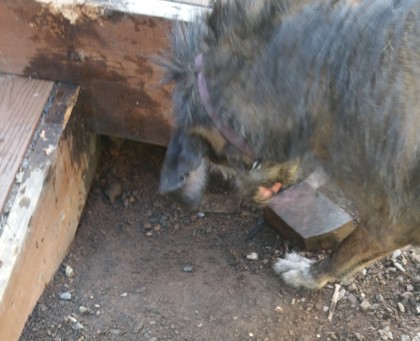
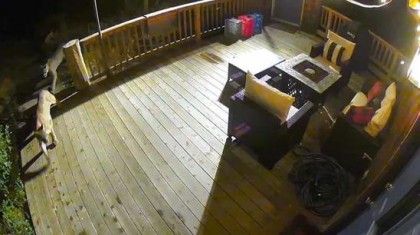
Video from a neighbor, couple of days ago.
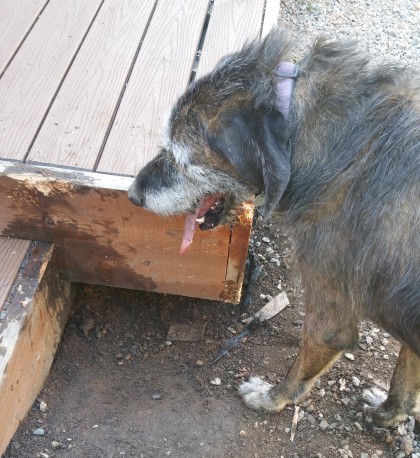
And, this one, too.

Winter New Imbolc Moon
Video from a neighbor, couple of days ago.
And, this one, too.

Winter Moon of the Long Nights
The solstices mark swings to and from extremes, from the longest day to the longest night, there, and as with Bilbo, back again. Darkness and light are never steady in their presence. The earth always shifts in relation to the sun, gradually lengthening the days, then the nights.
Most folks celebrate the Winter Solstice for its moment of change toward increasing light. Sol Invictus, the Roman sun god, added a martial spirit. The ancients feared that the nights would continue to grow in length, and act as a shroud thrown over the earth marking an end to growing seasons, to warmth, to life. It’s no wonder that relief at the return of the sun, revealed by small increases in the length of the day, caused holidays to be born around this subtle astronomical change.
There are also bonfires and songs and drinking and sex on the Summer Solstice. The sun manifests itself as light giver, light bringer, with the longest days. The growing season is well underway then, the miracle of life that the sun’s increasing light creates is the very relief anticipated on the Winter Solstice. Fear and the vanquishing of fear. Sol Invictus, the conquering sun.
Yet even in ancient times there had to be a few outliers like myself. We don’t begrudge the return of the sun, nor deny all the miracles that its return makes possible, that would be silly; but, for some psychic reason, perhaps not clear even to us, we reverse the common sensibility and find succor in the gradual lengthening of the nights that begins at the Summer Solstice and reaches its maximum on the night of the Winter Solstice.
We know that the cold and the darkness, the fallow time whose genesis each year happens on the longest day, is also necessary, also worthy of honor. It is earth’s sabbath, a time for all the generative powers to rest, to regather themselves, to ready themselves for the next florescence. I suspect somehow in our psyches we honor slight dips into depression or melancholy, knowing that in those times we regroup, rest the eager forward creative parts of our souls and the gradual lengthening of the darkness outside mirrors that.
In these long nights the cold often brings clear, cloudless skies. The wonderful Van Gogh quote that I posted a few days ago underscores a virtue of darkness, one we can experience waking or asleep. Dreaming takes us out of the rigors of day to day life and puts us in the realm where ideas and hopes gather. So, the lengthening of the nights increases our opportunity to experience dream time. Whether you believe in Jung’s collective unconscious or not-I do, the rich resources of dreaming are available to us with greater ease when the nights are long and the cold makes sleeping a joy.
It was, too, many years ago when I pushed the notion of transcendence out of my spirituality in favor of immanence, incarnation over a god in the sky. My focus moved to down and in, not up and out. Our inner world is a mystery, a place of fecundity, but also a place often occulted by the demands of the day. When we shift our focus to the night, to the half of the year when darkness grows, we can use that external change as a trigger to lean inside, to find the divine within. If we can make this discovery, the god that we are, we can stiff arm the notion that revelation stopped thousands of years ago.

Every moment of our existence is a revelation, the path of a god, the most fundamental ancientrail of all. No, we are not omnipotent, that’s an illusion created by the idea of transcendence, the need to find validation outside of our own soul. This is the true polytheism, the one that folds its hands, says namaste, bows to that of god in everyone, in every animal, in every plant and stone and star.
When you reach out in love to another person, to a dog, to a crocus blooming in the snow, you bring the finger held out by the white haired floating god in Michelangelo’s Sistine Chapel ceiling. That moment of creation is always, ongoing, a joint effort between and among us all, human and inhuman, animate and inanimate, the cosmic dance of Shiva brought into this mundane world. He or She is not out there, waiting to be called by prayer, but in here, waiting to be called by the quiet, by the joy, by the persistence held in the soul container that is you.
Winter Moon of the Long Nights

The Winter Solstice. Today and tonight. 23.4 degrees of tilt. Explanation for the tilt is not settled science though at least part of the answer seems to lie in the accretion of matter and the occasional outright collisions that occurred during our planets formation early in the history of the solar system. Another interesting theory, perhaps part of the answer too, is that any large imbalance, say a supervolcano with a huge mass, could have caused the earth to tilt so that mass ended up near the equator.
Whatever the exact reason, the current tilt, which remains constant as the earth revolves around the sun, creates our seasons. As the earth orbits, the tilt causes a reduction and increase of the energy of the sun’s light by either concentrating it during the summer solstice (leaning toward the sun) or by spreading the light over a wider area (leaning away from the sun) during the winter solstice. Today at 9:28 MST the northern hemisphere will be at its maximum tilt away from the sun while, of course, the southern hemisphere is thrust toward the sun and celebrating its summer solstice.

All of this is a continuing evolution caused by forces set in motion by the big bang over 13 billion years ago. The fact that I’m sitting at 8,800 feet on a chunk of rock thrust up by the Laramide orogeny, watching snow drift down as the air up here cools toward below zero temperatures, waiting for the longest night of the year, 14 hours and 39 minutes here in Conifer, showcases the violent origins and their ongoing impacts on earth and her sister planets. When we settle into the chair tonight, or hike outside with a headlamp, or listen to some quiet jazz or Holst’s The Planets, the darkness enveloping us is an in the moment result.
As the earth leans away from the sun, we can lean into the darkness, the long night when the woods are lovely, dark and deep. As we do, we have the opportunity to sink into the fecund darkness within us, a soul link with the darkness all around us and our tiny solar system. In it we can recall sleeping animals in their dens, beneath chilled lake waters, in their lodges made of sticks and branches. In the darkness we can rest a moment beneath the surface of the snow and cold covered soil where roots and microbes work feverishly transmitting nutrients and available water into plants slowed, but not killed by the seasonal temperatures.
In the darkness we can attend to the dark things within us, the places in our souls where our own origins and their ongoing impacts create a climate for our growth, down below the conscious considerations of our day-to-day lives. We can embrace this darkness, not as a thing to fear, but as a part of life, a necessary and fruitful part of life.
I’ll sit in my chair this evening as the night unfolds (I love that imagery.) and consider death, my death, my return to the woods, lovely dark and deep. And, I’ll hug close to my heart the life I’ve been given and this opportunity, granted by the stars, to meditate on it.
Samain Long Nights Moon
When Hanukkah ends tonight, it will only be two days to the Winter Solstice. I long ago kicked transcendence out of my religious toolkit, believing it encourages authoritarianism, the patriarchy, and body negativity. How, you might ask? If we find our source of authority outside of ourselves, either up in heaven or with a divine father figure or anywhere outside of our body, we give away our own deepest connection to divinity, the sacred that lies within us. BTW: locating revelation in written texts does the same.
You could argue that cavalierly jettisoning a millennia old religious idea, celebrated and loved by millions, is anathema. Yes, may well be. OK with me. You could say if transcendence is real, then denying it is misguided or just plain wrong. Yes, you could say that. But if the downside of accepting transcendence includes self-oppressing, self-negating ideas, then it’s functionally bad, whether it’s true or not. So out with it.
If not up and out, then what is the direction for spiritual enlightenment? In and down. In your body/mind, and down into the depths of your soul. You say soul links us to the transcendent. Yes, you might say that. I’m more in the metaphysical world of Jungian thought though, where the soul connects us to collective unconscious, a deep stream of reality to which we belong and which belongs to us. Or, another way to think about it, the soul is our direct link to the nature of reality. It is the part of us that is eternal, that is divine and to know eternity, to know the divine, we only need know ourselves, as the Delphic Oracle said long ago.

All this to say that the Winter Solstice is my high holiday (or, low holiday) because it encourages us to go inside, to sit in the darkness, to be part of the Gaian womb from which life emerged. As we head toward it, I’m considering my eternal soul, that divine spark within which makes me holy. And you, too.
The holy scripture I choose to read starts at my fingertips, but extends into the reality around me. When I look at the lodgepole pine and its elegant means of sloughing off snow, or at Maxwell Creek as it slowly carries Shadow Mountain toward the sea, or the lenticular clouds over Black Mountain, my sense of wonder and awe increases. These close by things and I share the same building blocks, the stuff, the things that burst out so long ago in the great expansion. Just after the tzimtzum, the great contraction. There is no transcendence here, only interpenetration, the universe and its evolutionary marvels.
Down we go, into the longest night. A darkness profound enough to reshape our lives, to help us see.
Samain Bare Aspen Moon
I also recalled yesterday that I’ve had this end of year let down often. When I worked for the Presbytery, I noticed that no congregation wanted a church executive around during the run up to Christmas and the week after, through New Year’s. This may have been a post-school rationalization to give myself a winter break. Whatever it was I think the pattern is probably there, triggered this time by the end of kabbalah.
It feels ok now that I know what it is. I’m going to ride it out through New Year’s, continuing to write Ancientrails and exercising, but other than that trying to follow a more unpredictable path. Getting some work done around the house. Reading outside my current Judaism concentration. Movies. More cooking. Enjoying holiday time and visits.
For lack of a better term, this is my winter break.
It also occurred to me that I live in the mountains, a spot in the U.S. that literally millions come to see every year, then go home. Maybe I’ll get out and about a bit more over the next couple of weeks. Strap on those snow shoes. Oh, yes, we did have snow. Not a lot, but enough for snow shoeing, I think.
Samain Bare Aspen Moon
The great wheel has turned again, moving Orion further down the southwestern horizon in the early morning. The air is cooler here. A Beth Evergreen friend, Alan, came in to the kabbalah class and announced, “Winter is really here. It’s so cold outside!” It was 22. Now in my fourth winter season here I’ve stopped commenting.
Temperature tolerance is so much about perspective. I saw a meme on Facebook that featured two parka clad folk with frost on the edges of their hoods. “What people in Texas are like if the temperature dips below 80.” A man from Texas wrote, “This is true.” Another posted a photograph of a red bench rest with two snow flakes, “It’s a blizzard in Dallas!”
Those -40 degree nights at Valhelga during one Woolly retreat. Working out on my snowshoes in the woods behind the library in Anoka, -20 degrees. The moments of -50 degree wind chill. Days with the temperature below zero, many days in a row. Minnesota. Not a lot of snow, but pretty damned cold.
And, yes, my body has begun to change its reaction, 22 does seem cold. Yet my brain. Nope. T-shirt weather. Rock the sandals and the shorts.
The Winter Solstice, no matter what the temperature, is coming. My favorite time of the year.
Samain Bare Aspen Moon

The nearly full bare aspen moon stood over Shadow Mountain drive last night, bright and low enough to be poked by the lodgepole pine. Full moons up here alter the appearance of the mountains, sometimes putting them in lunar shadows, dark silhouettes against the late evening sky, and shining their ghostly light into clearings and onto roadways. They also light up the eyes of animals wandering through the Arapaho National Forest or crossing the road: mountain lions, mule deer, elk, black bear.
When I was a flatlander, I imagined mountains as always the same, like the Matterhorn, tall and rocky, always tall and rocky. Or, Mt. Everest, always snowy and cold. Now that I’m a mountain man I know they change appearance many times during each day and from season to season. The beauty of the mountains is usually stark, but stark for different reasons: snow one day, hoar frost on another, golden aspens one season, bare aspen in another.

Mountain streams like Cub Creek, Maxwell Creek, Bear Creek, Shadow Brook run fast and full in the late spring, slower during the summer and often freeze over in the winter. There are, also, particularly this close to Denver, seasonal fluctuations in traffic on mountain roads. When Kate and I moved here in December of 2014, we saw signs that said Heavy Roadside Activity. We couldn’t imagine what meant. Lots of earth moving equipment? Animals? It wasn’t until spring that parking at trail heads along our drive down to Evergreen began to fill up with cars, then spill over to the roadside and fill even what we came to recognize as overflow parking lots that had been covered by snow.
Right now? Invisible. It’s dark. No mountains out there according to my eyes.
Samain Bare Aspen Moon

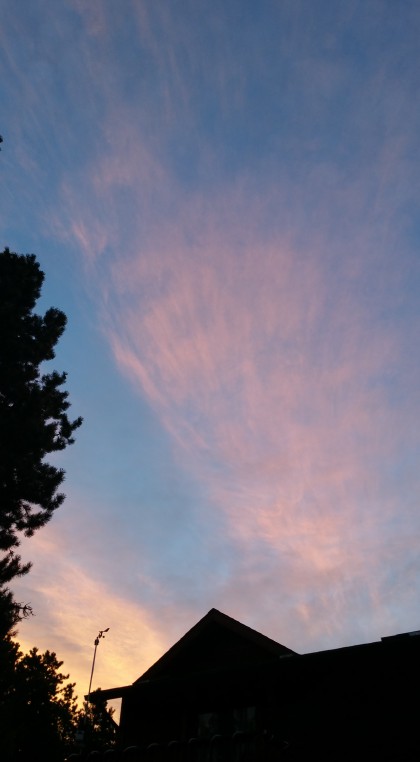
My phone camera didn’t do it justice, but Thanksgiving came in over Black Mountain with a gorgeous pink cloud, a penumbra of gold light on Black Mountain itself and a glow over our home. May the rest of the day, and especially the capon, be as beautiful.
Finished the pancetta and fig stuffing by celebrity felon, Martha Stewart, last night. It smells like it will be as good as I imagined. The capon-yes, we have it-thawed out and will go in the oven around 11:00 a.m. Kate made a pumpkin pie and got the caramelized yams ready. Ruthie’s pecan pie is covered in foil. She’s also bringing deviled eggs. They’re planning on coming up around noon or so.
Last night, for some strange reason, the neighbor had his sledge hammer out, using it to pound on a plastic garbage container. For quite a while. Don’t know if his mother or his mother-in-law or both are coming today.

We will be saying our gratefuls around 2 p.m. I’m grateful for you if you’re reading this. I’m also grateful for all the love here: dogs, Kate, Jon, Ruth, Gabe, Annie. I’m also grateful for the lodgepole pine that spent millions of years acclimating themselves to this particular altitude. And for the clouds and the mountains, which have such great altitude, and the streams and the mule deer. The elk, the red and gray fox, the moose, the mountain lions, the bears, the marmots and pikas. The rattlesnakes. The available oxygen in the atmosphere and the amazing organs we have that convert it to our use. So many things. Endless really. Thankful for all of them, now and forever.
Samain Bare Aspen Moon
Conversations with Ruth. Yesterday Kate wasn’t feeling so well in the a.m., nausea that plagues her mornings on occasion. So I was the breakfast guy for Ruth and Gabe, who stayed here starting on Sunday evening through last night. Ruth came down first, unusual because Gabe is usually the early riser. She fixed herself some ramen, she’s a good cook all on her own, learned from Grandma.

We started talking. She loves her new school, Mcauliffe. It’s not in a modernist soul stealing box like Sweigart, her elementary school. It has ornamentation, having been built in 1914, which she described in some detail. Gothic arches over drinking fountains, molding with inlays, stair rails with decor under the polyurethane, big windows and the exceptional cupolas visible in this photograph. She’s an arts oriented girl, very aware of the design of her surroundings. We both like this older, more whimsical era of architecture.

Mcauliffe also has periods, unlike the daily grind in an elementary classroom where you only leave for recess and lunch. The freedom that grants her between classes means a lot to her. She’s taking Mandarin, robotics, math, language arts, gym, earth science and art. It’s a more challenging environment for EGT’s, extremely gifted and talented, which she’s finally beginning to embrace as describing herself.
Polaris is the GT middle school, but she chose Mcauliffe because all save one of her friends from Sweigart chose it, too. Her bffs Wilson and Annika in particular are at Mcauliffe. Annika is a competitive climber, traveling the U.S. to participate in timed ascents of climbing walls. Wilson ran cross-country as she did. They spend a lot of time together outside of school.
This transition to middle school, along with declining stress from the divorce, seems to have allowed her to open up, blossom in ways that are beautiful to see.
We also talked about books. She’s a voracious reader, currently focusing a lot of her reading on Jodi Picoult, though she just started Little Fires Everywhere by Celeste Ng. Of course, she also has books to read for school, the humorous part there being that the first book assigned to her she had already read. In the third grade.
She wanted to know who my favorite authors were. Always a stumper for me since I’ve been reading much like Ruth for over 60 years. Lots of typeface over the eyeball transom, not all of it stuck in the memory banks. Yesterday I went with Herman Hesse, Tolstoy, Dostoevsky, and William Gibson. Asked today I would add Philip Kerr, Kim Stanley Robinson, Kafka. Tomorrow another group. Not to mention poets and classical authors, playwrights and non-fiction writers.
I put together an Ikea reading chair for her and an almost identical one for myself. She sat in hers, me in mine. She also loves art and wanted to know what my favorite piece of art was here in the loft. I have an Andy Warhol print of soup cans that I like a lot. She likes my Mike Elko print satirizing the Bush terror propaganda.
She’s a young lady with many interests, including alpine skiing. She’s been skiing since she was three and at this point is very accomplished. She and Jon are going to ski on Friday at Arapahoe Basin, or, as it is more usually known here, A-basin. She also loves to cook. Yesterday she made banana bread, rosemary bread, a pecan pie and cut up the yams for caramelized sweet potatoes. Today she’s making deviled eggs to bring to Thanksgiving tomorrow.
She’s still very tender on matters related to the divorce, not yet ready to sort out how she feels about it. The more I see her on this side of it, the more I believe the negative effects of Jon and Jen’s explosive fighting were awful for her. She has an inquisitive spirit, is very observant, and, unfortunately, is not inclined to talk about her feelings. All of these facets of her personality have made processing the turmoil of the last few years difficult for her. In the extreme.
It’s exciting to see her beginning to know herself, to gain agency in her life in a positive, not angry way. I’m grateful to have her as a grandchild, one I see frequently.
Samain Bare Aspen Moon

After a very busy week, a good busy with friends and Hebrew, kabbalah and time with Kate, yesterday was a rest day. Wrote, did my workout (which takes a while), napped, had a wonderful lamb supper cooked by Kate, who’s a wizard with meat. Watched some more of the Punisher on Netflix. On seeing that on the TV as she went to bed Kate said, “I don’t like your choice of programs.” “I know,” I said. Eating red meat and watching TV are hangovers from my Indiana acculturation, neither of which would I recommend to my children or grandchildren, but which I also thoroughly enjoy. No excuses.
Admitting to liking television in the crowds in which I tend to run is like admitting you enjoy belching or farting in public. Declassé. And it is, I suppose. My rationale (or, perhaps, as is often the case with rationales, my rationalization) is relaxation, in particular relaxation from a day usually spent in intellectual and physical activity. I love stories and TV, especially right now, is full of good storytellers who use visuals to enhance their storytelling. I’m sure there’s a sophisticated psychology explanation for this habit, but TV serves a purpose in my life. So there.
Thanksgiving this week. I’ve got a Martha Stewart recipe for capon with pancetta and fig stuffing. Which, of course, requires finding a capon, a mystery meat, as I said yesterday, to Colorado butchers. Tony’s Market. I ordered one and I’m going to call them today just to make sure it’s really coming. I did try to find a capon on which to experiment, but the only one I could find was $63.00. Ouch. Thanksgiving will be the experiment.
I really like cooking, used to do a lot more. It requires mindfulness and produces a meal for others to enjoy. Just popping up from my days of anthropology: The Raw and the Cooked, by Claude Leví-Strauss. In this book the French anthropologist talks about the binary of raw food to cooked, prepared food, seeing the development of cooking as fundamental for the human species, a key movement leading toward civilization. (I’m not going to go into it here, too complex, but if you’re interested in dialectical thinking, the raw-cooked distinction is an example of binary opposition, a distinctively French version of dialectical thought which underlies Leví-Strauss’s idea of structuralism, a short introduction to it is here.)
My point in this last paragraph is that cooking is central to being human; so, engaging in it, at any level, links us directly to the story of human evolution. In that way we can look at Thanksgiving, or any big holiday meal, as linking a key step in our change from merely animal to animal with culture, to another key step, the abstraction of particular days, the elevation of particular moments in time, into holidays. The other night I realized that for dogs all days are the same no Tuesdays or passovers or superbowls, no Guy Fawkes or Mexican independence days, rather sequences of day and night, with food and friends, human contact.
We’re not like dogs in that fundamental sense. As Emerson observed, “The days are gods.” Another binary opposition is the sacred and the profane, like the holy and the secular, ordinary time and sacred time. We imbue, out of our speculative capacity, the passing of time with certain significance. The day we were born. The yahrzeit notion in Judaism, celebrating the anniversary of a death. A day to celebrate the birth of a god, or to remember a long ago war against colonial masters. We identify certain days, a vast and vastly different number of them, as new year’s day, the beginning of another cycle marked by the return of our planet to a remembered spot on its journey.
When we merge our speculative fantasies with the chemistry of changing raw food into a beautiful cooked meal, we can have extraordinary times. The natural poetics of wonder join the very earthy act of feeding ourselves to create special memories. Very often on those days we gather with our family, a unit that itself memorializes the most basic human purpose of all, procreation of the species. We don’t tend to think of these most elemental components, but they are there and are sine qua non’s of holidays.
So, cook, pray, celebrate. Laugh. With those you love. If you care to, take a moment to consider these amazing things, too. That we know how to transform a neutered rooster into something delicious, something that will undergo the true transubstantiation, the changing of soil chemicals, the bodies of animals and plants into a human body. That we have the idea of Thanksgiving, or the idea of Hanukkah, or the idea of Labor Day and mark out a chunk of the earth’s orbit as special for those ideas. That we choose to gather on them with our small unit of humanity’s long, long ancientrail of development and critical change and doing so honor all of these elementals.